
A mortgage lets you borrow against a building you keep. A sale-leaseback sells the building to an investor and leases it back, so you keep operating but stop owning. For most owner-occupiers who plan to stay in the space for the long term, a mortgage or refinance keeps the appreciation, the tax position and the control. A sale-leaseback earns its place when you need more capital than a lender will advance and a long lease on the same site is acceptable. We advise owners in the Charlotte area on both paths, and the numbers decide which one wins.
TL;DR
- A mortgage adds debt you repay and leaves you as owner. A sale-leaseback converts the building into cash and leaves you as a long-term tenant.
- Lenders advance a share of value. A sale-leaseback can release the full market value, but rent usually costs more than debt service.
- The sale is a taxable event. Depreciation you claimed earlier can be taxed at a higher rate on the way out.
- A repurchase option or a lopsided lease can change how the deal is treated for accounting and tax.
- Model both structures over the full lease term, not just year one cash flow.
Table of Contents
- What each structure actually does
- Side-by-side comparison
- How much capital each one releases
- What each option costs over time
- The lease you sign is the real product
- Taxes: the part owners underestimate
- Accounting and legal tests the deal must pass
- Which option fits which owner
- A simple decision path
- Promo
- Our perspective
- FAQ
- Sources
What each structure actually does
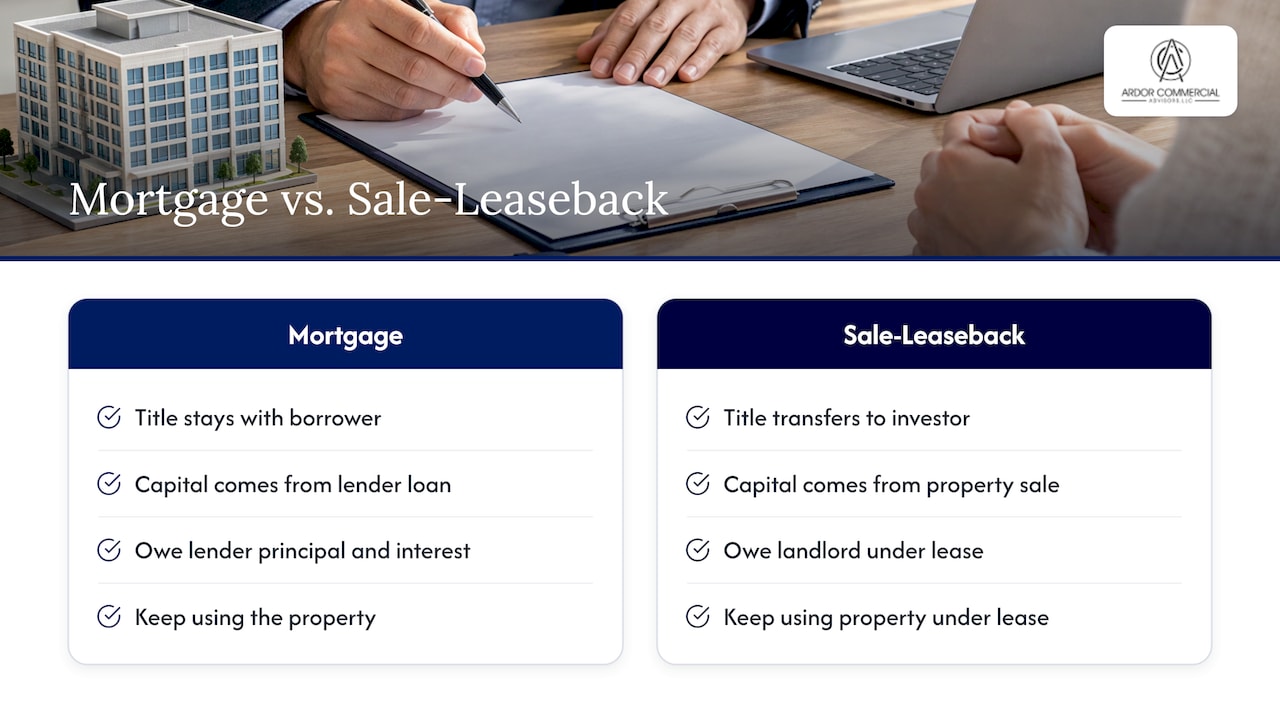
In a mortgage or refinance, you stay on title. A lender advances money against the property, you repay principal and interest, and the lender holds a lien until the loan is paid. You keep every upside and every obligation of ownership.
In a sale-leaseback, you transfer legal ownership to an investor and keep using the property under a lease. A company sells its real estate and simultaneously signs a long-term lease, which unlocks capital tied up in a fixed asset while operations continue. The deal rests on two interdependent documents: a purchase and sale agreement and a long-term lease, often with renewal options.
The practical difference for a dentist, a medical group or an office owner is simple. With a mortgage you owe a lender. With a sale-leaseback you owe a landlord, and you no longer own the asset behind your practice or business.
For the Charlotte-specific mechanics, see our guide to sale-leasebacks in Charlotte.
Side-by-side comparison
| Factor | Mortgage or refinance | Sale-leaseback |
|---|---|---|
| Ownership | You keep title | Investor takes title |
| Capital raised | A percentage of value, set by lender underwriting | Up to the full market value of the property |
| Ongoing payment | Debt service (principal and interest) | Rent, commonly on a triple net basis |
| Appreciation | Yours | Investor’s |
| Taxes at closing | Generally none on the loan itself | Taxable sale, gain measured against your adjusted basis |
| Control of the building | Full | Limited by the lease and landlord consent |
| Balance sheet | Loan liability | Lease liability and right-of-use asset |
| End of term | You own the building free of debt | Renewal, relocation or negotiated purchase |
The central tradeoff, as one law firm frames it, is owning with mortgage leverage versus selling to gain full liquidity. Every other row in the table follows from that choice.
How much capital each one releases
Lenders size a mortgage on a percentage of value, and on income coverage. If you are weighing a refinance, the number that usually limits proceeds is the debt service coverage ratio, the net operating income divided by the annual loan payment. Our DSCR loan sizing guide walks through how lenders use it.
A sale-leaseback is not limited by loan-to-value in the same way. Owners, particularly middle-market and private-equity-owned businesses, use it to extract equity for reinvestment in the core business instead of being capped by LTV constraints.
A worked example makes the gap concrete. Suppose a dental group owns a medical office building worth $4,000,000 with a $1,000,000 balance. A refinance sized at a lender’s percentage of value might return a modest amount of new cash after paying off the old loan. A sale at full value returns $4,000,000 less the payoff and costs, but converts the building to rent. Same building, very different cash and very different long-term position. The right answer depends on what the cash will earn inside your practice or business compared with what the building would earn for you.
What each option costs over time
The headline mistake is comparing only the first year. A sale-leaseback avoids balloon payments and loan covenants, but rent is often higher than mortgage debt service, and you give up appreciation and long-term ownership. A mortgage carries loan fees such as appraisal and legal costs, and you carry the interest.
To compare fairly, build a model with these lines for both paths:
- Cash in at closing, after payoff of existing debt, transaction costs and taxes.
- Annual cost: debt service for the mortgage, rent plus escalations for the lease.
- Occupancy costs you still carry: taxes, insurance and maintenance in both cases if the lease is net.
- Residual value: what the building is likely worth at the end of the horizon, which you keep only under the mortgage.
- Return on redeployed cash: what the proceeds earn in your business, compared against the rent premium.
Our commercial property valuation and DCF modeling service builds exactly this comparison for owners, using the building’s income and a realistic exit value. For a practice weighing ownership more broadly, our lease versus buy breakeven analysis shows the same logic from the tenant side. An independent appraisal approach to comparing lease payments with mortgage payments and other ownership costs can also inform your inputs.
The lease you sign is the real product
Once you sell, the lease sets your future. Sale-leasebacks are typically structured as triple net leases, where the tenant pays property taxes, insurance and maintenance, essentially mirroring the responsibilities of ownership. Our triple net lease guide explains what that means line by line.
Before you sign, check:
- Term and renewals. Medical build-outs and industrial equipment are costly to move. Renewal options at defined rent protect you.
- Rent escalations. Fixed bumps or CPI-based increases compound over a 15- or 20-year term.
- Alteration rights. As an owner you can renovate freely. As a tenant, altering the facility or disposing of the asset requires landlord consent.
- Purchase rights. A repurchase option or a right of first refusal can give you a path back to ownership, but a repurchase option also affects accounting treatment, covered below.
- Security. Investors often ask for a guarantee or deposit. Read our notes on a corporate guarantee lease and on cash versus a letter of credit.
- Estoppel and abstract. The investor will verify the lease, and you should too. See what an estoppel certificate confirms and how a lease abstract summarizes the critical terms.
A lease review before signing is the cheapest protection in the deal. We offer lease review and CAM reconciliation analysis for exactly this reason.
Taxes: the part owners underestimate
A mortgage does not trigger a sale. A sale-leaseback does. The sale is a taxable event, with gain equal to the sale price less your adjusted tax basis. Years of depreciation lower your basis, which raises the gain, and that portion can be taxed differently from ordinary long-term gain. This is the issue explained in how depreciation recapture works in real estate.
Two practical points follow:
- Model after-tax proceeds, not the sale price. An owner with a low basis in a long-held building can see a large tax bill reduce the cash that actually arrives.
- If you are an investor rather than an operating business, a sale may be paired with a deferral strategy. Our 1031 exchange rules and 1031 exchange timeline cover the deadlines. Confirm the details with your CPA or tax attorney before you commit, because your facts decide the result.
On the other side of the lease, rent paid by the seller-lessee is generally deductible as a business expense, while the buyer claims depreciation on the building. Interest on a mortgage is also generally deductible for a business, so compare after-tax cost for both, with your accountant.
Accounting and legal tests the deal must pass
A sale-leaseback has to be a real sale. The IRS and courts apply a substance-over-form approach, and the Supreme Court’s Frank Lyon decision is cited in IRS guidance for the principle that the buyer must take on genuine benefits and burdens of ownership, or the transaction can be treated as a disguised financing.
Accounting follows a parallel test. Under the FASB’s lease standard, a sale-leaseback qualifies for sale accounting only if control of the asset transfers, and a seller’s repurchase option generally precludes sale accounting unless the asset is nonspecialized and the price is fair market value when exercised. If the deal fails, you keep the asset on your books and record a financial liability.
The lease itself also reaches your balance sheet. Lessees record a right-of-use asset and a lease liability, and some credit agreements treat that liability as debt. If you have bank covenants, ask your lender how a new long-term lease will count before you sign. Your CPA and transaction attorney should review the structure; this is not a step to improvise.
Which option fits which owner
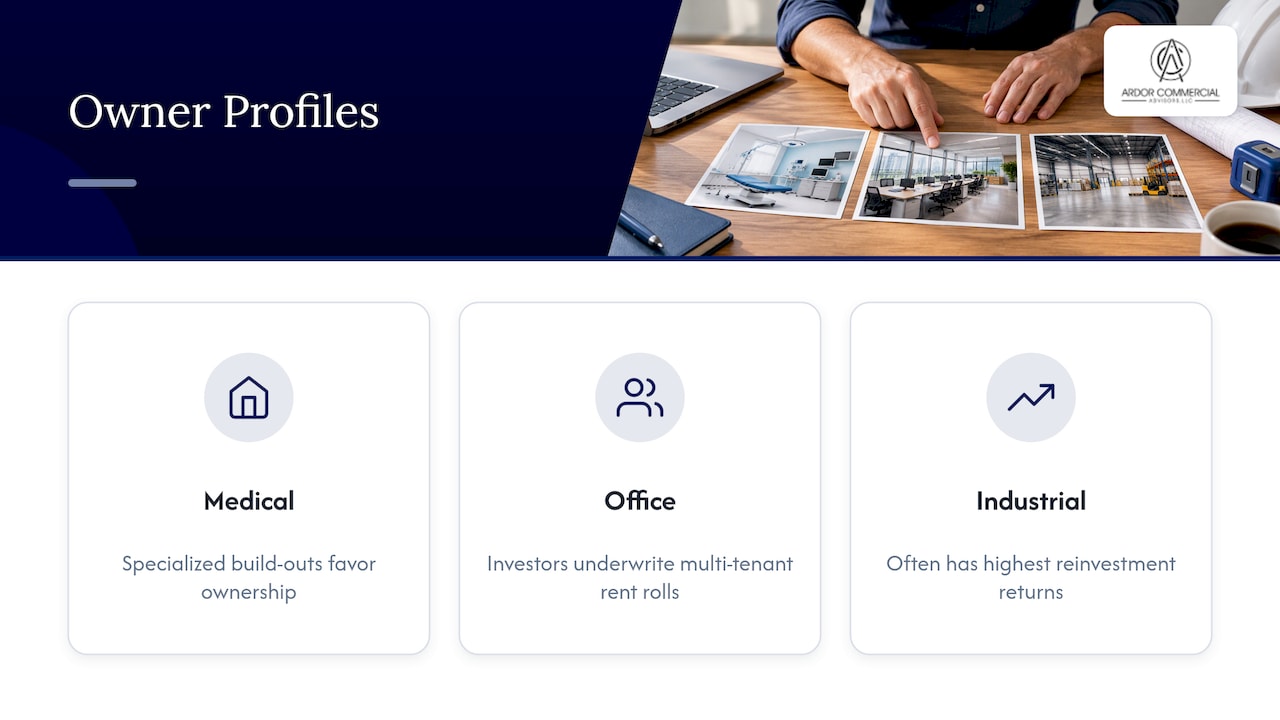
Medical and dental practice owners. If your building houses a specialized build-out you plan to occupy for decades, ownership usually carries more value than the cash you would release, particularly if the property is appreciating. A sale-leaseback can make sense when you need capital for equipment, a second location or a partner buyout, and the lease term and renewals are strong. Compare it with our guidance on leasing versus buying as a medical professional.
Office building owners. A single-tenant office you occupy is a candidate for either path. A multi-tenant building you partly lease to others changes the math: the investor will underwrite your rent roll, and you may keep management control only if the lease is structured for it. Our property management budget guide helps you see the real cost of holding the asset.
Industrial owners. Manufacturers and distributors often have the most equity tied up in real estate and the highest return on reinvesting it, which is why they use sale-leasebacks. Lease structure matters a great deal here; see industrial lease types so surprise costs do not appear after closing.
Before choosing, test these questions, which echo the factors owners should weigh: how much capital you need, your overall capital structure, how important owning the property is, and whether the facility will serve the business for the whole lease term. Financing choices cannot be judged in isolation from your capital structure.
A simple decision path
- Define the need: the dollar amount and what it will fund.
- Get a refinance quote and a sale-leaseback indication for the same building.
- Model 10 to 20 years of cost, including taxes at closing and the value of the building you would give up.
- Check the covenant, accounting and tax effects with your lender, CPA and attorney.
- Negotiate the lease terms before you accept the price. A higher price with a weak lease is rarely a better deal.
Promo
If you own a medical, office or industrial building in the Charlotte area and want the sale-leaseback and refinance numbers side by side, our team handles commercial real estate sales, leasing and investment advisory for owners and investors, including valuation, DCF modeling and lease review.
If you want your building valued before you choose, start with our commercial property valuation service.
Our perspective
Most owners we talk to start with the question of which structure is cheaper. The better question is what the building is worth to you in ten years, and what the cash is worth to your business in the same period.
A mortgage keeps you in control and keeps the upside. A sale-leaseback is a strategic trade: you give up the asset in exchange for capital and certainty of occupancy. When the lease is well negotiated and the cash earns more inside the business than the building would, it can be the right move. When it is rushed, the rent premium and the lost appreciation add up quietly.
That is why we build the model first, review the lease line by line and look at the tax result before anyone talks about price. We combine local market knowledge with a full-service approach, from valuation to lease analysis to the transaction itself, so you decide with the whole picture in front of you.
Jim
FAQ
Is a sale-leaseback a loan?
A true sale-leaseback is a sale: title transfers and you are paid at closing. Courts and tax authorities look at the substance of the deal, though, so features such as a fixed-price repurchase option can cause it to be treated as financing. Have your attorney and CPA review the structure.
Why would an owner choose a sale-leaseback over a mortgage?
The usual reasons are access to more capital than a lender will advance, no loan covenants or balloon payment, and keeping the business in the same location. The cost is higher rent in many cases and the loss of ownership and appreciation.
Does a sale-leaseback trigger taxes?
Yes. The sale is taxable, with gain measured against your adjusted basis, and prior depreciation can affect the rate. A mortgage does not create a sale. Run the after-tax numbers with your tax adviser before you choose.
Can I buy the building back later?
Only if the lease or a separate agreement gives you the right, such as a purchase option or right of first refusal. A repurchase option affects how the deal is accounted for, so negotiate it with advice from your attorney and accountant.
Sources
- Sale-leaseback vs. Traditional Debt: A Company’s Guide
- Sale-Leaseback Transactions Explained
- Sale-Leaseback Transactions, Davidson Law Group
- The Many Benefits of Sale-Leasebacks for Middle Market Companies
- Sale-Leaseback Transactions in M&A: Structuring Guide
- Sale and Leaseback Example: Accounting, Tax, and Risks
- IRS Notice 2005-13
- FASB Leases (Topic 842)
- Depreciation Recapture in Real Estate: How It Works
- Commercial property evaluation types for investors 2026