
A right of first refusal (ROFR) gives a named party the contractual right to match a bona fide third-party offer before the owner can complete a sale. If you hold one, your immediate steps are to review the full offer package, arrange financing or proof of funds, and send a signed acceptance before your response window closes. If you’re the seller, preserve the third-party offer in writing and follow your notice obligations precisely — a procedural misstep can expose you to damages or void the deal.
If you hold a ROFR:
- Confirm the notice you received includes all material terms (price, contingencies, closing timeline)
- Arrange financing or proof of funds before the deadline, not after
- Send written acceptance within the contractually defined window, which for most commercial contracts is 30–60 days
If you’re granting or triggering a ROFR:
- Document the third-party offer completely before delivering notice
- Follow the exact notice method the contract specifies (certified mail, email, or otherwise)
- Do not proceed with the outside buyer until the holder’s window has expired or they have formally declined
The Harvard Program on Negotiation describes ROFRs as potentially a “blessing or a curse” depending on how they’re drafted and which side of the deal you’re on. That tension is the whole story.
Table of Contents
- What is a right of first refusal, exactly?
- How does a right of first refusal work, step by step?
- Where do ROFRs show up most often?
- ROFR vs. ROFO: which one actually protects you?
- What should a well-drafted ROFR clause include?
- What are each party’s rights and duties, and where do disputes start?
- How does enforceability vary by state, and what pitfalls should you watch for?
- How do you exercise a ROFR, or respond when someone exercises one against you?
- What does a ROFR actually cost, and how does it affect your deal?
- Common drafting and negotiation pitfalls to avoid
- A commercial real estate advisor’s take on ROFRs in practice
- Key Takeaways
- The view from the advisory side
- Ardorcre can help you navigate ROFR clauses in commercial deals
- Useful sources for further reading
What is a right of first refusal, exactly?
A ROFR (also written RFR) is a contractual right, not a property deed right, that obligates an owner to offer a named holder the chance to buy an asset on the same terms a third party has already proposed. Three parties are always involved: the owner, the holder, and the prospective third-party buyer. The owner can market freely, but once a real offer arrives, the holder gets first crack at matching it.
A few terms come up constantly in ROFR discussions, and knowing them saves confusion later:
- Trigger event: The moment that activates the ROFR, usually the owner receiving a bona fide third-party offer
- Notice: The formal communication the owner must send the holder, containing the full offer terms
- Matching: The holder’s obligation to accept the same material terms as the third-party offer, not just the price
- Exercise window: The contractually defined period (often 30–60 days) during which the holder must respond
- Assignment: Whether the holder can transfer the ROFR to another party
- No-worse-than clause: A provision (more common in ROFO structures) ensuring the holder’s terms are at least as favorable as any outside offer
One important distinction worth flagging here: a ROFR is not the same as a right of first offer (ROFO). A ROFO requires the owner to approach the holder before marketing to anyone else. A ROFR lets the owner market freely and only kicks in once a real offer materializes. That difference has significant practical consequences, covered in detail below.

How does a right of first refusal work, step by step?
The mechanics follow a predictable sequence, though the details vary by contract. Here’s how a typical ROFR plays out from listing to closing.
- Owner receives a third-party offer. A legitimate, bona fide offer from an outside buyer triggers the ROFR. Casual inquiries or letters of intent without firm terms generally don’t qualify as triggers unless the contract says otherwise.
- Owner delivers formal notice to the holder. The owner must present the full offer package to the holder, including price, contingencies, financing structure, and closing timeline. A notice that omits material terms is defective and can expose the seller to liability.
- Holder’s exercise window opens. Response periods typically run 30–60 days, though commercial leases can specify shorter or longer periods as negotiated. The clock usually starts on the date the notice is received, not sent.
- Holder decides: match or decline. To exercise the right, the holder must match all material terms of the third-party offer, not just the headline price. Matching only the price while rejecting a financing contingency or a faster closing timeline usually doesn’t constitute valid exercise.
- Outcome A — holder matches. The holder steps into the third-party buyer’s position. The outside buyer is out, and the transaction proceeds between owner and holder on the matched terms.
- Outcome B — holder declines or misses the deadline. The owner is free to close with the third-party buyer, but typically only on terms no better than those presented to the holder. If the deal with the outside buyer falls through, many contracts require the owner to re-trigger the ROFR before pursuing a new transaction.
A concrete example: A commercial landlord in Charlotte receives an all-cash offer of $4.2 million with a 45-day close and no financing contingency. The tenant holds a ROFR. The landlord delivers written notice. The tenant has 30 days to match — which means $4.2 million, all cash, 45-day close. If the tenant can only offer $4.2 million with a financing contingency, that’s not a match, and the landlord can proceed with the outside buyer.
- Typical response window: 30–60 days for commercial contracts (varies by contract and asset type)
- Matching standard: all material terms, not price alone
- Failed exercise: owner may proceed with third party, but re-trigger rules apply if that deal collapses
Where do ROFRs show up most often?
ROFRs appear across a wide range of transactions. Knowing where they typically surface helps you spot one before it creates a surprise.
- Commercial leases: Tenants in office, retail, medical, and industrial buildings often negotiate a ROFR on adjacent space or the entire building. A medical practice leasing 3,000 square feet might secure the right to purchase the building if the landlord ever decides to sell.
- Residential tenant buybacks: Some states give residential tenants a statutory right of first refusal when a landlord sells. Maryland’s DHCD, for instance, administers tenant protections that include first-refusal rights in certain sale situations.
- HOA preemptions: Homeowners associations in planned communities sometimes hold a ROFR on unit sales to control who buys into the community or to maintain affordability.
- Family land transfers: Siblings or heirs frequently negotiate ROFRs on family-owned property to prevent outside buyers from acquiring a stake without the family having a chance to purchase first.
- Shareholder and LLC interest sales: Business partners routinely include first-refusal clauses in operating agreements and shareholders’ agreements to prevent unwanted third parties from buying into the company.
- Venture capital term sheets: In startup financing, existing investors often hold a ROFR on new share issuances to prevent dilution. Startup founders are generally advised to limit or negotiate out this right, because it can signal weakness to incoming investors and suppress valuation.
- IP licensing: A film studio might grant a producer a ROFR on sequels or derivative works from a licensed screenplay.
The commercial lease context is where ROFRs get most complicated in practice. A retail tenant who holds a ROFR on a shopping center building may not realize the right doesn’t automatically survive a lease renewal unless the contract says so explicitly. That gap has generated significant litigation.
ROFR vs. ROFO: which one actually protects you?
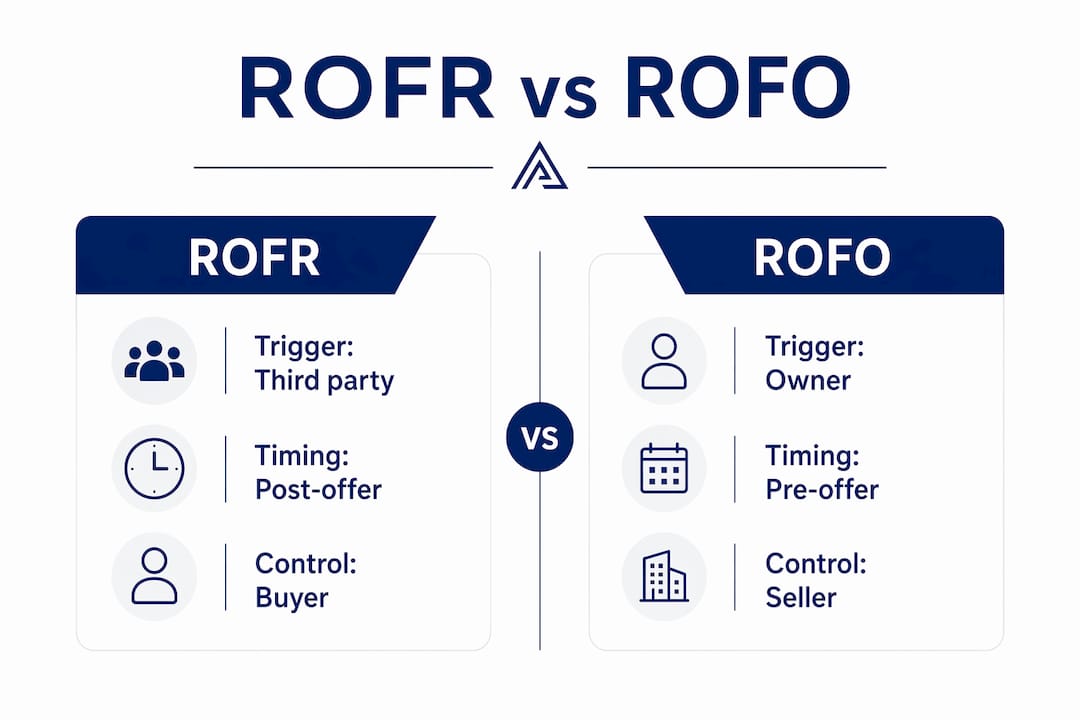
The choice between a ROFR and a ROFO isn’t just semantic. It determines who controls the deal timeline and who bears the most risk.
A ROFO requires the owner to approach the holder first, before marketing to anyone else. The holder makes an offer, the owner accepts or rejects it, and only then can the owner go to market. A ROFR lets the owner market freely and only gives the holder a “last look” once a real offer appears.
| Dimension | ROFR | ROFO |
|---|---|---|
| Timing / trigger | After a third-party offer is received | Before the owner markets to anyone |
| Who it favors | Rights holder (last look, market-tested price) | Seller (preserves open market competition) |
| Assignment / transferability | Typically personal; assignment requires explicit language | Same — personal by default |
| Price / matching mechanics | Must match all material terms of third-party offer | Holder sets opening bid; no third-party benchmark |
| Typical uses | Tenant buybacks, family transfers, VC anti-dilution | Commercial sales, shareholder exits, partnership buyouts |
Pro Tip: If you’re a seller who needs maximum flexibility, push for a ROFO. It lets you test the market before the holder gets involved. If you’re a tenant or investor who wants certainty, insist on a ROFR — you’ll see exactly what the market will pay before you have to decide.
Neither structure is objectively better. Practitioners consistently recommend matching the right to the parties’ actual goals rather than defaulting to whichever term the other side’s attorney drafted first.
What should a well-drafted ROFR clause include?
Poorly drafted ROFR clauses are among the most litigated provisions in commercial real estate. Courts routinely invalidate or limit rights that are vague, indefinitely long, or that impose unreasonable restraints on alienation. A solid clause addresses every item below.
Drafting checklist:
- Trigger definition: Specify exactly what constitutes a triggering event (executed purchase agreement, letter of intent, or something else)
- Notice content: List every term the notice must include (price, contingencies, financing structure, closing date, earnest money amount)
- Delivery method: State how notice must be delivered (certified mail, overnight courier, email with read receipt) and when the clock starts
- Response window: Set a clear deadline — 30 days is common for commercial deals; shorter windows favor sellers
- Matching standard: Define whether the holder must match price only or all material terms, including contingencies
- Assignment rules: State whether the right is personal to the named holder or can be transferred; whether it runs with the land
- Re-trigger language: Require the owner to re-trigger the ROFR if the third-party deal falls through before closing
- Carve-outs: List transactions that don’t trigger the right (transfers to affiliates, estate transfers, foreclosure sales, lender-required dispositions)
- Survival through renewals: Explicitly state whether the right continues through lease renewals and extensions
Sample clause language (for reference only — not legal advice): “Owner shall deliver written notice to Holder within five (5) business days of executing any letter of intent or purchase agreement with a third party, including all material terms. Holder shall have thirty (30) calendar days from confirmed receipt to elect to purchase the Property on identical terms. Failure to respond within such period constitutes a waiver for that transaction only. This right survives any renewal or extension of the Lease unless expressly waived in writing.”
Common negotiated carve-outs and their effects on marketability:
- Affiliate transfers: Excluding sales between related entities keeps internal restructuring clean but can be abused if “affiliate” is defined too broadly
- Foreclosure and lender transfers: Lenders almost always require this carve-out; without it, financing the property becomes difficult
- Estate and probate transfers: Excluding transfers by operation of law prevents the ROFR from complicating inheritance
- Distressed or court-ordered sales: Excluding these protects sellers in bankruptcy or receivership situations
What are each party’s rights and duties, and where do disputes start?
Holder’s rights:
- Receive timely, complete notice of the triggering offer
- Review all material terms before the exercise window opens
- A reasonable period to arrange financing and respond
Holder’s duties:
- Respond within the contractual deadline
- Match all material terms, not just the price
- Deposit earnest money per the contract if exercising
Seller’s duties:
- Deliver full and accurate offer terms — omitting a contingency or misrepresenting the closing timeline is a breach
- Follow the exact notice procedure the contract requires
- Re-trigger the ROFR if the third-party deal collapses before closing
- Refrain from proceeding with the outside buyer until the holder’s window has expired or they’ve formally declined
Two common dispute scenarios:
Scenario 1 — Incomplete notice. A seller delivers notice listing the purchase price but omits the buyer’s financing contingency. The holder declines, believing the deal is all-cash. Later, the holder discovers the third-party buyer had a 30-day financing contingency. Courts in most jurisdictions treat this as a defective notice, meaning the holder’s window never validly opened. The seller may face damages or be required to re-offer.
Scenario 2 — Holder’s financing contingency vs. all-cash offer. The third-party offer is all-cash with a 21-day close. The holder attempts to exercise with a financing contingency and a 60-day close. Most courts and arbitrators would find this is not a valid match. The holder loses the right for that transaction, and the seller proceeds with the outside buyer.
How does enforceability vary by state, and what pitfalls should you watch for?
ROFR enforceability is not uniform across U.S. states. Courts apply different standards, and a clause that holds up in Texas may be invalidated in California or New York. The most common enforceability concerns:
- Vagueness: Courts strike down ROFRs that don’t define the trigger event, the matching standard, or the response window with sufficient clarity
- Indefinite duration: A perpetual ROFR with no expiration date is vulnerable to challenge as an unreasonable restraint on alienation in many states
- Restraint on alienation: Some states apply a strict rule against restraints that make property effectively inalienable; a ROFR that covers every possible transfer can cross this line
- Unclear trigger language: “If the owner decides to sell” is weaker than “upon execution of a purchase agreement with a third party” — courts interpret ambiguity against the drafter
- Survival through renewals: A ROFR may not survive a lease renewal unless the contract explicitly says it does. This is one of the most common and costly oversights in commercial leasing
Pro Tip: State law governs whether a ROFR is treated as a contract right (remedies limited to damages) or a property right (potentially voidable sale). In some jurisdictions, recording the ROFR in the public land records gives it greater enforceability against subsequent purchasers. Check your state’s recording statutes and consult a real estate attorney before signing.
The practical takeaway: always include an explicit expiration date, a clear trigger definition, and survival language for renewals. Without those three elements, you’re drafting a litigation target.
How do you exercise a ROFR, or respond when someone exercises one against you?
Steps for the holder who wants to exercise:
- Verify the offer package is complete. Confirm the notice includes price, contingencies, financing terms, earnest money, and closing date. If anything is missing, send a written request for the missing terms before your window starts running.
- Arrange financing or proof of funds. If the third-party offer is all-cash, you need to match that. Explore commercial financing options early — waiting until day 25 of a 30-day window is how holders lose rights they legitimately hold.
- Send signed written acceptance before the deadline. Deliver it by the method the contract specifies. If the contract says certified mail, a text message doesn’t count.
- Deposit earnest money per the contract terms. Typical earnest money runs 1%–5% of the purchase price depending on asset type and market. Failure to deposit on time can be treated as a failed exercise.
- Complete title and entity checks. Confirm the seller has clear title and that your purchasing entity is properly formed before closing.
Steps for the seller when a holder exercises:
- Preserve the third-party offer record. Keep every version of the offer, including any amendments, in writing.
- Deliver notice precisely as the contract requires. Wrong delivery method, wrong address, or missing terms can restart the clock or expose you to liability.
- Confirm receipt. Use certified mail, overnight courier with tracking, or email with a read receipt. Document the timestamp.
- Proceed with the holder if they exercise validly. If they decline or miss the deadline, document that in writing before moving forward with the outside buyer.
Sample acceptance language (for reference only — not legal advice): “Holder hereby elects to exercise its Right of First Refusal with respect to the Property located at [address], on the identical terms set forth in Owner’s Notice dated [date], including a purchase price of $[X], [all-cash / financing contingency as stated], and a closing date of [date]. Holder will deposit earnest money of $[X] with [escrow agent] within [X] business days of this notice.”
Pro Tip: Send your acceptance by certified mail AND email with a read receipt. Courts have found that a holder who sent acceptance by email alone, when the contract specified certified mail, lost the right even though the seller actually received the email. Timestamps and delivery confirmation matter more than you’d expect.

What does a ROFR actually cost, and how does it affect your deal?
The costs of a ROFR are both direct and indirect, and sellers often underestimate the indirect ones.
Direct costs:
- Legal review of the ROFR clause and notice: typically $500–$2,500 depending on complexity
- Notice preparation and certified delivery: minor but real
- Expedited financing costs for holders who need to move fast: appraisal fees, lender fees, rate premiums for compressed timelines
Indirect costs and market effects:
- Longer marketing periods because sophisticated buyers know a holder can match their offer at the last minute
- Lower initial offers from third parties who discount for deal uncertainty
- Opportunity cost for sellers who lose a motivated buyer during a 30–60 day holder window
The Harvard Program on Negotiation documents the chilling effect directly: third-party buyers often avoid deals encumbered by a ROFR because they’re unwilling to invest due diligence time and money into a transaction that a holder can match at the last minute. For a commercial property listed on an open commercial marketplace, that reduced competition can translate into a measurably lower sale price.
Timeline to expect when a ROFR is triggered:
- Notice delivery: 1–5 business days after triggering event
- Holder response window: 30–60 days for most commercial contracts (contract-dependent)
- Closing after exercise: typically 30–90 days depending on financing and asset complexity
The valuation impact is real but hard to quantify precisely. What’s consistent across markets is that buyers price in the uncertainty. A property with a well-drafted, short-window ROFR held by a financially strong tenant is less impaired than one with a perpetual, vaguely triggered right held by an unknown party.
Common drafting and negotiation pitfalls to avoid
Most ROFR disputes trace back to a handful of drafting failures. Here’s what to watch for before you sign.
Red flags for sellers:
- Perpetual duration with no expiration date
- Trigger language broad enough to cover affiliate transfers or estate transfers
- No carve-out for lender-required dispositions (this can make the property unfinanceable)
- Missing re-trigger language that could trap you if the third-party deal collapses
Red flags for holders:
- A response window shorter than 15 business days (nearly impossible to arrange financing in time)
- No re-trigger obligation if the outside deal falls through
- Assignment prohibited, meaning the right dies with you and can’t be transferred to an entity you control
- Survival through renewals not addressed
Red flags for both sides:
- Vague matching standard (“same terms” without defining which terms)
- No specified notice delivery method
- No stated consequence for defective notice
- Ambiguous trigger definition that could generate disputes over whether a given offer qualifies
Experienced commercial practitioners consistently recommend short response windows and narrow trigger definitions for commercial properties specifically because broad, open-ended ROFRs are the ones that end up in court.
Pro Tip: Before signing any agreement containing a ROFR, run a two-minute checklist: Does it define the trigger? Does it set a response window? Does it define matching? Does it address survival through renewals? Does it include lender carve-outs? If any answer is “no” or “unclear,” flag it before you sign, not after.
A commercial real estate advisor’s take on ROFRs in practice
Working with commercial clients across office, medical, retail, and industrial deals in the Charlotte MSA, I see ROFR clauses misused in both directions. Tenants ask for them without thinking through whether they can actually execute if the trigger fires. Sellers grant them without understanding the marketability consequences.
Here’s my honest read on when a ROFR makes sense commercially and when it doesn’t:
- Grant a ROFR when: The tenant is a strong, long-term occupant who genuinely adds value to the asset (a medical anchor tenant, for example), and you want to preserve that relationship if you ever sell. A ROFR can be a meaningful concession that costs you little if the tenant can’t actually match a competitive offer.
- Avoid granting a ROFR when: You’re in a market with thin buyer pools. The chilling effect is most damaging when you can’t afford to lose even one serious buyer. In those situations, push for a ROFO or a right of first negotiation with a short window.
- Negotiate scope aggressively: The difference between a ROFR that covers “any sale” and one that covers “any arm’s-length sale to an unaffiliated third party” is enormous. The narrower the trigger, the more marketable the asset.
One deal I’ve seen play out repeatedly: an investor acquires a multi-tenant building with an existing ROFR buried in a legacy lease. They don’t discover it until they’re under contract with a buyer. The holder then has 30 days to decide, the outside buyer gets nervous, and the deal either falls apart or closes at a discount. That scenario is entirely avoidable with a proper lease review before acquisition.
Whether you’re a landlord considering granting a ROFR, a tenant negotiating one, or an investor inheriting one, the math is the same: the right is only as good as the drafting behind it.
Key Takeaways
A right of first refusal is only as enforceable as the precision of the language behind it, and the costs of a poorly drafted clause fall on both sides of the deal.
| Point | Details |
|---|---|
| Matching means all terms | Holders must match price, contingencies, financing structure, and closing timeline, not price alone. |
| Response windows run 30–60 days | Most commercial contracts set a 30–60 day exercise window; shorter windows favor sellers. |
| Chilling effect is real | Third-party buyers often avoid ROFR-encumbered deals, which can reduce competition and depress sale prices. |
| Survival language is non-negotiable | A ROFR may not survive a lease renewal unless the contract explicitly states it does. |
| Ardorcre advises on ROFR impact | Ardorcre’s advisors review lease and sale agreements to identify ROFR exposure before it affects your deal. |
The view from the advisory side
The most underappreciated aspect of a ROFR isn’t the legal mechanics — it’s the deal psychology. Sellers often grant these rights casually, as a negotiating chip, without modeling what happens if the right is actually exercised at the worst possible moment. A holder who exercises during a rising market, matching a price the seller thought was generous, can feel like a betrayal even when it’s exactly what the contract said would happen.
What I tell clients at Ardorcre is this: treat the ROFR clause the same way you’d treat a purchase price. Negotiate it carefully, document it precisely, and understand what you’re giving or receiving before you sign. A right that looks like a small concession at lease signing can become the most consequential clause in the document when the property goes to market five years later.
For holders, the right is only valuable if you can execute. Knowing you have a ROFR and being able to arrange financing, match all terms, and close within 30 days are very different things. If you’re a tenant or investor holding a ROFR on a commercial property, it’s worth reviewing your readiness to act before the trigger fires, not after.
Ardorcre can help you navigate ROFR clauses in commercial deals
Ardorcre’s advisors work with commercial property owners, tenants, and investors across the Charlotte MSA to identify ROFR exposure in existing leases, negotiate protective carve-outs in new agreements, and manage the marketability impact when a right is triggered. Whether you’re a landlord trying to structure a sale without losing your buyer pool, or a tenant who wants to understand what your first-refusal clause actually requires, the team at Ardorcre brings direct commercial brokerage experience to the conversation.
If you’re buying, selling, or leasing office, medical, retail, or industrial property and need advisory support on ROFR language or deal structure, contact Ardorcre to speak with an advisor. You can also browse current commercial listings to understand how encumbrances like ROFRs are disclosed and priced in active Charlotte-area deals.
Useful sources for further reading
- Harvard Program on Negotiation — “Blessing or Curse? The Real-Estate Right of First Refusal”: The most-cited academic treatment of ROFR deal dynamics, including the chilling effect on third-party buyers. Useful for understanding negotiation tradeoffs.
- LegalClarity — “ROFO vs. ROFR: Key Differences and How They Work”: Plain-language breakdown of matching mechanics, timing, and enforceability pitfalls. Good starting point for drafting review.
- LoopNet — “Right of First Offer (ROFO) in Commercial Real Estate”: Commercial-focused explanation of ROFO and ROFR structures, including re-trigger and price-floor clauses. Practical for investors and landlords.
- HFW Insights — “Navigating a Shareholders Agreement: ROFR or ROFO”: Practitioner perspective on choosing between the two rights in business and shareholder contexts.
- Katten QuickReads — “Differentiating Between ROFOs and ROFRs”: Commercial real estate attorney analysis of scope, duration, and litigation risk. Particularly useful for identifying red flags before signing.
- Maryland DHCD — Right of First Refusal: State-level example of statutory tenant first-refusal rights. Useful for residential tenants and for understanding how state law can layer on top of contractual rights.
This article is general information, not legal advice. ROFR enforceability, notice requirements, and remedies vary by state and contract. Consult a licensed real estate attorney in your jurisdiction before drafting, signing, or exercising a right of first refusal.