
An estoppel certificate is a tenant’s signed confirmation of key lease facts that buyers, lenders, and their counsel rely on to close a sale or secure financing. Sign one without checking it against your actual lease, and you may permanently waive rights you didn’t know you were giving up. Purchase agreements routinely require signed estoppels from tenants representing 75–85% of occupied square footage as a condition to close, which means a single holdout or an inaccurate return can stall an entire transaction.
Before signing anything, verify at minimum:
- Lease commencement and expiration dates (including any amendments)
- Current base rent and escalation schedule
- Security deposit amount on file
- Outstanding landlord obligations (TI allowances, free-rent periods)
- Any defaults, offsets, or side letters not reflected in the main lease
- Renewal and purchase options
Table of Contents
- What is an estoppel certificate and when do lenders and buyers request one?
- What does a standard estoppel checklist cover?
- What does signing an estoppel actually do to your legal rights?
- How should you review, correct, and return an estoppel?
- What red flags in a returned estoppel should stop a deal?
- Annotated sample estoppel: what to accept, amend, or reject
- Key Takeaways
- Why estoppels matter more than most investors realize
- Ardorcre handles estoppel management for Charlotte MSA transactions
- Useful sources
What is an estoppel certificate and when do lenders and buyers request one?
The estoppel certificate is a snapshot: it freezes the lease relationship at a specific date so a third party can rely on it. The buyer or lender’s counsel typically drafts the form and pre-fills it from the landlord’s rent roll; the tenant signs and certifies that the facts are accurate.
Commercial deals rarely close without estoppels from major tenants. The four most common triggers are a property sale, a refinance, a lender’s closing conditions in a loan commitment, and a large tenant assignment or sublease. In a purchase and sale agreement, the estoppel delivery deadline usually falls inside the due-diligence window, often 30–45 days before closing. For refinances, the lender’s commitment letter specifies which tenants must certify and by when.
Lease clauses often set a 10–15 day response window, but experienced practitioners build a 30-day cushion into due-diligence schedules to absorb tenant review, disputes, and follow-up rounds. Lenders and buyers who skip that buffer frequently find themselves scrambling at the end of the diligence period. Capital advisors working on commercial property financing treat estoppel collection as a parallel-path task, not a last-minute checkbox.
What does a standard estoppel checklist cover?
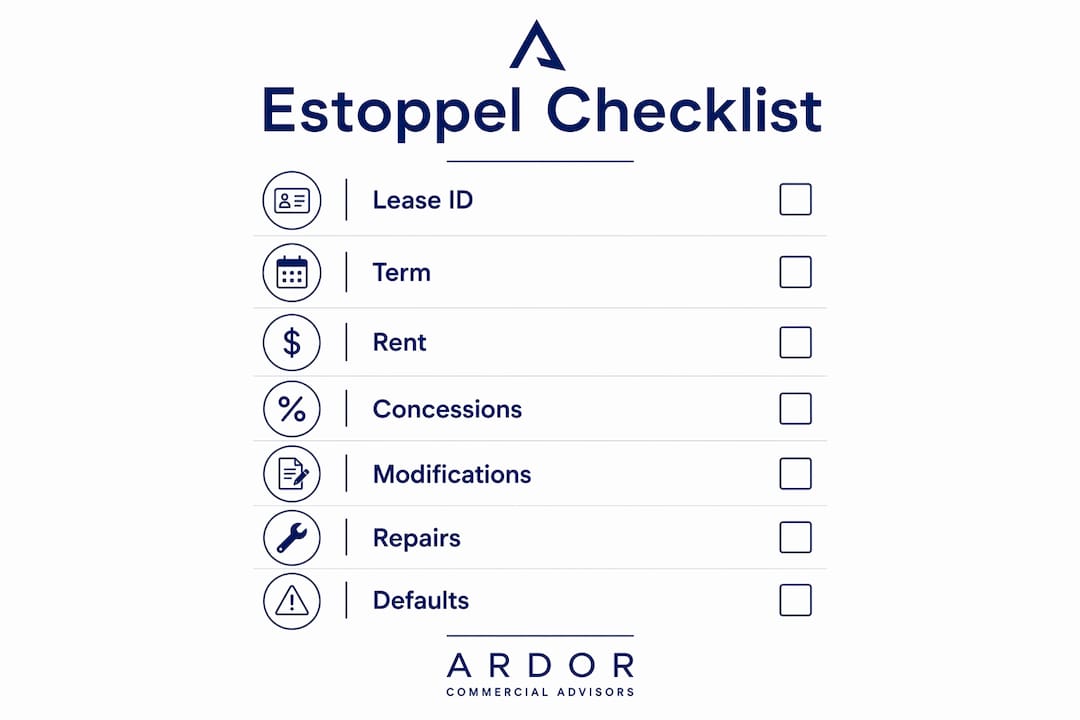
A well-drafted estoppel asks the tenant to confirm a specific set of facts. The table below maps each field to the lease document you should cross-check it against.
| Estoppel Field | Cross-Check Source |
|---|---|
| Lease identification (date, parties) | Original lease signature page |
| Commencement and expiration dates | Lease § 1 or commencement letter |
| Renewal and extension options | Lease rider or option addendum |
| Base rent and escalation schedule | Rent schedule exhibit |
| Rent paid-through date | Payment receipts or bank records |
| Security deposit amount | Lease § 5 and landlord ledger |
| TI allowances and outstanding landlord obligations | Work letter or amendment |
| Defaults or offsets claimed by either party | Correspondence file |
| Assignments, subleases, or guarantors | Consent agreements |
| Side letters or oral modifications | Any separate written agreements |
A few practical notes on timing: standard estoppels confirm lease identification, term, rent, concessions, modifications, defaults, and options. An estoppel dated more than 60 days before closing is generally considered stale; buyers should request a fresh certification if the original falls outside that window.

Pro Tip: When certifying a complex item like a TI allowance, attach the relevant lease page or amendment as an exhibit to the estoppel. It anchors your certification to a specific document and limits the scope of what you’re confirming.
What does signing an estoppel actually do to your legal rights?
Once a tenant certifies facts in an estoppel, courts generally bar that tenant from asserting contrary facts against a party who reasonably relied on the certificate. Courts treat estoppels as written instruments, which means their contents are presumed true for evidentiary purposes and can override prior understandings that conflict with what was certified.
That said, reliance is not absolute. Courts assess party sophistication and whether the third party could have independently verified the facts before relying on the certificate. A sophisticated buyer who had full access to the lease file and still relied on an incorrect estoppel may get less judicial sympathy than a lender with no independent access.
The practical takeaway: an estoppel is not a substitute for full lease review. Buyers and lenders must still read every lease, amendment, and side letter. The estoppel confirms the tenant’s understanding; it does not replace the underlying documents.
How should you review, correct, and return an estoppel?
Act the moment the request lands. Here is the sequence that protects both tenants and investors:
- Confirm the requester’s identity and the return deadline. Note whether the deadline is contractual (lease clause) or negotiated (PSA).
- Pull every lease document. Original lease, all amendments, the rent schedule, any side letters, and your payment records.
- Compare each pre-filled field to your documents. Flag every discrepancy in writing before you respond.
- Propose corrected language for any inaccurate field. Do not simply cross out text; write the accurate version and note the source (e.g., “per Amendment No. 2, dated March 15, 2023”).
- Add a knowledge qualifier where appropriate. Language like “to the best of Tenant’s actual knowledge” limits your exposure on facts you cannot independently verify.
- Return with your signature and copy your counsel. For any material dispute, request an attorney opinion before signing.
Safe language examples tenants can adapt:
- “Tenant certifies the foregoing to the best of Tenant’s actual knowledge as of the date hereof.”
- “Tenant is not aware of any default by Landlord; however, Tenant reserves all rights under the Lease.”
- “The security deposit on file is $[X], per Section 5 of the Lease dated [date].”
Signing a pre-filled estoppel without checking it against your actual lease is one of the most common and costly mistakes in commercial transactions. Tenants who ignore errors in pre-filled fields risk unintentionally waiving rights they may not recover.
Pro Tip: Build a 30-day buffer into every due-diligence schedule for estoppel collection. Lease clauses may say 10–15 days, but real transactions rarely move that fast once tenants start asking questions.
What red flags in a returned estoppel should stop a deal?
Certain patterns in a returned estoppel deserve immediate attention before closing proceeds.
Red flags to escalate:
- Missing amendments or side letters not referenced in the estoppel
- Rent figures that don’t match the rent roll
- Tenant qualifications like “to the best of our knowledge” on items that should be verifiable facts
- Assertions of landlord default or offset rights
- Inconsistent commencement or expiration dates across multiple tenant estoppels
- Pre-filled broad waiver language that goes beyond what the lease requires
Negotiation levers for tenants:
- Limit certifications to “actual knowledge” rather than absolute representations
- Negotiate a 30-day response window in the lease at signing, not after the request arrives
- If the lease attaches a standard estoppel form as an exhibit, review it carefully at lease execution — an overly broad exhibit locks in your obligations before any transaction is on the table
- Push back on liquidated damages clauses for late delivery; they should be commercially reasonable, not punitive
- Require that any estoppel form conform to the lease-exhibit template if one exists
When a returned estoppel contains material discrepancies that could affect valuation or lending assumptions, pause the closing and involve counsel before proceeding.
Annotated sample estoppel: what to accept, amend, or reject
| Clause | Sample Language | What to Check | Suggested Edit |
|---|---|---|---|
| Header / Lease ID | — | Verify date and party names match the original lease signature page. | — |
| Rent certification | — | Confirm against rent schedule exhibit and payment records. | — |
| Default certification | “Tenant is not in default; Landlord is not in default.” | Review correspondence for any unresolved repair requests or unpaid TI reimbursements. | Add qualifier: “To Tenant’s actual knowledge, neither party is in default as of the date hereof.” |
| Knowledge qualifier | Absent from form. | A missing qualifier on complex items is a red flag. | Insert: “All certifications herein are made to the best of Tenant’s actual knowledge.” |
| Signature block | Signed by individual employee. | Confirm signatory has authority under the entity’s operating agreement or bylaws. | Require title and entity authorization confirmation. |
Pro Tip: An absolute certification (“Landlord is not in default”) is far riskier than a knowledge-qualified one (“To Tenant’s actual knowledge, Landlord is not in default”). Always push for the qualified version on any item you cannot independently verify from your own records.
Key Takeaways
An estoppel certificate is a transaction-critical document that locks in the tenant’s confirmed lease facts for buyers and lenders, and signing an inaccurate one can permanently waive rights.
| Point | Details |
|---|---|
| Closing threshold matters | Buyers typically require estoppels from tenants representing 75–85% of occupied square footage to close. |
| Pre-filled fields are high risk | Tenants who sign inaccurate pre-filled estoppels may unintentionally waive lease rights or create new obligations. |
| Build a 30-day buffer | Lease clauses often allow only 10–15 days, but practitioners recommend a 30-day due-diligence cushion. |
| Knowledge qualifiers limit exposure | Certifying “to the best of actual knowledge” materially reduces the risk of estopping unverified facts. |
| Ardorcre adds local expertise | Ardorcre manages estoppel collection and lease review for Charlotte MSA transactions, including portfolio assets like Century House. |
Why estoppels matter more than most investors realize
Most investors treat the estoppel as a formality, a box to check before closing. That’s the wrong frame. The estoppel is where the seller’s rent roll meets reality, and the gap between those two things is where deals go sideways.
The subtler risk is on the tenant side. A tenant who signs a pre-filled estoppel without reading it carefully has effectively agreed to the landlord’s version of the lease relationship. Courts don’t look kindly on sophisticated commercial tenants who claim they didn’t understand what they signed. The knowledge qualifier (“to the best of actual knowledge”) exists precisely because tenants can’t always verify every fact independently, and using it is not weakness; it’s precision.
For investors, the estoppel is also a negotiating signal. A tenant who returns a heavily qualified estoppel, or who asserts landlord defaults, is telling you something about the asset that the rent roll never will. Treat that signal seriously before you close.
Ardorcre handles estoppel management for Charlotte MSA transactions
Estoppel collection is one of those tasks that looks simple until a tenant pushes back at day 28 of a 30-day window. Ardorcre works with landlords, tenants, and investors across the Charlotte MSA to manage the full estoppel process: drafting forms, coordinating tenant responses, flagging discrepancies, and keeping transactions on schedule.
At Century House, early estoppel collection during a refinance process helped surface a tenant’s unresolved TI reimbursement claim before it became a lender condition issue. That kind of proactive diligence is what Ardorcre brings to every transaction. Whether you need tenant representation, landlord representation, or a full lease-review advisory, the team at Ardorcre is ready to help you move from due diligence to closing with fewer surprises. Reach out to request a lease review or discuss your next Charlotte commercial transaction.
Useful sources
The sources below were used to prepare this guide. Each is worth consulting directly for deeper legal analysis or transaction-specific questions.
- Practical Law: Tenant Estoppel Certificate — Thomson Reuters Practical Law’s standard definition and scope of a tenant estoppel certificate; authoritative for legal practitioners.
- Klein & Wilson: The Role of an Estoppel Certificate — Law firm analysis of how courts treat estoppels as written instruments and the evidentiary weight they carry.
- Hollander PLLC: Commercial Lease Estoppel Certificates — Detailed practitioner guide covering purpose, scope, timing, and negotiation issues including liquidated damages.
- LeaseParse: CRE Investor Guide to Estoppel Certificates — Investor-focused breakdown of closing thresholds, pre-filled form risks, and lease-exhibit negotiation.
- Lev: Estoppel Certificate Guide for CRE Deals — Explains why estoppels are a standard closing condition and how they connect the rent roll to tenant reality.
- Blakes: Tenant Estoppel Certificates — Analysis of third-party reliance standards and how courts assess party sophistication.
- U.S. House of Representatives: Estoppel Certificate Guidance — Government-issued procedural guidance on handling estoppel certificates as a tenant.
Estoppel certificates are not a substitute for full lease due diligence. Always read every lease, amendment, and side letter independently, and consult qualified legal counsel for any material dispute or ambiguous obligation before signing.
This article is general information, not legal advice. Confirm current requirements with a qualified real estate attorney for your specific transaction.