
The debt service coverage ratio (DSCR) is the single number that determines whether your commercial property qualifies for a loan and, more importantly, how large that loan can be. The formula is straightforward: DSCR = Net Operating Income ÷ Annual Debt Service. A ratio above 1.0 means the property generates more income than it costs to service the debt. Below 1.0, and the property is cash-flow negative on paper — a hard stop for most lenders.
Here is the verdict most borrowers learn too late: even when your loan-to-value (LTV) supports the amount you requested, a lender will reduce loan proceeds if the property’s NOI only supports a smaller debt service at their required DSCR floor. DSCR is the binding constraint more often than LTV in today’s rate environment.
Quick thresholds by risk profile:
- Stabilized multifamily (5+ units): minimum DSCR is commonly near 1.20x; some agency programs accept this level
- Industrial and self-storage: minimum DSCR is commonly near 1.20x; strong sponsors may qualify for slightly lower
- Retail and mixed-use: minimum DSCR is generally above 1.20x; higher for single-tenant or credit-sensitive deals
- Office: minimum DSCR required is usually above 1.30x, reflecting vacancy risk in many markets
- Hospitality and special-purpose: minimum DSCR is typically above 1.40x, per JPMorgan’s CRE benchmarks
- Bridge and value-add: underwritten to stabilized DSCR commonly near 1.20x
Quick example: A property with net operating income slightly above annual debt service produces a DSCR slightly above 1.0. That clears a 1.20x floor but leaves no cushion — expect lenders to scrutinize every line of the operating statement.
Table of Contents
- How do you calculate DSCR for a commercial property?
- How lenders normalize NOI before underwriting
- What do DSCR lenders typically require?
- How does DSCR compare with LTV and debt yield?
- How lenders use DSCR to size loans and run stress tests
- Loan covenants, DSCR maintenance, and what happens when the ratio falls
- Practical ways to improve your DSCR before applying
- Key Takeaways
- The constraint most investors underestimate
- Ardorcre helps you model DSCR before lenders do
- Useful sources and further reading
How do you calculate DSCR for a commercial property?
DSCR starts with two inputs: Net Operating Income and annual debt service. Getting both right is where most borrowers stumble.

Net Operating Income is gross rental income plus ancillary income (parking, laundry, storage fees), minus all operating expenses. Operating expenses include property taxes, insurance, utilities, repairs and maintenance, management fees, and administrative costs. NOI does NOT include mortgage payments, depreciation, income taxes, or capital expenditures — those are excluded by definition.
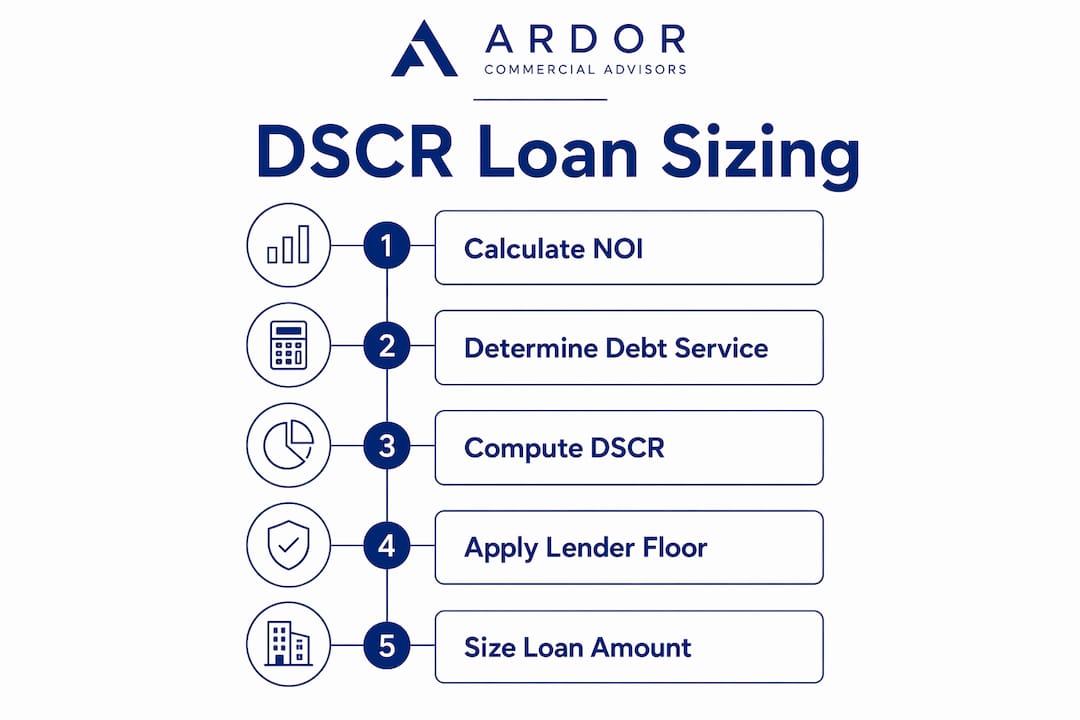
Annual debt service is the total of all principal and interest payments due on the proposed loan over 12 months. For an interest-only loan, that is simply 12 months of interest. For a fully amortizing loan, use the full P&I payment.
Step-by-step calculation
- Collect the rent roll. List every unit or suite, current rent, lease expiration, and any rent concessions in effect.
- Calculate gross potential income (GPI). Multiply each unit’s rent by 12 and sum across the property.
- Apply vacancy and collection loss. Subtract a market-appropriate vacancy factor (typically 5%–10% for stabilized assets).
- Add ancillary income. Include parking revenue, vending, storage, or other recurring income streams.
- Subtract total operating expenses. Use actual trailing 12-month figures, normalized for one-time items.
- Arrive at NOI. This is your numerator.
- Calculate annual debt service. Use the proposed loan amount, interest rate, and amortization term to compute the monthly P&I payment, then multiply by 12.
- Divide NOI by annual debt service. The result is your DSCR.
Worked example:
| Line Item | Amount |
|---|---|
| Gross potential rent | typical amount |
| Less vacancy (typical %) | (typical deduction) |
| Effective gross income | adjusted income |
| Plus ancillary income | additional income |
| Total income | total revenue |
| Less operating expenses | expenses deducted |
| Net Operating Income | calculated NOI |
| Annual debt service (proposed) | loan debt service |
| DSCR | ratio above 1.0 |
For a quick spreadsheet model, the Excel formula for annual debt service on a fully amortizing loan is =PMT(rate/12, term_months, -loan_amount)*12. Pair that with your NOI cell and you have a live DSCR calculator that updates as you adjust loan size or rate assumptions. A dedicated DSCR calculator can also run these figures quickly if you want to test multiple scenarios before building a full model.
DSCR-based financing applies across all major income-producing property types: multifamily, office, retail, industrial, self-storage, hospitality, and mixed-use. It is not used for raw land, vacant properties, or assets under construction — those require construction or land loans with different underwriting logic entirely.
How lenders normalize NOI before underwriting
The NOI you calculate from your own books and the NOI a lender underwrites are rarely the same number. Lenders apply a standard set of adjustments to stress-test income and normalize expenses. Knowing these adjustments in advance lets you anticipate the underwritten DSCR and avoid a surprise at the term sheet.
Common lender adjustments:
- Vacancy and collection loss: Lenders apply a minimum vacancy factor regardless of actual occupancy — often 5%–10% for stabilized assets, higher for office or retail with near-term lease expirations. A fully occupied building still gets a haircut.
- Management fee normalization: If you self-manage, lenders add a market-rate management fee (typically 4%–8% of EGI) to expenses, even if you pay yourself nothing. This is non-negotiable.
- Non-recurring income removal: One-time lease termination fees, insurance proceeds, or above-market lease buyouts are stripped from income. Lenders want recurring, sustainable cash flow.
- Owner add-back scrutiny: Expenses paid to related parties (owner’s management company, family-owned maintenance firm) are reviewed for market reasonableness. Inflated related-party expenses get added back; below-market ones get grossed up.
- Capital expenditure reserves: Lenders add a replacement reserve line — often $0.15–$0.25 per square foot for commercial assets — even if your operating statement shows no such line. For older properties, this figure climbs.
- Tax and insurance normalization: If taxes were recently reassessed or insurance costs spiked (a real issue across many Sun Belt markets), lenders use the current or projected figure, not the trailing 12-month average. Rising insurance costs have materially compressed underwritten NOI for many property owners in recent years.
- Market rent vs. in-place rent: When in-place rents are above market, lenders may underwrite to market rents, particularly for leases expiring within 12–24 months. The reverse — below-market in-place rents — is generally not adjusted upward unless the lease has a near-term reset or expiration.
Reported vs. underwritten NOI — a quick illustration: A property reports $175,000 NOI. After the lender adds a 6% management fee ($13,200), applies a 7% vacancy factor ($11,000), and adds a $0.20/SF replacement reserve on 8,000 SF ($1,600), underwritten NOI drops to roughly $149,200. On a $128,000 debt service, that shifts DSCR from 1.37x (sponsor-calculated) to 1.17x (lender-underwritten) — below a 1.20x floor.
Pro Tip: Prepare a lender-ready operating statement that already includes a management fee line, a replacement reserve, and a vacancy assumption. Submitting a clean, pre-adjusted statement signals sophistication and reduces the number of underwriting questions — which speeds up the process and reduces the chance of a lender applying a more conservative adjustment than you would.
What do DSCR lenders typically require?
Minimum DSCR and related terms by asset class
| Asset Class | Min. DSCR | Typical LTV | Amortization | Reserve Requirement |
|---|---|---|---|---|
| Stabilized multifamily | commonly near 1.20x | moderate LTV levels | standard amortization | typical DSRA reserves |
| Industrial / self-storage | commonly near 1.20x | moderate LTV levels | standard amortization | typical DSRA reserves |
| Retail (multi-tenant) | generally above 1.20x | moderate LTV levels | standard amortization | typical DSRA reserves |
| Office | minimum DSCR usually above 1.30x | somewhat lower LTV | shorter amortization | larger DSRA reserves |
| Hospitality / special-purpose | minimum DSCR typically above 1.40x | lower LTV | shorter amortization | full-year DSRA typical |
| Bridge / value-add | underwritten to stabilized DSCR commonly near 1.20x | moderate LTV levels | interest-only plus amortization | reserves including completion and DSRA |
Recently, lenders have generally increased DSCR floors for stabilized assets compared to prior rate cycles.
What else lenders look at
Beyond the DSCR floor, expect lenders to evaluate:
- Credit score: Most conventional CRE lenders want a 680+ personal FICO for recourse loans; some non-QM programs accept 620+.
- Guarantor net worth: Typically 1.0x–1.25x the loan amount in net worth, with liquidity equal to 10%–15% of the loan.
- Reserves: Six to twelve months of debt service held in a debt service reserve account (DSRA) is now standard for many commercial programs.
- Down payment / equity: LTV limits imply a 25%–40% equity contribution depending on asset class.
- Amortization: Conventional CRE loans typically offer 25–30 year amortization; interest-only periods of 1–3 years are available for higher-DSCR deals.
Conventional CRE loans vs. non-QM DSCR products
These are two distinct markets. Conventional CRE term loans use DSCR as one of several underwriting criteria alongside borrower financials, global cash flow, and net worth. Non-QM investor DSCR loan products underwrite almost entirely to property cash flow with minimal borrower income documentation — no tax returns, no W-2s. The tradeoff is real: non-QM products carry higher rates, shorter prepayment windows, and sometimes recourse requirements that conventional loans avoid. Speed and documentation simplicity come at a pricing cost.
How does DSCR compare with LTV and debt yield?
All three metrics measure credit risk, but they measure different dimensions of it — and in any given deal, one will bind before the others.
LTV (Loan-to-Value) measures leverage relative to the appraised value of the asset. It answers: how much of the property’s value is the lender financing? A 65% LTV on a $5 million property means a $3.25 million loan.
Debt yield is NOI divided by the loan amount (not the property value). It answers: what return does the lender earn on the loan balance if they foreclose? A $160,000 NOI on a $2 million loan produces an 8.0% debt yield. Lenders use this metric because it is independent of interest rates and cap rates — it cannot be gamed by a low-rate environment or an aggressive appraisal.
DSCR measures whether the property’s cash flow covers the debt payments at the proposed rate and amortization. It is the most rate-sensitive of the three.
When each metric typically binds:
- High-rate environment (now): DSCR binds most often. Rising rates inflate annual debt service, compressing DSCR even when NOI is stable. A deal that cleared 1.30x at a 4.5% rate may fall to 1.08x at 6.5% — same property, same income, different constraint.
- Low-rate environment: LTV tends to bind first. When debt service is cheap, DSCR is easy to clear, and lenders focus on collateral protection.
- Distressed or transitional assets: Debt yield often becomes the controlling metric because appraisals are unreliable and cash flow is uncertain.
A deal that passes LTV but fails DSCR is one of the most common surprises in commercial lending. Consider a $4 million retail property with a 65% LTV request ($2.6 million loan) and $195,000 NOI. At a 6.75% rate on a 25-year amortization, annual debt service is approximately $213,000. DSCR = 0.92x — well below any lender’s floor. The LTV is fine. The cash flow is not. The lender will either cut the loan to the amount the NOI can support or decline the deal entirely.
Understanding which metric will bind on your specific deal — before you submit — is the difference between a clean approval and a re-trade at the term sheet.

How lenders use DSCR to size loans and run stress tests
Lenders do not just use DSCR as a pass/fail test. They use it mechanically to compute the maximum loan the property’s NOI will support. Here is the exact sequence:
- Start with underwritten NOI. Apply all lender adjustments (vacancy, management fee, reserves) to arrive at the lender’s NOI figure.
- Divide by the lender’s DSCR floor. This gives the maximum annual debt service the lender will permit. Formula: Max Debt Service = Underwritten NOI ÷ DSCR Floor.
- Convert max debt service to a loan amount. Using the proposed rate and amortization, solve for the loan principal that produces that annual payment. In Excel:
=PV(rate/12, term_months, -max_monthly_debt_service). - Compare to the LTV cap. The loan amount is the lower of the Discretized loan and the LTV-capped loan.
Example: Underwritten NOI = $149,200. Lender DSCR floor = 1.25x. Max annual debt service = $149,200 ÷ 1.25 = $119,360. At 6.75% on a 25-year amortization, that debt service supports a loan of approximately $1.54 million. If the borrower requested $1.8 million, the “sizing gap” is $260,000 — equity the borrower must contribute or a loan amount they must accept.
Stress-test checklist
Before submitting, run your model through these scenarios:
- Vacancy shock: Increase vacancy assumption by 5–10 percentage points above your base case.
- Expense inflation: Raise operating expenses by 10%–15% to reflect insurance, tax, and labor cost pressure.
- Rate shock: Add 100–200 basis points to the proposed rate and recalculate debt service. This is what lenders do internally.
- Lease rollover: Model what happens if your largest tenant (or top two tenants) vacate at lease expiration.
- IO expiration: If the loan has an interest-only period, model the DSCR at full amortization — that is when covenant risk is highest.
Bridge and construction loans underwrite to a projected stabilized DSCR and rely on completion guarantees or reserves to bridge the gap. If your deal is value-add, the lender’s stress test will model the stabilized state, not the current one — so your proforma assumptions carry enormous weight.
Advisors consistently recommend calculating a conservative, stress-tested DSCR before approaching lenders so you understand likely loan sizing and avoid surprises at the term sheet. Deals that arrive pre-modeled close faster and re-trade less.
Loan covenants, DSCR maintenance, and what happens when the ratio falls
Most borrowers focus on getting the loan approved. Fewer think carefully about what happens after closing — and that is where covenant risk lives.
Common ongoing covenants
- DSCR maintenance covenant: The lender requires the property to maintain a minimum DSCR (often the same as the origination floor, sometimes 5–10 bps lower) tested quarterly or annually. Breach triggers a cure period, not an immediate default — but the clock starts.
- Debt service reserve account (DSRA): Funded at closing and replenished if drawn. Lenders can require additional deposits if DSCR falls below a trigger level.
- Reporting requirements: Quarterly rent rolls, annual operating statements (often CPA-prepared for loans above a threshold), and notice of any tenant default or lease modification.
- Repair and maintenance covenants: Lenders may require capital expenditure plans for aging properties and reserve replenishment after major repairs.
What lenders do when DSCR falls
When a maintenance covenant is breached, lenders typically have a menu of remedies before declaring default:
- Require a cash deposit to the DSRA (often 3–6 months of debt service)
- Restrict distributions to the borrower until DSCR recovers
- Require a principal paydown to reduce debt service to a level the NOI can support
- In severe cases, declare an event of default and accelerate the loan
Maintenance covenants are often overlooked during the excitement of closing. Borrowers should plan ongoing monitoring and maintain reserves because lenders can require additional equity or declare default if a DSCR covenant breach occurs.
Questions to ask your lender before signing
- What is the exact DSCR maintenance threshold and testing frequency?
- What is the cure period after a covenant breach?
- Is the DSRA funded upfront or can it be funded over time?
- Are distributions restricted during a cure period?
- Does the lender test DSCR on trailing 12-month actuals or on an annualized current-quarter basis?
Pro Tip: Active property management and disciplined lease enforcement are the most reliable tools for covenant compliance. A vacancy that drags for two quarters can push a 1.25x DSCR below the maintenance floor faster than most owners expect. Monthly rent roll reviews and proactive lease renewals are not administrative overhead — they are covenant risk management.
Practical ways to improve your DSCR before applying
If your current DSCR is marginal, you have two levers: increase NOI or reduce debt service. Both matter, but they operate on different timelines.
NOI improvements (income side)
- Audit below-market rents. Compare in-place rents to current market comps. Even a 5%–8% rent increase across a multifamily portfolio materially moves NOI.
- Add ancillary income streams. Parking fees, storage unit rentals, vending, rooftop antenna leases, and EV charging revenue are all NOI-positive and often underdeveloped.
- Re-bill utilities. Converting from gross leases to modified gross or NNN structures shifts operating expenses to tenants. This takes time but permanently improves NOI.
- Contest property taxes. An informal or formal tax appeal on an over-assessed property can reduce a major expense line. Results are not guaranteed, but the cost of filing is low.
- Reduce management costs. If you are paying above-market management fees, renegotiate or rebid. Lenders will underwrite to market rates anyway — you might as well capture the savings.
- Stabilize occupancy before applying. A property at 88% occupancy with two signed leases pending is a different underwriting story than one at 88% with no pipeline. Get leases executed, not just letters of intent.
Debt-side actions
- Reduce the requested loan amount. Bringing more equity to the table directly reduces annual debt service and improves DSCR. The math is simple: less debt, lower payment, higher ratio.
- Extend amortization. A 30-year amortization produces lower annual debt service than a 25-year schedule on the same loan amount. The tradeoff is more interest paid over the life of the loan.
- Request an interest-only period. IO periods reduce debt service during the IO window and can push DSCR above the floor while you execute a value-add plan. Lenders typically reserve IO for higher-DSCR deals — so improving NOI first creates a virtuous cycle.
- Buy down the rate. Paying points upfront to reduce the note rate lowers annual debt service. Run the breakeven: if the points cost is recovered within 3–4 years of improved loan terms, it often pencils.
Quick wins vs. longer-term plays: Documenting existing income streams, correcting operating statement errors, and contesting taxes are fast. Lease reconfiguration, utility re-billing, and capex repositioning take 6–24 months. Plan accordingly — if you need the loan in 90 days, focus on the documentation and debt-side levers first.
Key Takeaways
A property’s DSCR is the primary constraint lenders use to size commercial real estate loans, and a stress-tested ratio below the lender’s floor will reduce loan proceeds even when LTV supports the full request.
| Point | Details |
|---|---|
| DSCR floors by asset class | Stabilized multifamily minimum DSCR commonly near 1.20x; office minimum DSCR usually above 1.30x; hospitality minimum DSCR typically above 1.40x. |
| Lenders adjust your NOI | Expect vacancy haircuts, a management fee add-in, and replacement reserves to reduce your reported NOI before underwriting. |
| Reserves are now larger | Most 2026 lender programs require six to twelve months of debt service in a reserve account at closing. |
| Stress-test before you apply | Model a rate shock of 100–200 bps and a vacancy increase of 5–10 points to find your real loan ceiling before the lender does. |
| Ardorcre advisory | Ardorcre helps Charlotte MSA investors run pre-application DSCR sizing, covenant reviews, and loan-prep analysis before they approach lenders. |
The constraint most investors underestimate
Most of the DSCR guides out there treat the ratio as a checkbox — clear 1.25x and you are done. That framing misses the real risk. DSCR is not just a qualification hurdle; it is a mechanistic loan-sizer that can cut your proceeds by hundreds of thousands of dollars based on adjustments you never saw coming. The management fee add-in alone can swing a deal from approved to re-traded.
What I find consistently underappreciated is the interaction between interest rates and DSCR in the current environment. A deal that underwrote comfortably at 4.5% in 2021 may now produce a DSCR that barely clears the floor at 6.75% — same property, same tenants, same leases. The income did not change. The debt service did. Investors who built their acquisition models around low-rate assumptions are now discovering that the asset they own cannot support the refinance they planned. That is not a lender problem. It is a modeling problem that should have been caught with a rate-shock stress test before the original purchase.
The other thing worth saying plainly: covenant risk after closing is real and undermonitored. Borrowers negotiate hard on rate and LTV, then sign maintenance covenant language without fully understanding what a breach triggers. Read the covenant section of your loan agreement the way you read the rent roll — carefully, with a specific question in mind: what happens to my cash flow and my equity if DSCR drops 15% from where it is today?
Ardorcre helps you model DSCR before lenders do
Running a clean DSCR analysis before you approach a lender is the single step that separates investors who close on their terms from those who accept a re-traded deal. Ardorcre’s advisors work with commercial property owners and investors across the Charlotte MSA to prepare loan-ready operating statements, run pre-application DSCR sizing models, and review covenant language before you sign.
Whether you are acquiring an office building, refinancing a retail center, or repositioning an industrial asset, the team at Ardorcre can help you understand exactly where your DSCR stands and what it will take to hit a lender’s floor. Browse available commercial properties or reach out directly to schedule a loan-prep consultation.
Useful sources and further reading
The thresholds and methodology in this guide draw from the following authoritative sources. DSCR floors, reserve requirements, and underwriting standards vary by lender, market, and property type — always confirm lender-specific assumptions directly before submitting a loan application.
- OCC Comptroller’s Handbook: Commercial Real Estate Lending — The federal regulatory framework governing CRE underwriting standards at national banks and federal savings associations.
- JPMorgan Insights: What Is DSCR in Real Estate? — Benchmark DSCR ranges by asset class from a major institutional lender.
- COR Advisors: DSCR Loan Requirements 2026 — Current lender threshold shifts, reserve requirement changes, and stress-test methodology.
- Lev: DSCR Loans — A Complete Guide for CRE Borrowers — Loan-sizing mechanics, sizing gap explanation, and borrower strategy.
- Anchor Commercial Capital: DSCR Loans for Commercial Real Estate — Non-QM DSCR product structure, documentation tradeoffs, and pricing considerations.
- Relip: Commercial DSCR Lending Guide — Eligible property types and program eligibility overview.
- FinHelp: How Lenders Use DSCR for Commercial Loans — Bridge and construction loan DSCR treatment and stabilized underwriting methodology.
- Platinum Capital Advisors: DSCR Calculator — Online tool for running quick DSCR and cash flow scenarios on rental properties.