
What is a lease abstract and why does it matter?
A lease abstract is a concise, structured summary of the critical business terms extracted from an executed commercial lease. Rather than forcing a property manager, investor, or lender to read through a 60-page document every time they need a rent escalation date or a renewal deadline, the abstract puts every decision-relevant fact in one place, organized and searchable.
The concept is simple, but the value compounds fast. A single commercial lease can run dozens of pages with amendments, exhibits, and side letters scattered throughout. A well-built abstract collapses all of that into a standardized record covering the terms that actually drive decisions: who the parties are, what the rent is, when options must be exercised, and what obligations each side carries.
Lease abstracts serve different people in different ways:
- Landlords and asset managers use them to track rent rolls, monitor critical dates, and prepare for renewals or re-leasing.
- Tenants rely on them to verify charges, understand their rights, and avoid missing notice deadlines.
- Investors and lenders use abstracts during due diligence to assess income stability and lease risk across a portfolio.
- Accountants and compliance teams need them to satisfy ASC 842 lease accounting requirements, which demand accurate financial and date data for every lease on the books.
Essential fields in a standard abstract include:
- Landlord and tenant legal names, entity type, and notice addresses
- Lease commencement and expiration dates
- Base rent, rent escalation schedule, and free rent periods
- Renewal, expansion, and termination options with notice deadlines
- Common area maintenance (CAM) charges and expense caps
- Security deposit amount and conditions for return
- Permitted use and exclusivity provisions
- Assignment and subletting rights
- Guarantor information and any burn-off provisions
Table of Contents
- Key components every commercial lease abstract should capture
- Why lease abstracts improve decision-making across the portfolio
- Common mistakes that undermine lease abstraction
- Special clauses that demand careful attention during abstraction
- How to keep lease abstracts accurate as living documents
- Ardorcre brings lease expertise to the Charlotte commercial market
- Key Takeaways
Key components every commercial lease abstract should capture
A standard commercial lease abstract covers 20 to 50-plus fields, grouped into logical categories so the document is both readable and comparable across a portfolio. The grouping matters as much as the fields themselves. A flat list of 40 data points is harder to use than the same data organized by category.
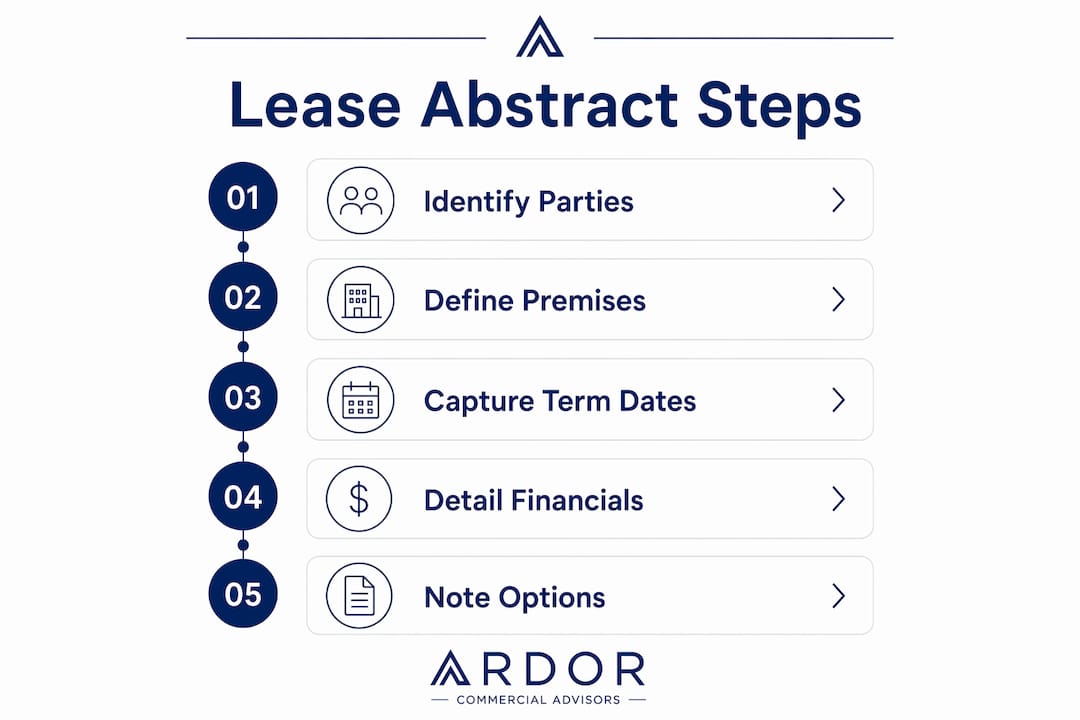
Parties and premises form the foundation: legal names, entity types, state of formation, and the precise description of the leased premises including rentable square footage and suite number. Get these wrong and every downstream calculation is suspect.
Term and critical dates is where most operational risk lives. This category captures the commencement date, expiration date, any early access or rent commencement dates, and every option deadline with its required notice period. A renewal option that requires 12 months’ notice is worthless if no one flags the deadline 13 months out.
Financial terms cover base rent by period, escalation clauses (fixed percentage, CPI-linked, or stepped), percentage rent thresholds for retail leases, and any tenant improvement allowances or landlord contribution obligations.
Operating expenses and CAM require their own section. This means the expense inclusion and exclusion list, the gross-up methodology, the management fee cap, the base year or base amount, and the tenant’s pro-rata share calculation.

Options and rights captures renewal terms, expansion rights, rights of first refusal or first offer, termination rights, and any co-tenancy provisions.
Legal and security provisions round out the abstract: security deposit amount and return conditions, insurance requirements, assignment and subletting restrictions, guarantor details, and default and cure periods.
Key components grouped for a complete abstract:
- Tenant and landlord legal names, addresses, and entity details
- Premises description, floor, suite, and rentable square footage
- Lease term: commencement, expiration, and any phased dates
- Base rent schedule with escalation mechanism and timing
- CAM structure: inclusions, exclusions, cap, gross-up, and pro-rata share
- Renewal, expansion, and termination options with notice periods
- Security deposit amount, form, and return conditions
- Permitted use, exclusivity, and co-tenancy clauses
- Assignment and subletting rights and landlord consent requirements
- Guarantor identity, guarantee scope, and burn-off conditions
- Insurance requirements and indemnification obligations
Why lease abstracts improve decision-making across the portfolio
Lease abstracts enable quick access to critical lease information, which matters most when decisions need to happen fast. An acquisition team reviewing a 20-property portfolio cannot re-read every lease during a 30-day due diligence window. Abstracts make that review possible.
The benefits extend well beyond speed. When abstracts are built on a consistent template, you can run portfolio-wide analysis: compare average CAM caps across properties, identify which leases have near-term expirations, or flag which tenants have termination rights that could disrupt cash flow projections. That kind of portfolio-level insight is impossible when lease data lives only in the original documents.
ASC 842 compliance is another concrete driver. The standard requires companies to recognize right-of-use assets and lease liabilities on the balance sheet, which demands accurate commencement dates, lease terms, and payment schedules for every lease. Abstracts supply exactly that data in a format accountants can work with directly.
Major benefits of maintaining current lease abstracts:
- Time savings: No re-reading full leases for routine questions or annual reconciliations.
- Risk reduction: Critical dates and notice deadlines are visible before they become missed obligations.
- Audit readiness: Structured data with source citations supports CAM reconciliation and financial audits.
- Better transparency: Landlords and tenants share a common reference point, reducing disputes.
- Stronger underwriting: Investors and lenders can assess lease quality and income stability quickly.
- ASC 842 compliance: Accurate financial and date fields feed directly into lease accounting calculations.
Common mistakes that undermine lease abstraction
The most frequent abstraction error is also the most preventable: missing lease amendments or related documents before the abstraction begins. An abstract built from the original lease but missing a rent modification amendment or a lease extension is not just incomplete. It is actively misleading.
Inconsistency across a portfolio creates a different problem. When different team members abstract leases using different field definitions or varying levels of detail, the resulting data cannot be aggregated. You end up with a collection of individual summaries rather than a portfolio-level dataset.
Skipping source citations is a subtler but costly mistake. Without page-level citations linking each abstracted value back to the original lease, the abstract functions only as a summary. Every time someone needs to verify a figure during due diligence or a dispute, they have to go back to the original document. That defeats much of the purpose.
Common abstraction problems and their consequences:
- Incomplete document collection: Amendments, side letters, and exhibits missed before abstraction begins, creating data gaps.
- Inconsistent field definitions: Different abstractors defining CAM inclusions or pro-rata share differently across leases, making portfolio comparison unreliable.
- No source citations: Abstracted values cannot be verified without re-reading the lease, slowing due diligence.
- Ignoring audit window clauses: Failing to capture the timeframe for disputing operating expenses, sometimes as short as 30 to 60 days after statement receipt.
- Static abstracts: Treating the abstract as a one-time document rather than updating it after amendments, leaving the record stale.
- Over-reliance on automation: AI tools process leases fast, but complex or ambiguous provisions still require human review for accuracy.
Special clauses that demand careful attention during abstraction
Some lease provisions carry disproportionate financial and legal weight. Getting them right in the abstract is not optional.
Renewal options are the most time-sensitive. The option itself is only valuable if the tenant exercises it within the required window, which means the abstract must capture not just the renewal term and rent, but the exact notice deadline and the method of delivery required. A 12-month notice period with a certified mail requirement is a different operational task than a 6-month window with email notice permitted.
Audit rights and windows deserve their own field. Many commercial leases restrict the period during which a tenant can dispute CAM charges, sometimes to as little as 30 to 60 days after receiving the annual reconciliation statement. Missing that window means losing the right to challenge the charge permanently. A commercial lease audit depends entirely on knowing these windows in advance.
Termination rights require precise capture of the trigger conditions, the notice period, the termination fee calculation, and any conditions that must be satisfied before the right can be exercised. An abstract that notes “tenant has termination right” without the specifics is nearly useless.
Special clauses requiring precise abstraction:
- Renewal options: Notice deadline, notice method, rent for renewal term, and any conditions precedent.
- Termination rights: Trigger conditions, notice period, termination fee formula, and effective date.
- Escalation mechanisms: Fixed percentage, CPI index and cap, or stepped rent schedule with effective dates.
- CAM expense caps: Whether the cap is cumulative or non-cumulative, which expense categories it applies to, and the base year.
- Subletting and assignment restrictions: Landlord consent requirements, profit-sharing provisions, and recapture rights.
- Audit rights window: The exact period to dispute operating expense charges and the required notice method.
- Guarantor burn-off provisions: The conditions under which a personal guarantee reduces or terminates.
- Insurance requirements: Coverage types, minimum limits, additional insured requirements, and waiver of subrogation.
- Co-tenancy clauses: Anchor tenant requirements and the tenant’s remedies if those conditions are not met.
How to keep lease abstracts accurate as living documents
Treating lease abstracts as living documents is the single practice that separates a functional lease management system from a collection of outdated summaries. Every amendment, extension, or modification to the underlying lease should trigger an immediate update to the abstract. Not at the next quarterly review. Immediately.
Consistency in field structure is what makes the living-document approach work at scale. When every lease in a portfolio uses the same template with the same field definitions, a single analyst can pull renewal dates or CAM caps across 50 leases in minutes. Diverge from that template and the data becomes siloed again.
Source citations belong in every field. When the abstract notes a base rent of $28.50 per square foot, it should also note the page and section of the lease where that figure appears. This takes seconds to add during abstraction and saves hours during due diligence or a CAM dispute.
Pro Tip: AI-powered abstraction tools can process a lease in minutes versus the 2 to 4 hours manual abstraction typically requires, but complex provisions like CAM caps, co-tenancy clauses, and guarantor burn-off terms still need a human review pass before the abstract is considered final. Use automation for speed and humans for accuracy.
Strategies for maintaining abstracts as reliable, current records:
- Update the abstract immediately upon execution of any amendment, extension, or modification.
- Use a standardized lease abstract template across every property in the portfolio.
- Include page and section citations for every abstracted value.
- Assign clear ownership: one person or team responsible for abstract updates per property or portfolio.
- Store abstracts in a centralized system accessible to asset managers, accountants, and legal counsel.
- Schedule periodic audits of abstracts against original lease documents to catch drift.
Ardorcre brings lease expertise to the Charlotte commercial market
Navigating commercial lease terms in the Charlotte MSA is a different challenge than reading about them in a guide. The financial stakes on a 5-year office lease or a multi-tenant retail strip are real, and the difference between a well-abstracted lease and a missed clause can cost tens of thousands of dollars over a lease term.
Ardorcre’s advisors work on both sides of the table, representing landlords and tenants across office, medical, retail, and industrial properties throughout the Charlotte market. That dual-representation experience means the team knows exactly which clauses landlords build in for leverage and which provisions tenants most often overlook during negotiation and ongoing administration. Whether you are reviewing a lease before signing, managing an existing portfolio, or preparing for a property acquisition, Ardorcre brings the analytical depth to make lease terms work in your favor. Reach out to the team at Ardorcre to discuss your lease review or advisory needs.
Key Takeaways
A complete, consistently maintained lease abstract is the foundation of sound commercial lease management, risk control, and financial compliance.
| Point | Details |
|---|---|
| Core purpose | A lease abstract extracts critical terms from complex leases into a structured, searchable record for faster decisions. |
| Field consistency | Using a standardized template across all leases enables portfolio-wide comparison of rent, options, and CAM terms. |
| Audit window risk | CAM dispute windows can be as short as 30 to 60 days; missing them means permanently losing the right to challenge charges. |
| Living document rule | Every lease amendment must trigger an immediate abstract update to keep the record accurate and trustworthy. |
| Ardorcre | Ardorcre advises Charlotte-area landlords, tenants, and investors on lease review, representation, and portfolio analysis. |