
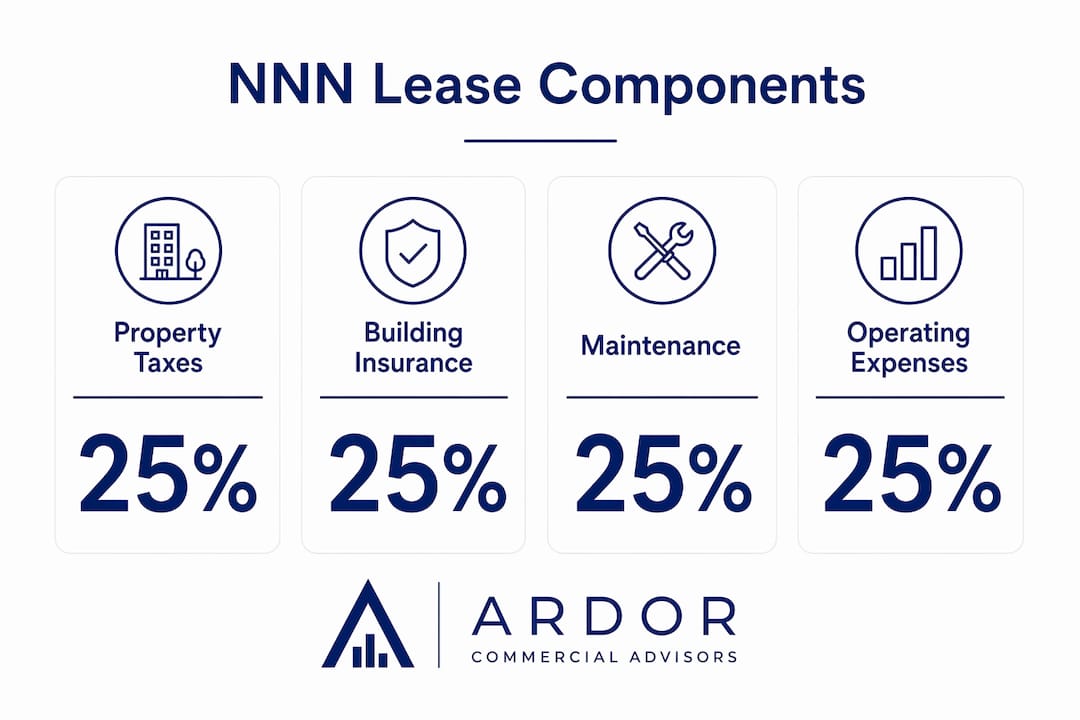
A triple net lease means the tenant pays base rent plus three additional expense categories: property taxes, building insurance, and maintenance. That structure shifts operating cost risk from landlord to tenant, which is why NNN base rents typically run lower than comparable gross-lease rents. For a quick read on a listing: a quote of “$20/sf NNN” on a 2,000 sf space means $40,000/year in base rent, plus whatever the property taxes, insurance, and maintenance actually cost, often quoted as a separate NNN figure (say, $5/sf), bringing effective rent to $25/sf or $50,000/year total.
The tradeoffs break down cleanly by role:
- Landlord: Lower day-to-day management, predictable net income, and built-in protection against rising operating costs, offset by concentration risk if a single tenant vacates.
- Tenant: Lower base rent and more control over how the property is maintained, but direct exposure to tax increases, insurance spikes, and CAM surprises.
- Investor: Stable, predictable cash flow with minimal operational involvement, but returns depend heavily on tenant credit quality and lease term remaining.
Per Cornell LII, the most common NNN lease terms are often long-term, with many leases lasting multiple years. One critical caveat: the NNN label is not legally standardized. What a lease actually requires depends entirely on the signed contract language, not the listing description.
Table of Contents
- What do the three “nets” actually cover?
- How does an NNN lease compare to other lease types?
- What are the pros and cons of NNN leases?
- How are NNN costs quoted and calculated?
- Key lease clauses and negotiation checklist
- How do NNN leases affect investor returns and taxes?
- What due diligence should you do before signing or buying?
- Worked example: what does “$20/sf NNN” actually cost?
- How Ardorcre evaluates NNN leases in the Charlotte MSA
- Key Takeaways
- NNN leases reward preparation, not assumptions
- Ardorcre’s NNN lease advisory services in Charlotte
- Useful sources and further reading
What do the three “nets” actually cover?
The three Ns stand for property taxes, building insurance, and maintenance, but in practice, the third N is where most of the complexity lives. In a multi-tenant building, maintenance is typically delivered through a Common Area Maintenance charge, or CAM, which bundles shared costs like parking lot upkeep, landscaping, hallway cleaning, and building management fees. In a single-tenant freestanding property, the tenant often handles maintenance directly.
Beyond the core three, landlords frequently pass through additional costs under the NNN umbrella: utilities for shared spaces, property management fees, trash removal, pest control, and sometimes reserves for future repairs. In-suite utilities (electricity, gas, water used only by the tenant) are almost always separate from CAM and billed directly to the tenant or metered independently. The distinction matters because a landlord can quietly expand “maintenance” to include items that arguably belong in capital expenditures unless the lease defines the boundary.
Pro-rata share mechanics determine how much of the building’s total operating costs each tenant owes. The standard formula is: tenant’s rentable square footage divided by total building rentable square footage, multiplied by total operating expenses. For example, if a tenant occupies 2,000 sf in a 20,000 sf building and annual operating expenses are $60,000, the tenant’s pro-rata share is 10%, or $6,000 per year ($500/month). The denominator matters: some leases use total building SF, others use only occupied SF. An occupied-SF denominator means the tenant’s share rises when other spaces are vacant, which is a significant exposure in a partially leased building.
Pro Tip: Before signing, verify the CAM definition clause, confirm which denominator the pro-rata formula uses, and ask whether capital expenditures are explicitly excluded. These three items alone can change your annual cost by thousands of dollars.
How does an NNN lease compare to other lease types?
Commercial leases sit on a spectrum from fully gross to absolute net. Understanding where NNN falls on that spectrum prevents costly misreads of listing sheets.

| Lease Type | Who Pays Operating Expenses | Typical Use Case |
|---|---|---|
| Gross (Full-Service) | Landlord pays all operating costs | Office buildings, multi-tenant |
| Modified Gross | Costs split by negotiation | Flex, suburban office |
| Single Net (N) | Tenant pays property taxes only | Less common, smaller properties |
| Double Net (NN) | Tenant pays taxes + insurance | Retail, some office |
| Triple Net (NNN) | Tenant pays taxes, insurance, maintenance | Single-tenant retail, medical, industrial |
| Absolute/Bondable Net | Tenant pays everything including structural | Credit-tenant fast food, pharmacy |
A standard NNN lease typically still leaves major structural repairs and large capital expenditures with the landlord. Roof replacement, foundation work, and structural wall repairs are commonly carved out. An absolute or bondable net lease goes further: it shifts nearly every cost to the tenant, including structural replacements and even rebuilding after a casualty event. That is a materially different risk profile, and the distinction must be written explicitly into the lease.
A typical NNN CAM clause might read: “Tenant shall pay its pro-rata share of all costs incurred by Landlord in operating, maintaining, and repairing the Common Areas, including but not limited to landscaping, parking lot maintenance, and building insurance premiums.” An absolute-net clause, by contrast, typically reads: “Tenant shall be solely responsible for all costs of maintaining, repairing, and replacing all structural and non-structural components of the Premises, including the roof, foundation, and exterior walls.”
The Prologis NNN guide makes the point plainly: whether a NNN lease functions as an absolute net lease often depends on the building’s age and the specific language used. A brand-new building may push all repair costs to the tenant; an older building may retain landlord responsibility for structural items even under a “triple net” label. Read the lease, not the listing.
What are the pros and cons of NNN leases?
For landlords and investors
Advantages:
- Operating cost inflation passes through to the tenant, protecting net operating income (NOI) from rising taxes or insurance premiums.
- Minimal day-to-day management, especially in single-tenant freestanding properties where the tenant handles maintenance directly.
- Long lease terms (typically 10–20 years per Investopedia) provide income predictability that supports lower cap rates and higher valuations.
- Easier to underwrite for lenders and buyers because expenses are largely tenant-borne.
Disadvantages:
- Tenant concentration risk is real: one vacancy in a single-tenant NNN property eliminates 100% of income.
- Tenant credit quality drives everything. A national pharmacy chain on a 15-year NNN is a different investment than a local restaurant on a 5-year NNN.
- Retail market shifts, like the wave of store closures affecting single-tenant retail, can strand investors in vacant properties with long re-leasing timelines.
For tenants
Advantages:
- Base rent is lower than a comparable gross lease because the tenant absorbs operating costs directly.
- Greater operational control: tenants often manage their own maintenance vendors, which can reduce costs if managed well.
- Long terms provide location stability, which matters for businesses that invest in build-out or depend on foot traffic.
Disadvantages:
- Exposure to uncontrollable cost increases in property taxes and insurance, particularly in high-growth markets.
- CAM reconciliation can produce unexpected year-end bills if estimates were set too low.
- Structural repair responsibility can be ambiguous without careful lease drafting.
NNN leases are most common in single-tenant retail (pharmacies, fast food, dollar stores), medical office, freestanding bank branches, and industrial/warehouse properties. These property types suit the structure because the tenant typically controls the entire building and has strong incentive to maintain it.
How are NNN costs quoted and calculated?
NNN charges are almost never paid directly to the taxing authority or insurer. Instead, landlords collect monthly estimates from tenants, remit those payments to the relevant parties, and then reconcile actual costs against estimates at year-end. If actual costs exceeded estimates, the tenant owes a true-up payment. If estimates ran high, the tenant gets a credit or refund.
Here is a straightforward breakdown for a 2,000 sf tenant in a 20,000 sf building:
| Cost Component | Annual $/sf | Annual Total | Monthly |
|---|---|---|---|
| Base Rent | — | $40,000 | $3,333 |
| Total Effective Rent | approximate $25 per sf | $50,000 | $4,167 |
The $5/sf NNN figure in the table above is an estimate. At year-end reconciliation, the landlord produces actual invoices for taxes, insurance, and CAM. If actual NNN costs came in at $5.50/sf, the tenant owes an additional $1,000 for the year. Tenants have the right to audit those invoices in most well-drafted leases, and exercising that right is one of the highest-impact steps in the due-diligence process.
Pro Tip: Request three years of CAM statements before signing. Year-over-year trends reveal whether the landlord has been managing costs or letting them drift, and they give you a realistic baseline for budgeting.
Key lease clauses and negotiation checklist
The CAM clause is typically the most negotiated section of any NNN lease. Here is a numbered checklist of the items that matter most:
- CAM definition and exclusions. Insist on an explicit exclusion list: capital improvements, leasing commissions, depreciation, costs for other tenants’ spaces, and expenses covered by insurance proceeds should all be excluded from CAM.
- Controllable expense cap. Negotiate a cap (often 3–5% annually) on controllable CAM expenses (management fees, landscaping, cleaning) to limit year-over-year increases. Taxes and insurance are typically excluded from caps because they are outside the landlord’s control.
- Gross-up clause. If the building is less than fully occupied, a gross-up provision adjusts variable operating expenses to what they would be at a specified occupancy level, typically 90–95%. Without this, a tenant in a half-empty building subsidizes the vacant space.
- Pro-rata denominator. Confirm whether the denominator is total building SF or occupied SF. Total building SF is the tenant-favorable choice.
- Audit rights. Require the right to audit CAM records within a defined window (typically 12 months after receiving the reconciliation statement) and specify a remedy if overcharges exceed a threshold, such as the landlord covering audit costs.
- Capital expenditure treatment. Clarify whether CapEx is excluded from CAM entirely or amortized over the useful life of the improvement with only the annual amortized portion passed through. Amortization is more tenant-friendly than a lump-sum pass-through.
- Structural repair responsibility. Confirm in writing who is responsible for roof, foundation, and exterior walls. In a standard NNN, this typically stays with the landlord unless the lease says otherwise.
- Management fee cap. Cap the landlord’s property management fee as a percentage of actual CAM costs, not gross revenues. A common range is 3–5% of actual operating expenses.
- Insurance minimums. Specify minimum coverage amounts and confirm whether the tenant’s own liability insurance satisfies the lease requirement or whether additional landlord-named coverage is required.
- Lease escalation clause. Understand how base rent escalates: fixed annual bumps (e.g., 2% per year), CPI-indexed increases, or percentage-rent provisions. Over a 15-year term, a 3% annual bump compounds significantly.
Red flags to watch for: open-ended CAM definitions with no exclusion list; reconciliation timing controlled solely by the landlord with no tenant deadline rights; missing audit rights; ambiguous pro-rata denominator language; and any clause that defines “maintenance” broadly enough to include capital replacements.
How do NNN leases affect investor returns and taxes?
Because tenants pay operating expenses directly, NNN leases protect NOI from the cost inflation that erodes returns in gross-lease properties. When property taxes rise 10% or insurance premiums spike after a storm season, those increases pass through to the tenant rather than compressing the landlord’s net income. That pass-through mechanism is one of the primary reasons institutional investors and REITs favor NNN assets.

Cap rates on NNN properties tend to be lower than comparable gross-lease assets, reflecting the income predictability and lower management burden. A 15-year NNN lease with a national credit tenant commands a tighter cap rate than a 3-year gross lease with a local tenant, because the income stream is more bond-like. The trade-off is concentration risk: a single-tenant NNN property with one year remaining on the lease is a very different underwriting story than the same property with 12 years left.
On the tax side, investors in NNN properties can depreciate the building over 39 years (commercial real estate) under IRS rules, reducing taxable income even while cash flow remains positive. When selling, a 1031 exchange allows investors to defer capital gains taxes by rolling proceeds into a like-kind replacement property, and NNN properties are a common target for 1031 buyers because of their passive income profile. Investors considering rising delinquency trends in commercial real estate should factor tenant credit quality into their underwriting before assuming NNN income is truly passive. Tax structuring for NNN investments is transaction-specific; consult a qualified tax advisor before making decisions based on depreciation or 1031 timelines.
What due diligence should you do before signing or buying?
Due diligence on an NNN lease or NNN property goes well beyond reviewing the rent schedule. Here is what to request and verify:
- Three years of CAM, tax, and insurance invoices. Year-over-year trends reveal cost management practices and flag any unusual spikes.
- Capital expenditure history. Ask what major repairs or replacements have been made in the past five years and what is deferred. A roof nearing end of life is a negotiating point.
- Vendor contracts. Review maintenance and service agreements to understand ongoing obligations and termination rights.
- Audit supporting records. Request the underlying ledgers and invoices that support the most recent CAM reconciliation statement.
- Estoppel certificate. For buyers, an estoppel from the existing tenant confirms lease terms, rent amounts, and any disputes or defaults, directly from the tenant.
- Tenant financials or credit report. For investors, tenant credit quality is the single biggest driver of NNN value. A publicly traded national tenant is fundamentally different from a private operator.
- Maintenance logs. HVAC service records, roof inspection reports, and parking lot condition assessments reveal deferred maintenance.
- Property Condition Assessment (PCA). Commission an independent PCA from a licensed engineer before closing on any NNN acquisition.
- Insurance policies. Confirm coverage amounts, named insureds, and whether the current policies meet the lease’s minimum requirements.
Pro Tip: Insist on a full CapEx reserve history and ask the landlord directly what major systems are scheduled for replacement in the next five years. If the lease is ambiguous about who pays for those replacements, get it clarified in writing before you sign.
Worked example: what does “$20/sf NNN” actually cost?
Start with an advertised listing: $20/sf base rent plus $5/sf NNN on a 2,000 sf space.
- Monthly base rent: 2,000 sf × $20/sf ÷ 12 = $3,333/month
- Monthly NNN estimate: 2,000 sf × $5/sf ÷ 12 = $833/month
- Total monthly payment: $4,167/month
- Annual effective rent: $50,000/year
Now run the reconciliation scenario. At year-end, actual NNN costs came in at $5.50/sf instead of the estimated $5.00/sf. The tenant’s actual annual NNN obligation is $11,000 (2,000 sf × $5.50). Against $10,000 in estimates paid, the tenant owes a $1,000 true-up payment.
The sensitivity compounds over time. If NNN costs increase 5% per year from a $5/sf base, by year five the NNN component alone reaches roughly $6.38/sf, adding $2,760/year to the tenant’s cost compared to year one. Over a 10-year lease with annual escalations in both base rent and NNN, the gap between the advertised rent and actual effective rent can be substantial.
- A 3% annual base rent escalation on $20/sf reaches approximately $26.88/sf by year 10.
- A 5% annual NNN increase on $5/sf reaches approximately $8.14/sf by year 10.
- Combined effective rent in year 10: roughly $35/sf versus the $25/sf advertised at signing.
That math is why requesting historical CAM data and negotiating expense caps matters so much before the lease is executed.
How Ardorcre evaluates NNN leases in the Charlotte MSA
In the Charlotte market, NNN lease terms vary meaningfully by property type. Medical office tenants, particularly those affiliated with Atrium Health or Novant Health, typically negotiate longer terms with more landlord responsibility for structural items, because their build-out investment is substantial and relocation is disruptive. Retail NNN deals for national credit tenants, such as dollar stores or quick-service restaurants, tend to be closer to absolute-net in structure, with tenants handling nearly all maintenance. Industrial NNN leases in submarkets like Steele Creek or the I-85 corridor often include landlord responsibility for the building shell but tenant responsibility for interior systems.
When Ardorcre evaluates an NNN opportunity in the Charlotte MSA, the analysis focuses on four factors: tenant credit quality, remaining lease term, CAM history and trend, and CapEx exposure. A property with a strong tenant, 12 years remaining, flat CAM history, and a recently replaced roof is a fundamentally different risk profile than one with a local tenant, 2 years remaining, rising CAM, and aging mechanical systems.
Key things Ardorcre looks for in Charlotte-area NNN deals:
- Whether the CAM definition includes a management fee cap and an explicit exclusion list.
- The pro-rata denominator and whether gross-up provisions protect the tenant from vacancy subsidization.
- Remaining lease term relative to the financing term, since a lease expiring before the loan maturity creates refinancing risk.
- Local comparable NNN rents for the submarket to assess whether the asking rent is at, above, or below market.
For a Charlotte office market tenant or investor, understanding how submarket dynamics affect NNN terms is as important as understanding the lease structure itself. A well-located medical office in South End commands different terms than a retail pad site in a secondary corridor.
Key Takeaways
A triple net lease shifts property taxes, insurance, and maintenance costs to the tenant, making the NNN structure the dominant choice for long-term single-tenant commercial assets where income predictability matters most.
| Point | Details |
|---|---|
| NNN = three cost layers | Tenant pays property taxes, building insurance, and maintenance on top of base rent. |
| Effective rent exceeds listed rent | A $20/sf NNN listing with $5/sf in NNN charges costs $25/sf in effective rent, not $20/sf. |
| CAM clause is the key battleground | Negotiate exclusions, expense caps, gross-up provisions, and audit rights before signing. |
| Tenant credit drives investor value | Long-term NNN income is only as stable as the tenant’s ability to pay through the full lease term. |
| Ardorcre advises on NNN deals | Ardorcre provides lease analysis, CAM review, and tenant/landlord representation for NNN transactions in the Charlotte MSA. |
NNN leases reward preparation, not assumptions
The most common mistake I see in NNN transactions is treating the lease label as a complete description of the deal. A listing that says “NNN” tells you almost nothing about who actually pays for a roof replacement, whether the CAM is capped, or whether the pro-rata denominator protects you from subsidizing vacant space. The label is a starting point, not a contract.
What actually determines whether an NNN lease works in your favor is the clause-by-clause negotiation: the CAM exclusion list, the CapEx amortization language, the gross-up percentage, and the audit rights. Tenants who skip that work often discover the exposure at year-end reconciliation, when the bill arrives and the lease is already signed. Investors who skip it discover it at disposition, when a buyer’s attorney flags ambiguous structural repair language and reprices the deal.
The Charlotte market adds another layer. Submarket dynamics, tenant mix, and property type all affect what NNN terms are achievable and what is standard. A medical tenant in a Class A building near Ballantyne has different leverage than a retail tenant in a secondary corridor. Knowing the market comparables is what separates a well-negotiated lease from one that looks fine on paper until the first reconciliation.
Ardorcre’s NNN lease advisory services in Charlotte
Ardorcre works with commercial tenants, landlords, and investors across the Charlotte MSA on NNN lease analysis, negotiation, and due diligence, covering office, medical, retail, and industrial properties. The practical difference between working with an advisor and going it alone is access to market comparables, clause-by-clause lease review, and a negotiation counterpart who has seen the same landlord language before.

Services include CAM reconciliation review, pro-rata denominator analysis, CapEx exposure assessment, tenant credit evaluation, and coordination of property condition assessments. For investors, Ardorcre provides market comp analysis and lease underwriting support to model realistic effective yields using the Commercial Property Loan Calculator for Naples Investors. For tenants, the focus is on negotiating caps, exclusions, and audit rights before the lease is executed, not after the first surprise reconciliation bill.
To review an NNN lease or evaluate a Charlotte commercial property, contact Ardorcre directly. The firm’s background and advisory approach are available on the website for tenants and investors who want to understand the team before reaching out.
Useful sources and further reading
- Cornell LII: Triple Net Lease — The authoritative U.S. legal definition, including enforceability notes and typical lease term guidance.
- Nareit: Triple Net Lease Glossary — Industry-standard definition used by REIT analysts and institutional investors.
- LoopNet: NNN Lease Costs and Risks — Practical breakdown of NNN costs, absolute-net distinctions, and investor risk considerations.
- Investopedia: Triple Net Lease — Accessible overview of NNN lease mechanics, typical lease lengths, and investor appeal.
- CapVeri: Annotated NNN Lease Examples — Sample CAM clause language, gross-up provisions, audit rights, and reconciliation mechanics with annotated examples.
- Prologis: What Is a Triple Net Lease? — Industrial real estate perspective on NNN structure, including how building age affects repair responsibility.
- Landlord Studio: NNN Lease Guide — Explains monthly accrual and annual reconciliation mechanics from the landlord’s operational perspective.
- IRS: Like-Kind Exchanges — Primary source for 1031 exchange rules applicable to NNN investment property dispositions.
For transaction-specific tax or legal questions, consult a qualified CPA or real estate attorney. For local market guidance on NNN leases in the Charlotte MSA, Ardorcre advisors are available for consultation.