
A sale-leaseback lets you sell the building your business occupies and sign a lease to stay in it. You turn real estate equity into cash and keep operating from the same space. In Charlotte, the owners who ask about it are usually medical practice owners, office users and industrial operators who own their building and want capital for growth, debt reduction or a partner buyout. This guide covers how the deal works, how price and rent are set, which lease terms matter most, and what to ask your CPA and attorney before you list.
TL;DR
- A sale-leaseback is a sale of an asset with a simultaneous lease back to the seller, who pays rent to keep using it.
- Price and rent are tied together through a cap rate, so the lease is as important as the sale price.
- Leases are typically triple net, which means you carry taxes, insurance and maintenance as a tenant.
- Tax and accounting treatment depends on how the deal is structured, so involve your CPA before you sign a letter of intent.
- Compare the deal with a refinance or a hold before you commit, because you give up future appreciation.
Table of Contents
- What a sale-leaseback is, in plain terms
- Who in Charlotte considers one
- Why owners do it
- How price and rent are set
- The lease terms to review before you sign
- Tax and accounting: questions for your CPA
- What you give up
- Sale-leaseback or refinance?
- Perspective
- How Ardorcre can help
- Before you call a buyer: a short checklist
- FAQ
- Sources
What a sale-leaseback is, in plain terms
You own a building and operate a business in it. You sell the building to an investor. At closing you sign a lease and keep working in the space without moving. The investor becomes your landlord, and you become the tenant of your own former property.
PwC’s U.S. accounting guidance describes the seller as the seller-lessee and the buyer as the buyer-lessor. The seller leases back all or part of the asset, and the rent is what keeps its right to use it.
The usual sequence, in the order it happens:
- Valuation and marketing. The property is valued and offered to investors who want long-term income from a creditworthy tenant.
- Buyer due diligence. The buyer reviews title, survey, environmental condition, physical condition and your financials.
- Lease negotiation. Price and lease terms are negotiated together, not one after the other.
- Closing and title transfer. Ownership moves to the buyer.
- Lease commencement. Your tenancy begins the same day, with no gap in operations.
The deal is a third-party sale paired with a lease back to the seller, so every document must work for you as the future tenant and for the buyer’s lender.
Who in Charlotte considers one
The Charlotte MSA has a wide mix of owner-occupants. A few typical situations:
- Medical and dental practices that own their office condo or building and want capital for equipment, a second location or an associate buyout, without losing the location patients already know.
- Office users that own a building larger than they need and want cash without a move.
- Industrial operators with warehouse or manufacturing space near the I-85 and I-77 corridors who want to free capital for inventory, machinery or acquisitions.
- Owners planning succession who want to separate the real estate from the operating business.
Charlotte has a real precedent on the industrial side. Gladstone Commercial reports that its Eastern Metal Supply portfolio includes a 114,978-square-foot Charlotte facility on 12.5 acres next to I-85 and I-77. The portfolio was acquired in a sale-leaseback on January 27, 2020, for $34.57 million at a 6.25% going-in cap rate. The Charlotte property was leased on a 20-year absolute-net lease. It shows what institutional buyers look for: a long lease, a strong operator and a location on a major highway corridor.
Why owners do it
The core appeal is converting an illiquid asset into working capital. Money that sat in drywall and concrete can go into the business, into paying down higher-cost debt or into a second location.
Other reasons we hear from owners:
- Capital without a new partner. You raise money without selling equity in your practice or company.
- Clean balance sheet options. Proceeds can retire a mortgage, including a loan with a prepayment structure that you have already priced out.
- Real estate separate from operations. Succession and a future sale of the business can be simpler when you do not own the building.
- Tax planning. Some owners pair the sale with a 1031 exchange into other property. Your tax advisor has to confirm whether that fits your facts.
How price and rent are set
Price and rent are two sides of one calculation. Parties typically use a cap rate: the purchase price divided by net rental income. Torys notes that because the deal functions as a form of financing, the cap rate behaves much like an interest rate.
A simple illustration, with made-up numbers:
| Item | Example |
|---|---|
| Agreed purchase price | $4,000,000 |
| Cap rate | 7.0% |
| Implied first-year net rent | $280,000 |
| Monthly base rent, triple net | about $23,333 |
A lower cap rate means a higher price for the same rent, or lower rent for the same price. The buyer’s number depends on market interest rates and your credit. The ICSC legal materials say the purchase price is often built on a percentage return reflecting those factors. FBT Gibbons adds that rent is usually the price plus interest or a cap rate on that price.
Two practical points:
- Do not negotiate price in isolation. A high price paired with aggressive rent escalations can cost you more than a slightly lower price with a gentle rent schedule.
- Know your own number first. If you want to check the arithmetic yourself, a cap rate calculation walkthrough shows how price, income and rate relate. Then compare against an independent view of value. Our commercial property valuation work includes DCF modeling for that purpose.
The ICSC materials also stress that rent must be ascertainable and certain, with reasonable and limited adjustments. That is what lets the buyer finance the purchase, so expect fixed bumps or a capped index rather than open-ended resets.
The lease terms to review before you sign
The lease is the investor’s income stream, so it is drafted to be predictable and enforceable. As the tenant, you live with it for years. Review these items line by line:
- Term and renewal rights. Initial terms of 15 to 25 years with several extension options are common in this market, per Hermes Capital Partners, though a medical practice or small office user may negotiate a shorter term.
- Permitted use. Make sure the clause covers your current use and reasonable changes, such as adding a specialty or a new service line.
- Rent and expense structure. The lease is usually absolute net or triple net, with the tenant handling insurance, maintenance, repairs and capital expenditures. Our guide to the triple net lease and to industrial lease types breaks down who pays for what.
- Improvements and alterations. Decide now what you can build out, such as dental operatories or imaging rooms, without the landlord’s consent.
- Insurance, damage and condemnation. Know what happens to the lease and the proceeds after a casualty.
- Default and cure rights. Look for reasonable notice periods and cure windows.
- Assignment and subletting. This matters if you later sell the practice or business.
- Environmental provisions. Especially important for industrial sites.
- Lender protections. The buyer’s lender will want specific rights, and those clauses affect you too.
One point owners often miss: you know the property better than the buyer does. FBT Gibbons notes the seller may be asked for more representations in the purchase agreement and more responsibility in the lease than in a standard transaction. Have counsel read both documents together.
Expect the buyer to ask for an estoppel certificate confirming lease status, and expect your lease to be summarized in a lease abstract for the buyer and its lender. It pays to check that abstract for accuracy.
Tax and accounting: questions for your CPA
This is the area where structure matters most, and where we send clients to their CPA and tax attorney early.
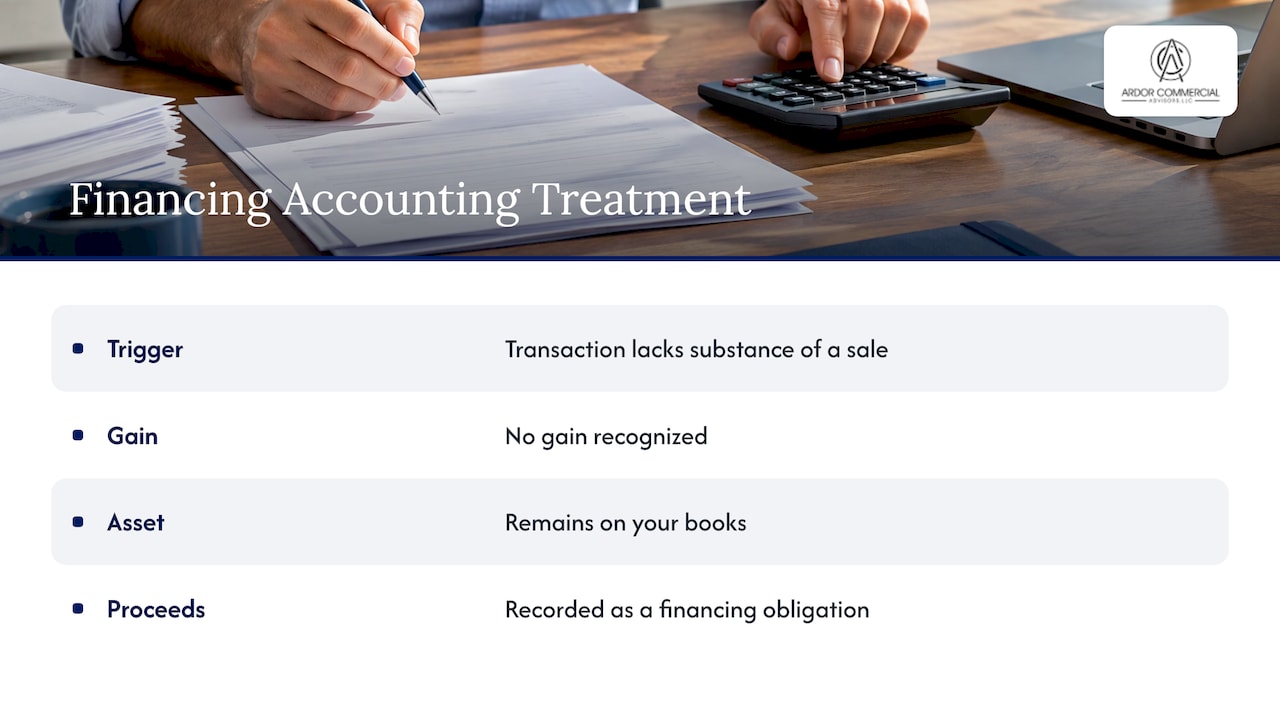
Accounting. Under U.S. GAAP, the transaction has to qualify as a sale under ASC 606 and the leaseback as an operating lease under ASC 842. If it lacks the substance of a sale, it is treated as financing: no gain is recognized, the asset stays on your books and the proceeds are recorded as a financing obligation. A North Carolina company’s SEC filing shows this outcome in practice: it accounted for its sale-leaseback as a financing because the lease was a finance lease, and recognized no gain or loss. Whether your deal is a true sale on your books can change your financial statements and your loan covenants.
Tax. The IRS has a long history of scrutinizing these transactions. One academic review describes three principal lines of attack, including an argument under Section 1031 that a sale coupled with a very long leaseback can be treated as a like-kind exchange. That is older analysis, so rely on your current advisor for today’s rules. If you are thinking about deferring gain, read our pieces on 1031 exchange rules and the 1031 exchange timeline before you set a closing date, because the identification and closing deadlines are fixed.
Bring your CPA in before you sign a letter of intent, not after.
What you give up
A sale-leaseback is a trade. You get liquidity, and in return you give up future increases in property value and some control over how the property is used and operated, and you face questions about what happens at the end of the lease. That analysis comes from a UK firm but describes a trade-off that applies in any market.
The way to handle those trade-offs is to plan for them in the documents:
- Negotiate renewal options at defined rents instead of leaving renewal to chance.
- Ask for a right of first refusal or first offer if the investor later sells. Our guide to the right of first refusal explains how those clauses work.
- Cap escalations so rent growth does not outrun your revenue growth.
- Understand total transaction costs up front. See our overview of commercial transaction costs for buyers and sellers.
Sale-leaseback or refinance?
A sale-leaseback is one of several ways to pull capital from a building you own. Before choosing, compare the options on the same terms:
| Option | What you keep | What you get | Main consideration |
|---|---|---|---|
| Sale-leaseback | Use of the space | Cash for the full value, less costs | You no longer own the asset |
| Cash-out refinance | Ownership and appreciation | Cash up to the loan limit | New debt service; sized by DSCR |
| Selling and relocating | Nothing in the building | Cash for the full value | Moving costs and disruption |
| Holding and leasing out part | Ownership | Rental income | Becoming a landlord, vacancy risk |
If you refinance, lenders size the loan largely on debt service coverage. Our DSCR loan sizing guide shows how that math works. Run both paths side by side: the after-tax cash from a sale, the annual rent you would pay, and the annual debt payment you would carry on a refinance. If you own a multi-tenant building, a partial approach can also work, such as selling and leasing back only your own suite or floor through a different structure. Your advisor can tell you what is workable for your property.
Perspective
In Charlotte, we see owners treat a sale-leaseback as a finance decision when it is really a real estate decision with a finance result. The building, the lease and the location all stay part of your business for years afterward.
Our view is simple. Get a defensible value before you talk to buyers, negotiate the lease as hard as the price, and know your alternatives before you commit. That means a valuation with a DCF behind it, a lease review from the tenant’s chair, and a clear read on what a refinance would look like. Medical and office owners in particular have specialized build-outs and patient or client relationships tied to the address, so renewal rights and permitted use deserve as much attention as the rent.
Our advisors work on both sides of the table, as landlord and tenant representatives, so we know what a buyer’s lender will ask for and what a long-term tenant needs protected.
Jim
How Ardorcre can help
If you own a medical, office, retail or industrial building in the Charlotte MSA and are weighing a sale-leaseback, we can help you test the idea before you commit. Our team covers commercial sales and leasing, landlord and tenant representation, and advisory work for owners and investors. We can support valuation, lease review and abstraction, and market reporting for your property type.
For a starting point on value, see our commercial property valuation service, or reach out through ardorcre.com to talk through your building.
Before you call a buyer: a short checklist
- Get an independent value and a target cap rate range.
- Decide the lease term you can live with, and the renewal options you need.
- Have your CPA model the tax and accounting outcome.
- Price a refinance as the alternative.
- Gather leases, financials, environmental reports and the survey.
- Check Charlotte industrial lease rates or office market data to see whether your proposed rent is in line with the market. Our Charlotte office market analysis is a good starting point for office owners.
FAQ
Is a sale-leaseback the same as a loan?
Not legally, but economically it works like one. The buyer’s return is set through a cap rate, which functions much like an interest rate. For accounting, a deal that does not qualify as a sale is recorded as financing. Your CPA can tell you which treatment applies.
What kind of lease comes with a sale-leaseback?
Most are triple net or absolute net, so you pay property expenses on top of base rent. Terms are often long, with renewal options. Smaller owners, such as medical practices, should negotiate the term and options to fit their plans.
Can I defer taxes on a sale-leaseback?
Some sellers pair the sale with a 1031 exchange, but eligibility depends on your facts and on current rules. Talk to a tax advisor before you sign anything. Our 1031 exchange timeline explains the deadlines that apply.
How do I know what rent is fair?
Rent comes from the price and the cap rate, so test both against comparable leases and sales in your submarket. A valuation and a lease review from a Charlotte broker give you a benchmark before you negotiate.
Sources
- PwC Viewpoint: Sale and leaseback transactions, introduction
- Reed Smith: Exploring alternative financing, sale and leaseback transactions
- Gladstone Commercial: Eastern Metal Supply regional industrial portfolio
- Torys: Sale-leaseback transactions
- ICSC: Sale-leasebacks and financeable leases
- FBT Gibbons: Sale-leaseback transactions explained
- Hermes Capital Partners: Sale leaseback finance
- EisnerAmper: Sale-leaseback transactions under new accounting standards
- SEC filing: sale-leaseback accounting, 12 months ended April 30, 2023
- Vanderbilt Law Review: Taxation of sale and leaseback transactions
- Clifford Chance: Easing liquidity concerns by unlocking capital from real estate