
Landlord representation puts a licensed commercial broker on your side of the table when you lease or sell space. The broker markets the property, qualifies tenants, negotiates rent and lease terms, and protects your net operating income. For owners of office, medical, retail and industrial buildings in the Charlotte area, the payoff is usually a better tenant, cleaner lease language and fewer expensive surprises at refinance or sale.
TL;DR
- A landlord rep works for you, not the tenant: marketing, tenant screening, negotiation and lease structure, all aimed at protecting your income.
- In North Carolina, get the agency relationship in writing before the property is offered for lease. Without it, a broker’s role can be unclear.
- Lease terms feed straight into your DSCR and debt yield, so negotiating them well is a financing strategy as much as a leasing one.
- Tax timing matters too. Tenant improvements can qualify for 100% bonus depreciation if the dates line up.
- The strongest case for representation is a building with vacancy, a rollover on the horizon or a loan maturing within two years.
Table of Contents
- What a landlord representative actually does
- The benefits, one by one
- Landlord representation vs. property management
- When representation pays for itself
- Our perspective
- How to choose a landlord representative
- Working with Ardorcre
- FAQ
- Sources
What a landlord representative actually does
A landlord representative is a commercial broker hired by the property owner to fill space on the best available terms. The work breaks into five jobs.
- Positioning. Setting asking rent, concessions and the tenant improvement (TI) allowance against what comparable buildings are really signing, not what they advertise.
- Marketing. Reaching tenants and tenant brokers who fit the space, whether that is a dental suite, a flex bay or a Class B floor.
- Qualification. Checking a prospect’s financials, guarantor strength and use before you spend legal fees on a lease draft.
- Negotiation. Holding the line on rent, escalations, term, expense pass-throughs, exclusives and early-termination rights.
- Closing. Coordinating the letter of intent, lease, work letter, estoppels and commencement paperwork through to move-in.
Most owners already know a tenant’s broker will be at the table, paid to push rent down and flexibility up. Representation levels that field.
The benefits, one by one
You get an advocate with a legal duty to you
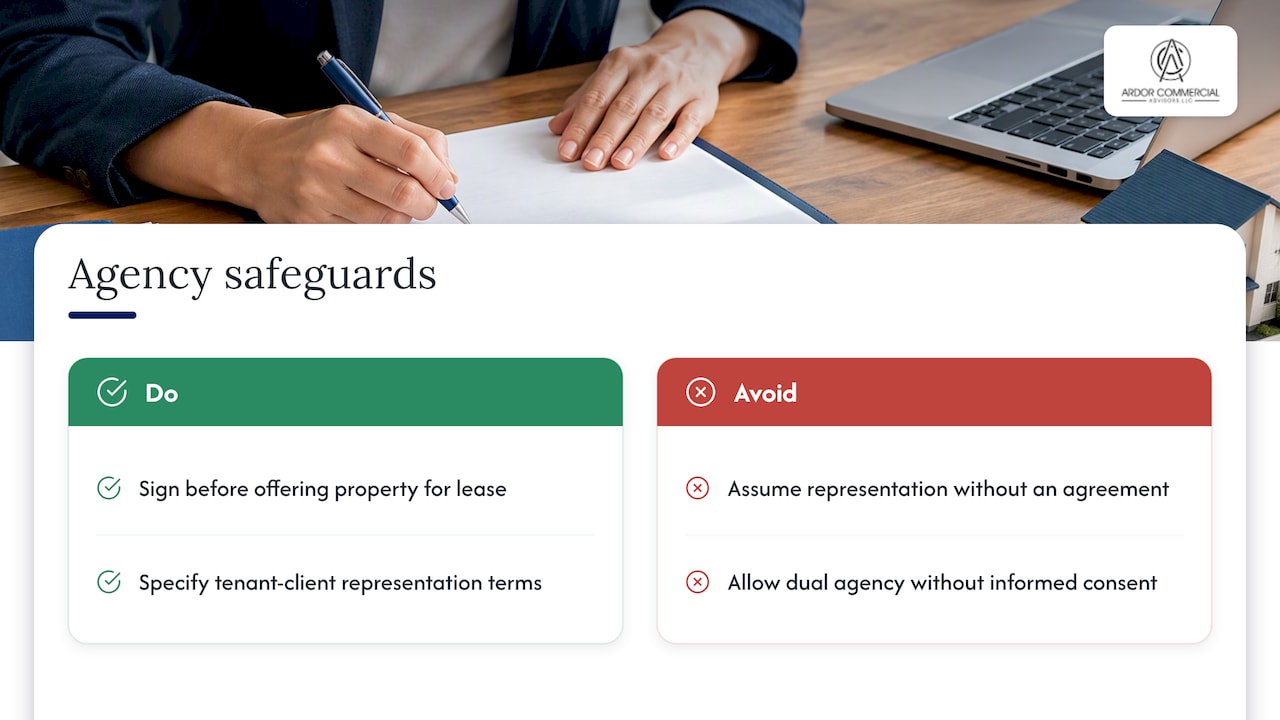
The clearest benefit is the legal one. A broker who represents you owes duties of loyalty, confidentiality and reasonable care. North Carolina’s Real Estate Commission requires brokers to review the Working with Real Estate Agents disclosure at first substantial contact, and it warns that commercial agents are sometimes inconsistent about doing so.
The practical lesson: sign a written agency agreement with your broker before the property is offered for lease. Without one, you may assume you are represented while the broker is legally acting as a facilitator, or even leaning toward the tenant. A listing agreement should also say what happens if the broker works with a tenant who is also their client, so dual representation never happens without your informed consent.
You reach better tenants, faster
Vacancy is the costliest line on your operating statement. A rep with an active pipeline of tenant brokers and practices can put your space in front of qualified prospects in days. That matters most for specialized product. A medical tenant needs plumbing, floor loads and parking ratios that a generic office listing never mentions. A rep who knows that can screen out poor fits before anyone tours.
You negotiate from data, not instinct
Every lease term has a price. Free rent, TI dollars, rent bumps and renewal options can be traded against each other, and the right trade depends on your loan, your hold period and your exit. A rep builds that comparison as a net effective rent calculation, so you see what a 5% higher face rent is worth against two extra months of free rent.
Expense structure is another place owners lose money quietly. How operating costs are passed through, and how they are reconciled each year, decides whether you recover what you spend. Our guides on triple net leases and industrial lease types show how much the wording changes the outcome.
You protect the building’s value at refinance and sale
Lenders do not underwrite your hopes; they underwrite signed leases. Federal bank supervisors advise owners to focus on debt service coverage well before maturity, and stress testing has tightened, particularly for office assets where vacancy and operating costs have risen.
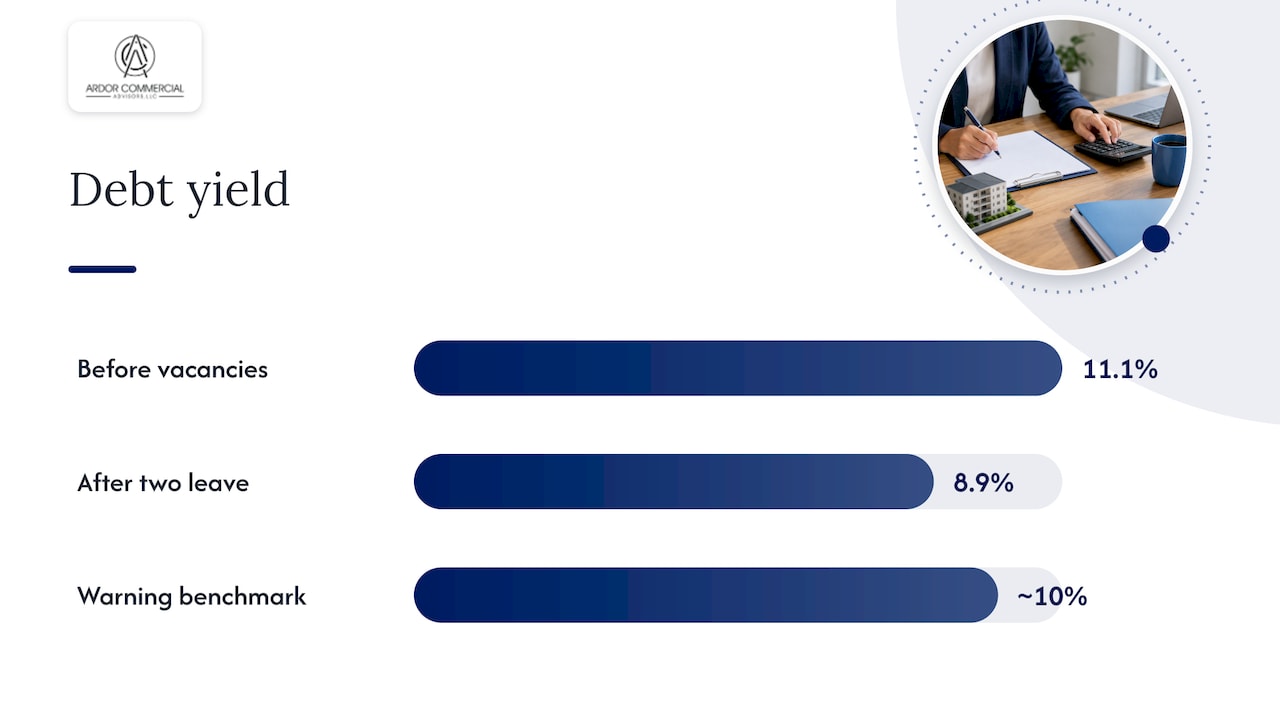
The typical benchmark is a stabilized DSCR of 1.20x or higher, and lenders on securitized loans also look at debt yield, which is net operating income divided by the loan amount. A debt yield under roughly 10% is often read as a warning sign that can lead to a required pay-down at maturity. Lease length, credit quality and rent steps all move those numbers. See our DSCR loan sizing guide for the math.
A simple example, with illustrative numbers only: a building with $500,000 of NOI and a $4.5 million loan has an 11.1% debt yield. If two tenants leave and NOI falls to $400,000, the debt yield drops to 8.9%, and the same loan now looks like a candidate for a pay-down. Filling those suites on well-structured terms is the fix, and the timeline is long, which is why the conversation should start 18 to 24 months before maturity.
You catch tax timing before it is gone
The 2025 federal tax law permanently reinstated 100% bonus depreciation for qualified property acquired and placed in service after January 19, 2025. That can include qualified improvement property such as interior electrical, plumbing and HVAC work. The IRS has issued guidance on the additional first-year depreciation deduction under the amended rules.
What this means for leasing: when you fund a landlord work letter, the dates and the scope of the work can affect your deduction. A rep who coordinates the buildout schedule with your CPA helps you avoid missing eligibility on a technicality. Your CPA decides what qualifies; the broker’s job is to keep the paper trail and the schedule clean. Our landlord work letter checklist covers the ten items to settle before construction starts.
You avoid costly lease mistakes
A few errors show up again and again:
- Vague definitions of operating expenses that let a tenant dispute pass-throughs for years.
- Renewal options at “fair market rent” with no process for deciding what fair market means.
- Guarantees that are weaker than the rent they secure.
- Missing insurance and indemnity requirements. A commercial insurance agency has a useful overview of insurance requirements for commercial real estate that is worth reading before you finalize lease language.
- Estoppel and subordination terms that do not match what your next buyer or lender will demand. See our note on estoppel certificates.
A rep does not replace your attorney. The broker negotiates the business terms, your attorney papers the legal ones, and the two should speak before the letter of intent is signed.
Landlord representation vs. property management
Owners often mix these up. Landlord representation is transactional: it is about getting a lease signed or a building sold. Property management is ongoing: rent collection, maintenance, vendor oversight, budgets and reporting. Some owners use both, and some buildings are managed by the owner. If you are unsure what operating a building should cost, our property management budget guide walks through the line items.
| Landlord representation | Property management | |
|---|---|---|
| Main goal | Fill space on strong terms | Run the building day to day |
| Timing | Per transaction | Ongoing |
| Typical pay | Commission at lease signing | Management fee |
| Key output | Signed lease, sale or renewal | Clean operations and reporting |
Commercial landlord representation is commonly paid through a commission at lease signing, usually a percentage of total lease value, though exact structures vary by market and agreement. Settle the rate, the renewal and expansion treatment, and the tail period in the written agreement. Our own leasing commission structure page explains how we approach it.
When representation pays for itself
Not every owner needs a broker for every lease. It tends to pay most clearly in these situations:
- Multi-tenant medical or office buildings with staggered expirations, where one lease affects the next.
- A loan maturing in the next two years, when lease-up and rollover risk decide your refinance terms.
- Specialized space, such as dental and orthodontic suites, where the buildout is expensive and the right tenant is hard to find.
- Owners who live outside Charlotte or who run another business and cannot answer tenant brokers quickly.
- Renewals, where a tenant with a broker will happily test the market. Our 120-day renewal strategy shows how to run that process.
It matters less for a single-tenant building leased to a long-term credit tenant on a lease with years to run and no pending sale.
Our perspective
We work with owners across office, medical, retail and industrial property in the Charlotte area, and the pattern is consistent. The owners who get the most out of representation treat leasing as the first step of a financing and exit plan, not a standalone task. Before we talk about asking rent, we ask three things: when does your debt mature, when do your tenants roll, and what do you want to do with the building in five years?
Those answers decide the strategy. A seller planning to list in 18 months wants long, clean leases with credit tenants. An owner holding for income may accept shorter terms in exchange for rent growth. A medical building owner may value a stable dental practice over a higher face rent from a tenant who might leave in three years.
We would also say plainly: hire a rep who will put the agency agreement in writing, show you the net effective math on every offer, and tell you when a tenant is not worth the concession. Representation is only a benefit when the advocate is honest about trade-offs.
— Jim
How to choose a landlord representative
Ask any broker you interview:
- Will you sign a written agency agreement before marketing begins, and what does it say about dual representation?
- How many comparable leases in this submarket have you closed in the past two years?
- How will you present each offer: face rent, net effective rent, and the effect on my DSCR?
- How do you handle tenant brokers and the commission split?
- What is the plan for the first 90 days of marketing, and how will you report back?
- Who handles lease abstraction, CAM reconciliation and estoppels after signing?
The last question catches a gap many owners find too late. A signed lease that nobody abstracts and audits is a lease that leaks money. We cover that in our guides on lease abstracts and CAM charges.
Working with Ardorcre
We provide landlord representation, tenant representation, commercial leasing, property management, valuation and lease analysis for owners and investors in the Charlotte MSA. If you have a building with vacancy, a lease rolling over or a loan to plan around, start with our services overview or ask us for a commercial property valuation so you know where the building stands before you set terms.
FAQ
Who pays for landlord representation?
The landlord hires the broker and the fee is typically a commission tied to the lease or sale, set out in a written agreement. In many deals the commission is shared with the tenant’s broker, so ask your rep how that split works before you sign.
Do I need a written agreement with my broker in North Carolina?
Yes, in practice. The Real Estate Commission’s guidance says agency agreements should be in writing before property is offered for lease or sale, and it requires the agency disclosure at first substantial contact. A written agreement removes doubt about who the broker represents.
Is landlord representation worth it for a small building?
Often, yes, if you have vacancy or a lease rolling soon, because one signed lease can change your NOI and your financing options. It is less necessary when you have a stable long-term tenant and no plans to sell or refinance.
How does landlord representation affect refinancing?
Lenders size loans on income they can verify, so lease quality directly affects DSCR and debt yield. A rep helps you lease up and structure terms before the lender reviews your rent roll, which gives you more room at maturity.
Sources
- NCREC Bulletins: Top Ten Issues for Commercial Real Estate Brokers
- OCC Comptroller’s Handbook: Commercial Real Estate Lending
- OCC Examination Handbook 210 Appendix A: Income Property Lending
- EisnerAmper: Opportunities and Enhancements for Real Estate in the One Big Beautiful Bill Act
- IRS: Guidance on the additional first year depreciation deduction