
CAM charges are additional rent fees commercial tenants pay on top of base rent to cover the operating costs of shared spaces. The standard formula is straightforward: divide your rentable square footage by the property’s total leasable area, multiply by the annual CAM pool, then divide by 12 for your monthly charge. What the formula does not tell you is that the real money is in the definition, not the math.
Common area maintenance (CAM) typically covers:
- Utilities for lobbies, hallways, and parking areas
- Landscaping, snow removal, and exterior maintenance
- Janitorial services for shared spaces
- Property management and administrative fees
The single most powerful lease lever is a narrow, itemized CAM definition paired with a written audit right. Everything else in this guide builds on those two points.
Table of Contents
- What CAM charges actually include — and what landlords dispute
- How to calculate CAM charges: the formula, variants, and a worked example
- How lease type determines who pays what — and what the clause language looks like
- Estimates, reconciliations, and true-ups: how the billing cycle actually works
- Caps, floors, and base-year stops: how to limit CAM volatility in your lease
- What CAM usually excludes — and how amortized CapEx sneaks in
- Audit rights, documentation checklists, and how to dispute a CAM charge
- Negotiation checklist and sample lease language for tenants and landlords
- Key Takeaways
- What Charlotte practitioners see tenants get wrong
What CAM charges actually include — and what landlords dispute
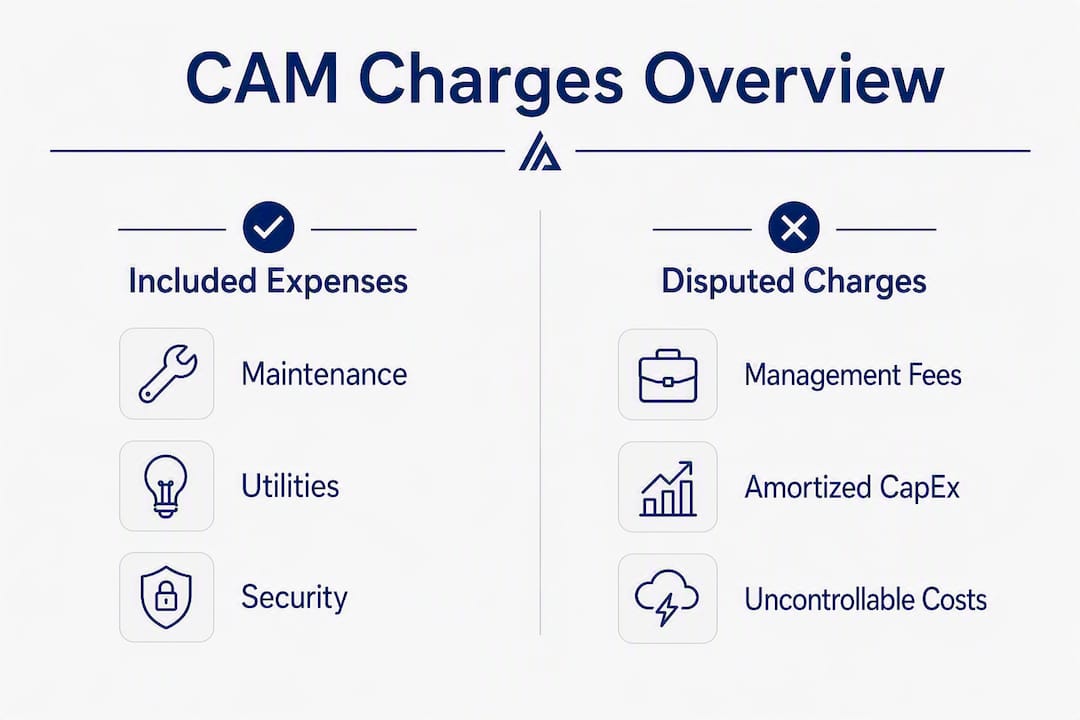
CAM expense categories span a wider range than most tenants expect when they sign. The clearest way to read a CAM reconciliation is to sort line items into categories and then ask whether each one genuinely serves the shared space.

Maintenance and repairs cover routine upkeep of common areas: HVAC servicing for lobby systems, elevator service contracts, roof repairs over shared corridors, and exterior lighting replacements. These are generally accepted.
Landscaping and grounds include mowing, mulching, irrigation system maintenance, seasonal plantings, and tree trimming. In the Charlotte MSA, these costs spike in spring and early summer, so a landlord’s annual budget can look low in January and run over by June.
Parking lot maintenance is one of the most concrete and verifiable CAM line items. Sealcoating, striping, pothole repair, and crack filling are recurring vendor-driven costs that show up on invoices with specific scope and unit pricing. If a landlord bills $40,000 for parking lot work, you can request the vendor contract and compare it against market rates.
Common area utilities cover electricity for hallways, stairwells, exterior signage, and shared restrooms. These are nearly always legitimate, though the allocation method matters if the landlord uses a gross-up clause (more on that in the calculation section).
Janitorial services for shared areas, including lobby cleaning, restroom maintenance, and window washing on common-area glass, are standard. Janitorial costs for tenant-specific spaces are not CAM and should never appear in the pool.
Security includes guard services, access control systems, and surveillance cameras covering shared areas. Costs tied exclusively to a single tenant’s suite are not recoverable.
Property management fees are where disputes concentrate. Landlords typically charge a percentage of collected rents, often in the range of 3–5%, as a management fee passed through CAM. This is a landlord profit center. The American Bar Association flags the breadth of operating expense definitions as the central negotiation battleground, and management fees sit at the center of that fight.
Insurance for the building and common areas is a standard CAM item. Landlord-only coverage, such as directors and officers liability, is not.
Controllable vs. uncontrollable expenses is a distinction worth building into your lease. Controllable expenses (janitorial, landscaping, management fees) are ones a landlord can manage through vendor selection and contract terms. Uncontrollable expenses (insurance, real estate taxes, utilities) respond to market forces. Capping only controllable expenses is a common and reasonable negotiating position.
How to calculate CAM charges: the formula, variants, and a worked example
The standard pro-rata formula works in three steps:
- Calculate pro-rata share: Tenant RSF ÷ Property GLA = Pro-rata percentage
- Calculate annual tenant CAM: Pro-rata percentage × Annual CAM pool = Annual tenant CAM
- Convert to monthly: Annual tenant CAM ÷ 12 = Monthly CAM charge
Worked example:
- Tenant rentable square footage (RSF): 5,000 sq ft
- Property gross leasable area (GLA): 50,000 sq ft
- Annual CAM pool: $200,000
Step 1: 5,000 ÷ 50,000 = 10% pro-rata share
Step 2: 10% × $200,000 = $20,000 annual tenant CAM
Step 3: $20,000 ÷ 12 = $1,667/month
Per-square-foot rate: $20,000 ÷ 5,000 = $4.00/sq ft/year
That $4.00/sq ft figure is what you will see quoted in lease abstracts and offering memoranda. It is also the number to benchmark against comparable properties in your submarket.
Common formula variants:
- Fixed per-square-foot CAM: Some leases set a flat CAM rate (e.g., $3.50/sq ft/year) that adjusts annually by CPI or a fixed percentage. Simpler to budget, but it may not reflect actual costs.
- Gross-up clause: Property managers frequently apply a gross-up adjustment to variable operating expenses, inflating them to a hypothetical 95–100% occupancy level. If the building is 70% occupied, your share of utility costs gets calculated as if it were 95% occupied. This protects landlords from under-recovery but can significantly inflate per-tenant costs. Limit gross-up in your lease to specific categories (common area utilities only) and tie it to a defined occupancy floor.
Pro Tip: Before accepting a landlord’s CAM reconciliation, request three documents: the annual operating budget, at least three vendor invoices for the largest line items, and the management agreement. Cross-check the management fee against the agreement’s stated percentage. Arithmetic errors in pro-rata calculations are common, and the management fee is the most frequently inflated line.
How lease type determines who pays what — and what the clause language looks like
Lease structure is the primary driver of CAM allocation. The same building with the same operating costs can produce dramatically different tenant obligations depending on which lease form governs.

Gross lease: The landlord bundles most operating costs into a single base rent figure. Tenants pay one number and have limited exposure to CAM volatility. The tradeoff is that base rent is higher, and landlords price in a cushion for cost increases.
Modified gross lease: Base rent covers some operating expenses; others pass through separately. A common structure has the tenant paying base rent plus electricity and janitorial for their suite, while the landlord absorbs common area costs. The exact split is negotiated and should be spelled out line by line in the lease.
Double net (NN) lease: Tenants pay base rent plus property taxes and insurance. CAM for common areas typically stays with the landlord, though this varies.
Triple net (NNN) lease: Tenants pay base rent plus property taxes, insurance, and operating expenses including CAM. This is the dominant structure in retail and many industrial leases. Under a true NNN, the tenant’s exposure to CAM increases is nearly unlimited unless the lease contains explicit caps.
What to look for in the lease language:
A base-year stop clause reads roughly like this: “Tenant shall pay its pro-rata share of Operating Expenses in excess of Operating Expenses incurred during the Base Year.” This protects tenants from paying CAM on costs the landlord was already absorbing before the lease started, but it only limits increases above the base year, not the base year costs themselves.
An NNN pass-through clause typically reads: “In addition to Base Rent, Tenant shall pay Tenant’s Pro-Rata Share of all Operating Expenses, as defined herein, within thirty (30) days of Landlord’s written statement.” The definition of “Operating Expenses” in that clause is the document you need to read most carefully. Broad definitions include items like capital improvements amortized over their useful life, which can quietly add significant cost.
For tenants, the practical signposts are: push for a defined and exclusive list of includable expenses, not a broad category with carve-outs; require that management fees be capped as a percentage of actual collected rents; and never accept a definition that allows landlord corporate overhead or off-site administrative costs.
Estimates, reconciliations, and true-ups: how the billing cycle actually works
CAM charges are typically billed as monthly estimates and reconciled annually. Here is how the cycle runs in practice:
- Budget production (October–December): The landlord or property manager prepares an operating budget for the coming year, estimating each CAM expense category. This budget drives the monthly pre-bill amount.
- Monthly pre-bills (January–December): Tenants pay their pro-rata share of the estimated annual CAM pool, divided by 12, each month alongside base rent. These are estimates, not final figures.
- Fiscal year-end close (January–February): The landlord compiles actual expenses for the prior year and calculates the true annual CAM pool.
- Reconciliation statement (February–April): The landlord issues a reconciliation showing actual costs versus estimated billings. If actual costs exceeded estimates, the tenant owes the difference. If estimates were too high, the tenant receives a credit or refund.
- Audit window (typically 12–18 months after fiscal year-end): Tenants with audit rights can inspect supporting documentation during this window.
A concrete reconciliation example: If your monthly pre-bill was $1,500 (based on a $200,000 estimated CAM pool) but actual costs came in at $220,000, your annual true-up would be:
- Estimated annual payment: $1,500 × 12 = $18,000
- Actual annual obligation: 10% × $220,000 = $22,000
- True-up due: $22,000 − $18,000 = $4,000
That $4,000 is typically billed as a lump sum in the reconciliation statement, which is why CAM true-ups can hit tenant cash flow hard in Q1. Budget for some variance above your monthly pre-bill as a reserve.
Transparent annual budgets and itemized reconciliations reduce disputes and preserve the landlord-tenant relationship. Landlords who communicate budget changes proactively avoid the surprise increases that generate the most friction.
Caps, floors, and base-year stops: how to limit CAM volatility in your lease
CAM caps are the most direct tool tenants have to control long-term cost exposure. There are two main structures, and they work very differently over a multi-year lease term.
Year-over-year cap: Limits the increase in controllable CAM expenses to a fixed percentage (commonly 3–5%) over the prior year’s actual costs. If controllable CAM was $150,000 in Year 1, it cannot exceed $157,500 in Year 2 regardless of actual spending. This is the most tenant-favorable structure because it compounds from actual costs, not a base year.
Year-over-base cap: Limits total CAM to a percentage above the base year amount. This sounds similar but behaves differently over time. If the base year was unusually low (a new building, a partially occupied year), the cap may provide little real protection.
Floors: A floor sets a minimum CAM contribution regardless of actual costs. Landlords use floors to guarantee recovery of fixed overhead. Tenants should resist floors or negotiate them at a level that reflects genuinely fixed costs only.
Base-year stops: As noted in the lease structure section, a base-year stop means the tenant only pays CAM increases above the base year level. The base year selection matters enormously. A base year with unusually low expenses (say, a year when the building was newly constructed and had no deferred maintenance) will produce higher future obligations than a base year with normalized costs.
Sample cap language tenants can request:
“Notwithstanding anything to the contrary, Tenant’s share of Controllable Operating Expenses shall not increase by more than five percent (5%) per calendar year over the immediately preceding calendar year’s actual Controllable Operating Expenses.”
Pros and cons:
| Mechanism | Tenant benefit | Landlord concern |
|---|---|---|
| Year-over-year cap | Predictable cost growth | May not cover actual cost spikes |
| Year-over-base cap | Limits total exposure | Base year selection is critical |
| Floor | None | Guarantees minimum recovery |
| Base-year stop | Protects against legacy costs | Base year must be carefully chosen |
In a tight leasing market, landlords resist caps on uncontrollable expenses (insurance, taxes, utilities). In a tenant-favorable market, you can push for caps on the full CAM pool. Charlotte’s office and retail submarkets have seen enough vacancy in recent cycles that tenants in many properties have real leverage on this point.
What CAM usually excludes — and how amortized CapEx sneaks in
Standard CAM exclusions protect tenants from paying for costs that benefit the landlord’s asset rather than the shared operating environment. The American Bar Association identifies the operating-versus-capital distinction as the principal negotiation lever.
Typical exclusions tenants should demand in writing:
- Capital expenditures (roof replacement, HVAC system replacement, structural repairs)
- Tenant improvement allowances for any tenant in the building
- Landlord’s mortgage interest, debt service, and financing costs
- Depreciation on the building or its systems
- Costs to lease vacant space (marketing, broker commissions, legal fees for new leases)
- Landlord corporate overhead and off-site management office expenses
- Penalties, fines, or litigation costs resulting from landlord negligence
- Costs covered by insurance proceeds or warranty recoveries
The amortized CapEx problem: Landlords sometimes amortize capital improvements over their useful life and pass the annual amortization through CAM. A $500,000 roof replacement amortized over 20 years produces $25,000/year in CAM charges. Whether this is legitimate depends entirely on the lease language. If the lease excludes capital expenditures but allows “capital improvements that reduce operating costs,” a landlord can argue that a more efficient HVAC system qualifies.
A conceptual example: a $300,000 parking lot resurfacing (a capital project, not routine maintenance) amortized over 15 years at a 6% interest factor produces roughly $30,800/year in annual charges. At a 10% pro-rata share, that is $3,080/year added to your CAM bill for a project that arguably should not be in the pool at all.
Pro Tip: When reviewing vendor invoices, flag any description that includes words like “replacement,” “installation,” “upgrade,” or “new system.” These are signals of capital work. Cross-reference against the lease’s exclusion list before accepting the charge.
Negotiation carve-out language:
“Operating Expenses shall exclude any capital expenditure as defined under generally accepted accounting principles (GAAP), provided that capital improvements that reduce operating expenses may be included in Operating Expenses to the extent of the annual savings generated, not to exceed the annual amortization of such improvement.”
That last clause limits the landlord’s recovery to actual documented savings, which is a reasonable compromise.
Audit rights, documentation checklists, and how to dispute a CAM charge
Tenant audit rights materially reduce year-end disputes. A well-drafted audit clause is worth more than almost any other CAM protection because it creates accountability throughout the year, not just at reconciliation time.
Documentation to request for a CAM audit:
- Annual operating budget for the property (current and prior year)
- General ledger or expense detail report for the audit period
- Vendor invoices for all major CAM line items (landscaping, janitorial, parking maintenance, HVAC)
- Management agreement showing the fee structure and any incentive arrangements
- Insurance certificates and premium invoices
- Payroll summaries for on-site property staff allocated to CAM
- Utility bills for common areas
- Any vendor contracts with multi-year terms or automatic escalation clauses
Audits that allow property-level invoice inspection, rather than review of corporate pooled statements, produce the clearest verification and fastest resolution. If a landlord offers only a summary report, push back.
Typical audit clause elements to negotiate:
- Notice period: tenant provides written notice within 12–18 months after fiscal year-end
- Inspection window: 30–60 days to complete the review after documents are delivered
- Cost allocation: tenant pays auditor costs unless overcharge exceeds an agreed threshold (commonly 3–5% of billed CAM), at which point the landlord covers audit costs
- Confidentiality: auditor signs a non-disclosure agreement; findings are not shared with other tenants
Dispute resolution path:
- Request the full documentation package in writing, citing the lease audit clause
- Reconcile each line item against invoices and the lease’s includable expense definition
- Prepare a written dispute letter identifying specific overcharges with supporting calculations
- Negotiate directly with the property manager or asset manager
- If unresolved, escalate to mediation (faster and cheaper than litigation)
- Arbitration or litigation as a last resort, typically only for material overcharges
When to bring in outside help: a forensic accountant is worth the cost when the disputed amount exceeds roughly $20,000 or when the landlord’s records are complex (multiple properties pooled, related-party vendors, or management fee structures that are difficult to verify). Legal counsel becomes necessary if the landlord denies audit access or if the dispute involves lease interpretation rather than arithmetic.
Negotiation checklist and sample lease language for tenants and landlords
This is where the practical work happens. A prioritized checklist, because not every point carries equal weight:
Priority 1: Narrow the CAM definition
Get an exclusive, itemized list of includable expenses. Broad language like “all costs of operating the property” is a blank check. Push for: “Operating Expenses shall include only the following categories: [list].”
Priority 2: Explicit exclusions
Write out every exclusion in full. Do not rely on implied exclusions or GAAP references alone. The ABA’s guidance on operating expense definitions confirms that explicit, itemized exclusions are the most enforceable protection.
Priority 3: Cap on controllable expenses
Request a 3–5% year-over-year cap on controllable CAM. This is the most commonly granted concession in negotiated leases.
Priority 4: Management fee cap
Cap the property management fee at a specific percentage of collected rents (not gross rents, not potential rents). Require line-item support for any administrative fee above that cap.
Priority 5: Gross-up limits
Tie any gross-up adjustment to a defined occupancy floor (e.g., 85%) and limit it to variable utility costs only. Sample language: “Variable Operating Expenses may be grossed up to reflect ninety-five percent (95%) occupancy, provided such adjustment applies only to utility costs for common areas.”
Priority 6: Audit rights
Negotiate the full audit clause as described in the previous section. A 12-month notice window after fiscal year-end is standard. Insist on property-level invoice access, not consolidated statements.
Priority 7: CapEx exclusion with amortization carve-out
Use the carve-out language from the exclusions section above. This is a negotiated middle ground most landlords will accept.
When to escalate: If a landlord refuses audit rights, refuses to provide an itemized CAM definition, or insists on an unlimited gross-up, those are material issues. Bring a tenant rep advisor or counsel into the negotiation before signing. The cost of a lease review is a fraction of the CAM exposure over a five-year term.
Charlotte MSA context: In the Charlotte office market, vacancy in certain submarkets has given tenants meaningful leverage on CAM concessions over the past few years. Retail and medical office tenants in high-demand corridors have less room to negotiate. Knowing which side of that dynamic you are on before you start negotiating makes the difference between getting a cap and being told the lease is non-negotiable. Ardorcre’s advisors track submarket conditions across Charlotte’s office and retail corridors and can tell you what is actually achievable before you sit down at the table.
Pro Tip: Before your first call with an advisor, pull together your signed lease, the last two years of CAM reconciliation statements, and the property’s annual operating budget if you have it. Those three documents let an advisor identify the highest-risk line items in under an hour. A lease abstract can also help you quickly locate the CAM definition, exclusion list, and audit rights clause without reading the full document.
Key Takeaways
CAM charges are calculated on a pro-rata basis, and the lease definition of includable expenses determines your actual exposure far more than the formula itself.
| Point | Details |
|---|---|
| Pro-rata formula | Divide tenant RSF by property GLA, multiply by the annual CAM pool, divide by 12 for monthly cost. |
| Narrow the definition | An itemized, exclusive list of includable expenses is the single most protective lease provision. |
| Cap controllable costs | A small year-over-year cap on controllable CAM is the most commonly granted concession in negotiated leases. |
| Audit rights matter | A written audit clause with property-level invoice access is worth more than most other CAM protections combined. |
| Ardorcre advisory | Ardorcre’s advisors provide CAM reconciliation review, lease analysis, and negotiation support across the Charlotte MSA. |
What Charlotte practitioners see tenants get wrong
Most CAM disputes are not about the math. They are about what the lease says is includable, and whether the tenant ever pushed back on that language before signing.
The most common mistake I see is tenants accepting a broad operating expense definition because the monthly CAM estimate looks reasonable at signing. Three years into a lease, after a roof repair gets amortized in, a management fee increases, and a gross-up clause inflates utility costs during a low-occupancy period, that “reasonable” estimate has grown 25–30% with no cap in sight. The tenant has no audit rights, no cap, and no leverage.
The second mistake is treating CAM as a fixed cost for budgeting purposes. It is not. CAM reconciliations in Q1 can produce material true-up bills that hit cash flow at the worst time. Tenants who budget only their monthly pre-bill and ignore the reconciliation risk are setting themselves up for a surprise.
On the landlord side, the mistake is the opposite: failing to communicate budget changes proactively. A landlord who sends a $15,000 true-up bill with no prior warning, no itemized reconciliation, and no explanation will spend more time and money on the dispute than the amount at issue. Transparent budgeting and early communication are the cheapest dispute-prevention tools available.
In Charlotte’s current market, seasonal landscaping and storm-related parking lot repairs are the two most volatile CAM line items. A wet spring or a late-season ice event can push actual costs well above budget. Tenants in properties with significant surface parking or mature landscaping should pay particular attention to those line items in reconciliations.
The tenants who come out ahead are the ones who treat the CAM clause as seriously as the base rent. They negotiate the definition, get the cap, and exercise their audit rights. That combination consistently produces better outcomes than any single tactic alone.
Ardorcre’s CAM review and lease negotiation services
If you are heading into a lease negotiation or just received a CAM reconciliation that does not add up, Ardorcre’s advisors can work through it with you. The team handles lease review, CAM reconciliation analysis, audit coordination, and negotiation support across the Charlotte MSA for office, medical, retail, and industrial tenants and landlords.
Before a first call, pull together your signed lease, the last two years of CAM reconciliation statements, and the property’s annual operating budget if you have it. Those three documents are enough to identify the highest-risk line items and determine whether a formal audit is worth pursuing. If you are evaluating a new lease, a lease abstract from Ardorcre’s team can extract every CAM-related clause and flag the provisions that need redlining before you sign.
For building owners and investors assessing how CAM obligations affect property-level cash flow and financing, Ardorcre’s advisory services extend to commercial real estate services in Charlotte including asset-level analysis and landlord representation. Request a lease review or advisory session directly through the Ardorcre website.
This article provides general information about commercial lease terms and CAM charges. It is not legal or financial advice. Consult a qualified attorney or CPA before finalizing lease terms or taking action based on a CAM reconciliation.
Sources and further reading
The following resources support the analysis in this guide and provide tools for running your own CAM calculations or reviewing lease language.
| Resource | What it offers |
|---|---|
| CAM Formula and Calculator — Wall Street Prep | Step-by-step formula, worked numeric example, and a downloadable CAM calculator for pro-rata calculations. |
| CAM Charges in CRE — J.P. Morgan | Authoritative overview of CAM definitions, gross-up mechanics, and reconciliation best practices from a major institutional lender. |
| Operating Expenses in Commercial Leases — American Bar Association | Legal analysis of operating expense definitions, exclusion strategies, and negotiation approaches; useful for drafting or redlining lease language. |
| CAM Audits and Portfolio Management — CLAConnect | Practical audit guidance including documentation checklists, audit clause elements, and dispute resolution frameworks. |
| Common Area Maintenance Charges — Wikipedia | Accessible overview of CAM terminology, reconciliation mechanics, and lease type interactions. |
| CAM Charges Guide — Occupier | Tenant-focused breakdown of expense categories, commonly disputed items, and practical reconciliation tips. |
For final lease drafting, clause redlining, or formal dispute letters, consult a licensed real estate attorney in your jurisdiction. The resources above are educational references, not substitutes for legal counsel.