
Charlotte’s medical office market is tight. Occupancy is at record levels, new supply is slow to arrive, and hospital systems are adding capacity across the region. A November 2025 PwC report cited by Bisnow put Charlotte’s medical office occupancy at a record, above 93%. For a physician, dentist or orthodontist, that means starting the space decision early. For an owner or investor, it means well-located medical buildings are in demand. At Ardorcre, our tenant and landlord advisors work on both sides of that decision in the Charlotte MSA.
TL;DR
- Charlotte medical office occupancy is above 93%, and available space is scarce, so practices should plan a lease or purchase 12 to 18 months ahead.
- Population growth, hospital expansion and high construction costs are the main reasons supply is tight.
- Leasing keeps cash free for the practice. Buying builds equity but puts a loan, a building and a vacancy risk on your books.
- A multi-tenant medical building spreads income across several tenants, and lenders will size the loan on its debt service coverage ratio (DSCR).
- Hospital projects in Mecklenburg, Cabarrus, Union and York counties will keep reshaping where medical tenants want to be.
Table of Contents
- What the Charlotte medical office market looks like now
- Why supply is so tight
- Where the hospital pipeline is pointing
- Lease or buy: the decision for a medical professional
- The advantages of buying a multi-tenant medical building
- Ways to finance a medical or office purchase
- Industrial and office: what changes
- How we help
- Our view
- FAQ
- Sources
What the Charlotte medical office market looks like now
The headline is scarcity. The same PwC-based Bisnow report found record-setting occupancy above 93% in Charlotte. If you want to check how a figure like that is built, an occupancy rate calculation with formulas and examples walks through occupied space divided by total rentable space, and shows why a few percentage points of vacancy matter so much in a small asset class.
The national picture points the same way. Avison Young’s Q2 2026 healthcare report, as covered by Realty Today, shows national healthcare net absorption of 3.5 million square feet in the quarter and occupancy of 92.4%. Available space was down 4% year over year, and the development pipeline was down 10% from Q2 2025. Trailing 12-month U.S. healthcare sales were up 77%.
Those are national numbers, and rents, vacancy and pricing differ by submarket: South Charlotte, Uptown, University, the Union County and Lake Norman corridors, and Fort Mill across the state line. Treat any single citywide figure as a starting point. The practical question is what is available within a drive of your patients, at what rent, on what terms. Our page on what practices pay for medical office space in Charlotte goes deeper on rents.
Why supply is so tight
Three forces keep showing up.
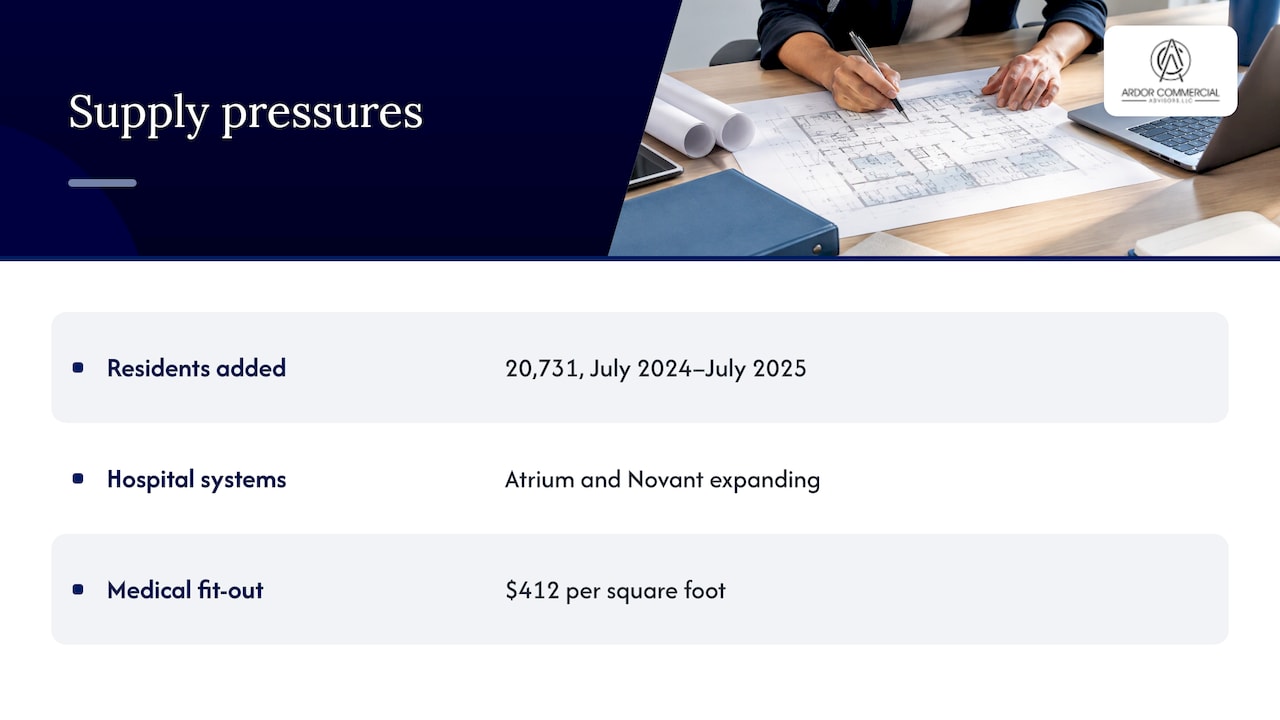
People. According to Hoodline’s June 2026 report, Charlotte added roughly 20,731 residents between July 2024 and July 2025, the largest numeric gain of any U.S. city in that period. More residents mean more patients, and more patients mean more exam rooms.
Hospital systems. Atrium Health and Novant Health keep expanding, and medical office buildings follow hospitals. Hoodline’s analysis ties the squeeze to aggressive hospital-system expansion, and notes that smaller practices can find themselves bidding against health-system tenants.
Construction costs. Building new is expensive. A February guide cited by Bisnow puts fit-out costs for medical outpatient space at $412 per square foot, which is why existing medical space is sought after. Realty Today’s reading of the Avison Young data adds that rising construction costs and more selective lending make new medical office projects harder to pencil out, even as completed buildings lease up quickly. Developers are leaning toward preleased, hospital-backed projects over speculative construction.

The result is a market where demand looks durable and new supply is limited. That is the combination that draws investment capital, and it is also the one that makes a practice’s search harder.
Where the hospital pipeline is pointing
Medical office follows patients, so it helps to know where the health systems are building.
- In March 2026, the Charlotte Observer reported that Atrium Health and Novant Health submitted Certificate of Need proposals totaling $385 million, including Atrium’s $360.9 million, 65-bed Harrisburg expansion, a $74 million, 30-bed Cabarrus project and Novant’s $457.3 million, 50-bed Cabarrus medical center expansion. Atrium also proposed $62.5 million for two freestanding emergency departments in NoDa and Moores Chapel. A Certificate of Need is the state approval hospitals need in North Carolina before adding certain beds and services.
- In April 2026, WRHI reported that Atrium Health finalized a $5 million purchase of more than 10 acres at I-77 and Sutton Road in York County, a key step toward a planned $450 million Fort Mill campus. The plan includes a 200,000-square-foot, 60-bed hospital and a medical office building, expected to open in 2029.
- In September 2026, Hoodline reported that Atrium Health Union West broke ground on a $116 million patient tower in Stallings, adding 88 patient rooms and 11 ER bays, expected to open in fall 2028. The report cites the N.C. DHHS 2025 State Medical Facilities Plan, which identified a need for 136 additional acute care beds in Union County, where the estimated 2025 population was 267,674, up more than 12% since 2020.
If your practice depends on referrals from one of these systems, proximity to a new campus can matter for decades. It is also where competition for nearby medical space is likely to rise first.
Lease or buy: the decision for a medical professional
This is the question we hear most from physicians, dentists and orthodontists. The honest answer depends on cash, timing and how permanent the practice is.
When leasing fits
Leasing makes sense when you want your capital in equipment, staff and patient growth rather than in a building. It also fits a practice that may add providers, relocate toward a new hospital campus, or is still settling on its patient base. The costs to model are base rent, the pass-through charges in a triple net lease (taxes, insurance and common area maintenance, or CAM), and the tenant improvement (TI) allowance for building out exam rooms and plumbing. Our guide to the triple net lease explains what those pass-throughs include.
Timing is the part tenants underestimate. In a tight market, a medical build-out has to be planned long before your current lease ends. We lay out the work in starting 12 to 18 months early on medical office leasing, and the 3 to 6 month commercial leasing timeline shows how the negotiation, legal review and construction phases stack up.
Before you sign, have the lease reviewed. CAM charges are a common source of surprise costs, and our lease review and CAM reconciliation analysis is built to catch them. If a landlord asks for a personal or corporate guarantee, read how to negotiate a corporate guarantee lease and cap it at 12 months’ rent.
When buying fits
Buying makes sense when the practice is established, you expect to stay in the same location for many years, and you want to control occupancy cost. A purchase gives you control over the build-out and removes the risk of a landlord raising rent or redeveloping the building. Many practices buy a suite or a small building and lease the extra space to another provider.
The tradeoffs are real. You take on a loan, the down payment, maintenance and the responsibility of keeping the building leased. Because fit-out for medical space is so costly, a buyer should know the condition of existing plumbing, electrical, and build-out before offering. A professional commercial property valuation with DCF modeling shows what the income and the building are worth under different assumptions, so you are pricing the asset rather than the asking number.
If you are a medical professional with a financial planner, bring them in early. The decision involves your personal balance sheet, your practice’s cash flow and often a personal guarantee on the loan, and it deserves the advice of a certified financial planner and your tax advisor.
A simple way to frame it
| Question | Leaning toward leasing | Leaning toward buying |
|---|---|---|
| How long will you stay? | Under about 5 to 7 years, or unsure | A decade or more |
| Where does your capital work hardest? | Equipment, staff, growth | Building equity |
| Will you add providers? | Possibly, and you want flexibility | You can plan space for them or sublease |
| Who handles the building? | You prefer the landlord does | You are ready to own it |
The year ranges are a rule of thumb for starting the conversation, not a rule. Run both options through a cash-flow model for your practice before deciding.
The advantages of buying a multi-tenant medical building
For investors and for practices that want to own, a multi-tenant medical office building can be stronger than a single-tenant one.
- Spread of income. With several tenants, one departure does not zero out your rent roll. Tenants in medical space also tend to stay because relocating means rebuilding an expensive fit-out.
- Owner-occupant plus rent. A practice can occupy part of the building while other tenants help pay the debt service.
- Defensive appeal. Hoodline’s analysis describes investors circling well-located medical buildings as relatively defensive assets.
- Room to add value. Vacant suites can be leased to complementary specialties, which can raise the building’s income and value.
What to verify before you buy: the lease abstract for each tenant (a short summary of rent, term, options, expenses and termination rights), the estoppel certificates in which tenants confirm the lease terms to the buyer, and any right of first refusal that could affect your purchase. Our pages on lease abstraction, estoppel certificates and the right of first refusal explain each one, and our property management budget guide helps you estimate the cost of running the building.
Investor demand is visible in the data. The February guide cited by Bisnow reports that national MOB investment rose 35% year over year in 2025 to $12.6 billion per CBRE, with the Southeast leading in Q4 2025 at $1.6 billion. Our look at Charlotte medical office demand, including the $59.5M Azalea sale shows how that plays out locally, and our medical office cap rates page explains how pricing varies by property type and quality.
Ways to finance a medical or office purchase
Financing shapes what you can afford and what return you earn, so it deserves as much attention as the property.
Bank and credit union loans. Local and regional lenders often finance owner-occupied medical buildings and may know the borrower’s practice. Terms depend on the lender and the property.
SBA-backed loans. Owner-occupied practices can look at U.S. Small Business Administration programs, which are offered through participating lenders. Confirm eligibility and current terms with the lender and the SBA.
Conduit (CMBS) loans. Commercial mortgage-backed securities loans are pooled and sold to investors. They are typically used for stabilized investment property and usually carry strict prepayment terms. If you hold one, the payoff cost is a key part of any sell-or-refinance decision.
Debt service coverage ratio (DSCR) loans. The DSCR is a property’s annual net operating income divided by its annual loan payments. A ratio above 1.0 means the property’s income covers the debt, and lenders set their own minimums. Because DSCR underwriting leans on the building’s income more than the borrower’s personal finances, it suits investors buying income-producing property. Our DSCR loan sizing guide shows how to calculate how much a building can support.
Seller financing and 1031 exchange proceeds. An investor selling one property can reinvest the proceeds into another through a 1031 exchange, which defers capital gains tax if the rules are met. Talk to a qualified intermediary and your tax advisor before you list.
Sell or refinance a CMBS loan?
When a CMBS loan nears maturity or the property has gained value, owners face the choice. Compare three numbers: what you net after the loan payoff, including any defeasance or yield maintenance (the prepayment cost of exiting early); what a refinance would cost and whether the property’s income still clears the lender’s DSCR at today’s rates; and what the building would earn if held. Because medical office is in short supply, a well-leased building may attract buyers, which gives sellers leverage. Rates and lender terms change often, so test the options against live quotes instead of old ones. Our valuation and DCF modeling is built for exactly this comparison.
Industrial and office: what changes
The same discipline applies outside medical. For industrial owners, the lease structure drives your true occupancy cost, so see our guide to industrial lease types before buying or leasing. For office owners and tenants, our Charlotte office market analysis of leasing and sales trends covers a market that behaves very differently from medical, and our look at the Charlotte flex office market covers the in-between space.
How we help
We are a commercial real estate brokerage in the Charlotte MSA, handling sales and leasing of office, medical, retail, industrial, land and investment properties. Our advisors do tenant and landlord representation, property management, lease analysis and valuation. If you are a practice looking for space, our tenant representation covers the search through the transaction. If you own or are considering a building, see our full list of services.
Tell us the specialty, the square footage and the part of the Charlotte area you need, and we will work from there at ardorcre.com.
Our view
In a market this tight, the practices that do well are the ones that start early and know their numbers. We would rather walk a physician through a lease and a buy side by side, with real rent, TI and loan figures, than let a deadline pick the answer.
For owners, the same rule applies. A medical building with good tenants is a scarce asset in Charlotte, and the way you sell, hold or refinance it should come from a model, not from a hunch. That is why we pair brokerage with lease analysis, valuation and DCF work, and why our advisors represent tenants and landlords.
Whether you are a dentist adding a second chair, an orthodontist outgrowing a suite, or an investor looking at a multi-tenant building, we can help you set the plan and carry it through to closing.
Jim
FAQ
Is Charlotte’s medical office market tight?
Yes. A PwC report cited by Bisnow put Charlotte’s medical office occupancy at a record, above 93%. Population growth, hospital expansion and high construction costs are limiting new space, so practices should plan well ahead.
How early should a practice start looking for medical office space?
We recommend starting 12 to 18 months before your current lease ends or before you need to open. That covers the search, negotiation, legal review and build-out. Our medical office leasing guide breaks the timeline down.
Should a dentist or physician lease or buy in Charlotte?
Leasing keeps capital free for the practice and gives flexibility. Buying builds equity and gives control of the space for a long stay. Model both with real rent, TI, taxes and loan terms, and involve your financial planner and tax advisor.
What is a DSCR and why does it matter for a building purchase?
DSCR is a property’s net operating income divided by its annual loan payments. Lenders use it to decide how much a building can borrow against, so it sets how much you can pay. A ratio above 1.0 means income covers the debt.
Sources
- Primary Care Space Loses Its Luster Within The MOB (Bisnow)
- Charlotte Doctors Squeezed as Medical Office Space Hits Rock Bottom (Hoodline)
- Healthcare Real Estate Is Filling Up Faster Than It’s Being Built (Realty Today)
- Atrium and Novant propose major Charlotte hospital projects (Charlotte Observer)
- Atrium Health Expands Holdings Near Fort Mill (WRHI)
- Stallings Hospital Breaks Ground On $116M Tower (Hoodline)