
An SNDA agreement, short for Subordination, Non-Disturbance, and Attornment, is a tripartite contract signed by a commercial tenant, a landlord, and the landlord’s lender that defines each party’s rights if the property ever changes hands through foreclosure. For tenants, the bottom line is this: without a signed SNDA, your lease can be wiped out the moment a lender forecloses, even if you have never missed a rent payment. For lenders, the document preserves lien priority while keeping the rent stream intact after a foreclosure event. For landlords, it is often a non-negotiable condition of financing, which means getting tenant cooperation early is not optional.
According to Holland & Knight, an SNDA is a foundational document in commercial leasing that defines the relationship between all three parties, particularly when foreclosure is on the table. The ACRE sample form used by practitioners provides a working template that covers all three components. Ardorcre’s lease analysis and closing coordination services help tenants and landlords in the Charlotte MSA navigate exactly this process.
Table of Contents
- The three components of an SNDA, explained
- When are SNDAs required?
- What tenants and landlords should negotiate in an SNDA
- Typical SNDA clauses and what to check before signing
- How an SNDA differs from an estoppel certificate
- How a commercial real estate advisor can help with SNDAs
- Key Takeaways
- The non-disturbance clause is the one you cannot afford to skip
- Ardorcre helps you navigate SNDA review and lease closing
- Useful sources for further reading
The three components of an SNDA, explained
Subordination
Subordination means the tenant agrees that the mortgage lien takes priority over the lease. In practice, most commercial leases are already subordinate to existing or future mortgages by their own terms, but lenders want an explicit, recorded agreement rather than relying on a lease clause. The risk for tenants is stark: a subordinated lease without non-disturbance protection can be terminated by a foreclosing lender as though it never existed. That means a tenant who spent $500,000 on buildout could walk away with nothing.
Non-disturbance
Non-disturbance is the tenant’s core protection, and Lextract is direct about why: it prevents a new owner from terminating a lease after foreclosure, provided the tenant is not in default. That conditionality matters. The protection is not unconditional. A tenant in material default at the time of foreclosure typically loses the non-disturbance benefit entirely.
What successor owners must assume under a non-disturbance clause is a frequent negotiation point. Lenders often try to limit their obligations to the lease “as it exists” at foreclosure, disclaiming responsibility for pre-foreclosure landlord obligations such as unpaid tenant improvement allowances or outstanding warranty work. Tenants should push back on that limitation explicitly.
Hypothetical without an SNDA: A retail tenant signs a 10-year lease and invests $300,000 in buildout. The landlord defaults on the mortgage in year three. The lender forecloses, the lease is extinguished, and the tenant is evicted with no compensation and seven years of expected occupancy gone.
Hypothetical with a properly negotiated SNDA: Same scenario, but the SNDA is in place and the tenant is current on rent. The lender forecloses, becomes the successor landlord, and the tenant continues operating under the original lease terms. The $300,000 buildout is protected.
Attornment
Attornment is the tenant’s agreement to recognize the new owner as landlord and continue paying rent after a foreclosure or deed in lieu of foreclosure. Without it, a tenant could argue they have no obligation to pay the new owner because there is no direct lease between them. The SNDA eliminates that ambiguity. Once the foreclosure is complete and the new owner provides written notice, the tenant attorens and rent flows to the new party.
A brief enforceability note: SNDAs are governed by contract law, and their enforceability depends on proper execution (signatures, notarization) and, critically, recordation. An unrecorded SNDA may not bind a subsequent purchaser who takes without notice.
When are SNDAs required?
Lextract notes that SNDAs are most commonly required at loan closings, refinancings, and acquisitions. Leases often obligate tenants to execute an SNDA within a defined period, and failure to comply can have consequences under the lease.
Common trigger events:
- Loan closing for acquisition or refinance: Lenders routinely require SNDAs from all tenants above a minimum lease size before funding.
- Lease commencement on an encumbered property: If the property already carries a mortgage when the lease is signed, the lender may require an SNDA as a condition of approving the new tenancy.
- Property sale or transfer: Buyers and their lenders want assurance that tenants will attorn to the new owner.
- Lender underwriting thresholds: Many lenders require SNDAs from any tenant occupying more than a set percentage of the building’s rentable area, or from anchor tenants in retail properties.
- Lease modification or extension: Lenders sometimes require a new or amended SNDA when a lease is materially changed after the original mortgage was recorded.
Consequences of skipping the SNDA:
- Tenants risk losing leasehold improvements, free-rent periods, and the remainder of their lease term.
- Lenders face an interrupted rent stream and potential litigation from tenants who claim they were not properly noticed.
- Landlords can face financing delays or outright loan denial if tenants refuse or delay execution.
On timing: lenders typically present their own standard form, which favors the lender. Tenants usually have a short window (often 10–30 days under the lease) to review and return it. That window is not enough time to negotiate from scratch, which is why the best practice is to address SNDA terms during the original lease negotiation, not after a lender sends a form under deadline pressure.
What tenants and landlords should negotiate in an SNDA
Negotiating leverage in an SNDA shifts based on tenant size, lease length, and the amount of capital the tenant has invested. Holland & Knight confirms that lenders present standard forms weighted in their favor, but those forms are negotiable when tenants have real leverage.
Tenant priorities:
- Full non-disturbance language: Confirm the clause covers all lease rights, not just the right to occupy. Renewal options, rent abatements, and expansion rights should be explicitly preserved.
- Successor-landlord performance of pre-foreclosure obligations: Push for language requiring the new owner to complete outstanding tenant improvement work or honor unpaid TI allowances. Lenders resist this, but it is achievable for strong tenants.
- Credit for prepaid rent and security deposits: The SNDA should require the successor landlord to credit any prepaid rent and return the security deposit under the original lease terms.
- Narrow lender consent rights: Broad lender consent requirements over lease amendments can paralyze operations. Negotiate deemed-approval windows (e.g., consent is deemed given if the lender does not respond within 10 business days).
Landlord priorities:
Landlords need tenant cooperation without conceding leverage that the lender requires for financing. The practical goal is to get the SNDA executed quickly and on terms the lender will accept, while preserving the landlord’s ability to amend leases for future lender requirements. Landlords should avoid agreeing to SNDA terms in the lease that they cannot actually deliver from a given lender.
Common lender positions and how to push back:
- Lenders often disclaim all pre-foreclosure landlord obligations. Tenants can counter by limiting the disclaimer to obligations that arose before the lender acquired title, while requiring the successor to honor obligations that arise after.
- Lenders may include blanket waivers of tenant offset rights against the successor. These are red flags. A tenant who has a valid claim for landlord breach should not be forced to waive it simply because the property changed hands.
- Unlimited lender consent rights over lease modifications are another red flag. Cap them with a materiality threshold and a deemed-approval mechanism.
Pro Tip: If you are a tenant with significant tenant improvement investment, tie rent commencement to delivery of a fully executed SNDA. This gives you real leverage before you spend money on buildout and before the landlord has your rent flowing.
The single most effective strategy, according to experienced advisors, is to negotiate SNDA terms during the lease itself rather than reacting to a lender’s form later. Attaching a tenant-preferred SNDA form as an exhibit to the letter of intent or lease is a strong protective move that most tenants never think to do.
Typical SNDA clauses and what to check before signing
The ACRE sample form covers the four core clause types that appear in virtually every SNDA. Here is how lender-form language and tenant-preferred language typically differ:
| Clause | Lender-Form Language (typical) | Tenant-Preferred Language |
|---|---|---|
| Non-disturbance | “Lender will not disturb possession so long as tenant is not in default” | “Lender will not disturb possession, and successor will honor all lease terms, options, and allowances” |
| Subordination | “Lease is and shall remain subordinate to the mortgage and all modifications” | “Subordination is conditioned on lender’s delivery of non-disturbance protections” |
| Attornment | “Tenant shall attorn to any purchaser at foreclosure” | “Tenant shall attorn, provided successor assumes all landlord obligations accruing after transfer” |
| Limitation of liability | “Successor not liable for any act or omission of prior landlord” | “Successor not liable for prior acts, except obligations that survive transfer and are stated in the lease” |
Checklist before signing any SNDA:
- Execution and notarization: all three parties must sign, and signatures must be notarized for recordation.
- Scope of non-disturbance: confirm it covers renewal options, rent abatements, expansion rights, and TI allowances, not just the right to occupy.
- Successor performance obligations: verify what the new owner must and must not assume.
- Prepaid rent and security deposit credit: confirm the successor is bound to honor both.
- Lender consent mechanics: check for deemed-approval windows and materiality thresholds.
- Estoppel representations: if the SNDA includes estoppel language, verify every factual statement before signing.
- Recordation: confirm who records the SNDA and in which county. An unrecorded SNDA may not bind future purchasers.
Recording the SNDA in the county where the property is located gives it priority against subsequent parties who take without notice. The landlord or lender typically handles recordation, but tenants should confirm it happened and obtain a copy of the recorded document.
For context on how lease abstract tracking captures SNDA execution status and flags missing agreements, Ardorcre’s lease analysis process treats an unexecuted SNDA as a material risk item.
How an SNDA differs from an estoppel certificate
These two documents are requested together so often that tenants and landlords sometimes treat them as the same thing. They are not.
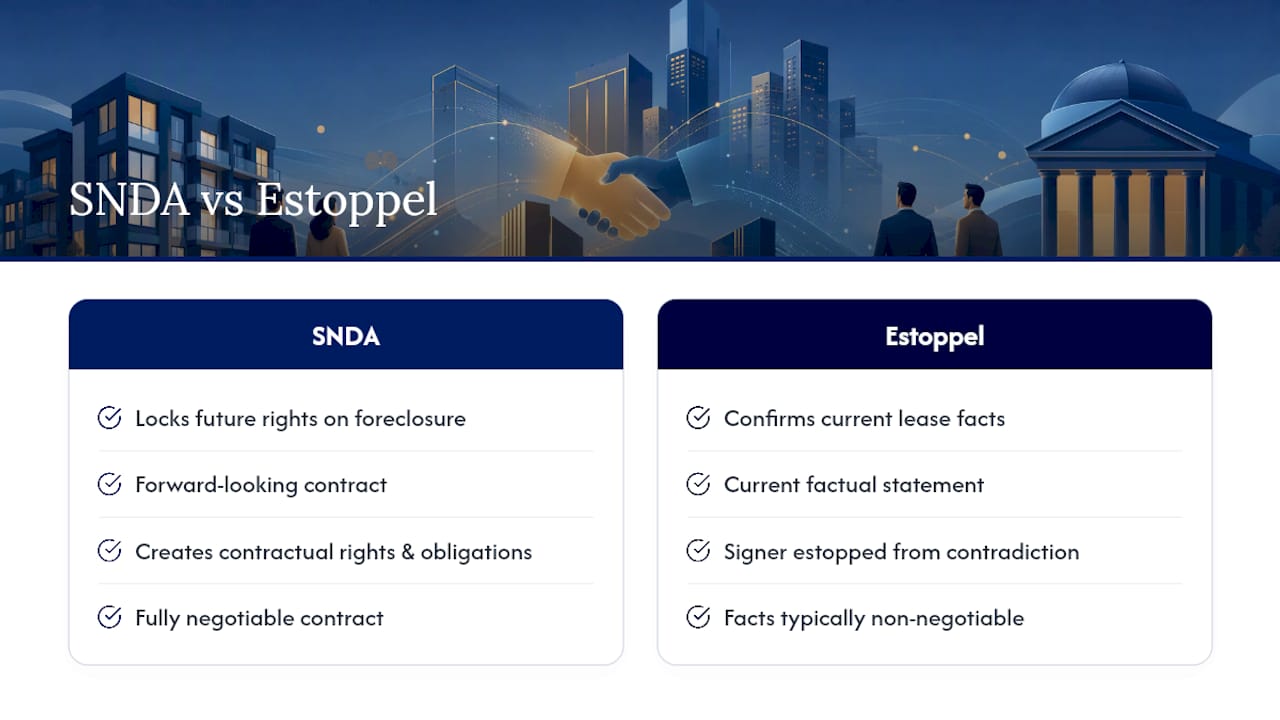
An estoppel certificate is a statement of current facts: the lease is in effect, rent is current, no defaults exist, the landlord has performed all obligations to date. It is a snapshot. The party signing it is estopped (legally prevented) from later claiming facts that contradict what they certified. Holland & Knight draws the distinction clearly: an SNDA governs future rights in a foreclosure scenario, while an estoppel is a current factual confirmation of lease status for a lender or buyer.
An SNDA is forward-looking. It creates contractual rights and obligations that govern what happens if the ownership structure changes. You cannot revoke an SNDA the way you might correct an estoppel; it is a binding tripartite contract.
At loan closings and property sales, lenders and buyers typically request both. The estoppel confirms the lease is what the landlord represented it to be during underwriting. The SNDA locks in the parties’ rights going forward. Estoppel inaccuracies create post-closing disputes because a buyer or lender who relied on a certified fact has a claim against the certifying party. That is why tenants should review estoppel certificates with the same care they give to the SNDA itself.
For a deeper look at what lenders and investors verify through estoppel certificates, Ardorcre’s guide to estoppel certificate review walks through the process in detail.
One procedural difference worth noting: estoppel certificates are typically non-negotiable in their factual content (you either certify the facts or you note exceptions), while SNDAs are fully negotiable contracts. The SNDA has legal consequences that extend years beyond the closing; the estoppel’s consequences are tied to the accuracy of the facts at the time of signing.
How a commercial real estate advisor can help with SNDAs
Most tenants encounter their first SNDA when a lender sends a form with a 10-day deadline. That is the worst possible moment to start learning what the document does. A commercial real estate advisor or lease analyst can intervene much earlier and at several key points in the transaction lifecycle.
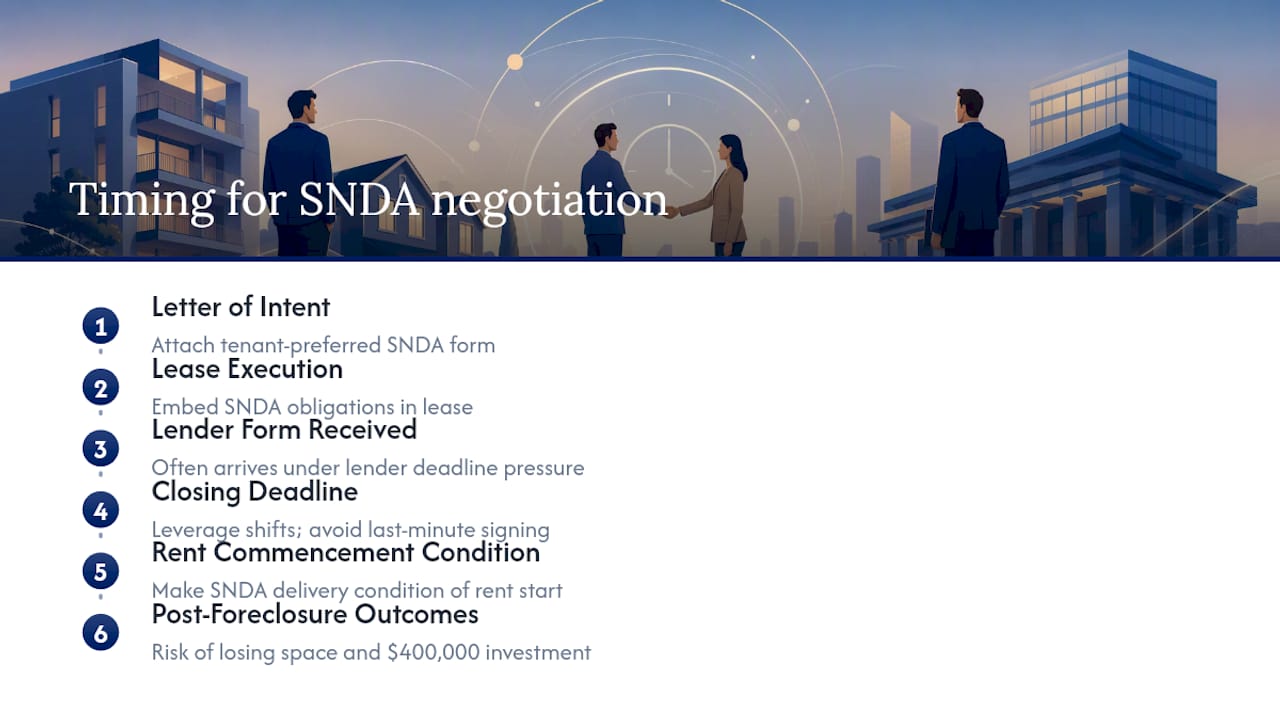
Before lease execution: An advisor can attach a tenant-preferred SNDA form to the letter of intent, negotiate SNDA obligations into the lease itself, and flag properties where the existing mortgage terms create unusual SNDA risks. MHC Law recommends negotiating SNDA terms at the lease stage rather than reacting to a lender’s form later.
During loan underwriting: Advisors coordinate between the tenant, landlord, and lender to keep the SNDA process on schedule. Delays in SNDA execution are a common cause of loan closing delays, and an advisor who knows the lender’s timeline can prevent that.
At loan closing or refinance: A lease abstract that captures SNDA execution status, lender identity, and non-disturbance conditions is a standard part of closing due diligence. A missing SNDA is a material risk item that should appear on every closing checklist.
When to call an attorney versus a broker or lease analyst: complex indemnity provisions, unusual successor obligations, and state-specific enforceability questions require a real estate attorney. Advisors handle coordination, abstraction, negotiation support, and form attachment. Attorneys handle the legal analysis of unusual clauses and jurisdiction-specific enforceability.
Ardorcre’s advisors in the Charlotte MSA provide lease abstraction, SNDA coordination, and tenant and landlord representation across office, medical, retail, and industrial properties. When a lender’s form arrives, having an advisor who already knows the lease is the difference between a 10-day scramble and a controlled review.
Key Takeaways
An SNDA agreement protects all three parties in commercial leasing, but only if it is properly negotiated, executed, and recorded before a foreclosure event occurs.
| Point | Details |
|---|---|
| Insist on full non-disturbance | Confirm the clause covers renewal options, TI allowances, and rent abatements, not just the right to occupy. |
| Verify successor performance obligations | Negotiate explicit language on what the new owner must assume after foreclosure, especially unpaid TI work. |
| Tie rent commencement to SNDA execution | Tenants with significant buildout investment should condition rent start on a fully executed SNDA when possible. |
| Record the SNDA | File the executed agreement in the county where the property sits; an unrecorded SNDA may not bind future purchasers. |
| Ardorcre lease analysis | Ardorcre’s lease abstraction and closing coordination services flag missing SNDAs as material risk items before closing. |
The non-disturbance clause is the one you cannot afford to skip
Most tenants focus on rent, term, and tenant improvement allowances when negotiating a commercial lease. The SNDA lands on the desk weeks or months later, often under deadline pressure from a lender, and tenants sign it without reading it carefully because the deal is already done. That is the wrong sequence.
The non-disturbance clause is, in practice, the most important protection a commercial tenant can secure. Real estate counsel consistently say that tenants underestimate its value until a foreclosure actually happens, at which point the absence of that clause is catastrophic. A tenant who spent $400,000 on a medical office buildout and signed a lender’s standard SNDA without negotiating successor performance obligations could lose both the space and the investment if the landlord defaults.
What I see repeatedly in commercial deals is that tenants treat the SNDA as administrative paperwork rather than a negotiating opportunity. It is not. The moment a lender sends that form, the leverage dynamic shifts. The lender’s form is written entirely in the lender’s interest. Tenants who push back with a tenant-preferred form, or who have already embedded SNDA obligations in the lease, consistently get better outcomes.
The practical advice is simple: address the SNDA at the letter of intent stage, attach a preferred form, and make SNDA delivery a condition of rent commencement if you are making a capital investment in the space. Waiting until the lender sends a form under a closing deadline is not a strategy.
Ardorcre helps you navigate SNDA review and lease closing
Tenants and landlords in the Charlotte MSA deal with SNDA requests at every stage of a commercial transaction, from initial lease signing on an encumbered property to refinancing years into a tenancy. The difference between a protected lease and an exposed one often comes down to whether the SNDA was reviewed carefully before it was signed.

Ardorcre’s advisors provide lease abstraction and SNDA tracking that captures execution status, lender identity, and non-disturbance conditions as part of every closing checklist. For tenants making significant tenant improvement investments, that review happens before rent commences. For landlords coordinating lender requirements across multiple tenants, Ardorcre manages the timeline so financing does not stall. Whether you are at the LOI stage, approaching a refinance, or reviewing a lender’s SNDA form under deadline, reach out to Ardorcre to get an advisor on your side before you sign.
Useful sources for further reading
The following sources provide authoritative guidance on SNDA agreements, sample forms, and negotiation frameworks for commercial real estate practitioners.
- SNDAs from the Tenant’s Perspective: What to Negotiate and Why It Matters | Insights | Holland & Knight
- Tenant’s Form Subordination, Non-Disturbance, and Attornment Agreement (ACRE sample form)
- SNDA Agreements Explained: What Tenants Need to Know | Lextract
- Demystifying Subordination, Non-Disturbance, and Attornment (SNDA) Agreements | LiffWalsh
- Part 21*: What is a “SNDA” in a commercial lease? | Betensky Law
- What is an SNDA and When do I Need One? | MHC Law