
Choose single-tenant net lease if you want predictable, largely passive income backed by a long lease. Choose multi-tenant if you want growth potential and don’t mind hands-on management. Single-tenant suits income-focused owners who accept concentrated risk for stability; multi-tenant suits growth-focused owners willing to manage turnover in exchange for repricing power.
TL;DR:
- Single-tenant properties typically sign 10 to 20 year triple-net leases, which focus on stability but create full vacancy risk if the tenant leaves.
- Multi-tenant buildings usually have 3 to 7 year leases, offering more flexibility to reprice rents but requiring active management of multiple tenants and shared expenses.
- Financing for single-tenant deals favors strong tenants with long leases, but any vacancy can trigger immediate risks, while multi-tenant loans are more conservative, allowing for vacancy allowances.
- Management costs differ significantly: single-tenant ownership is more passive, requiring handling only one relationship, whereas multi-tenant ownership demands managing multiple lease renewals, shared expenses, and frequent capital expenses.
- Evaluating vacancy risk with conservative modeling of possible periods before purchase is essential, especially for single-tenant deals, to ensure the asset remains resilient under downturn scenarios.
Table of Contents
- Single Tenant vs Multi Tenant: The Core Structural Differences
- How Single Tenant vs Multi Tenant Impacts Your Financial Returns
- What Management and Maintenance Actually Cost You
- How to Choose Between Single-Tenant and Multi-Tenant Assets
- Why ArdorCRE Sees This as a Fit Question, Not a Rankings Question
- How ArdorCRE Helps You Underwrite the Right Asset
- Sources
Single Tenant vs Multi Tenant: The Core Structural Differences
The gap between these two asset types starts with the lease itself, and everything else follows from there.
Single-tenant properties typically run 10 to 20 year leases, often structured as triple-net (NNN), where the tenant covers property taxes, insurance, and most operating costs. Multi-tenant buildings work on a different clock. Leases usually last 3 to 7 years, and the landlord is more likely to carry gross or modified gross terms, absorbing a share of operating expenses rather than passing all of it through.
That structural split creates very different risk exposure:
- Vacancy risk: a single-tenant asset goes from fully leased to fully vacant overnight if that one tenant leaves, while a multi-tenant property spreads that risk across several rent rolls, so one vacancy dents income without stopping it.
- Lease complexity: absolute NNN deals push taxes, insurance, and many capital obligations onto the tenant, but not every NNN lease is “absolute.” Some modified versions leave roof and structure with the landlord, so the fine print matters.
- Operational load: multi-tenant ownership means juggling several relationships, several renewal dates, and common area maintenance (CAM) reconciliations every year, something a single-tenant deal simply doesn’t require.
None of this makes one format objectively better. It just means the tenant mix determines how much attention the asset demands and how exposed you are to a single point of failure.
How Single Tenant vs Multi Tenant Impacts Your Financial Returns
Cash flow behaves differently depending on which structure you own, and that difference shows up in cap rates, financing, and how you time an exit.
Single-tenant NNN income is steady almost by design. A creditworthy tenant on a long-term lease produces the kind of predictability that compresses cap rates, because buyers pay a premium for certainty. Multi-tenant assets trade some of that certainty for upside. As leases roll, owners can reprice units to market rent, which is exactly how a well-managed strip center outgrows its original underwriting in a rising market.
Financing follows the same logic. Lenders sizing a loan against debt-service coverage ratio (DSCR) tend to favor single-tenant deals with strong tenant credit, since the income stream is easier to model. But that same simplicity cuts both ways: if the tenant vacates, the loan covenant risk hits immediately, with no other rent roll to soften the blow. Multi-tenant loans often price in a vacancy allowance from day one, which can mean more conservative leverage but less shock if one tenant leaves.
- Single-tenant exits work best timed well before lease expiration, when term remaining still supports institutional pricing.
- Multi-tenant exits benefit from a fresh rent roll, ideally right after a wave of renewals at market rates.
Pro Tip: Before you underwrite a single-tenant deal, model the loan at a conservative DSCR assuming 12 to 24 months of vacancy. If the numbers still work, you’ve found a genuinely resilient asset.
What Management and Maintenance Actually Cost You
Budgeting for these two property types isn’t just about square footage. It’s about how many relationships and how much recurring administration you’re signing up for.
- Single point of contact vs a roster of tenants. One lease means one relationship to manage, which is a real reason single-tenant ownership skews passive. Multi-tenant ownership means several lease files, several renewal timelines, and several personalities to manage at once.
- CAM reconciliation. Multi-tenant landlords must track shared expenses, reconcile estimated CAM charges against actuals annually, and bill or refund tenants accordingly. This is one of the most underestimated administrative burdens in multi-tenant ownership.
- Capital expense cadence. Roofs, paving, and HVAC systems age on their own schedule regardless of tenant count, but multi-tenant assets see more frequent capex triggers tied to tenant improvement allowances during turnover.
- When to outsource. Once you own more than two or three tenant suites, or the asset sits outside your local market, third-party property management usually pays for itself in reduced vacancy and cleaner books. Budget accordingly with a property management plan before you close, not after.
How to Choose Between Single-Tenant and Multi-Tenant Assets
Run this checklist before you write an offer, not after you own the building.
- Define your objective first. If you need dependable, largely hands-off income for the next decade, single-tenant NNN fits. If you’re chasing growth and can handle active management, multi-tenant offers more upside through rent repricing.
- Check tenant credit and lease term remaining. A single-tenant deal is only as strong as the tenant behind it. Pull financials, review the lease abstract for escalation clauses, and confirm how many years remain before renewal risk kicks in.
- Stress-test vacancy. Model a 12 to 24 month dark period on any single-tenant acquisition and see if the debt service still holds. For multi-tenant deals, model a rolling vacancy of one or two suites at a time.
- Price in management cost. The gap between self-managing a single-tenant NNN deal and running a five-tenant strip center is not small. Bake that differential directly into your NOI projections, not as an afterthought.
Statistic to remember: single-tenant leases commonly run 10 to 20 years against 3 to 7 years for multi-tenant deals, a gap wide enough to change how you finance, hold, and eventually sell the asset.
Why ArdorCRE Sees This as a Fit Question, Not a Rankings Question
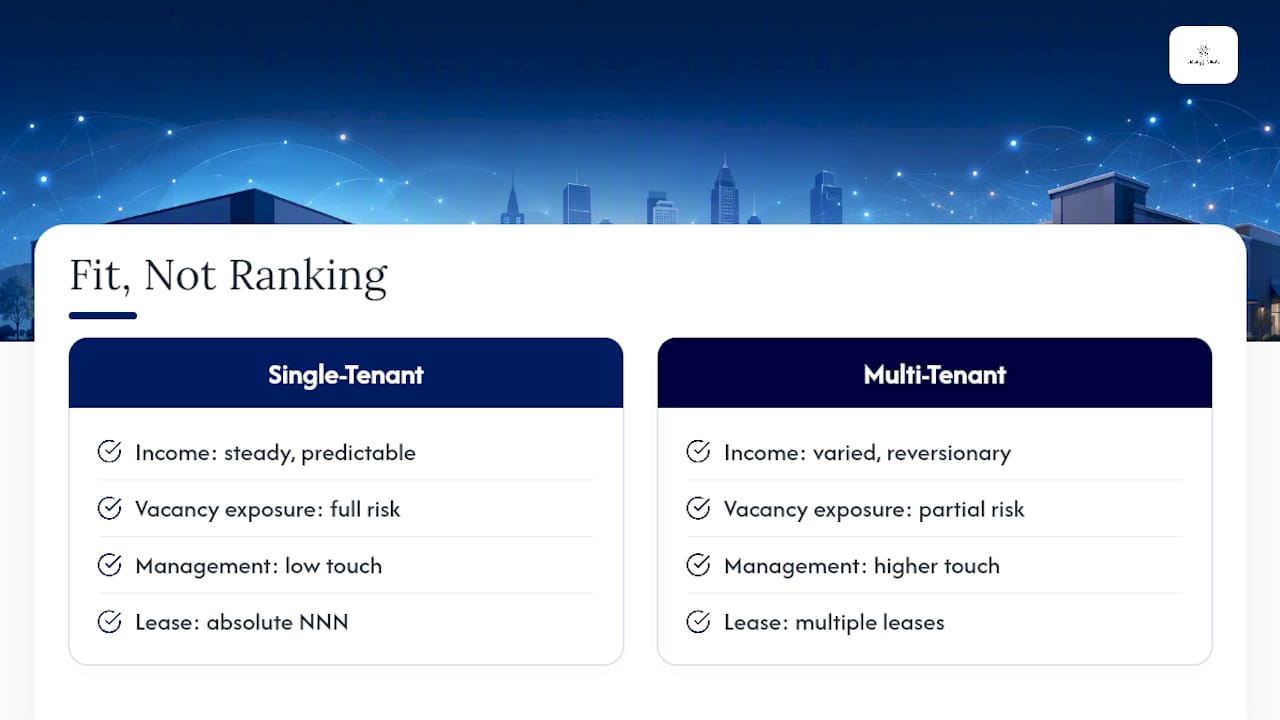
Owners often ask which asset type performs better. Wrong question. The real question is which one performs better for you, given your appetite for risk and your bandwidth to manage tenants.
Take two live scenarios: an investor buying a single-tenant convenience store on an absolute NNN lease wants boring, dependable income and is willing to accept full vacancy exposure for it. A second investor buying a three-tenant retail strip wants the ability to push rents on renewal and doesn’t mind fielding three sets of tenant calls instead of one. Both are sound strategies. Only one fits a given balance sheet and temperament. Before committing capital, review the triple-net lease structure behind any single-tenant deal, and confirm your DSCR assumptions against realistic vacancy, not best-case leasing.
— Jim
How ArdorCRE Helps You Underwrite the Right Asset
Deciding between a single-tenant NNN deal and a multi-tenant retail strip gets a lot easier when someone has already pulled the lease abstract, run the DSCR numbers, and modeled the vacancy downside for you. That’s the gap ArdorCRE closes for owners across the Charlotte MSA: acquisition and lease advisory, lease abstraction, loan sizing, and property management budgeting, all handled by advisors who work both sides of the table as landlord and tenant representatives.

If you’re weighing a specific deal right now, request a lease abstract on the property in question, or run a DSCR sizing call before you submit an offer. Either step takes the guesswork out of the financing conversation and tells you, in real numbers, whether the asset matches your goals. Schedule a consultation with ArdorCRE to walk through your specific underwriting scenario.
Sources
- Characteristics of Single Tenant vs. Multi-Tenant Commercial Real Estate Investments
- Triple net lease — Cornell Law School Legal Information Institute
- The Advantages and Disadvantages of Single-Tenant vs Multi-Tenant Investment Properties – Financial Poise
- Single-Tenant vs. Multi-Tenant Properties: Which CRE Investment is Right for You?