
Most Charlotte restaurant space is advertised between about $20 and $48 per square foot per year. Specialty units such as ghost kitchens run far higher. A 2,000 SF restaurant at $32 per SF costs $64,000 a year, or $5,333 a month, in base rent alone. Your real occupancy cost depends on the lease structure, the pass-through charges and the condition of the space. The sections below show what listings say, how to turn a quoted rate into a monthly budget, and what to check before you sign.
TL;DR
- Current Charlotte listings for conventional restaurant space range from roughly $32 to $48 per SF per year, with older or less visible space asking less.
- Many asking rates are NNN. Taxes, insurance and common area maintenance come on top of base rent.
- An “average Charlotte restaurant rate” misleads, because the listing pool mixes tiny specialty stalls, ordinary retail shells and large boxes.
- Existing hood, grease trap, ventilation and utility capacity can matter more than a few dollars of base rent.
- Get the lease reviewed and the CAM history in hand before you sign.
Table of Contents
- What Charlotte restaurant space is asking right now
- Turning a per-SF rate into a monthly number
- Why a single “average” misleads
- The costs that move your real occupancy cost
- How to compare locations in Charlotte
- Our perspective: price the building, not the average
- Working with us on a restaurant lease
- FAQ
- Sources
What Charlotte restaurant space is asking right now
Listings are the best public evidence of rates, but treat them as asking prices, not what tenants pay. A snapshot of Charlotte restaurant listings on LoopNet from May 2025 showed an average ask of about $30 per SF and an average listing size of about 3,166 SF. Individual listings ran from 150 SF to 10,340 SF. Portal counts change constantly, so use that as a reference point rather than a census.
A recent CityFeet restaurant search for Charlotte shows a wider spread across neighborhoods:
| Location | Size | Asking rate (per SF per year) |
|---|---|---|
| 28204 (1950 building) | 3,781 SF | $47.61 |
| 3232 South Blvd (28209) | 7,982 SF | $45.00 |
| 9518 University City Blvd (28213) | 3,712 SF | $40.00 |
| 1001 E WT Harris Blvd (28213) | 1,900 to 5,300 SF | $32.00 |
The pattern is what you would expect. Central, high-visibility addresses ask the most. University-area and east-side corridors ask less. South End sits at the top for small units: one Lower South End listing shows 187 to 246 SF ghost-kitchen spaces at roughly $173 to $196 per SF per year. That is an all-in, turnkey product with delivery access, not a storefront, so do not compare it with a standard shell.
Turning a per-SF rate into a monthly number
Quoted rates are annual and per square foot. Divide by 12 after multiplying by the size.
One Independence Boulevard center lists three spaces, all NNN:
| Size | Rate | Base rent per month |
|---|---|---|
| 1,700 SF | $24.00 per SF per year | $3,400 |
| 2,500 SF | $22.00 per SF per year | $4,583 |
| 3,200 SF | $22.00 per SF per year | $5,867 |
Those figures exclude utilities, property expenses and building services. That is the gap that surprises first-time operators. If a landlord tells you the rent is $3,400, ask what the monthly total is once the NNN charges are added.
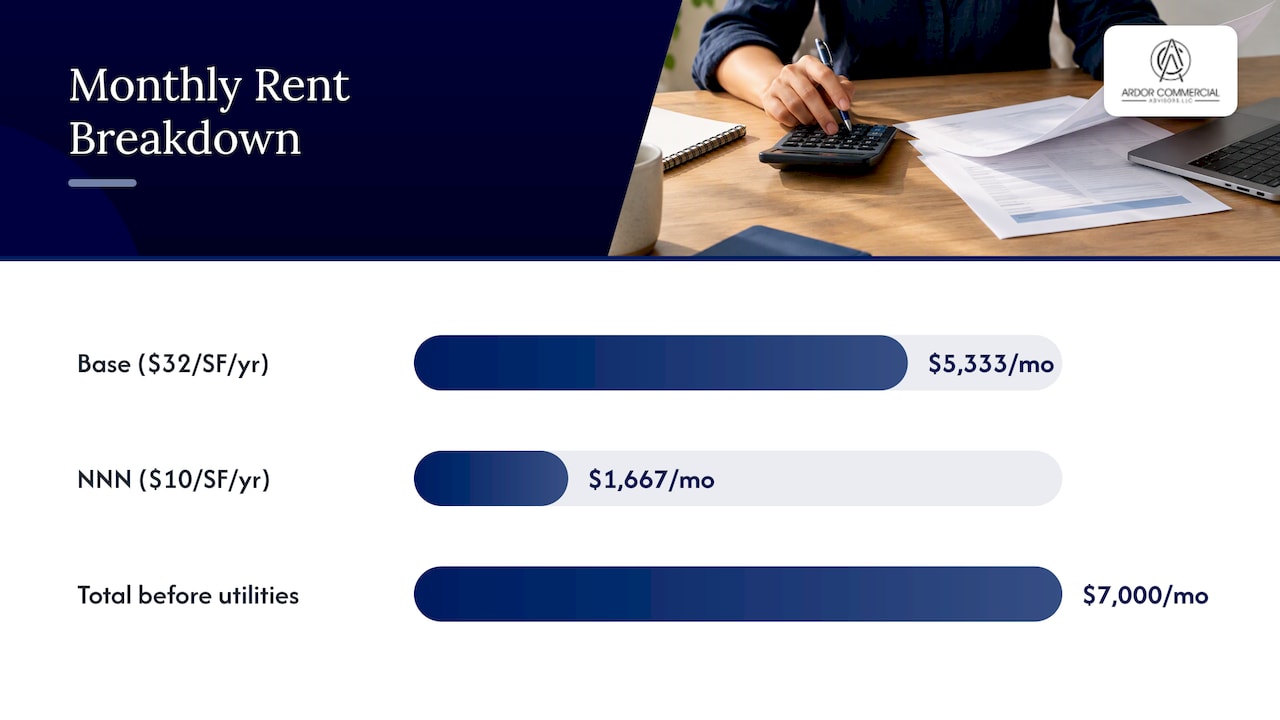
Here is a simple worked example with an assumption you should replace with the landlord’s real numbers. Say you lease 2,000 SF at $32 per SF NNN. Base rent is $5,333 a month. If the NNN charges were $10 per SF (an illustrative figure, not a market quote), you would add $1,667 a month, for $7,000 in total before utilities. Ask for the actual per-SF estimate and the prior-year reconciliation.
Why a single “average” misleads
The listing pool mixes second-generation restaurant space, ordinary retail shells, food-hall or ghost-kitchen stalls and large boxes. Lease structure, condition and pass-through costs are not standardized across them. A $24 NNN space and a $32 modified gross space may cost nearly the same once everything is included. Use averages to set an expectation, then price specific buildings.
The costs that move your real occupancy cost
NNN, CAM and what sits outside the quoted rate
In a triple net lease, you pay your share of property taxes, insurance and common area maintenance in addition to base rent. Our guide to the triple net lease for tenants and landlords explains how those pieces are built. Landlords and lenders both read lease income line by line, which is why rent roll underwriting pays so much attention to gaps between quoted and collected rent. As a tenant, you can use the same discipline: ask what is billed monthly, what is trued up annually, and what is capped.
CAM reconciliation is where errors hide. Our CAM charge and lease review service exists for exactly that reason: checking whether the charges you are billed match what the lease allows.
Second-generation space versus a vanilla shell
Second-generation space already has some of the infrastructure a restaurant needs. Existing hood, grease trap, ventilation, utility capacity, patio rights, parking and zoning can matter more than a small difference in base rent. A cheaper shell that needs a hood, a grease interceptor and new electrical service can cost far more in the first year than a pricier second-generation space where you can open with light modifications.
Before you tour, ask the landlord or broker for:
- Whether a hood and make-up air system are in place, and whether they are included in the lease or owned by the prior tenant.
- Grease trap or interceptor size and its condition.
- Electrical, gas and water capacity, in amps and line size.
- Whether the permitted use already includes a restaurant, and any patio or outdoor seating rights.
- Parking counts and any shared-parking restrictions.
If you want a landlord contribution to the buildout, understand how a landlord work letter is structured so the allowance, scope and delivery condition are all written down.
Tenant improvement allowance and free rent
A higher rate with a generous tenant improvement allowance can beat a lower rate with none, particularly on a 10-year term. Negotiate the allowance, free rent period and rent steps together. Our guide to negotiating a first retail lease covers how a letter of intent can lock TI and CAM terms before the lease draft arrives.
Personal and corporate guarantees
New restaurant concepts are often asked for a personal guarantee. A guarantee can sometimes be limited in amount or burned off over time. See how a corporate guarantee lease can be capped and negotiate that before the signature page.
How to compare locations in Charlotte
Traffic, parking and the neighboring uses drive restaurant sales more than they drive rent. The Independence Boulevard listing above, for example, is pitched on traffic counts, a dealership corridor and nightlife and dining. South End charges more per square foot for walkability and density. University City and east-side corridors may offer larger floor plates at lower rates.
Pick two or three candidate trade areas, then compare them on the same sheet: base rent, NNN estimate, buildout needed, and the sales you would need to cover occupancy. Our retail site selection playbook walks through that data-driven comparison.
Our perspective: price the building, not the average
We see operators anchor on a single number from a listing site and then get surprised by the second and third lines of the budget. The rate is just the start of the conversation. What decides whether a lease works is the total occupancy cost relative to what the concept can sell, and the lease terms that protect you if the first two years are slower than the plan.
Our advice is practical. Build a one-page comparison per space. Ask for the CAM history. Read the assignment, relocation and personal guarantee clauses with the same attention as the rent. Have someone who negotiates leases every week sit on your side of the table, because the landlord’s side certainly has one. Charlotte’s market is local down to the block, and we work it every day as Charlotte-area commercial brokers.
— Jim
Working with us on a restaurant lease
If you are choosing between spaces, our advisors do tenant representation and lease review across the Charlotte MSA. We can help you compare buildings on total cost, check the lease against what was quoted, and negotiate allowances and terms. See everything we do on our services page, or reach us through ardorcre.com.
FAQ
How much does it cost to lease restaurant space in Charlotte?
Listed asking rates for conventional restaurant space run from about $22 to $48 per SF per year, depending on location, age and size. A 1,700 SF space at $24 NNN works out to $3,400 a month in base rent before pass-throughs. Specialty ghost-kitchen units ask far more per SF because they are tiny and turnkey.
What does NNN mean on a restaurant listing?
It means the tenant pays a share of property taxes, insurance and common area maintenance in addition to base rent. The listed rate excludes those charges, and often utilities too. Ask the landlord for the current per-SF estimate and last year’s reconciliation.
Is second-generation restaurant space worth a higher rent?
Often, yes, when the hood, grease trap and utilities are in place and fit your concept. Those items can cost far more to install than a few dollars per SF of rent over the term. Have a contractor confirm the equipment’s condition before you commit.
Can I negotiate a restaurant lease rate in Charlotte?
Yes. Asking rates are starting points, and base rent is only one lever. Tenant improvement allowance, free rent, rent escalations, CAM caps and guarantee terms can often move too.
Sources
- Charlotte Restaurants for Lease, LoopNet
- Charlotte, NC Restaurants For Lease, CityFeet
- Independence Promenade, 5301-5323 E Independence Blvd, LoopNet
- South End Eats, 500 W Summit Ave, LoopNet