
Negotiate the letter of intent before you touch the lease draft, hire a tenant rep broker when the deal size justifies it, and get a retail-focused attorney reading before you sign anything. Lock the economics first: tenant improvement (TI) money, CAM caps, co-tenancy protection, and a guarantee that ends. Before that first call with a landlord, pull comps, gather your financials, draft your LOI priorities, and set a realistic timeline.
TL;DR:
- Securing professional representation, especially a tenant broker, can provide valuable market comps and leverage, but is often unnecessary for short-term or small deals.
- Negotiating and locking in key financial terms like tenant improvement allowances, CAM caps, and rent commencement dates upfront avoids costly surprises later in the deal.
- Operational clauses such as CAM, co-tenancy, and exclusivity should be carefully negotiated with caps, cure periods, and clear language to minimize ongoing costs and risks.
- Pay close attention to personal guarantees, CAM audit rights, renewal formulas, and relocation clauses, as unfavorable terms in these areas can lead to long-term financial losses.
- An LOI-first approach ensures the core deal terms are set early, preventing them from being buried or altered during the lengthy lease drafting process.
Table of Contents
- What Should You Prepare Before Retail Lease Negotiation Begins?
- How Do You Negotiate the Money Terms in a Retail Lease?
- What Operational Clauses Actually Determine Your Risk?
- What Red Flags Should Stop You From Signing?
- What Do Experienced Tenant Advocates Push For That Others Miss?
- Why an LOI-First Approach Protects You
- How a commercial real estate advisor can help you negotiate a retail lease
- Sources
- FAQ
What Should You Prepare Before Retail Lease Negotiation Begins?
A landlord’s leasing agent negotiates commercial space for a living. You do it once every five to ten years. That imbalance is exactly why preparation matters more here than in almost any other business negotiation you’ll have this year.
Start with the question of representation. A tenant rep broker typically costs you nothing directly, since the landlord pays the commission, usually 4% to 6% of the total rent over the lease term. In exchange, that broker brings comps you can’t easily get on your own, knowledge of which centers have vacancy pressure, and leverage in a room where the other side negotiates leases full time. For a short-term pop-up or a single small suite, direct negotiation can work fine. For a multi-year retail or restaurant lease with real capital at stake, professional representation earns its keep.
Comps do the heavy lifting in any rent argument. If three spaces within a mile are sitting vacant, or asking rents in the corridor have softened, that’s your justification for a lower base rent or a longer free rent period. Landlords rarely volunteer this data. You have to bring it to the table yourself, or have your broker bring it.
Before you sign an LOI, build a cash-flow model that includes your build-out budget, when TI dollars actually arrive, and what rent you’re paying during construction. Tie your lease length to how you’re amortizing that capital. A five-year term on a $150,000 build-out rarely pencils out; a ten-year term with a renewal option usually does.
- Confirm whether you need broker representation or can negotiate directly.
- Pull rent and vacancy comps for the trade area.
- Model TI funding against your actual construction draw schedule.
- Decide your target lease term based on capital payback, not just what feels comfortable.
Pro Tip: Ask your broker for the landlord’s leasing history on that specific center. A landlord who’s given three other tenants a CAM cap will give you one too, once you ask.
How Do You Negotiate the Money Terms in a Retail Lease?
Every dollar in a retail lease negotiation traces back to five levers: base rent, escalations, TI, rent commencement, and (for many retail tenants) percentage rent. Get these wrong and you can overpay for a decade without ever missing a payment.
- Base rent. Use your comps to argue the number, not your gut feeling about what you can afford. If vacancy in the corridor is climbing, ask for a lower starting rent or a phased step-up instead of a flat rate from day one.
- Rent commencement. Push hard on when rent actually starts. Tie it to practical milestones such as delivery of the space or your certificate of occupancy, rather than simply possession, to avoid paying rent during construction without revenue.
- TI allowance. TI allowances in retail deals typically range within a broad per square foot amount common in the industry, and they’re usually paid as reimbursements rather than cash up front. Negotiate a milestone schedule instead of a single payment at final completion, request lien waivers tied to each draw, and cap retainage at a level your contractor can live with.
- Escalations. Fixed percentage bumps (3% is common) are predictable and easy to model. CPI-based escalations track inflation but can spike unexpectedly, so if you accept one, insist on a cap, often 3% to 5% annually, so a bad inflation year doesn’t blow up your budget.
- Percentage rent. If your lease includes it, restaurant percentage rent typically runs 6% to 10% of gross sales, apparel 4% to 7%, and jewelry 8% to 12%. Push the breakpoint higher, exclude returns, refunds, sales tax, and e-commerce fulfilled from other locations, and insist on the right to audit the landlord’s calculation.
Rent abatement during build-out deserves its own line item in the LOI. Ask for a defined number of abated months tied to construction duration, not a vague “reasonable time” promise that gives the landlord room to interpret it however benefits them later.
What Operational Clauses Actually Determine Your Risk?
Rent gets the attention, but CAM, co-tenancy, exclusivity, and assignment clauses are where retail tenants quietly lose money for years without noticing.
CAM charges should be split into controllable and uncontrollable expense buckets. Controllable items, such as landscaping, management fees, and general repairs, can carry an annual increase cap around 3% to 5%. Uncontrollable costs like property taxes and insurance typically stay uncapped because the landlord doesn’t control them either. Beyond the cap, insist on annual reconciliation statements and a 30 to 90 day window to audit the landlord’s books, with a one to three year lookback period if you ever suspect a past charge was wrong.
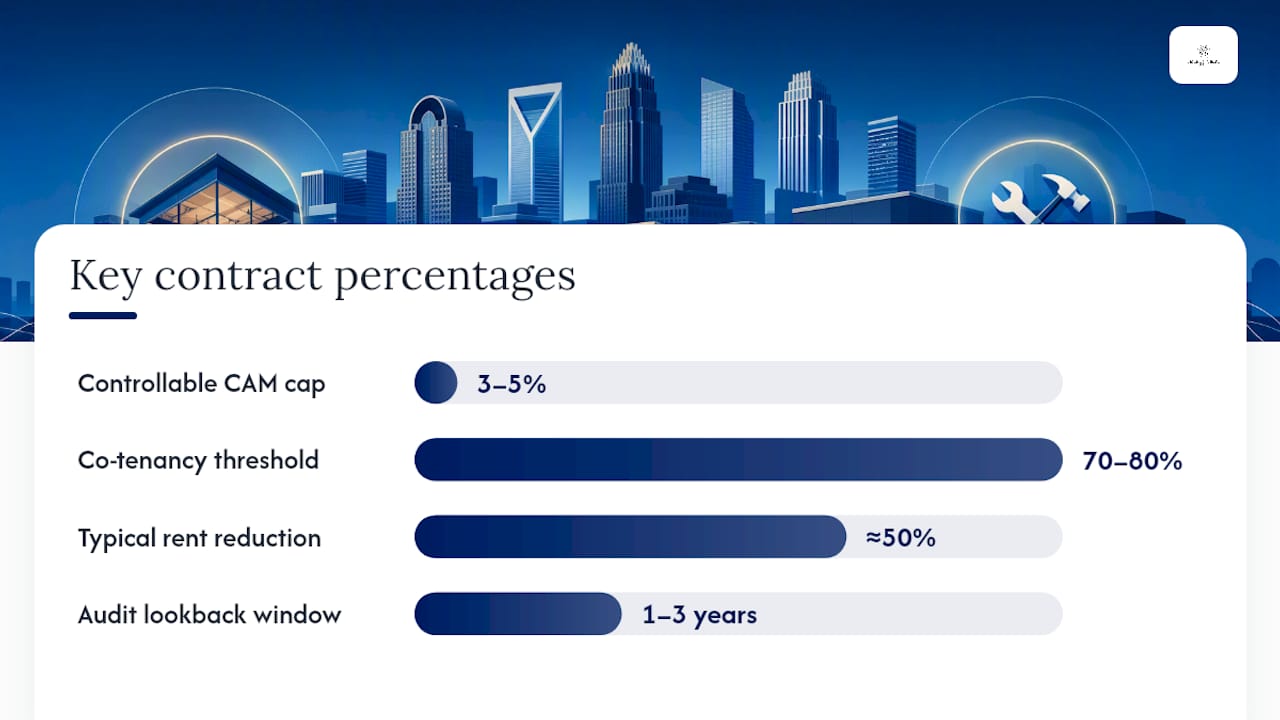
Co-tenancy provisions protect you when an anchor tenant leaves or the center’s occupancy drops. Ongoing co-tenancy remedies commonly kick in when center occupancy falls below roughly 70% to 80%, triggering either a rent reduction, often around 50%, or a termination right if the vacancy persists past a defined cure period. Push for termination rights, not just rent relief, if an anchor stays dark for six to twelve months.
Exclusivity clauses should be narrow. You want the landlord barred from leasing to a direct competitor selling the same primary product category within the center, not a blanket restriction that’s unenforceable and invites disputes.
- Negotiate a controllable CAM cap and annual audit rights.
- Set co-tenancy thresholds with a defined cure period and a real termination option.
- Keep exclusivity language tied to your specific product category, not a vague competitor description.
- Remove relocation clauses entirely, or require equivalent space plus reimbursement for moving and re-build-out costs.
- Require landlord consent to assignment or subletting “not to be unreasonably withheld,” with carve-outs for transfers to affiliates or a business sale.
Pro Tip: If a landlord won’t budge on a CAM cap, ask for a total occupancy cost cap instead, a combined ceiling on rent plus CAM plus taxes. It gets you the same protection through a different door.
What Red Flags Should Stop You From Signing?
Some lease terms are worth losing the deal over. A few are common enough that you should assume you’ll see them, and plan your pushback in advance.
- Unlimited personal guarantee. If the landlord doesn’t accept a burn-off or a capped guarantee, that’s a real warning sign about how they’ll treat you post-signing.
- No CAM cap or audit right. Without either, you have no defense against an unpredictable pass-through bill each year.
- Vague renewal formula. “Fair market rent” with no defined method for determining it invites a dispute exactly when you have the least leverage, at renewal time.
- Relocation without compensation. A clause letting the landlord move you to a worse spot with no reimbursement should never make it into a signed lease.
- Mismatch between LOI and lease draft. Compare the final lease against your LOI line by line. Confirm the TI reimbursement schedule, verify the commencement date language, check cure periods, and calendar every renewal and notice deadline before you sign.
Most retail deals take two to four rounds of LOI revisions and another one to three rounds on the lease draft itself, roughly four to eight weeks total, though complex build-outs or multi-location deals can run longer.
What Do Experienced Tenant Advocates Push For That Others Miss?
The details that separate a survivable lease from a painful one usually live in the fine print of reimbursement timing and guarantee language, not the headline rent number.
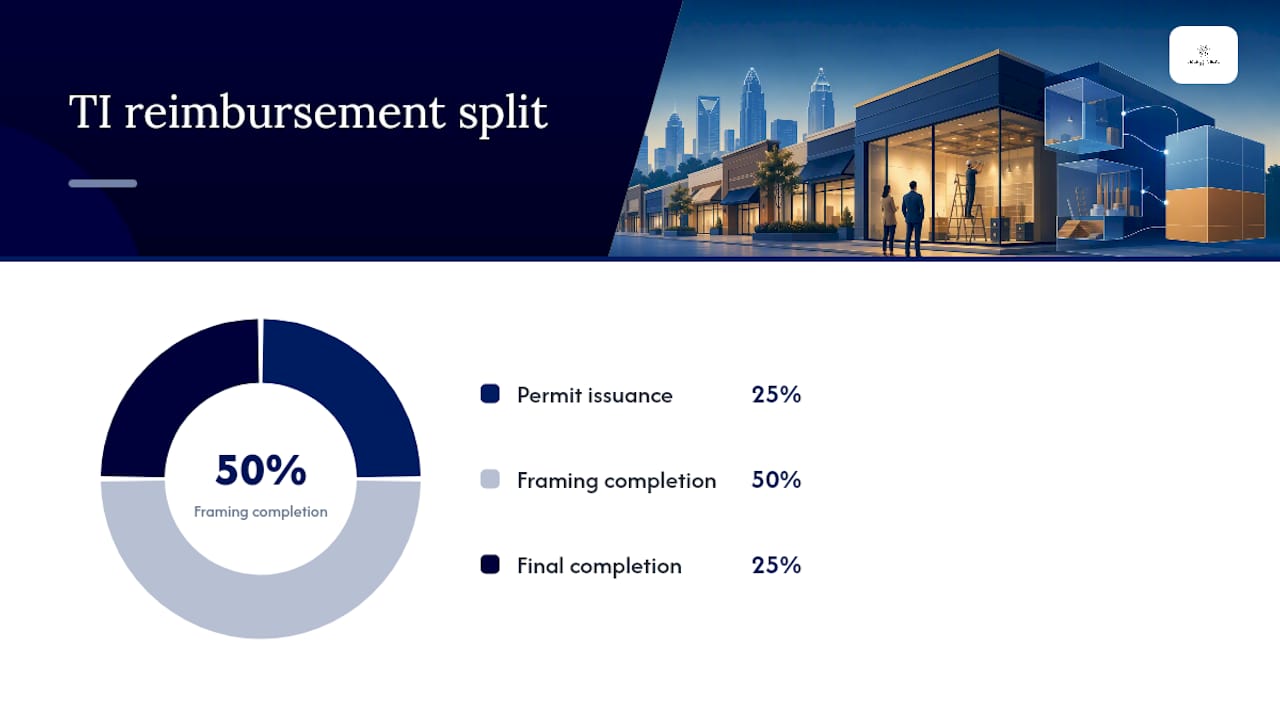
Structure TI reimbursement by construction milestone: for example, 25% at permit issuance, 50% at framing completion with a lien waiver, and the final 25% at completion with a final lien waiver. That schedule keeps you from fronting six figures of construction cost while waiting on a landlord’s accounting department.
On personal guarantees, propose a burn-off provision. A 12 to 36 month burn-off that releases the guarantor after a defined stretch of on-time rent payments is realistic for most tenants with a track record or extra security to offer. If you have a franchisor or a lender in the picture, disclose those financing conditions in the LOI stage and negotiate landlord consents, like lien waivers or a collateral assignment, before they become a closing-week scramble.
- Stage TI draws to match construction milestones, not a single lump payment.
- Negotiate a guarantee burn-off tied to a clean payment history.
- Bring lender and franchisor requirements into the LOI early, not after the lease is drafted.
- Weigh a longer term against a bigger TI allowance using renewal NPV thinking rather than gut feel.
Why an LOI-First Approach Protects You
The letter of intent decides more than most tenants realize. Once a landlord’s attorney turns your agreed terms into 40 pages of lease language, small concessions you thought were settled tend to disappear or get buried in a subordinate clause. Get the economics locked in writing at the LOI stage, before legal fees and momentum make everyone reluctant to reopen anything. A broker earns their commission most in the first two weeks of a deal, not the last two. Keep every renewal date, notice deadline, and TI milestone on one calendar you actually check.
— Jim
How a commercial real estate advisor can help you negotiate a retail lease
You don’t have to build your LOI priorities alone or guess at what a CAM cap should look like for your center. Ardorcre works with retail tenants across the Charlotte MSA on tenant representation, lease review, CAM reconciliation analysis, TI allowance negotiation, and lease abstraction, the same clause-level details covered above, applied to your actual deal.
If you’re heading into a renewal or a new location and want a second set of eyes before you sign, a lease review can catch a missing audit right or an unlimited guarantee before it costs you. For legal review on notice and cure language, a retail-focused attorney or a resource like Calil Law’s premises liability guidance fills the gap a broker doesn’t cover. Start with a look at Ardorcre’s full service list and reach out for a lease consult before your next LOI goes out the door.
Sources
For more depth on specific clauses, see tenant improvement allowance strategy, triple net lease structures, lease abstracting, and early lease termination costs for a fuller picture of tenant risk and exit options.
- Retail Leasing: A Merchant’s Guide To Finding & Negotiating a Lease (2026) – Shopify
- Understanding tenant improvement (TI) allowances in retail CRE – CompStak
- How to negotiate a lease to protect your business: Top 10 tips for retail tenants – Williams Mullen
FAQ
What Are the Best Tactics for Negotiating a Retail Lease?
Lead with an LOI that locks the economic terms, base rent, TI, CAM caps, and co-tenancy protection, before the formal lease draft begins. Bring market comps to justify your rent ask, and involve a tenant rep broker whose commission the landlord typically pays.
What Are the Four Golden Rules of Negotiation?
Definitions vary across negotiation frameworks, but for retail leases the working version is: prepare with comps and financials, negotiate the LOI before the lease draft, protect your cash flow through milestone-based TI reimbursements, and never sign without a retail-focused attorney’s review.
How Long Does It Take to Negotiate a Commercial Lease?
Most retail deals run four to eight weeks from LOI to signed lease, covering two to four rounds of LOI revisions and one to three rounds on the lease draft. Complex build-outs, multi-location deals, or landlord approval chains can extend that timeline further.
Can I Renegotiate My Commercial Lease?
Yes, most commercial leases allow renegotiation at renewal, and some permit a mid-term reopener if the lease includes that language. Compare your renewal rent against current market comps and calendar your notice deadline well ahead of time, since missing it can forfeit your renewal option entirely.