
A landlord work letter is the lease exhibit that allocates who builds what, who pays what, and when rent starts. Negotiate four things first: the improvement allowance, the scope of work, the construction schedule, and the remedies for delay. Get those wrong and you inherit unplanned costs, a late opening, and exposure to public compliance claims that no contract clause can fully erase.
TL;DR:
- Negotiating a fixed completion date and clear delay remedies is crucial, especially in medical buildouts requiring specialty equipment and longer lead times.
- The work letter should align precisely with the landlord’s construction contract to prevent disputes over scope, schedule, or change orders during construction.
- Key provisions must specify the allowance limits, scope of work with detailed drawings, and enforceable milestones tied to rent commencement and acceptance standards.
- Proper insurance coverage, including naming the landlord as an additional insured and addressing policy exclusions, is essential to mitigate ongoing legal exposure.
- Landlords typically aim to cap their allowance exposure and control modifications, while tenants prioritize fixed deadlines and remedies like rent offsets if delays occur.
Table of Contents
- What a landlord work letter is and when to use each type
- Key elements to include in every landlord work letter
- Who is responsible for what: landlord duties vs tenant duties
- Timelines, delivery conditions, rent commencement, and remedies for delay
- Payment mechanics: draws, retainage, final payment and lien-waiver practice
- Insurance, indemnity, ADA and code compliance: allocating ongoing legal exposure
- Common negotiation tactics, red flags, and fallback positions
- Sample clause snippets and drafting notes
- Perspective from Ardor CRE: practical steps for office and medical-office clients
- What most negotiation advice gets backward
- How Ardor CRE helps with work-letter negotiation and project coordination
- Sources
- FAQ
What a landlord work letter is and when to use each type
A work letter is a lease exhibit, not a stand-alone contract. It attaches to the lease, borrows the lease’s defined terms, and sets the schedules and deliverables that govern the buildout. The Skullcandy work letter exhibit filed with the SEC shows the pattern: the landlord agrees to complete specified landlord improvements, ties them to detailed drawings and payment terms, and makes the tenant responsible for costs above the negotiated allowance unless the tenant secured other protections. That last point matters more than most tenants realize when they sign a letter of intent without reading the exhibit.
Two models dominate commercial leasing.
- Landlord-performs work letters: the landlord hires the general contractor, controls the schedule, and bears contractor-delay risk, while the tenant reviews and approves plans at defined stages.
- Tenant-performs work letters: the tenant hires the contractor, manages the buildout, and takes on lien risk, while the landlord keeps approval rights over plans and disburses the allowance against draws.
The choice usually tracks who has more at stake in the specifics: a medical tenant installing imaging equipment or plumbed exam rooms often wants control, while a straightforward office tenant may prefer the landlord to run the job.
Whichever model you use, the work letter needs to match the landlord’s own construction contract with its general contractor. A project-management view of tenant allowances makes the point directly: when the work letter and the construction contract disagree on specs, approval timelines, or change-order process, the contractor ends up caught between two documents and disputes follow. Aligning the two before signing avoids that problem entirely.

Key elements to include in every landlord work letter
Run any draft against this list before you sign.
- Tenant improvement allowance. State the dollar amount, what it covers (hard costs, soft costs, or both), and who pays overages. Most letters push excess cost to the tenant, so negotiate a contingency or a shared-overage clause up front. Our tenant improvement allowance playbook breaks down how allowance gaps typically appear.
- Scope and deliverables. Attach final drawings and specs as exhibits, not narrative descriptions, and require testing and commissioning of mechanical, electrical, and plumbing systems before acceptance.
- Work schedule and rent commencement. Set a target start date, a substantial completion date, and a punch-list period, then tie rent commencement to a defined delivery event rather than a vague “when ready” standard.
- Change orders. Define what counts as a material change, set an approval turnaround (commonly 3 to 5 business days), and cap the number of tenant-initiated changes before additional fees apply.
- Payment mechanics. Spell out draw frequency, retainage percentage, and the documents required for each draw.
- Lien waivers. Require conditional waivers with each interim draw and unconditional waivers before final payment.
- Contractor selection and bidding. State whether the landlord’s contractor is preapproved or whether the tenant can bid the job, and set minimum qualification standards.
- Warranty periods. Fix a defect-notification window, typically 12 months, and name who inspects and certifies punch-list completion.
- Insurance and additional insured status. Require the contractor’s CGL and builder’s risk policies to name the landlord as an additional insured before work begins.
- ADA and code compliance. Assign responsibility for permits and code upgrades, and note in the letter that private allocation does not remove public compliance obligations.
Pro Tip: Attach the drawings, the draw schedule, and the punch-list form as numbered exhibits to the work letter itself, not just referenced in the lease body: a missing exhibit is the most common source of “who agreed to what” disputes after construction starts.
Landlords and tenants come to this list with different priorities. According to drafting notes on landlord-performed work, landlords typically want to cap their allowance exposure and keep the right to make reasonable changes, while tenants want a fixed completion date, a clear change-order process, and remedies like rent offsets if the landlord misses deadlines. Neither position is unreasonable; the work letter’s job is to reconcile them before the contractor ever picks up a tool.
Who is responsible for what: landlord duties vs tenant duties
The responsibility split changes almost every other term in the document.
- When the landlord controls construction: the landlord hires and manages the contractor, absorbs the risk of contractor delay, and the tenant’s role narrows to reviewing and approving plans at fixed checkpoints.
- When the tenant controls construction: the landlord keeps approval rights over drawings and contractor selection, but the tenant becomes responsible for preventing mechanic’s liens on the property and typically provides lien waivers and, on larger jobs, a payment bond.
- Allowance flow shifts accordingly: landlord-controlled projects usually pay the contractor directly from the allowance, while tenant-controlled projects reimburse the tenant against draws and documentation.
- Overage responsibility rarely moves with control: in both models the tenant usually absorbs costs above the allowance unless the letter says otherwise.
The practical stakes show up fastest in medical-office fit-outs. A practice installing lead-lined walls for imaging or dedicated medical gas lines needs scope language precise enough to survive a change in equipment vendor mid-project, and it needs to know before signing whether it or the landlord is on the hook if a specialty subcontractor runs late. A generic office tenant building out cubicles and conference rooms carries far less of that risk, which is one reason landlord-performed work letters are more common in plain office space than in medical suites.
Timelines, delivery conditions, rent commencement, and remedies for delay
Define substantial completion precisely: certificate of occupancy issued, permits closed, and base building systems operating, not just “walls up.” A substantial completion certificate is the document that typically triggers this milestone, and tying rent commencement to its issuance date, rather than to an estimated move-in date, removes a common point of dispute.
- Set a fixed completion date where the project scope allows it, with phased delivery language if the buildout will open in stages.
- Attach a punch-list timeline that requires the landlord to complete minor items within a set number of days after occupancy, commonly 30.
- Negotiate remedies for delay, including rent abatement for each day past the completion date, an offset right against future rent, and a termination window if delivery slips past an outside date.
- Watch the landlord’s carveouts. Force majeure, permitting delays, and tenant-caused delays are standard exclusions from delay remedies, but tenants should push to narrow permitting-delay language to delays outside the landlord’s reasonable control, not any permitting delay whatsoever.
Rent commencement terms interact directly with holdover and termination provisions elsewhere in the lease; our guide on exiting a commercial lease early covers how a late delivery date can cascade into later disputes if the work letter’s remedies are too thin.
Payment mechanics: draws, retainage, final payment and lien-waiver practice
Most work letters use a three-part payment structure.
- Interim draws are paid against percent-complete certifications from the contractor or architect, usually monthly.
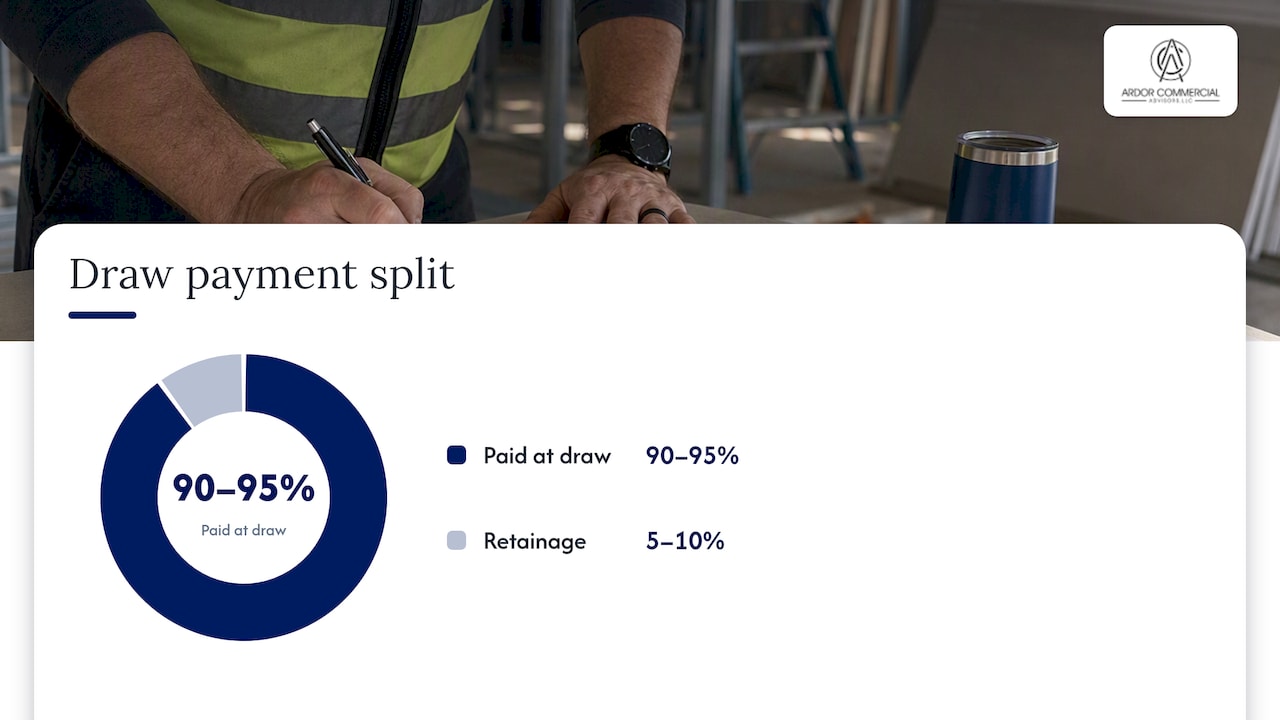
- Retainage, commonly 5% to 10% of each draw, is held back until the project reaches substantial completion.
- Final payment is released only after final lien waivers and closeout documents are delivered.
Lien waivers come in two forms, and the difference matters. A conditional waiver takes effect only once payment clears, which protects the paying party if a check bounces; an unconditional waiver takes effect immediately regardless of payment, so it should never be signed before funds are actually in hand. An example of tenant-managed construction disbursement practice shows the standard approach: landlords commonly withhold the final draw until the tenant delivers unconditional final lien waivers from the contractor and, in many cases, an architect’s certificate of completion.
Expect to produce invoices, waivers, contractor certifications, and architect sign-off at each draw. Tenants managing their own buildout should budget for the lag between finishing work and receiving that final disbursement, since it can stretch weeks past occupancy. Where the landlord controls the allowance, tenants should negotiate an offset right against rent if the landlord fails to pay a draw on time, and larger projects sometimes justify escrowed funds or a letter of credit to bridge timing gaps rather than relying on the landlord’s cash flow.
Insurance, indemnity, ADA and code compliance: allocating ongoing legal exposure
Insurance language in the work letter should mirror the lease, not contradict it.
- Require CGL and builder’s risk coverage from every contractor working on the space, with limits sized to the project’s scope.
- Name the landlord as an additional insured on the contractor’s policy before mobilization, not after.
- Watch ISO-form exclusions. Some standard additional-insured endorsements exclude structural alterations or new construction, which can leave the landlord uncovered for the exact work the letter authorizes.
- Close the gap in writing. The work letter and the contractor’s insurance certificate should both specify the correct endorsement form and primary-and-noncontribution language.
Insurance provisions for lease-construction projects commonly rely on additional-insured endorsements that exclude structural alterations unless the parties specify otherwise, according to ABA guidance on insuring work-letter construction projects, a gap that shows up only after a claim is filed if nobody checked the endorsement language beforehand. A broader overview of commercial insurance requirements covers how these endorsements typically fit into a commercial buildout program.
ADA compliance deserves its own line of attention. Assigning ADA responsibility to one party in the lease does not eliminate the other party’s exposure to the public. Under ADA Title III technical assistance materials, private contracts allocating compliance responsibility do not remove either party’s public obligations, so both landlord and tenant can remain liable to a member of the public regardless of what the work letter says between them.
Common negotiation tactics, red flags, and fallback positions
Watch for these red flags in any draft you receive.
- Vague scope language that describes finishes in general terms instead of referencing attached drawings and specs.
- No schedule at all, or a schedule with no consequence attached to missing it.
- Missing lien-waiver sequencing, which leaves the paying party guessing when waivers are actually due.
- Remedies that run one direction only, typically favoring the landlord with no matching tenant protection.
Tenants negotiating from these red flags should push for a firm completion date, an escrow or letter of credit backing the allowance on larger projects, a liquidated-damages provision for late delivery, and a hard cap on change-order costs. Landlords will often counter with a “material change” standard that limits when tenant approval is even required, and a cap on how many rounds of tenant plan revisions are included before additional fees apply, both of which are reasonable compromises rather than red flags on their own.
Pro Tip: When negotiations stall over remedies, propose a tiered fallback: a short cure period, then a defined daily rent credit, then a termination right only if delay passes an outside date, rather than trying to win an unconditional remedy in the first draft.
A drafting guide on work letter risk allocation notes that balanced markets commonly settle on capped liquidated damages, defined cure periods, and clearly excluded delay categories, terms that give tenants real leverage without asking landlords to underwrite unlimited risk.
Sample clause snippets and drafting notes
Use these as starting points, not finished language; every lease needs its own numbers filled in.
- Allowance clause: “Landlord shall provide an improvement allowance of [amount] toward the cost of the work described in Exhibit B. Costs exceeding the allowance shall be paid by Tenant within 30 days of invoice.” Drafting note: add a contingency line item inside the allowance budget rather than treating every overage as tenant-funded from dollar one.
- Substantial completion and rent commencement: “Rent shall commence on the earlier of (a) Tenant’s occupancy for business purposes, or (b) the date of Substantial Completion, as evidenced by a certificate of occupancy and Landlord’s certification that base building systems are operational.” Drafting note: never let rent commencement hinge on an estimated date alone.
- Final draw clause: “Landlord shall release the final draw within 15 days of receipt of unconditional lien waivers from Contractor and all subcontractors, and the Architect’s certificate of completion.” Drafting note: name the specific waiver form to avoid disputes over wording later.
- Liquidated damages: “For each day after the Outside Date that Substantial Completion has not occurred, Landlord shall credit Tenant [amount] per day, capped at [amount], excluding delays caused by force majeure or Tenant change orders.” Drafting note: the cap protects the landlord while the daily credit gives the tenant real leverage.
- ADA and code warranty: “Landlord’s completion of the work shall comply with applicable building codes; nothing herein relieves either party of independent obligations to the public under applicable accessibility laws.” Drafting note: this sentence does not transfer public liability, it only clarifies private allocation.
Perspective from Ardor CRE: practical steps for office and medical-office clients
We review work letters as part of tenant and landlord representation, lease review, and construction coordination for office and medical-office clients across our markets. The pattern we see most often on medical buildouts is a tenant who accepted a standard office-style work letter without adjusting the schedule or allowance for specialty equipment coordination, plumbing, or imaging-room shielding, then discovered the gap only after signing.
Start allowance and schedule planning as early as possible, ideally before the letter of intent is finalized, since permit timelines and long-lead equipment orders for medical suites routinely outpace the buildout schedule built for a standard office tenant. Our medical office leasing timing guide walks through why a 12 to 18 month runway is common for practices with specialty equipment.
What most negotiation advice gets backward
Most guidance on work letters treats the allowance number as the main event and treats schedule and remedies as boilerplate to accept quickly so the deal can close. That ordering is backward. A generous allowance with no fixed completion date and no delay remedy leaves a tenant exposed to open-ended carrying costs on their old space while a buildout drifts. The schedule and remedies sections are where landlords have the most incentive to keep language loose, precisely because loose language costs them nothing until something goes wrong.
The single highest-leverage move for either side is matching the work letter to the landlord’s actual construction contract before signing, not after a dispute forces the comparison. Tenants who read only the lease exhibit and never ask to see how the contractor’s obligations line up with it are negotiating half the document. Prioritize that alignment first, then negotiate dollar figures.
— Jim
How Ardor CRE helps with work-letter negotiation and project coordination
Reviewing a work letter clause by clause takes time most tenants and landlords do not have during an active lease negotiation, and a missed insurance endorsement or an undefined completion date costs far more to fix after the fact than before signing.
Commercial real estate professionals support tenants and landlords across office, medical office, retail, and industrial spaces with services that facilitate work letter negotiations, including:
- Lease review to identify missing schedule, remedy, or insurance language before signing.
- Tenant and landlord representation during negotiations, including allowance and scope discussions.
- Lease abstraction to summarize deadlines and obligations from signed work letters.
- Construction coordination to align the work letter with the contractor’s scope and schedule.
If your project involves a large allowance, specialty medical buildout requirements, or a multi-tenant office where consistency across leases matters, talk to our team before your next lease draft goes out. Visit our commercial real estate services page to get started.
Sources
For readers who want to go deeper, the Skullcandy work letter exhibit filed with the SEC is a real-world example of landlord-performed work letter language. ADA Title III technical assistance materials explain the public compliance obligations that survive private lease allocation. The American Bar Association’s practice notes on landlord-performed work letters and insuring work-letter construction projects cover drafting goals and insurance gaps in more detail than fits here.
This article is general information, not a substitute for advice from a qualified lawyer. Consult a qualified legal professional about your own circumstances before acting on anything here.
- EXHIBIT 10.3 – WORK LETTER (Skullcandy example)
- ADA Title III technical assistance materials
- Insuring lease work letter construction projects: Liability insurance (ABA)
- Lease work letters, Part One: When the Landlord Performs the Work (ABA)
FAQ
How do you write a landlord letter?
Start from the lease’s defined terms and attach exhibits for drawings, specs, and the draw schedule rather than describing them in narrative text. Define substantial completion, the allowance amount and overage treatment, the change-order process, and remedies for delay before addressing insurance and ADA allocation language, following the structure used in the Skullcandy exhibit.
What is a landlord approval letter?
In a work letter context, a landlord approval letter typically refers to the landlord’s sign-off on tenant construction drawings or a completed punch list, a step required before work proceeds or before final payment is released. It is distinct from a lease itself, functioning as a checkpoint document within the broader work letter process.
What not to say to a landlord?
Avoid agreeing verbally to schedule changes, cost overages, or scope revisions without putting them in writing as a formal change order, since unwritten agreements are difficult to enforce later. Also avoid accepting vague completion language like “substantially done” without tying it to a specific certificate of occupancy or systems-operational standard.
Why would a landlord send a letter?
A landlord sends a work letter to formally document construction obligations, allowance terms, and the schedule tied to a commercial lease before buildout begins. It protects both parties by setting expectations in writing rather than leaving scope, payment, and timing to informal understanding.