
A corporate guarantee lease adds a separate contract where a parent or affiliated company promises the landlord it will cover the tenant’s rent and other lease obligations if the tenant defaults. The immediate implication: the landlord can pursue the guarantor’s assets, not just the tenant’s, when payments stop. What varies enormously is how much the guarantor is exposed to, and that depends entirely on the type of guaranty and its exact wording, both covered below.
TL;DR:
- The exposure of a corporate guarantee depends heavily on its specific type and wording, with full guarantees covering all obligations and caps or burn-off clauses limiting liability.
- Definitions of “Guaranteed Obligations” vary widely and can include monetary and non-monetary duties, often extending beyond base rent to cover taxes, fees, and repair costs.
- Negotiating tactics include seeking liability caps, narrowing covered obligations, or substituting security deposits or letters of credit for some guaranty obligations.
- Verifying the guarantor’s financial health, authority, and creditworthiness is crucial, especially regarding survival clauses during lease modifications or assignments.
- Common red flags include blanket waivers, vague scope language, missing survival or reporting clauses, and broad obligation definitions that can inflate the guarantor’s actual liability.
Table of Contents
- Corporate Guarantee Lease Types Every Tenant Should Know
- What Obligations a Guaranty Can Actually Cover
- Negotiating a Corporate Guarantee Vs Personal Guarantee Alternative
- How Investors Should Underwrite a Corporate Tenancy Agreement
- Red Flags to Catch During Lease Guaranty Review
- How Brokers Handle Guarantee Terms in Medical and Office Deals
- The Overlooked Part of Corporate Guarantee Negotiation
- Get Help Reviewing a Lease Guaranty Before You Sign
- Where to Verify the Details Yourself
- Sources
- FAQ
Corporate Guarantee Lease Types Every Tenant Should Know
Not all guaranties are created equal, and the label on the document tells you almost nothing about the real exposure underneath it. Commercial lease guaranties generally fall into five structures, each shifting risk differently between landlord and guarantor.
- Full or absolute guaranty: The guarantor is on the hook for every obligation, for the entire lease term, with no cap. Landlords favor this structure most, especially with startups or single-purpose entities that lack a track record.
- Limited guaranty: Exposure is capped, often by a dollar amount, a fixed number of months’ rent, or a defined category of obligations rather than everything in the lease.
- Burn-off (or sunset) guaranty: Liability shrinks or disappears entirely once the tenant hits a performance milestone, such as two years of on-time payments or a minimum revenue threshold.
- Rolling or floating guaranty: Common in franchise and multi-entity operations, where liability shifts among affiliated companies as ownership or operating structures change.
- Good-guy guaranty: Limits the guarantor’s liability to the period before the tenant vacates and returns the space in good condition. This structure is popular in New York retail but its enforceability and exact mechanics vary sharply by jurisdiction, so never assume it works the same way in every state.
What Obligations a Guaranty Can Actually Cover
The word “guarantee” on a signature page tells you nothing about scope. What matters is the defined term “Guaranteed Obligations” buried in the body of the document, and that phrase can be narrow or nearly limitless depending on the drafting.
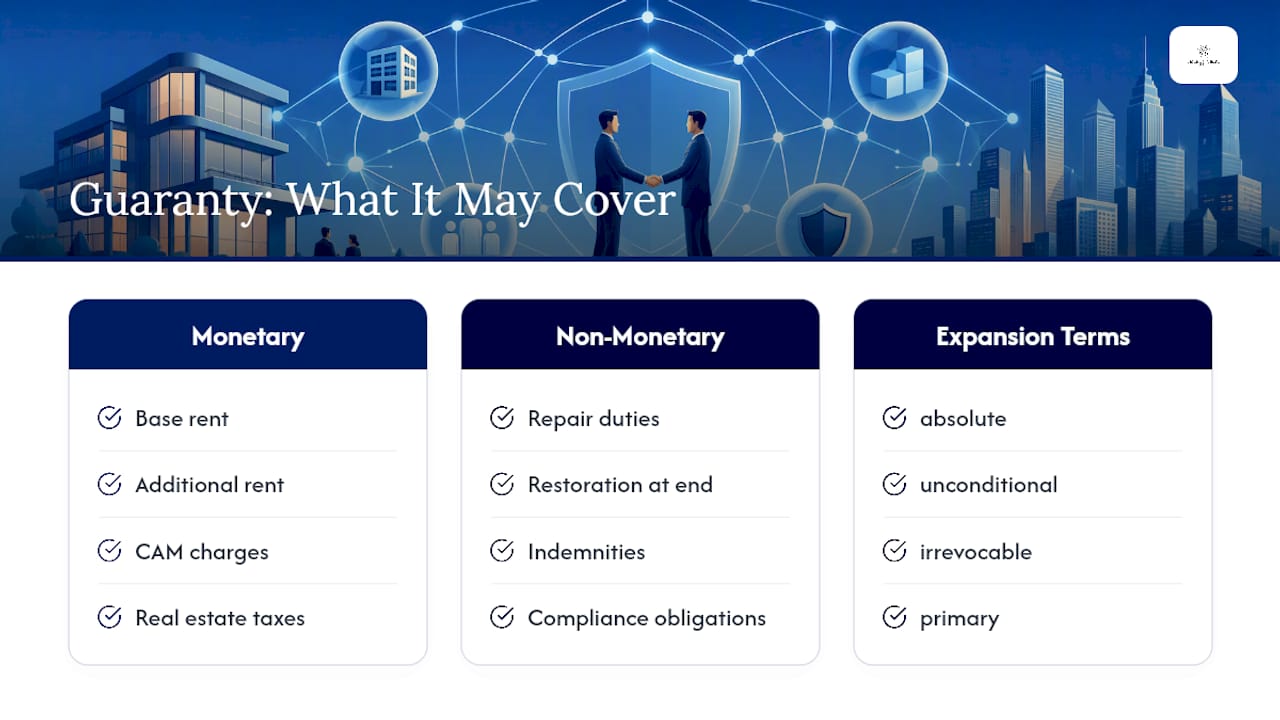
Monetary obligations typically include base rent, additional rent, common area maintenance charges, real estate taxes, and insurance premiums the tenant owes under the lease. Non-monetary obligations often get swept in too: repair duties, restoration at lease end, indemnification clauses, and regulatory compliance obligations tied to the space.
Watch the language closely. Phrases like “absolute,” “unconditional,” “irrevocable,” “primary,” and “joint and several” each expand the guarantor’s exposure in a specific way, and SEC-filed guaranty exhibits commonly stack several of these terms together, sometimes allowing the landlord to pursue the guarantor without first suing the tenant at all.
Statistic Callout: A cap that only mentions “rent” can be far weaker than it looks. If the guaranty’s defined obligations pull in CAM, taxes, indemnities, and attorneys’ fees, the real number a guarantor could owe often runs well past the base rent figure printed in the lease summary.
Negotiating a Corporate Guarantee Vs Personal Guarantee Alternative
Tenants rarely have to accept the first guaranty draft a landlord’s attorney sends over. There is almost always room to negotiate the scope, and landlords will often agree to real concessions if the tenant offers something else of value in return.
- Push for a dollar or time cap. Ask for liability capped at a fixed amount, such as twelve months’ rent, or a hard sunset date rather than the full lease term.
- Narrow the covered obligations. Limit the guaranty to base rent and CAM, and explicitly exclude indemnities, litigation costs, and future lease amendments the guarantor never agreed to.
- Offer a letter of credit or larger security deposit instead. Credit-support alternatives like these give landlords tangible, liquid collateral without tying up an entire parent company’s balance sheet. If the term is one year of rent or less, a cash-based structure is frequently the cleaner path. See how cash security compares to a letter of credit for the tradeoffs.
- Add financial reporting covenants. Landlords often accept a lower cap when the guarantor agrees to deliver quarterly or annual financials, giving early warning of trouble.
- Lock down survival language. Make sure the guaranty explicitly states what happens on assignment, renewal, or amendment. Silence here is not neutral. It typically defaults in the landlord’s favor.
Pro Tip: Never sign a guaranty that says it “survives any amendment to the lease” without reading exactly what that means. A tenant that later expands its space or extends the term can unknowingly drag the guarantor into obligations far beyond what was originally negotiated.
How Investors Should Underwrite a Corporate Tenancy Agreement
A guaranty is only worth as much as the entity standing behind it, and that is where a surprising number of buyers cut corners during acquisition diligence.
Start by verifying the guarantor’s identity and corporate authority. Confirm the entity that signed actually had legal power to bind itself, and pull formation documents to make sure the guarantor still exists in good standing. From there, underwrite the guaranty as its own contract claim against a specific entity, not as an abstract promise attached to the lease.
- Request current financial statements and check liquidity, not just revenue.
- Search for existing liens against the guarantor’s assets, since collateral already pledged to a lender leaves little for a landlord to collect.
- Confirm whether the guaranty survives assignment, tenant bankruptcy, or a lease renewal.
- Check for related-party exposure. A holding company guarantor with no unpledged assets of its own offers far less protection than the paperwork suggests.
An estoppel certificate can confirm many of these facts directly from the tenant before closing, which matters more than most buyers realize until a guaranty turns out to be worth far less than its face value.
Red Flags to Catch During Lease Guaranty Review
A handful of drafting patterns show up again and again in problem guaranties, and catching them before signing is far cheaper than fighting over them in court.
- Blanket waivers of notice, demand, or defenses that would normally protect a guarantor.
- A cap that names “rent” but leaves the full “Guaranteed Obligations” definition open to CAM, taxes, and fees.
- Vague or missing language on what happens to the guaranty during a lease amendment or renewal.
- No mechanism for the landlord to request updated guarantor financials or confirm continued solvency.
| Red flag | Why it matters |
|---|---|
| Blanket waiver clauses | Strips the guarantor’s normal legal defenses before a dispute even starts |
| Narrow cap, broad definition | Creates a false sense of limited exposure |
| Silent survival language | Defaults tend to favor whichever party drafted the lease |
| No reporting mechanism | Landlord has no early warning if the guarantor’s finances deteriorate |
A lease abstraction that specifically fields guarantor name, guaranty type, caps, burn-off date, and survival terms turns this checklist into something a broker or attorney can actually verify line by line.
How Brokers Handle Guarantee Terms in Medical and Office Deals
Medical-office and office leases put guaranty negotiation front and center, especially when a physician group is opening a new practice entity with no operating history. Landlords want assurance the group’s parent practice or holding entity stands behind the lease, while tenants want to protect the parent’s broader balance sheet from a single location’s risk.
The pattern we see most in medical-office deals is a limited guaranty with a burn-off tied to occupancy milestones, sometimes paired with a modest letter of credit instead of an unlimited parent guarantee. It gives the landlord real comfort during lease-up without asking the physician group to put its entire practice at risk over one location.
When the numbers get complicated, particularly with multi-tenant buildings or CAM structures layered on top of the guaranty, that is the point to bring in legal counsel or add formal financial reporting covenants rather than negotiating on instinct alone.
— Jim
The Overlooked Part of Corporate Guarantee Negotiation
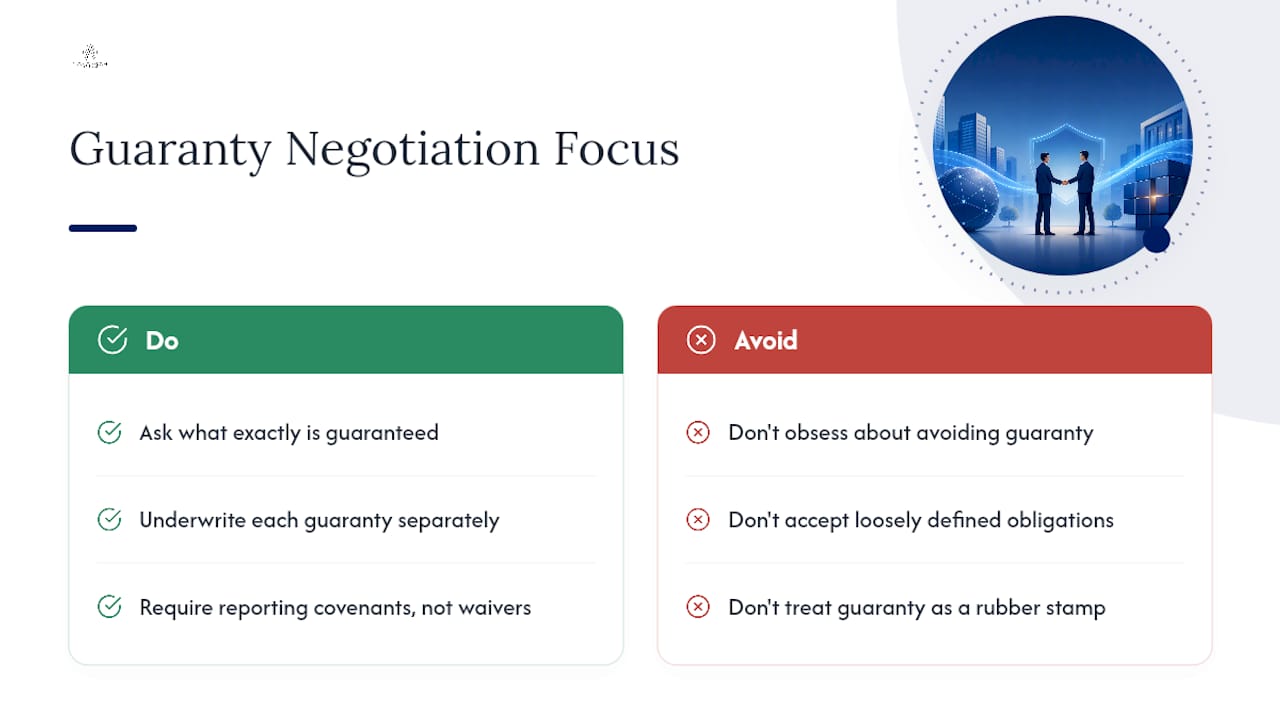
Most advice on corporate guaranties focuses on the wrong variable. Tenants obsess over whether they can avoid a guaranty entirely, and landlords obsess over getting the broadest one possible. Both sides are missing the point: the guaranty’s scope definition matters more than whether one exists at all.
A capped guaranty with a loosely written obligations definition can expose a guarantor to more risk than an uncapped one with tight, specific language. That is not intuitive, and it is exactly why so many tenants sign documents they think are protective when they are not.
My take: business owners should stop asking “can we avoid a guaranty” and start asking “what exactly did we agree to guarantee.” Investors buying leased property should treat every guaranty as a separate credit decision on the guarantor entity, not a rubber stamp on the lease itself. And landlords who actually want a durable, collectible guaranty should push for reporting covenants over blanket waivers. A guaranty nobody can enforce against real assets protects no one.
Get Help Reviewing a Lease Guaranty Before You Sign
Reading guaranty language against your own risk tolerance is hard to do alone, especially when a landlord’s attorney has drafted it to sound standard when it is not. Ardorcre reviews lease guaranties as part of full lease review and tenant representation work across the Charlotte MSA, checking cap language, survival terms, and covered obligations before you sign, not after a dispute forces the question.

A typical engagement starts with a document review of the lease and guaranty side by side, moves into a negotiation plan built around the levers that actually apply to your deal, such as caps, letters of credit, or reporting covenants, and ends with a clear summary of what you’re actually on the hook for. Ardorcre also handles CAM reconciliation analysis for tenants worried about operating expense obligations layered into a guaranty, and lease abstraction for investors who need every guaranty field documented before closing. If you’re negotiating or reviewing a new medical-office or office lease, consider requesting a lease review through a qualified commercial real estate advisory service.
Where to Verify the Details Yourself
- Types of Guarantees in Commercial Leases for structure definitions and drafting notes.
- SEC-filed guaranty exhibits as real model language.
- Consider reviewing BRRRR refinance risk underwriting when guaranty-backed leases factor into acquisition financing.
Sources
- Types of Guarantees in Commercial Leases | Insights
- Exhibit: Guaranty of Lease (SEC filing)
- Lease Guaranty (SEC filing)
- Corporate guarantee: Negotiation alternatives (UpCounsel)
FAQ
What is the purpose of a corporate guarantee in a lease?
A corporate guarantee gives the landlord a second, financially stronger party to pursue if the tenant defaults, which matters most when the tenant is a newly formed or asset-light entity. It shifts the landlord’s credit risk analysis from the tenant alone to whichever parent or affiliate signs the guaranty.
Is it normal to personally guarantee a commercial lease?
Personal guaranties are common for small businesses and sole proprietors without a strong corporate credit history, but they are a different instrument from a corporate guarantee, where a business entity stands behind the lease instead of an individual. Larger or franchise operations more often negotiate a corporate guarantee, sometimes limited or paired with a letter of credit, rather than a personal one.
Is corporate leasing legal?
Yes, corporate guaranties and corporate lease agreements are legal and widely used, though enforceability and available remedies depend on the governing law named in the guaranty and how precisely the document is drafted. Organizational authority, bankruptcy rules, and public policy limits in that jurisdiction can all affect how a court enforces it.
How does a lease guaranty work in practice?
If the tenant fails to pay rent or breaches another covered obligation, the landlord can pursue the guarantor directly for payment or performance, subject to whatever caps, notice periods, or cure rights the guaranty spells out. Whether the landlord must sue the tenant first or can go straight to the guarantor depends on whether the document is a guaranty of payment or a guaranty of collection, a distinction worth confirming during lease abstraction.
What’s the difference between a corporate guarantee and a security deposit?
A security deposit is a fixed sum of cash the landlord already holds, while a corporate guarantee is a promise to pay that only becomes real money if the guarantor actually has recoverable assets when a default happens. Many tenants and landlords combine both, using a smaller deposit alongside a limited guaranty or letter of credit to balance protection with exposure on both sides.