
A personal guarantee in a commercial lease makes you, the individual, directly liable for every rent payment, CAM charge, and fee your business entity owes — even after that entity folds. Before you sign anything, take four steps: flag the guarantee clause immediately, push the guaranty structure into your Letter of Intent (LOI) before the landlord’s attorney drafts the lease, pull together audited financials or strong credit references to trade for concessions, and retain a lease attorney for review. Under the statute of frauds, a guarantee must be in writing and signed by you to be enforceable — oral promises don’t count. Negotiated caps commonly limit personal exposure to about a year’s base rent or slightly more. Standard concessions include good-guy clauses, burn-off provisions, and phased reductions.
- Pause before signing. Identify every clause labeled “guaranty,” “personal guarantee,” or “guarantor.”
- Push guaranty terms into the LOI. Leverage disappears once the landlord’s attorney controls the draft.
- Gather your financials. Strong credit or audited statements are your primary trading chips.
- Hire a lease attorney. Guarantee language is dense, and one missed clause can multiply your exposure.
Key Takeaways
A personal guarantee on a commercial lease makes you personally liable for your business’s lease obligations, and the terms are negotiable — most effectively at the LOI stage before the landlord’s attorney drafts the document.
| Point | Details |
|---|---|
| Guarantee scope | Covers rent, CAM, taxes, and fees; an unlimited guarantee can expose you to the full remaining lease term. |
| Negotiation timing | Raise guaranty structure in the LOI — leverage drops sharply once the landlord’s attorney controls the draft. |
| Common cap benchmarks | Caps of 12–24 months of base rent and burn-off windows of 2–4 years are standard negotiated outcomes. |
| Red-flag terms | Rent acceleration, no cure period, and survival-on-assignment language multiply exposure and must be addressed. |
| Ardorcre’s role | Ardorcre provides tenant representation and lease analysis in the Charlotte MSA, including guaranty review before LOI submission. |
Table of Contents
- What types of personal guarantees can you be asked to sign?
- Why do landlords require a personal guarantee?
- How are personal guarantees enforced, and what are the real risks?
- How can you limit your personal exposure before signing?
- What benchmarks and market conditions should you know?
- Negotiation checklist and sample clause language
- What to do if a landlord tries to enforce the guarantee
- What most tenants get wrong about personal guarantees
- Ardorcre’s tenant representation services in the Charlotte MSA
- Sources
What types of personal guarantees can you be asked to sign?
Commercial law firms categorize guarantee structures into several distinct types, and each one changes your exposure in a meaningful way.
- Full/unlimited guarantee. You’re on the hook for every dollar owed under the lease for its entire remaining term, plus attorney fees and costs. This is the landlord’s opening position in most negotiations.
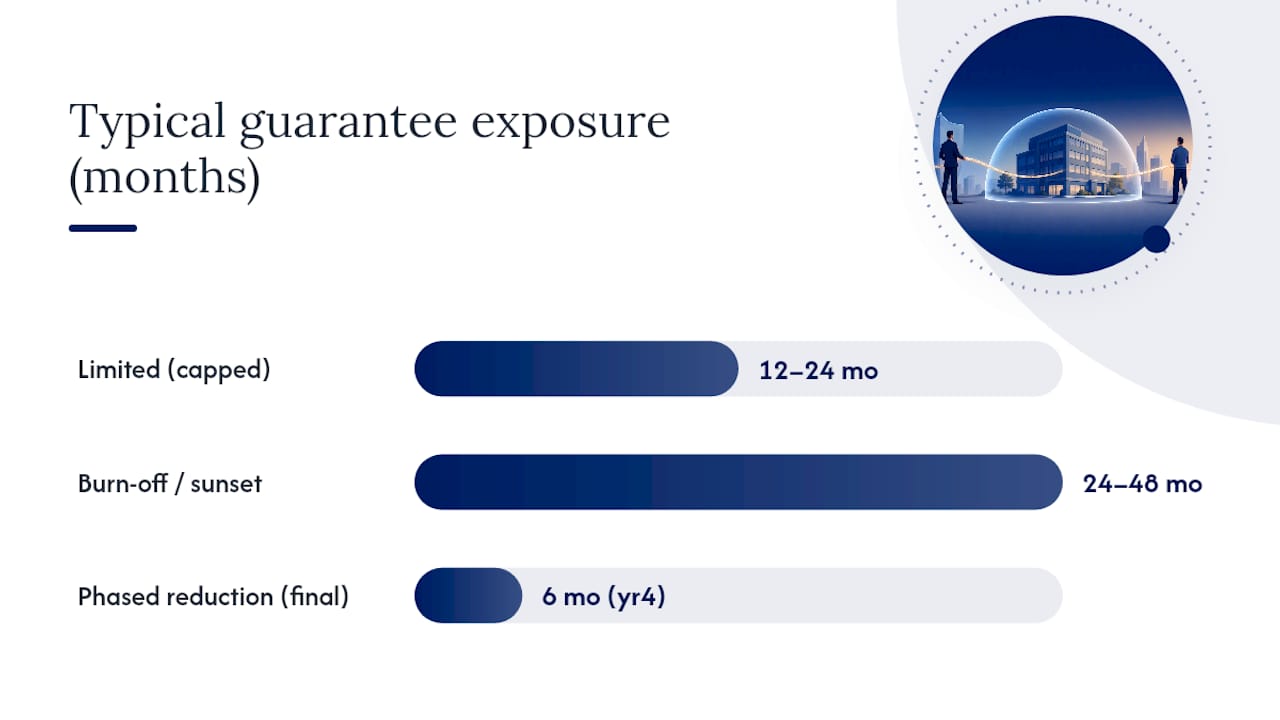
- Limited/capped guarantee. Liability is capped at a fixed dollar amount or a set number of months of base rent, often 12–24 months. Once that ceiling is hit, your personal exposure stops.
- Good-guy guarantee. You’re released from future obligations if you vacate the space, surrender keys, and give proper written notice. The catch: you still owe everything accrued up to the surrender date.
- Burn-off/sunset guarantee. The guarantee expires automatically after a defined period of on-time payments, typically two to four years into the lease term. No renegotiation required — it just ends.
- Phased reduction. Exposure decreases in steps over time. For example, liability might drop from 18 months to 12 months after year two, then to six months after year four.
- Springing/bad-acts guarantee. The guarantee is dormant unless a specific trigger occurs — usually a bad-faith act like fraud or intentional property damage. A well-drafted version of this is the most tenant-friendly structure available.
- Continuing vs. transaction-specific. A continuing guarantee covers all obligations under the lease including renewals and extensions. A transaction-specific guarantee covers only the original lease term. Always confirm which one you’re signing.
Watch for hidden amplifiers buried in the clause: rent acceleration language (which makes the entire remaining balance due immediately upon default), survival-on-assignment provisions (which keep you liable even after you sell the business), and spousal co-sign requirements. These terms often appear in the definitions or “miscellaneous” sections of the lease, not in the guarantee exhibit itself.
Pro Tip: Ask your attorney to search the full lease document for “guarantor,” “personal liability,” and “acceleration” — not just the guarantee exhibit. Landlords sometimes scatter amplifier language across multiple sections.
Why do landlords require a personal guarantee?
Landlords face a straightforward problem: a newly formed LLC or corporation may have no meaningful assets, no credit history, and no track record. If that entity stops paying rent, the landlord’s only recourse against the entity might be worthless. A personal guaranty commercial lease provision solves that by giving the landlord a creditworthy individual to pursue.
Institutional landlords — REITs, pension funds, and large private equity owners — often have lenders or investors who require guarantees as a condition of their own financing. That makes the guarantee less negotiable on the structure and more negotiable on the cap. Private owners, by contrast, usually have more flexibility on both.
The negotiation signals that matter most:
- Tenant credit strength. A personal FICO score above 700 or audited financials showing strong cash flow gives you a credible argument for a shorter or capped guarantee.
- Competing spaces. If the landlord knows you’re touring two other buildings, the guarantee becomes a deal variable rather than a fixed term.
- Longer lease term. Signing a seven-year lease instead of three often earns a shorter guarantee window, because the landlord’s re-letting risk is lower over a longer committed term.
- Established entity track record. Two or more years of profitable operating history, documented with tax returns, can reduce or eliminate the guarantee requirement entirely with some private landlords.
- Market conditions. In a soft market with high vacancy, landlords concede more. In a tight market, they concede less. Know your local vacancy rate before you negotiate.
How are personal guarantees enforced, and what are the real risks?
A personal guarantee must be in writing and signed by the guarantor to be enforceable under the statute of frauds. An oral promise to back a lease is generally not binding. That said, once a written guarantee exists, landlords have broad remedies.
Enforceability checklist — verify each item before signing:
- Who signed? Only the named guarantor is bound. Confirm the signature block matches the guaranty exhibit.
- Does the guarantee reference renewals and extensions? If yes, your exposure survives beyond the original term.
- Is there a rent acceleration clause? If yes, a single missed payment can trigger liability for the entire remaining balance.
- Does the guarantee include a waiver of defenses? Some clauses strip your right to raise the landlord’s own breach as a defense.
- Does it survive assignment? If you sell the business, you may remain liable unless the landlord explicitly releases you.
- Is a spousal signature required? In community property states, a landlord may seek a spouse’s signature to reach marital assets.
When a landlord enforces, the remedies are serious. They can sue you personally, obtain a judgment, levy your bank accounts, place liens on real property you own, and in some states pursue wage garnishment. A judgment also lands on your personal credit report, which affects your ability to borrow for years afterward.
A full, unlimited guarantee combined with a rent acceleration clause can make you personally liable for the entire remaining lease term the moment your business misses a single payment. On a five-year lease with three years remaining at $10,000 per month, that’s $360,000 due immediately — before attorney fees.
State law varies on deficiency periods, notice requirements, and the landlord’s duty to mitigate. California, New York, and Texas each have distinct rules on how quickly a landlord must act and what they must do to reduce losses. A lease attorney licensed in your state is not optional — it’s the minimum.
How can you limit your personal exposure before signing?
Guarantees are negotiable, and leverage is strongest at the LOI stage before the landlord’s attorney controls the draft. Here are the specific concessions to ask for, in rough order of how often they’re granted:
- Cap the guarantee. Request a fixed dollar amount or a months-of-rent ceiling. Twelve months of base rent is a common negotiated outcome; 18–24 months is the more typical landlord counter.
- Add a burn-off provision. Ask for automatic expiration after 24–36 months of consecutive on-time payments. Include a written notice requirement so you know when it’s triggered.
- Negotiate a good-guy clause. Useful if you’re uncertain about the business’s long-term trajectory. Tie release to proper written notice (typically 90–180 days) and full surrender of the premises.
- Limit triggers to nonpayment only. Push to narrow the guarantee so it activates only on rent default, not on every technical lease breach.
- Insert a cure period. A 10-business-day written notice and cure period prevents accidental triggering for minor administrative defaults. Without it, a missed invoice can become a personal liability event.
- Negotiate release on assignment. If you sell the business, the buyer’s creditworthiness should replace yours. Draft the release as automatic upon landlord-approved assignment.
- Remove spousal signature requirements. This is often achievable simply by asking, especially if your personal financials are strong.
- Substitute a letter of credit or larger security deposit. Landlords frequently accept a letter of credit (LOC) or an increased security deposit in place of a personal guarantee, particularly when the tenant’s financials are solid.
- Explore a parent company guarantee. If your operating entity is a subsidiary, a parent company guarantee may satisfy the landlord without exposing your personal assets.
- Consider Personal Guarantee Insurance. PGI products cover a portion of the guaranteed amount if the business defaults, reducing your net personal exposure without requiring the landlord to change the guarantee structure.
- Use a third-party or institutional guarantor. Institutional guarantor services can sometimes replace an individual guarantor for a fee, which may be worth the cost on a large or long-term lease.
Pro Tip: Raise the guaranty structure in the LOI with a line like: “Guaranty to be limited to [X] months of base rent, with a [Y]-month burn-off upon consecutive on-time payments.” Once the landlord’s attorney drafts the lease with a full guarantee, walking it back costs you goodwill and time.
A lease abstract prepared before negotiations gives you a clean summary of every obligation the guarantee would cover — rent, CAM, taxes, and fees — so you know exactly what you’re backing before you agree to any cap amount.
What benchmarks and market conditions should you know?
Negotiated caps commonly limit personal exposure to about a year’s base rent or slightly more, with burn-off windows typically running two to four years. Security deposit substitutions generally require three to six months of rent to replace a personal guarantee, though the exact amount depends on the landlord’s risk tolerance and market conditions.
Market benchmark: A capped guarantee of 12 months of base rent with a 24–36 month burn-off is a realistic target for a tenant with clean financials and at least one competing space option.
Landlords are most flexible when:
- Vacancy is high. A landlord sitting on 20% vacancy in a building has less leverage than one with a waitlist.
- You have competing options. Document them. A signed tour confirmation or competing LOI is more persuasive than a verbal claim.
- Your financials are strong. Audited statements, two years of tax returns, and a personal credit report above 700 are the three documents that move the needle most.
- The remaining lease term is short. A landlord re-signing a tenant for a new term often accepts reduced guaranty terms as a retention concession.
- The landlord is a private owner. Private owners have more discretion than institutional landlords constrained by lender covenants.
For context on how CAM charges and tax obligations factor into what a guarantee actually covers, the triple net lease overview at Ardorcre breaks down NNN obligations in plain terms.
Documenting your leverage matters. Bring a CRE broker’s market analysis showing comparable vacancy rates, your audited financials, and a clear LOI with guaranty terms already proposed. That package signals a prepared tenant, which shifts the negotiation dynamic.
Negotiation checklist and sample clause language
Before you or your attorney sit down to negotiate, confirm you have answers to each of these:
- Type of guarantee: full/unlimited, capped, good-guy, burn-off, or springing?
- Cap amount or months: what is the ceiling on your personal exposure?
- Triggers: does the guarantee activate on any default, or only nonpayment?
- Cure period: how many days do you have to fix a default before the guarantee is called?
- Survival on assignment: does your liability end when the lease is assigned?
- Spousal/co-guarantor requirements: who else is being asked to sign?
- Rent acceleration language: is the full remaining balance due on first default?
- Release mechanics: what exactly must happen for the guarantee to terminate?
Sample clause starters for your attorney to refine:
Capped guarantee: “Guarantor’s liability under this Guaranty shall not exceed an amount equal to [12] months of Base Rent as of the date of default, exclusive of any acceleration.”
Burn-off: “This Guaranty shall automatically terminate and be of no further force or effect upon Tenant’s completion of [24] consecutive months of timely Base Rent payments without default.”
Good-guy: “Guarantor shall be released from all obligations accruing after the date Tenant (i) vacates and surrenders the Premises in the condition required by the Lease, and (ii) provides Landlord with not less than [90] days’ prior written notice of such surrender.”
Release on assignment: “Upon Landlord’s written approval of an assignment of this Lease, Guarantor shall be released from all obligations arising after the effective date of such assignment.”
Red flags to negotiate out immediately:
- No cure period for the guarantor (any default triggers personal liability instantly)
- Rent acceleration covering the full remaining term
- Continuing guarantee language that extends to renewals and options
- Waiver of defenses clause
Reviewing an estoppel certificate alongside the guarantee helps confirm that the landlord’s representations about the lease match what the guarantee actually covers — a step worth taking before any assignment or renewal.
What to do if a landlord tries to enforce the guarantee
If you receive a notice of default or a demand letter directed at you personally, the window to act is short.
- Do not ignore the notice. Most leases require a response within 10–30 days. Missing that window can waive your right to cure.
- Preserve all communications. Save every email, letter, and text related to the default. Do not delete anything.
- Notify your attorney immediately. Before you respond to the landlord or make any payment, get counsel. A payment made without legal review can be construed as an admission of the full amount owed.
- Verify the landlord followed notice and cure requirements. Check the lease for the exact notice method required (certified mail, overnight courier, email). A defective notice can be challenged.
- Attempt a negotiated cure or forbearance agreement. Many landlords prefer a structured repayment plan over litigation. A written forbearance agreement, reviewed by your attorney, can buy time and limit the judgment amount.
- Assess the landlord’s duty to mitigate. Most states require landlords to make reasonable efforts to re-let the space. If they don’t, your exposure may be reduced. Document any evidence that the landlord is not marketing the space.
- Consider bankruptcy only as a last resort. Chapter 11 or Chapter 7 can discharge personal liability in some circumstances, but the costs, timeline, and credit impact are severe. Exhaust negotiated solutions first.
The DSCR framework used in commercial lending can help you model your personal debt capacity if you’re weighing whether to fund a cure payment versus pursuing a forbearance.
What most tenants get wrong about personal guarantees
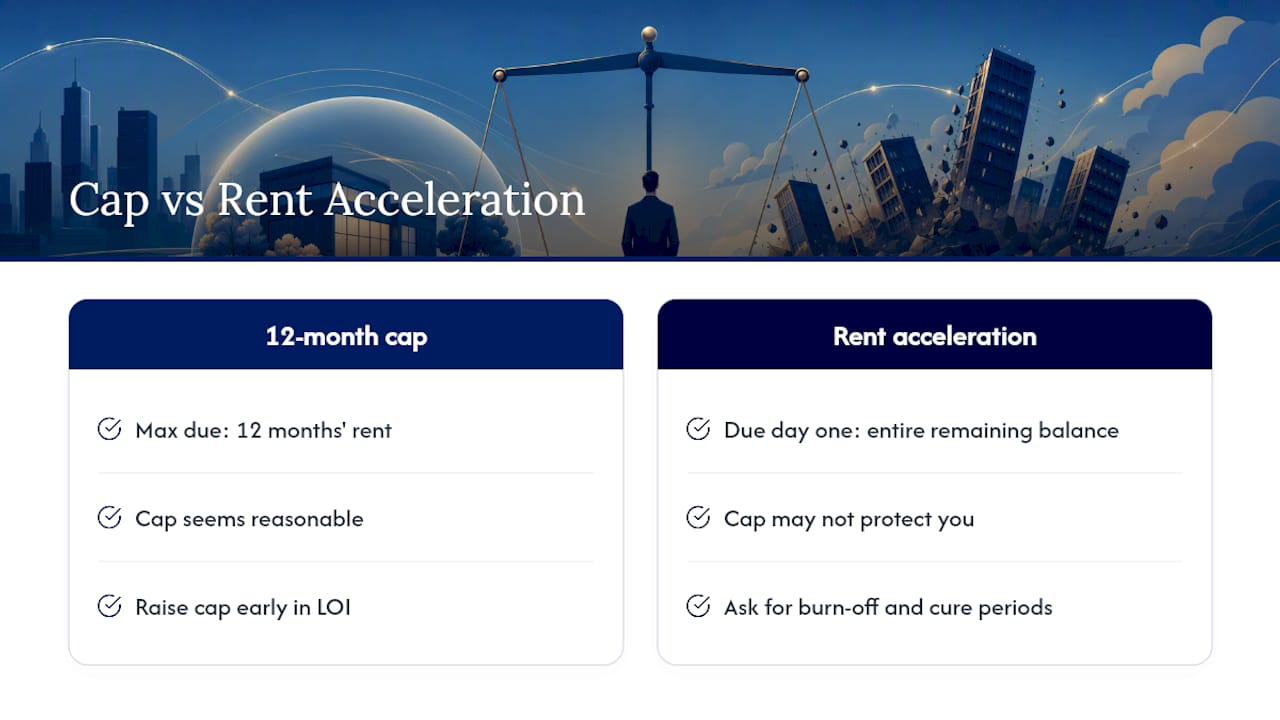
The standard advice is to negotiate hard and get a cap. That’s correct, but it misses the more dangerous problem: tenants focus on the guarantee exhibit and ignore the amplifiers scattered through the rest of the lease. Rent acceleration is the one that causes the most damage. A 12-month cap sounds reasonable until you realize the acceleration clause makes the entire remaining balance due on day one of default — at which point the cap may not protect you the way you assumed.
The second mistake is timing. Most tenants raise the guarantee after the landlord’s attorney has already drafted a full, unlimited guarantee into the lease. At that point, asking for a burn-off or a cap feels like a concession the tenant is requesting, not a standard negotiation point. Raise it in the LOI, frame it as a structural term, and the conversation is entirely different.
Private landlords in markets like Charlotte’s are often more flexible than tenants expect, particularly on burn-off provisions and cure periods. The ask doesn’t cost anything. What costs you is not asking.
Ardorcre’s tenant representation services in the Charlotte MSA
Negotiating a commercial lease guarantee without knowing the local market is like negotiating a car price without knowing the invoice cost. Ardorcre’s tenant representation advisors work in the Charlotte MSA across office, medical, retail, and industrial properties, and lease analysis is a core part of what they do — not an add-on.

When Ardorcre represents a tenant, the process includes a full lease abstract that surfaces every guarantee obligation, trigger, and amplifier before negotiations begin. Advisors bring market-level data on vacancy rates and competing spaces — the two factors that move landlords most on guaranty terms. The goal is to get you to the LOI with a proposed guaranty structure already on the table, not to fix a bad guarantee after the lease is drafted.
To request a lease review or tenant representation consultation, contact Ardorcre at Ardorcre.
Sources
The sources below are worth reading directly, each for a specific reason:
- Personal Guarantee in a Commercial Lease: What It Means, What’s at Stake, and How to Limit Your Exposure
- Is my personal guarantee enforceable?
- Types of Guarantees in Commercial Leases | Insights
- Do you need a personal guarantee for a commercial lease?
- Understanding the Role of a Lease Guarantor: Do You Need One? – Azibo
This article provides general information about commercial lease guarantees and is not legal advice. Consult a licensed attorney in your state before signing or negotiating any guarantee.
This article is general information, not a substitute for advice from a qualified lawyer. Consult a qualified legal professional about your own circumstances before acting on anything here.