
The Charlotte warehouse market has moved from a landlord’s market to one where tenants can negotiate. Developers added a lot of space, availability rose, and demand is now catching up. If you lease, own or invest in industrial space, the shift changes your timing, your rent and your leverage. We are Ardorcre, a commercial real estate brokerage in the Charlotte MSA, and we advise owners, investors and tenants on industrial leasing and sales.
This guide explains what drove the change, how to read the numbers, and what to check before you sign a lease or buy a building.
TL;DR
- Developers added more than 40 million square feet of industrial space across the metro in the four years through 2025, which pushed availability above 10% and gave tenants leverage for the first time since 2019.
- Demand is absorbing the new space: 12-month net absorption reached 4.9 million square feet through Q1 2026, and 2026 deliveries are expected to fall by more than half.
- Big-box availability (400,000+ square feet) has tightened about 800 basis points from its mid-2024 peak, so smaller and larger users face different conditions.
- Tenants should negotiate rent, free rent, improvements and lease type together. Buyers should size debt and test the building against the tenant’s real needs.
Table of Contents
- What “the Charlotte warehouse market” covers
- What is driving demand
- Supply, vacancy and absorption: reading the numbers
- Where tenants have leverage, and where they do not
- How submarkets differ
- What to evaluate in a warehouse
- If you own: pricing, timing and positioning
- If you invest: buying and financing industrial
- Working with Ardorcre
- Our perspective
- FAQ
- Sources
What “the Charlotte warehouse market” covers
Brokers and lenders usually say “industrial” rather than “warehouse.” The category includes distribution and fulfillment buildings, bulk warehouses, light manufacturing, flex space and small-bay buildings for contractors and local businesses. Each behaves differently. A 600,000 square foot distribution center leases to a national logistics user on a long timeline. A 15,000 square foot small-bay unit leases to a local business, often faster and with different terms.
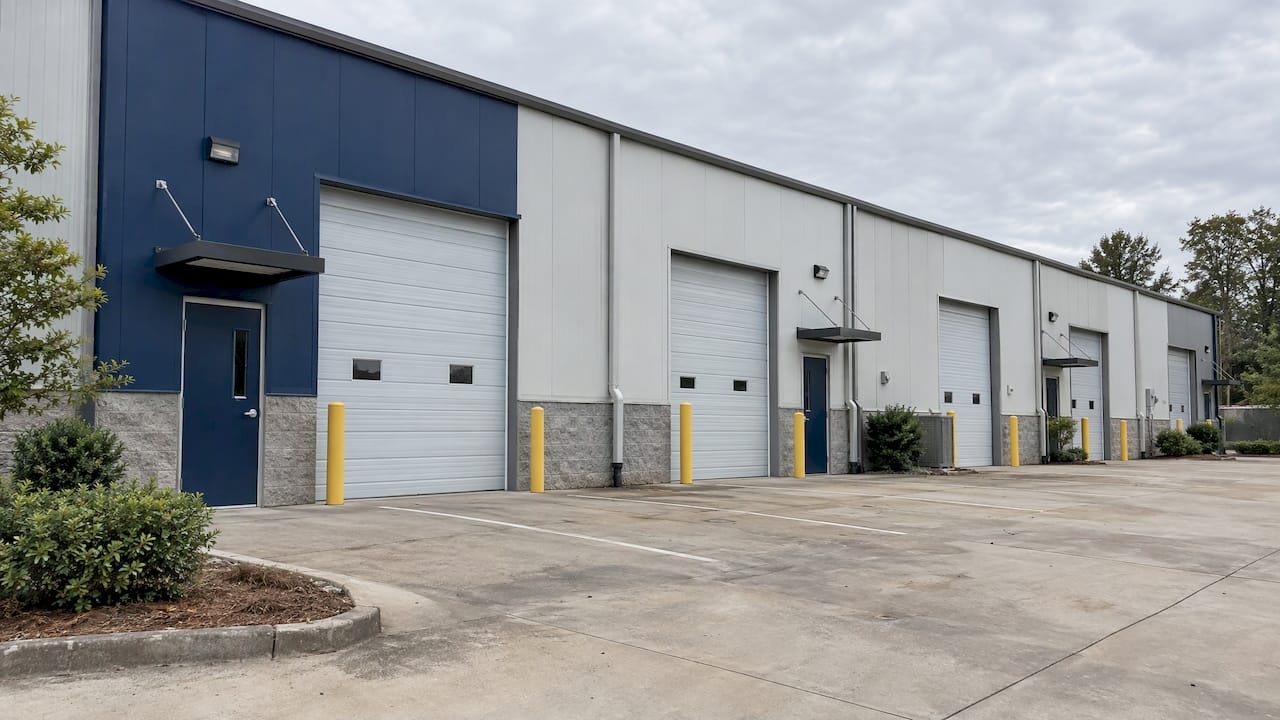
That is why a single metro-wide vacancy number only tells part of the story. The size of the space you need decides which part of the market you are in.
What is driving demand
Charlotte’s industrial demand rests on more than one engine. According to Southeast Economic Advisors’ May 2026 Charlotte outlook, the drivers include:
- A deep manufacturing base. The report counts about 800 plants in Mecklenburg County alone.
- Advanced manufacturing and data center investment. It cites Jabil’s $500 million AI-hardware plant in Salisbury, Corning’s $6 billion fiber agreement with Meta, and expansions by Siemens Energy and Trench Group.
- Logistics demand. Amazon and Walmart are named as drivers, along with Maersk’s move of its North American headquarters to the region.
This mix matters for owners. Demand tied to manufacturing and data infrastructure tends to want power, heavier floors and flexible layouts, while logistics users want dock doors, truck courts and highway access. When you assess a building, ask which of these users it can realistically serve. For the wider employment picture, see our look at job growth and commercial real estate in Charlotte.
Supply, vacancy and absorption: reading the numbers
Three numbers tell you where the market is.
Vacancy and availability. Vacancy counts empty space. Availability counts everything being marketed, including space still occupied but offered for lease. The same report finds that availability across the metro went above 10% after the construction wave. Our own pages on Charlotte warehouse vacancy and industrial vacancy explain how these measures differ and what they mean for a deal.
Absorption. Absorption is the change in occupied space over a period. Positive absorption means more space was taken than given back. The Southeast Economic Advisors report puts 12-month net absorption at 4.9 million square feet through Q1 2026. That is real demand, but it has to work through a very large supply of new buildings.
Deliveries. New construction completions are expected to fall by more than half in 2026. Fewer new buildings arriving while absorption continues is what normally tightens a market. The effect shows first in the largest buildings: availability for 400,000+ square foot space has come down roughly 800 basis points from its mid-2024 peak, per the same source.
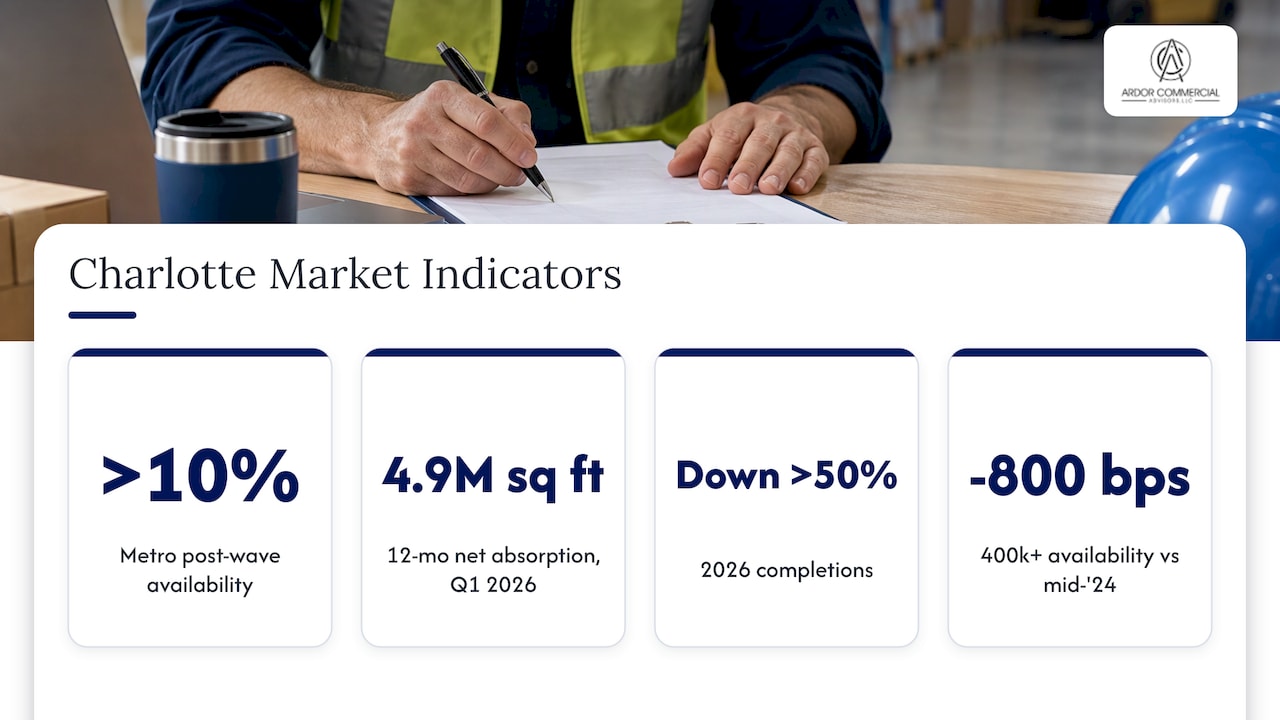
These figures are published for specific periods and are revised each quarter, so use them as direction. When you make a decision, ask for the latest quarter’s report and compare it with the building you are considering.
A quick example
Suppose you lease 40,000 square feet and your lease ends in 12 months. In a market with rising availability, you have more buildings to tour, more landlords competing and a stronger position to ask for free rent, a larger improvement allowance or a lower escalation. If you wait until the last 90 days, you lose most of that leverage, because moving, build-out and permitting take time. Starting early is the single most valuable move a tenant can make.
Where tenants have leverage, and where they do not
The leverage tenants gained is real but uneven. Newer, well-located buildings in the 400,000+ square foot range are tightening, so landlords there have less reason to concede. Older, smaller or less well-located buildings with vacancy have more reason to compete on price and terms.
For a tenant, the practical points to negotiate are:
- Base rent and escalations. Annual increases compound. A 3% escalation over a five-year term adds up, so compare total cost over the term and not only the starting rate. Our pages on warehouse lease rates and industrial rents go through typical pricing.
- Free rent and improvement allowance. In a softer market these are often easier to win than a headline rate cut.
- Lease type. The structure decides who pays taxes, insurance and maintenance. Read our guide to industrial lease types and the explanation of triple net leases before you compare two offers, because two quotes at the same rate can cost very different amounts.
- Operating expense pass-throughs. Common area maintenance charges can be a surprise. Our CAM charges page shows how lease review and CAM reconciliation analysis catch overbilling.
- Expansion, renewal and termination rights. A growing business should secure the right to expand into adjacent space.
A tenant representation broker negotiates these items on your side, and on our tenant representation page we explain how that works.
How submarkets differ
Charlotte’s industrial space clusters along the interstates and rail corridors. Buildings near the airport and the I-85 and I-485 corridors serve distribution and last-mile users who want quick access across the region. Other parts of the metro serve manufacturers and smaller local businesses and often carry different rents and vacancy. Pricing, vacancy and tenant mix can all differ from one corridor to the next, so a metro average is only a starting point.
When you compare two buildings in different submarkets, compare more than the rent:
- Drive time to your customers, suppliers and workforce
- Highway and interchange access for tractor-trailers
- Nearby labor availability and commute patterns
- Power capacity and utility availability
- Local zoning and permitted uses
What to evaluate in a warehouse
A building that looks right on paper can fail on operations. Walk through this list before you commit.
Physical specs
- Clear height, which sets how high you can stack and rack
- Column spacing and floor load capacity
- Number and type of dock-high doors and drive-in doors
- Truck court depth, trailer parking and turning radius
- Power, lighting, sprinklers and HVAC, especially if you need climate control
Site and legal
- Zoning and permitted uses, including outdoor storage
- Environmental history of the site
- Roof age and condition
- Access easements and parking
A pre-lease or pre-purchase inspection is worth the cost, and it is useful to know what a commercial warehouse inspection typically covers so you can plan the timeline.
Lease documents
- The operating expense definitions and exclusions
- Who is responsible for roof, structure and parking lot repairs
- Any guarantee requirement. See our page on the corporate guarantee lease for how to cap exposure.
- Estoppel and subordination provisions. For buyers, our guide to the estoppel certificate shows what to verify from existing tenants.
We also summarize lease terms in a lease abstract, a short document that pulls the dates, rent steps, options and obligations out of a long lease so that nothing is missed.
If you own: pricing, timing and positioning
For owners of existing warehouses, a market with higher availability means your building competes with newer product. Three things help:
- Price to the real market. An overpriced listing sits and weakens your position. A broker’s market report and a current valuation, including DCF modeling, give you a defensible number.
- Prepare the building. Roof, lighting, paving and clean dock areas shorten the time on market.
- Plan the tenant mix and lease structure. Staggered expirations reduce the risk of facing vacancy all at once.
If you lease out space, landlord representation puts a broker on your side to market the property, screen tenants and negotiate terms. The benefits for commercial owners are laid out on a separate page, and our property management budget guide helps you plan operating costs.
If you invest: buying and financing industrial
The supply wave and slowing deliveries make this a market where careful underwriting pays. Before you buy:
- Underwrite the rent roll. Compare in-place rents against current market rents, and check expiration dates.
- Check the debt coverage. Lenders size many commercial loans on debt service coverage ratio (DSCR), which is net operating income divided by annual debt payments. Our DSCR loan sizing guide shows how to calculate the maximum loan a property supports.
- Plan the tax strategy. If you are selling another property, a 1031 exchange can defer capital gains when done correctly. See our 1031 exchange rules and 1031 exchange timeline, because the deadlines are strict. Talk with a tax adviser or a certified financial planner about your own situation.
- Consider land. Developers and long-term investors may also look at land development in Charlotte.
If you want a price opinion before you list, buy or refinance, commercial property valuation is a good place to start.
Working with Ardorcre
Our work in the Charlotte MSA covers sales and leasing of office, medical, retail, industrial, land and investment properties, along with landlord and tenant representation, property management, lease analysis and advisory services. Whether you need a market report, a lease review or someone to run a tenant search from first tour to signed lease, you can start on our services page.
If your lease is coming up or you are weighing a purchase, the best time to talk is before you have a deadline. Reach us through ardorcre.com.
Our perspective
The Charlotte warehouse market is no longer one story. For several years the story was scarcity, and tenants took whatever they could find. Now the story is choice, and choice rewards the people who prepare.
We believe the best deals come from starting early and comparing buildings on total cost over the full term, not on the headline rate. Lease type, escalations, operating expenses and improvement allowances matter as much as the rent. That is why we focus on lease review and clear market reporting for both tenants and owners.
Owners deserve the same discipline. A realistic valuation, a building that is ready to show and a clear leasing strategy do more than a price cut. And investors should underwrite debt coverage and exit options before they fall for a building.
Our approach is tailored, hands-on guidance from the first search through the transaction and beyond.
Jim
FAQ
Is Charlotte a good market for warehouse tenants right now?
Tenants have more leverage than at any point since 2019, according to the Southeast Economic Advisors May 2026 outlook, because availability rose above 10% after heavy construction. Leverage is strongest for older and smaller buildings. Large, modern big-box space has tightened, so the answer depends on the size and quality of space you need.
What is the difference between vacancy and availability?
Vacancy counts space that is empty. Availability also includes space that is still occupied but being offered for lease, such as a tenant planning to move out. Availability is usually the higher number and is a better signal of the choices a tenant will see.
Should I lease or buy an industrial building?
Leasing keeps capital free and gives flexibility, while buying builds equity and gives control over the property. The right choice depends on how long you will need the space, your financing and your tax position. A broker can compare total occupancy cost for both paths, and a financial planner can review how a purchase fits your finances.
How early should I start a warehouse search?
Start well before your lease ends. Touring, negotiating, build-out and permitting take time, and a longer runway gives you more bargaining power. Our leasing timeline guide walks through the stages for medical and office tenants, and the same principle applies to industrial users.
Sources
- Southeast Economic Advisors, Charlotte Economic Spotlight, May 2026
- Commercial warehouse building inspection: what to expect