
You can sell a commercial building with tenants in it, and for most office, medical, retail and industrial investments that is the normal way it trades. The leases stay in place, the buyer becomes the new landlord, and the signed leases and the rent they produce become the core of what you are selling. The work is in making those leases clean, documented and easy for a buyer and a lender to verify. Our Charlotte brokerage team handles sales and leasing of office, medical, retail and industrial property, including landlord representation, so the lease file is part of the sale from the start.
TL;DR
- A commercial lease generally survives a sale. The buyer takes over your position as landlord and must honor the lease terms.
- Tenants are part of your sales package: buyers and lenders price the building on the rent roll, so lease accuracy drives value.
- Estoppel certificates and, when the buyer finances, SNDAs are the documents that most often decide whether a sale closes on time.
- Showings and inspections are governed mainly by the lease, so read the entry clause before you schedule anything.
- Rights of first refusal, purchase options and termination-on-sale clauses must be found before you go to market.
Table of Contents
- What happens to the leases when you sell
- Step 1: Find and summarize every lease
- Step 2: Deal with rights of first refusal early
- Step 3: Plan showings and inspections around the lease
- Step 4: Order estoppel certificates
- Step 5: Prepare for SNDAs when the buyer finances
- Step 6: Handle closing mechanics
- If the buyer wants the building empty
- Our perspective
- Next step for Charlotte-area owners
- FAQ
- Sources
What happens to the leases when you sell
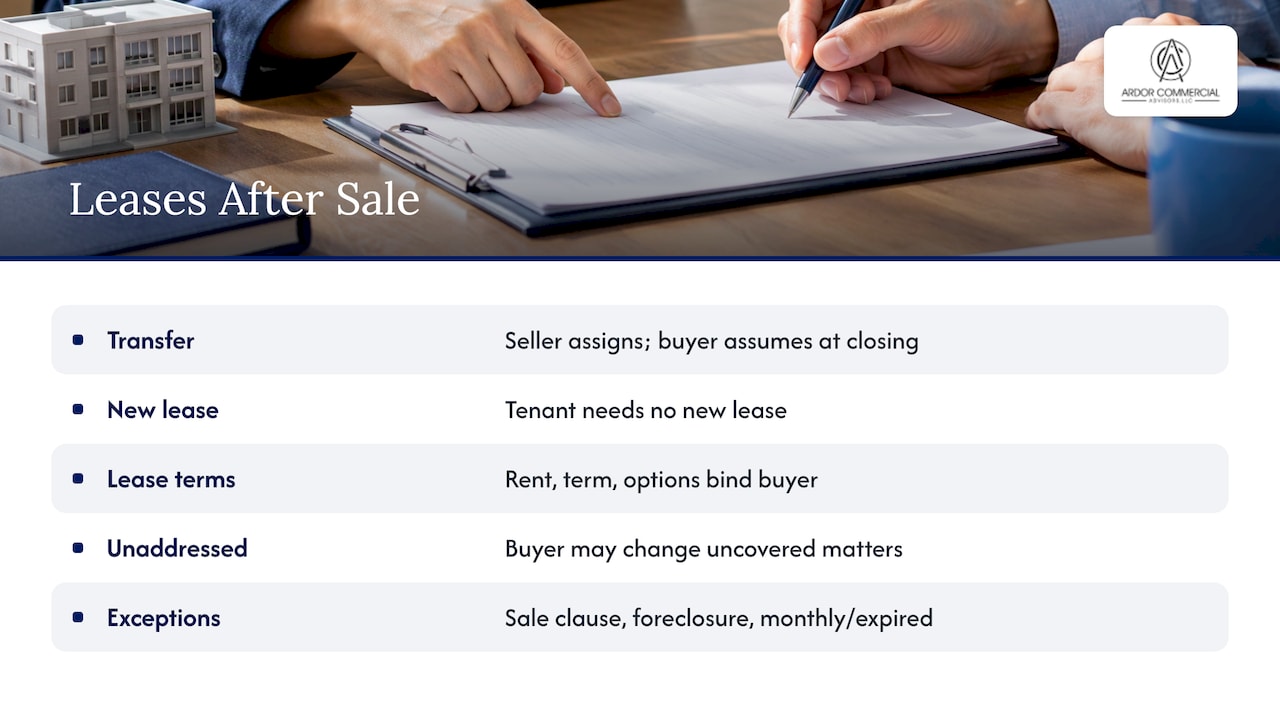
In a typical commercial purchase agreement, the seller assigns its interest as landlord under the leases, and the buyer assumes that interest as of closing, as reflected in a standard assignment and assumption of leases. Your tenants do not need a new lease, and the buyer cannot rewrite the one they have.
Nolo explains that the new owner can change only matters the lease does not address, such as how rent is paid or when janitorial service runs. Everything the lease does address, including rent, term, options and expense pass-throughs, binds the buyer.
There are exceptions a seller should know before talking to buyers. Touma Law lists them: a termination-on-sale clause, a lease subordinate to a foreclosing lender, and month-to-month or expired tenancies, which a new owner can end with proper notice. A buyer who tries to end a lease without one of those rights is breaching it.
What this means for pricing
Because leases carry over, a buyer is really buying a stream of contractual rent. A medical suite on a long lease with a creditworthy practice, or a warehouse with a multi-year industrial tenant, supports a lower-risk valuation than the same space vacant. Month-to-month tenants and leases near expiration make the income look less certain, and buyers discount accordingly. Our commercial property valuation work with DCF modeling shows owners how lease terms flow into value before the building is listed.
Step 1: Find and summarize every lease
Practice guides advise identifying all leases before the purchase and sale agreement is drafted, because the buyer steps into your shoes as landlord (Texas practice guide). In practice that means collecting each lease, amendment, side letter, commencement memo and guaranty, then summarizing them in one place.
A lease abstract does this: rent, escalations, term, options, expense recoveries, deposits and special rights, one page per tenant. Look for the items that surprise sellers most:
- Rights of first refusal or purchase options in favor of a tenant
- Termination-on-sale or relocation clauses
- Free-rent periods and unpaid tenant improvement allowances
- Renewal options and how renewal rent is set (see our guide to fair market rent renewal)
- Exclusive-use and signage rights (see signage rights in a commercial lease)
- Expense reconciliations that are open or disputed
For medical buildings, a lease audit before marketing catches mismatches between what the lease says and what the tenant is actually billed. Our lease review and CAM reconciliation analysis, along with lease abstraction, are services we offer for exactly this purpose.
Step 2: Deal with rights of first refusal early
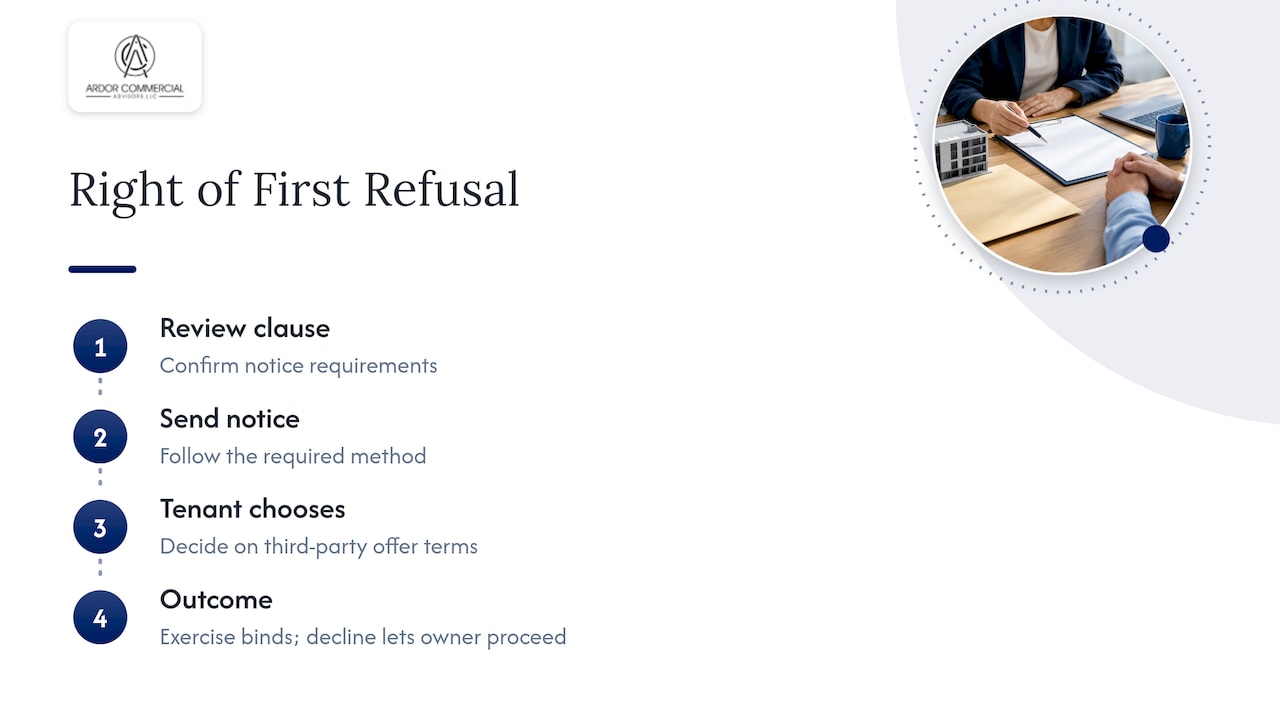
A right of first refusal (ROFR) gives a tenant the chance to buy on the terms of a third-party offer. In New York’s Danyluk v. Glashow decision, the court held that a ROFR does not force an unwilling owner to sell, but once the owner decides to sell, the holder must be offered the property first, and electing to buy on the offer’s terms creates a binding contract. Vlodaver Law makes the same practical point: a tenant who exercises the right may form a binding contract on the offer’s terms.
The lesson is sequence. Read the clause, send the required notice in the required way, and only then sign with a buyer. Our right of first refusal guide walks through how these provisions work for both buyers and sellers.
Step 3: Plan showings and inspections around the lease
Buyers will tour the building and run inspections while your tenants work in it. Whether you can enter, and on what notice, depends mostly on the lease. Nolo notes that commercial leases commonly require at least 24 hours of advance notice, may specify 24 to 48 hours or “reasonable notice,” and that a commercial tenant generally has no statutory right to notice unless the lease gives one. Some states do set rules: Maryland, for example, requires written notice at least 24 hours before entry, with limited hours and a stated purpose. Check the law where your property sits and follow the lease clause either way.
A few habits keep tenants cooperative:
- Tell tenants a sale is coming before buyers appear, and give them a single contact for scheduling.
- Group tours into set windows so a dental practice is not interrupted all week.
- Keep invasive testing out of occupied suites unless the tenant agrees in writing.
- Put access, tenant communication, insurance and damage indemnities into the purchase agreement. Dentons’ contract guide lists these as key points on the access issue.
Buyers will also want to see the building envelope. Knowing the age and condition of the roof before they ask helps, and a primer on what a commercial roof inspection covers and how often it is done shows what an inspector will look at.
Step 4: Order estoppel certificates
An estoppel certificate is a statement signed by the tenant confirming the facts of its lease. Touma Law notes it typically confirms rent, term, security deposit, that the lease is in effect, and that the landlord is not in default, and that a tenant can be held to what it signs. Most leases require the tenant to return one within a set number of days after a request, so check that clause first.
Buyers and lenders treat estoppels as proof that your rent roll is real. Purchase agreements show how much weight they carry:
| Document | Estoppel requirement |
|---|---|
| A sample purchase agreement | Estoppels covering at least 85% of net rentable square feet by the end of the inspection period |
| A 2022 REIT purchase agreement | Major tenants plus enough others to reach 75% of leased floor area, delivered five business days before closing, with a 14-day extension option |
Timing matters too. One due-diligence checklist notes that most purchase agreements and lenders want estoppels dated within 30 to 45 days of closing, so early ones may need to be reissued. Lender rules add pressure: YieldStack reports that Freddie Mac’s multifamily guide requires estoppels from commercial tenants at 5% or more of gross potential rent, and that Fannie Mae’s guide requires one for each material commercial lease.
The same article points out why details matter: an omitted free-rent period lowers year-one income, and an unpaid tenant improvement allowance is a cash claim that can follow the property. Compare every returned estoppel to your lease abstract before it goes to the buyer. Our guide to what to verify in an estoppel certificate covers the line items.
Step 5: Prepare for SNDAs when the buyer finances
Most buyers use a loan. An SNDA (subordination, non-disturbance and attornment agreement) is a three-party deal: the tenant subordinates its lease to the mortgage, the lender agrees not to disturb a tenant that is not in default after a foreclosure, and the tenant agrees to recognize the lender or foreclosure buyer as landlord. HWH Law notes lenders require SNDAs from each major tenant when a sale is financed, and the sale will not close unless the lender’s requirements are met.
This is also why a buyer’s debt service coverage matters to you. A lender sizes the loan on the income the leases produce, so the quality of your rent roll affects the price a buyer can pay. Our DSCR loan sizing guide shows how that calculation works.
Step 6: Handle closing mechanics
At closing, a few lease items move from you to the buyer:
- Security deposits. Deposits you hold must be transferred to the buyer, who then owes the tenant the return at lease end. Lindell Law notes that Illinois law moves the return obligation to the new owner on sale, so confirm your own state’s rule with your attorney.
- Prepaid rent and prorations. Settle rent, expense reimbursements and open reconciliations on the closing statement.
- Tenant notices. One executed purchase agreement filed with the SEC has seller and buyer sign notices to all tenants at closing, telling them where to pay rent and send notices, delivered promptly afterward. Tenants should redirect rent only on verifiable written notice, as Touma Law advises.
A seller’s attorney drafts and reviews the purchase agreement and assignment of leases. We coordinate the lease side of the transaction alongside that counsel.
If the buyer wants the building empty
Some buyers, such as an owner-user who wants to occupy the space, ask for vacant possession. A tenant with an unexpired lease is not required to leave or sign a new lease, and removal generally requires a material breach and formal process, as Vlodaver Law explains. Realistic paths are:
- Use an existing relocation clause, which a new owner can invoke even if the prior owner never did
- Negotiate a buyout with a defined date and payment
- Wait for expiration, or end month-to-month tenancies with proper notice
For the tenant’s perspective on a negotiated exit, see our guide to exiting a commercial lease early. If your tenants are likely to stay, a retention plan keeps the income that supports your price: see NPV-based tenant retention for medical and office.
Our perspective
Owners often think of tenants as an obstacle to a sale. We see them as the product. A building with documented leases, reconciled expenses and tenants who answer estoppel requests on time shows a buyer exactly what they are buying.
That is why we start with the paper, not the listing. We abstract the leases, run the numbers on valuation, and find the ROFRs and options before any buyer does. Our advisors work on both sides of the table as landlord and tenant representatives, so we know what a tenant will sign and what a lender will ask for.
For medical and office owners in the Charlotte area, the sale price is usually decided in the lease file. Clean it up first.
Jim
Next step for Charlotte-area owners
If you own an office, medical, retail or industrial building in the Charlotte MSA and are weighing a sale, we can review your leases, value the property and represent you as landlord through closing. Our commercial property valuation service includes DCF modeling, and our lease review and CAM reconciliation analysis checks the numbers a buyer will check.
To discuss your building, start at ardorcre.com or see all of our services.
FAQ
Is it legal to sell a commercial property with tenants in it?
Yes. Commercial buildings are routinely sold with tenants in place. The seller assigns the leases to the buyer, who assumes them at closing and becomes the new landlord.
Does the buyer have to honor existing leases?
Generally, yes. Nolo explains that a commercial lease remains in place after a sale and the buyer must follow its terms. The exception is a lease that is subordinate to a mortgage and is cut off in foreclosure, unless the tenant holds a non-disturbance agreement.
Do I need the tenant’s permission to sell?
Usually not. Hollander Real Estate Law says a commercial tenant’s consent is not typically required for a lease transfer, though written notice after the sale is standard and often required. A tenant with a ROFR or purchase option is the main exception to plan for.
How much notice must I give tenants before showings?
It depends on the lease and, in some states, on statute. Commercial leases commonly require 24 hours or more, and Nolo notes a commercial tenant generally has no legal right to notice unless the lease provides one. Follow the lease and check your state’s rules.
Sources
- Assignment and Assumption of Leases (Practical Law)
- Property Ownership Changes in a Commercial Lease (Nolo)
- Commercial Lease When Property Is Sold (Touma Law)
- Commercial Real Property purchase and sale guide (Texas)
- Danyluk v Glashow (2004)
- Selling Tenant-Occupied Commercial Property (Vlodaver Law)
- Commercial Landlord Right of Entry (Nolo)
- Maryland Real Property §8-221
- Buying and Selling Commercial Real Estate (Dentons)
- Commercial Roof Inspection: What It Covers and How Often
- Sample purchase agreement (SEC filing, 2001)
- Purchase and Sale Agreement and Escrow Instructions (Justia, 2022)
- Real Estate Due Diligence Checklist for Commercial Property
- Why Do Commercial Lenders Require Tenant Estoppels and SNDAs
- Looking Down the Road: Estoppels, SNDAs and Other Lease Provisions (HWH Law)
- Executed purchase agreement, Exhibit 10.1 (SEC)
- What Happens When Commercial Property Is Sold With Tenants (Lindell Law)
- What Happens to Commercial Real Estate Leases When a Property Is Sold (Hollander)