
Charlotte’s flex market is really two markets under one name: office-style flex inside larger buildings, and industrial flex, which pairs warehouse bays with finished office space. Which one you need decides your rent, your lease terms and whether you should lease or buy. For medical practices, small professional firms and owners of multi-tenant buildings, the right answer usually comes from reading the lease and the building, not the headline rate. At Ardorcre we advise tenants, landlords and investors across the Charlotte MSA on exactly that decision.
TL;DR
- “Flex” in Charlotte means either flexible, short-term office space or industrial flex: light-industrial bays with built-in office finish. Check which one a listing means before you compare prices.
- Leasing activity in 2026 has leaned toward Class A buildings, and well-located older Uptown buildings have been able to push rents up.
- Medical and professional users should weigh lease versus buy by comparing total occupancy cost, not just the monthly rent.
- Owners and investors should look at suite size, parking, loading and lease expirations, because those drive re-leasing speed.
- Read the lease line by line before you sign: CAM charges, guarantees and renewal terms move your real cost more than the base rate.
Table of Contents
- What “flex” means in Charlotte
- What the Charlotte market is doing
- Where demand is coming from
- Lease or buy: the question for medical and office users
- How to evaluate a flex lease
- For owners and investors: leasing a flex building well
- Our perspective
- How Ardorcre helps
- FAQ
- Sources
What “flex” means in Charlotte
Search results for this topic mix several different products, so start with definitions.
Flex office space is office space with more flexible terms than a traditional lease. It often sits inside a larger office building or mixed-use project, and it suits service businesses and professional teams that want shorter commitments and can scale up or down.
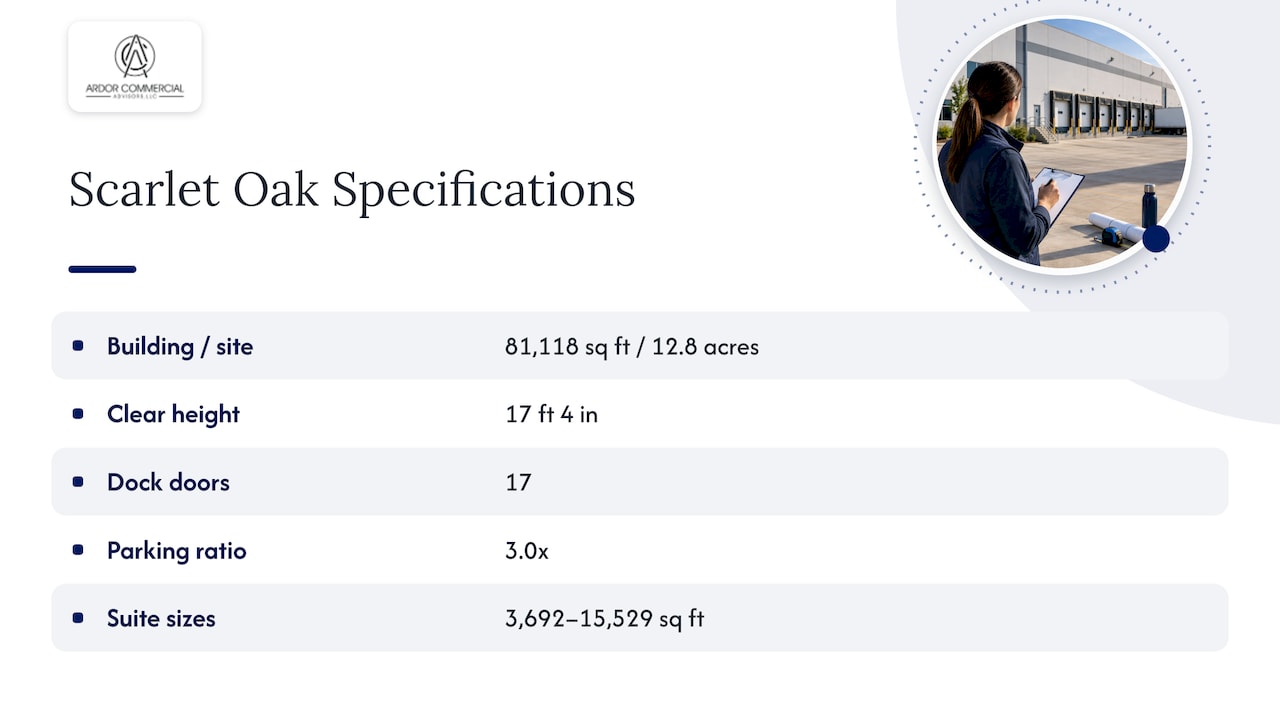
Industrial flex space is different. It is built for light manufacturing, assembly, trade work, showrooms or e-commerce fulfillment, and it combines an office front with warehouse space behind it. A Charlotte flex industrial property sold in early 2024 shows what the product looks like: 81,118 square feet of industrial and office space on 12.8 acres, 17 foot 4 inch clear heights, 17 dock doors, a 3.0x parking ratio and suites from 3,692 to 15,529 square feet. The buyer’s partner described Charlotte’s flex industrial market as robust over the prior several years.
Traditional office is a conventional multi-year lease in an office tower or suburban building, usually priced per square foot per year with annual escalations.
If you are a dentist, an orthodontist, a physical therapist or a small professional firm, you are usually shopping the first or third category. If you run a trade business, a distribution startup or a showroom, you are shopping the second. Owners and investors may hold either and often both.
What the Charlotte market is doing
The office side of the market has picked up. According to a July 2026 market report, leasing activity accelerated in early 2026, with nearly 70% of volume captured by Class A buildings. The same report notes that South Park continues to attract large-block users, and that rising construction costs for new buildings are widening the gap between new product and older inventory. That gap is letting owners of well-located older Uptown buildings push rents upward.
What that means in practice:
- Tenants who want quality space are competing for a limited pool of top-tier buildings, so decisions made slowly can lose the space.
- Tenants who can accept older, well-located buildings have room to negotiate on improvements and free rent, but rents in those buildings are firming where location is strong.
- Owners of older buildings with good locations and honest repositioning plans are in a stronger spot than they were a few years ago.
Rents and vacancy move every quarter, so treat any single number you read as a snapshot. For current Charlotte figures, our own pages track office rents per square foot, industrial rents, industrial vacancy and the office pipeline. For layouts and costs on the industrial side, see our guide to industrial flex space in Charlotte.
Where demand is coming from
Demand for flexible space comes from a few distinct groups in Charlotte.
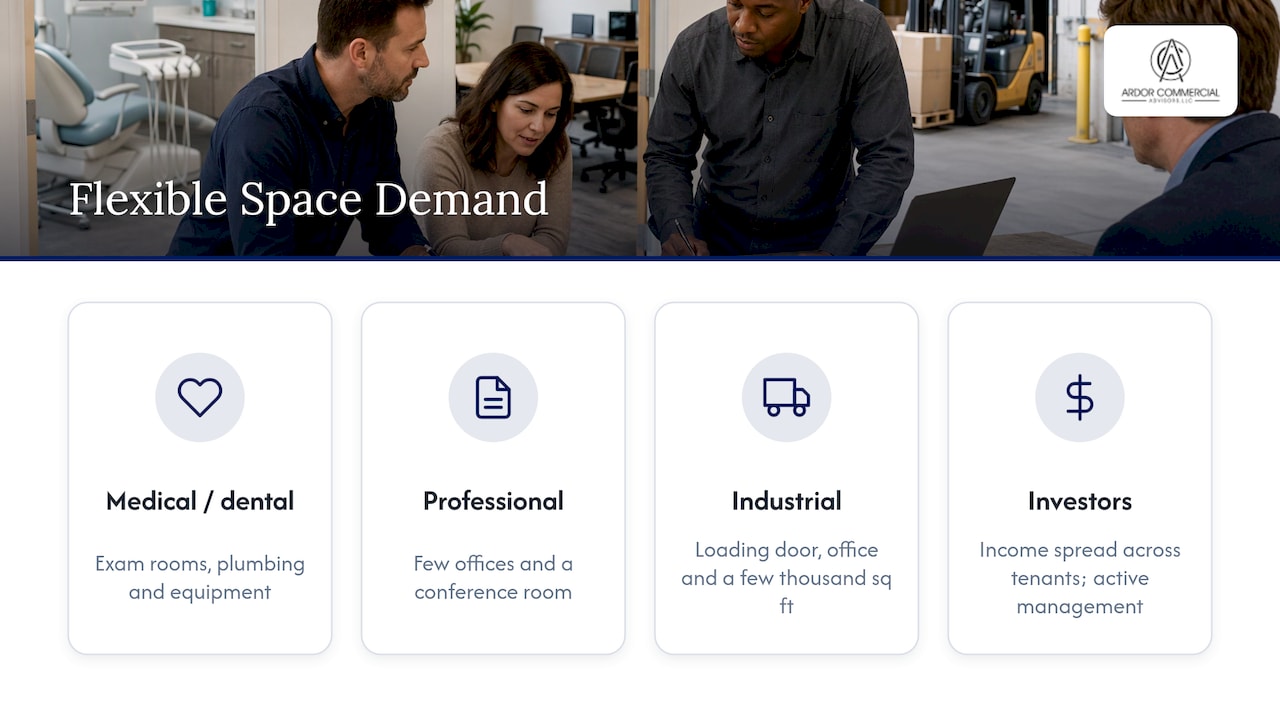
Medical and dental practices. Practices that outgrow a first suite, or that are opening a second location, want space that can be built out for exam rooms, plumbing and equipment without a long wait. They often prefer a stable location near referral sources and patients. Our look at Charlotte medical office demand covers recent sales and lease terms in that segment.
Professional services and advisers. Financial planners, small law and accounting firms and consultants want a professional address, a few offices and a conference room, without taking 10,000 square feet on a long lease.
Small industrial users. Contractors, e-commerce brands, service fleets and showroom businesses want a few thousand square feet with a loading door and an office. That is the flex industrial tenant.
Investors. Multi-tenant flex buildings spread income across several tenants, which is the draw. They also require more active leasing and management.
Submarket choice matters in all four cases. Our Charlotte submarket guide lays out where to buy, sell or refinance.
Lease or buy: the question for medical and office users
For a practice or firm with a stable headcount, owning can be attractive, and it is worth a proper comparison before you renew a lease. The comparison should be made on total cost of occupancy over the period you realistically expect to stay.
What to put in the comparison
| Item | Leasing | Buying |
|---|---|---|
| Upfront cash | Deposit, possibly some build-out | Down payment, closing costs, build-out |
| Monthly cost | Base rent plus pass-throughs | Loan payment, taxes, insurance, maintenance |
| Cost growth | Annual escalations in the lease | Fixed-rate debt stays flat; taxes and insurance still move |
| Control of space | Subject to the lease and landlord | Full control of build-out and use |
| Exit | Lease expiration or buyout negotiation | Sale of the property |
| Extra income | None | Rent from other tenants if the building is multi-tenant |
A worked example shows the mechanics. Suppose a practice occupies 3,000 square feet at $30 per square foot per year. That is $90,000 a year in base rent. With 3% annual escalations, year five rent is about $33.76 per square foot, or roughly $101,300. Add CAM (common area maintenance) charges, which are the tenant’s share of the building’s operating costs. Then compare it to the all-in annual cost of a loan, taxes, insurance and upkeep on a comparable purchase. These figures are illustrative, not Charlotte quotes. The point is that the lease side keeps rising while a fixed-rate loan payment does not.
Medical build-out changes the math
Medical build-out is expensive and specific to the user. Plumbing in every operatory, imaging shielding and specialized HVAC are investments you want to amortize over a long stay. If you lease, those improvements should be negotiated with the landlord’s contribution (a tenant improvement allowance) and a lease term long enough to recover your own spend. If you buy, you control them and they build the value of your asset.
Buying a multi-tenant building
Practices and professional firms with enough capital can buy a small multi-tenant building and occupy part of it. The advantages are straightforward: rent from the other tenants offsets your occupancy cost, you control the building’s use and improvements, and you build equity instead of paying a landlord. It also adds a role, landlord, that someone has to run. Property management, lease administration and CAM reconciliation are the day-to-day work, and our property management budget guide shows what to plan for. If you are unsure whether the property or its numbers hold up, a commercial property valuation with a discounted cash flow model gives you a price view before you commit.
Financing is the other half of this decision. Lenders size commercial loans on the property’s income, which is where the debt service coverage ratio comes in. Our DSCR guide for commercial real estate walks through loan sizing. If you are selling one property to buy another, the 1031 exchange rules govern how to defer the tax.
How to evaluate a flex lease
Whether the space is flex office or industrial flex, check these items before you sign.
1. Term and flexibility
Shorter terms give you room to grow but usually cost more per square foot and offer less landlord investment. Longer terms earn better concessions. Ask for renewal options at a defined rent method and, if growth is likely, expansion rights on adjacent suites. Our leasing timeline for medical and office tenants shows the three to six months a typical deal takes, which is why you should start well before expiration.
2. Lease structure and pass-throughs
The base rent is only part of what you pay. Most commercial leases pass operating expenses to the tenant. Our triple net lease guide explains the structure, and our industrial lease types guide covers what changes for warehouse and flex space. CAM charges are where surprises happen, so a lease review and CAM reconciliation analysis is worth doing before signing and again each year.
3. Guarantees
Landlords often ask a new or small business to back the lease with a personal or corporate guarantee. That can be negotiated. See our page on capping a corporate guarantee at 12 months’ rent.
4. Building specifications
For industrial flex, check clear height, dock doors versus drive-ins, power, truck court and the parking ratio. The Scarlet Oak example above lists those exact specs for a reason: they decide who can use the suite. For office flex, check the HVAC schedule, internet providers, signage and after-hours access.
5. Location against your customers
Patients, clients and employees all have a commute. A cheaper suite in the wrong submarket costs more in lost visits and turnover. Match the submarket to where your customers and staff are.
6. Rights that protect you
If you may want to buy the building later, or the landlord may sell, understand right of first refusal provisions.
For owners and investors: leasing a flex building well
Owners of multi-tenant flex buildings win by keeping suites full and rent rolls staggered. A few practices matter most:
- Stagger lease expirations so you never face the whole building rolling at once.
- Know your suite sizes. A building with a mix of small and mid-size suites can absorb more types of tenants than one with a single large floor plate.
- Refresh between tenants. Light improvements make a suite show better, and even something as simple as repainting commercial properties can improve first impressions.
- Price against the right comparables. A suite with dock doors competes with other industrial flex, not with Uptown office.
- Decide hold or sell with numbers. Valuation, DSCR and your loan terms tell you whether to hold, refinance or sell. Refinancing a commercial mortgage-backed loan, for example, depends on the loan’s remaining terms and on current coverage ratios, so run the numbers early.
Landlord representation covers pricing, marketing, tenant selection and lease negotiation. Property management covers rent collection, vendors and budgets. Our commercial property manager duties guide lists what to expect from either.
Our perspective
Most of the confusion in Charlotte’s flex market comes from one word covering two products. A dentist looking for a build-out-ready suite and a contractor looking for a bay with a dock door are not shopping the same market, yet they find the same search results.
Our advice is to define your use first, then the building, then the rate. We work with tenants, landlords and investors on both sides of the table, so we look at a deal the way each party will: the lease terms, the cost of occupancy over the full term, and what the space is worth when you leave.
For medical and office users, we recommend running the lease-versus-buy comparison before every renewal, not after. For owners of multi-tenant buildings, we recommend knowing your expirations, your coverage ratio and your valuation before a lender or a buyer asks.
Jim
How Ardorcre helps
We provide commercial real estate brokerage in the Charlotte MSA: sales and leasing of office, medical, retail, industrial, land and investment properties, with landlord and tenant representation, property management, lease analysis and advisory services. If you are weighing a flex lease, we can review the lease and CAM charges, and our tenant representation team can take on the search and negotiation. For a purchase, sale or refinancing decision, our valuation and DCF modeling work puts numbers behind the choice. See all of our services.
If you already own a building, we can help with valuation, leasing strategy and management. Start with a conversation about your property and your timeline at ardorcre.com.
FAQ
What is the difference between flex office and flex industrial space?
Flex office is adaptable office space, often with shorter terms, inside a larger office or mixed-use building. Flex industrial combines warehouse or light-industrial space with built-in office, usually with dock doors or drive-in access. The two are priced and leased differently, so compare each only with its own kind.
Who uses flex space in Charlotte?
Medical and dental practices, professional service firms, contractors, e-commerce brands and showroom businesses are common users. Which type of flex suits you depends on whether you need patient-ready offices or loading and storage. Our industrial flex guide covers the industrial side in detail.
Should a medical practice lease or buy in Charlotte?
Compare the total cost of occupancy over the years you expect to stay, including build-out, pass-throughs and escalations on the lease side and loan, tax, insurance and upkeep on the buying side. Practices with stable operations and capital often find ownership worth modeling. Talk to a commercial broker and your own accountant before deciding.
How long does it take to lease commercial space?
Plan on about three to six months from search to signed lease for a typical medical or office deal, longer if the space needs significant build-out. Our leasing timeline breaks down each stage.
What should I check in a flex lease before signing?
Check the term and renewal rights, lease structure and CAM charges, any guarantee, the building specifications and the location against your customers. A lease review before signing is the cheapest point to fix a problem.
Sources
- ABR Capital Partners and Somerset Properties acquire Charlotte flex industrial asset
- Charlotte’s Office Market Picks Up in 2026 as Activity Accelerates
- Why repaint commercial properties: a complete guide