
A build-to-suit project in Charlotte means a building designed and built around your operation, on a site you choose, under a lease or ownership structure agreed before construction starts. It makes sense when your space needs are specific, you plan to stay for the long term and you can live with a timeline measured in many months, not weeks. For most medical practices, offices and industrial users, the real question is not whether build-to-suit is possible. It is whether the custom fit is worth the wait and the cost exposure compared with existing space. At Ardorcre, we help Charlotte tenants and owners answer that before a site is ever picked.
TL;DR
- Build-to-suit is purpose-designed space, typically owned by or leased to one organization for the long term. Spec space is built by a developer to attract tenants later.
- It fits established organizations with capital and staying power. Growth-stage companies often do better in existing space.
- Expect a long sequence: site, program, pricing, financing, design, permitting, construction, inspections and occupancy. Permitting and site surprises cause most delays.
- Lease terms, cost overrun allocation and rent adjustment clauses decide who carries the risk. Have them reviewed before signing.
- In Charlotte, zoning, stormwater and plan review requirements shape both cost and schedule, especially for industrial sites.
Table of Contents
- What build-to-suit means in commercial real estate
- Who should consider build-to-suit in Charlotte
- The build-to-suit process, step by step
- Lease structures and who pays for what
- What drives cost and timeline in Charlotte
- Risks to address before signing
- Build-to-suit or existing space: how to decide
- Our perspective
- How we help with a build-to-suit decision
- FAQ
- Sources
What build-to-suit means in commercial real estate
The CRE Development Association describes build-to-suit buildings as purpose-designed and built, and typically owned, by a specific organization to accomplish its own goals. Owners usually have the capital and staying power for a long-term investment. In a leased version, a developer or landlord builds to your specifications and you sign a long lease before ground is broken.
Three paths are worth separating:
| Path | Who designs it | Typical fit | Main trade-off |
|---|---|---|---|
| Build-to-suit | You, with the developer and design team | Specialized needs, long horizon | Longest timeline, cost exposure |
| Spec building | The developer, for an unknown tenant | Companies that need space soon | Layout and systems are largely set |
| Existing space, lease or buy | A prior owner or tenant | Fast occupancy, flexible term | Fit-out limits |
The same CREDA piece notes that spec buildings are built by developers to attract tenants during or shortly after construction, not for a particular organization. Our own guide on build-to-suit versus spec for medical and office users walks through the 10 to 18 month wait and when it pays off.
Who should consider build-to-suit in Charlotte
CREDA’s view is that build-to-suit is a long-term investment generally suited to established organizations with capital and staying power, while companies focused on short-term growth lean toward spec space because it needs far less up-front capital.
In practice around Charlotte, the groups we hear from most are:
- Medical and dental practices that need plumbing, imaging shielding, specific exam room counts or ADA-friendly flow that a generic suite cannot give them. A buildout inside existing space can get close, but a ground-up building gets it exact.
- Corporate and professional office users with a headquarters-scale requirement and a long horizon, especially where parking ratios and branding matter.
- Industrial users that need clear height, column spacing, dock count, truck court depth or power that existing buildings do not offer.
- Owner-investors who want a single-tenant asset with a long lease in place.
If you are still comparing, start with the market. Our pages on Charlotte office rents, Charlotte industrial rents and the Charlotte office pipeline show what existing and incoming space costs, which sets the benchmark any custom building has to beat.
The build-to-suit process, step by step
Developer.com lays out a build-to-suit sequence that runs from an initial plan and site selection through a preliminary floor plan, cost estimate, financing, design, bidding, permitting, construction, inspections, certificate of occupancy, punch list and possession. Here is how each stage plays out locally, and where it goes wrong.
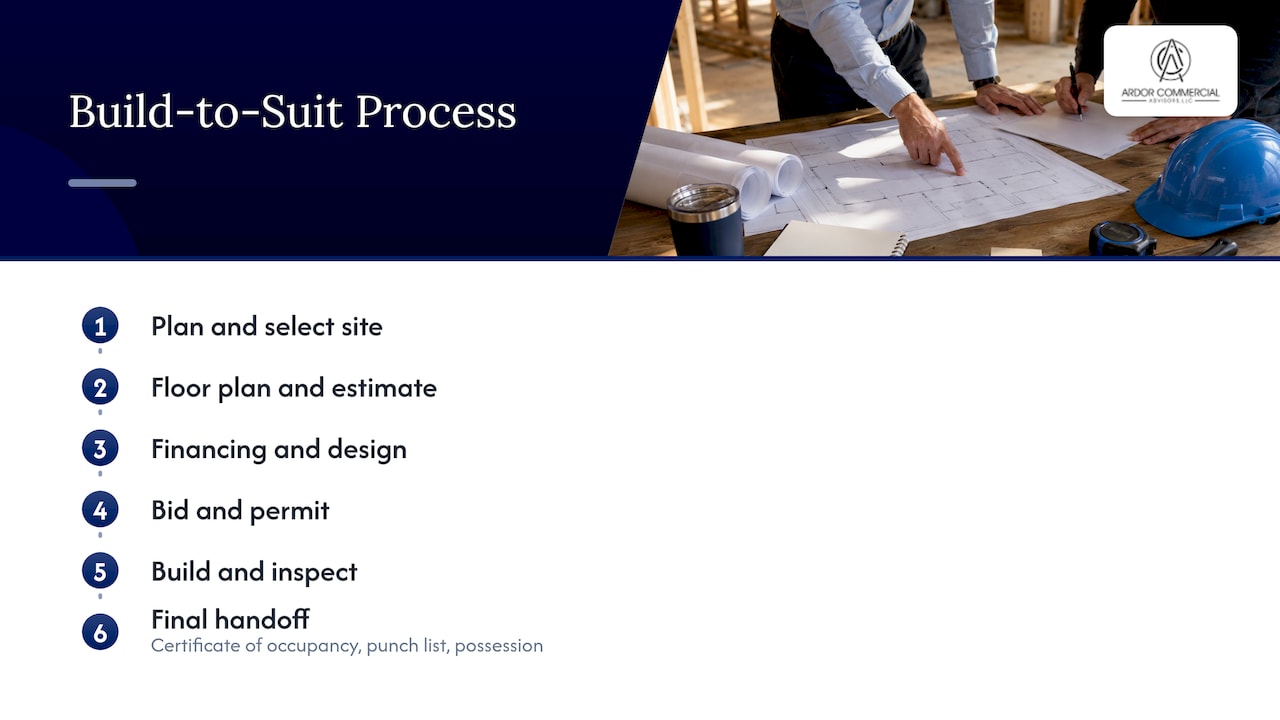
1. Define the program
Write down what the building must do: square footage, rooms, loading, power, parking, growth room. Where it goes wrong: a vague program leads to design changes later, and changes are what inflate cost. A tenant representation advisor can pressure-test the program against what the market already offers, so you know whether you need custom at all.
2. Select the site
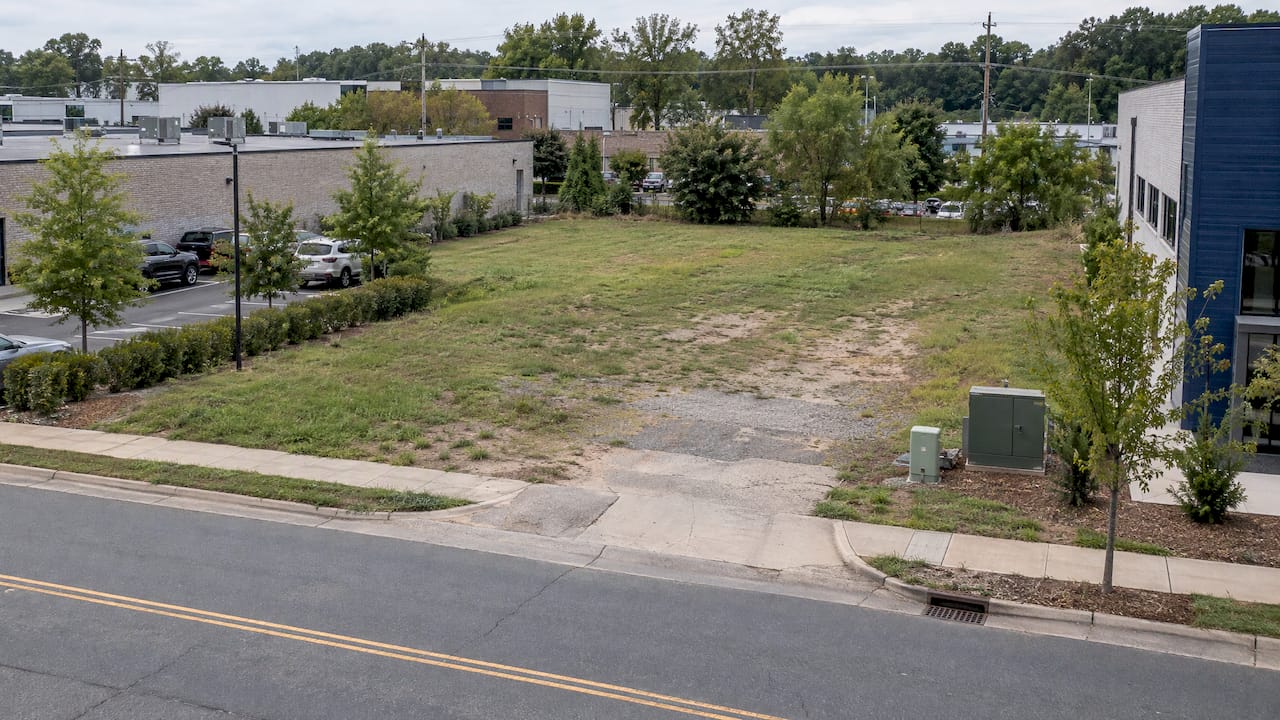
Zoning, utilities, access and surrounding uses decide whether a site works. Charlotte’s zoning checklist and review resources are the official starting point for what a parcel allows. Our guides to Charlotte land development and Charlotte land prices cover what an acre costs and what investors check first. Land sales are one of the services we offer, so site search and tenant advocacy can sit under one roof.
3. Price it and set the economics
Before design is final, you need a best-guess budget and a lease or purchase structure. This is where a valuation and DCF model earns its keep: it shows whether the rent or price the project implies is in line with the market. Our commercial property valuation and DCF modeling service is built for exactly this question.
4. Arrange financing
Developers, owner-users and investors each finance differently, and the lender’s debt service coverage test shapes how much you can borrow. Our DSCR loan sizing guide explains the math. If you are weighing lender options for a retail or mixed project, commercial retail loan programs are one place to start comparing.
5. Design, bid and permit
Design and permitting often run in parallel. In Mecklenburg County, plan review is handled through Code Enforcement, which publishes plan review policies and programs including options such as express and third-party review. Developer.com warns that the design and permitting track can cause delays if the local government is not a partner in the process. Ask early which review path fits your schedule.
6. Build, inspect, occupy
Construction is followed by inspections, a certificate of occupancy and a punch list. Rent usually starts at or near completion, so any slip in the schedule is a cost to someone. Who bears it is a lease question, covered below.
Lease structures and who pays for what
Build-to-suit leases are long, and the details are where tenants gain or lose money. Most are net leases, where the tenant pays operating costs on top of rent. Our triple net lease guide explains what that means for tenants, landlords and investors, and for industrial users, industrial lease types shows how the costs differ between structures.
A public example shows how specific the terms get. In a lease exhibit filed with the SEC in 2006, the tenant pays the landlord in cash the amount by which its costs exceed a tenant improvement allowance, and the landlord charges a development fee of 3% of the tenant improvement cost of work. The same filing sets base rent on estimated project costs, then adjusts it up or down based on actual total project costs per rentable square foot. That is one company’s agreement from twenty years ago, not a market standard, but it shows the clauses to look for:
- A cost-based rent adjustment, and how it is calculated
- A tenant improvement allowance and who pays above it
- A development or management fee on the work
- How change orders flow into rent
On a long lease, a single percentage in these clauses can be worth far more than a headline rate. Our lease review and CAM reconciliation analysis and lease abstraction services are designed for reading these documents line by line. Related protections such as a corporate guarantee cap and an estoppel certificate also belong in the review.
What drives cost and timeline in Charlotte
Existing-space leasing is quicker by design. Build-to-suit trades speed for fit, and a Charlotte project’s timeline is shaped by several local items:
- Zoning and entitlement. Industrial parcels in Charlotte and Mecklenburg County fall under the Unified Development Ordinance, and a use that is not allowed by right may need conditional rezoning, which adds time. Check the City’s zoning submittal resources before you commit to a site.
- Site conditions. Developer.com names rising costs and unexpected site challenges as the most significant common risk in build-to-suit work. Soil, grading and utility extensions are common culprits.
- Stormwater and site layout. Setbacks, buffers and impervious surface limits affect how much of a parcel you can actually build on, which matters most for industrial truck courts and parking-heavy office.
- Property taxes. A new building is reassessed at a higher value, so model the carrying cost. Our Charlotte commercial property tax guide covers rates and appeals.
- Permit review time. It varies with project complexity. Ask Code Enforcement and your design team for current review times on your project type, and build float into the schedule.
Risks to address before signing
Developer.com’s overview of build-to-suit risks and rewards points to two that matter most: rising costs or site surprises, and permitting delays through a local agency that push back the start and completion dates. Turn each into a contract answer:
- Cost overruns: Who pays above the budget, and is rent adjusted? Is there a guaranteed maximum price?
- Delay: Is there a delivery date with a remedy, such as rent credits or termination rights, if the building is late?
- Changing needs: What happens if your headcount, equipment or services change mid-design?
- Exit: What are your options if you outgrow the building? Build-to-suit leases are long, so assignment, sublease and expansion rights should be negotiated up front.
- Holdover: If your current lease ends before the new building opens, where do you sit? Our 3 to 6 month leasing timeline shows how to line up an extension or bridge space.
Build-to-suit or existing space: how to decide
Use four questions:
- Can existing space be adapted? If a second-generation medical suite or a flex building gets you 90% of the way, the custom premium may not pay. See our guide to industrial flex space in Charlotte and the warehouse lease rates page for what is available.
- How long will you stay? Custom buildings reward long horizons. If you may outgrow the space in a few years, spec or existing space leaves you more flexible.
- Can you wait? Plan on roughly 10 to 18 months for medical and office, per our build-to-suit guide, versus a few months for most existing-space leases.
- What does the asset do for you? Owner-users can build equity and, in some cases, use a 1031 exchange when selling an existing property to fund the new one. Check the 1031 exchange timeline early, since the deadlines are fixed.
For a medical practitioner the lease-versus-buy decision is part of the same question. A purpose-built medical building you own can lock in occupancy cost, while a leased build-to-suit gives you the custom fit without tying up capital in real estate.
Our perspective
Most people who call us about build-to-suit have not yet decided if they need it. That is the right moment to talk. A custom building is a long commitment, and the cheapest mistake to fix is the one you catch before a site is under contract.
We start with the numbers: what comparable existing space costs, what the build would cost, and what the lease or ownership structure does to your occupancy cost over ten or more years. Then we look at the lease language, because that is where cost overruns, delivery dates and rent adjustments are settled.
Our advisors work both sides of the table as landlord and tenant representatives, so we know what a developer will and will not give. If the answer is an existing building with a good buildout, we will say so and help you find it. If the answer is a ground-up building, we help you set the program, evaluate sites and negotiate terms that protect you.
Jim
How we help with a build-to-suit decision
We are a commercial real estate brokerage in the Charlotte MSA, working with office, medical, retail and industrial users, owners and investors. For a build-to-suit decision, the relevant pieces are tenant representation, landlord representation, valuation and DCF modeling, and lease review. You can see the full list on our services page.
If you are weighing a custom building against existing space in Charlotte, contact Ardorcre and we will start with the comparison.
FAQ
What is a build-to-suit lease?
It is a lease on a building that is designed and constructed to the tenant’s specifications, signed before or early in construction. The tenant usually commits to a long term, and the lease sets how construction costs, rent and delays are handled.
How long does a build-to-suit project take in Charlotte?
It depends on the site, entitlement and permitting. For medical and office projects, our guide puts the wait at roughly 10 to 18 months. Rezoning or unexpected site work can add to that, so ask the county and your design team for current review times.
Is build-to-suit cheaper than leasing existing space?
Not usually in the short run. You are paying for a custom fit, and the economics depend on the term, the rent structure and what you would otherwise spend adapting an existing building. A valuation and lease comparison shows the difference for your situation.
Who pays for cost overruns?
That is set in the lease or construction agreement. Some leases adjust rent to actual project cost, as in the SEC-filed example above, while others use a fixed budget. Have the clause reviewed before you sign.
Does build-to-suit work for small medical practices?
It can, especially for practices with specialized rooms and a long horizon. Many practices compare it against a second-generation suite with a custom buildout. We help you model both.
Sources
- CREDA: Build-to-Suit vs. Spec
- Developer.com: Step-by-Step Guide to the Build-to-Suit Process
- Developer.com: Build-to-Suit Leases, Risks and Rewards
- SEC Exhibit 10.1, Form 10-Q lease exhibit
- City of Charlotte: Commercial Plan Review Resources
- Mecklenburg County Code Enforcement: Plan Review Policies and Programs
- Commercial retail loans