
Charlotte warehouse space averaged $8.21 per square foot in asking rent in the second quarter of 2026, quoted triple net (NNN) across all classes of available inventory. That is a market average, not a quote for your building. Depending on submarket, age, size and lease structure, the number you actually pay can sit well above or below it. This guide shows where rates land by submarket, what sits on top of base rent, and how to compare two offers fairly.
TL;DR
- The Q2 2026 average asking rent for Charlotte industrial space was $8.21/SF, NNN, per Savills Research.
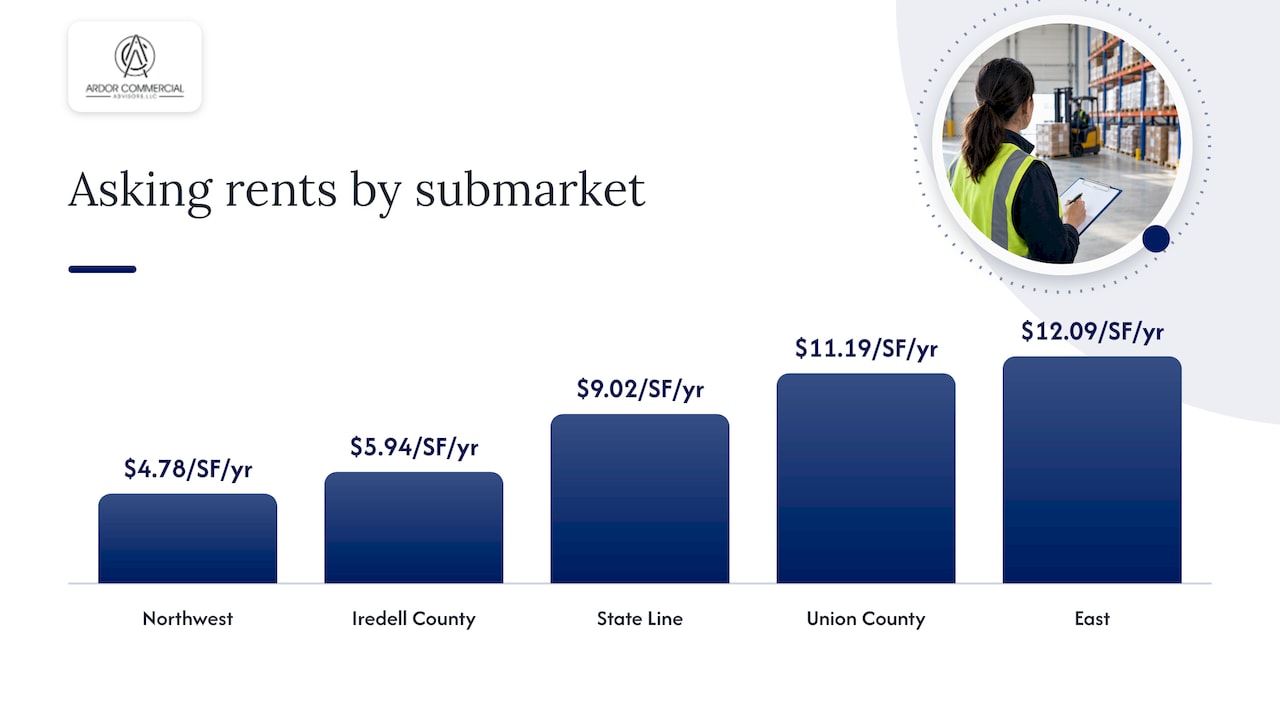
- Submarkets range widely: from $4.78/SF in Northwest to $12.09/SF in East.
- Base rent is only part of the cost. Under NNN, taxes, insurance and common area maintenance come on top.
- Rent per square foot means little until you compare building quality, lease type, escalations and term.
- Have the lease reviewed before you sign. A few clauses can move your annual cost more than a $0.50 difference in base rent.
Table of Contents
- Charlotte warehouse lease rates right now
- Rates by submarket
- What you pay beyond base rent
- Lease structure changes the math
- Perspective: how we read Charlotte warehouse rates
- Lease or buy: when owning a warehouse makes sense
- How to approach a Charlotte warehouse search
- Work with Ardorcre on your Charlotte industrial lease
- FAQ
- Sources
Charlotte warehouse lease rates right now
Savills’ Q2 2026 Charlotte industrial report puts the overall average asking rent at $8.21 per square foot. Rents there are quoted as average asking NNN rates. The prior report, for Q4 2025, recorded $8.20, so asking rents have been essentially flat across those two readings.
A few things to keep in mind when you see any Charlotte rate quoted:
- Asking is not signed. Asking rents are what landlords advertise. Final deals depend on term, tenant credit, concessions and how long a space has been vacant.
- Averages blend very different buildings. A 10,000 SF older bay and a new 200,000 SF distribution building are in the same average.
- Different sources give different numbers. Brokerage reports use different building classes, size cutoffs and quarters. Compare numbers only from the same report and period.
To put the average to work, here is a simple illustration. A 20,000 SF warehouse at $8.21/SF NNN means base rent of $164,200 a year, or about $13,683 a month, before any pass-through charges. That is arithmetic on the average, not a quote for any building.
Rates by submarket
Location moves the number more than most tenants expect. Savills’ Q2 2026 submarket averages show the spread:
| Submarket | Average asking rent (NNN, $/SF/yr) |
|---|---|
| Northwest | $4.78 |
| Iredell County | $5.94 |
| State Line | $9.02 |
| I-77/North | $9.15 |
| Airport/West | $9.20 |
| CBD | $11.15 |
| Union County | $11.19 |
| East | $12.09 |
Source for every row: Savills Research, Q2 2026.
On the same 20,000 SF example, Northwest at $4.78 is $95,600 a year in base rent. East at $12.09 is $241,800. That is a gap of $146,200 a year for the same square footage, so the right question is what the location buys you.
What drives the gap
Savills’ Q4 2025 report notes that remaining availability was concentrated in newly delivered speculative projects and older product lacking modern building characteristics. That split matters when you read a submarket average. A low average can reflect older buildings with limited clear height, dated docks or weak power. A high one can reflect newer, better-specified space close to customers or labor.
When we sit down with a tenant, we usually weigh these factors against the rent:
- Access. Distance to I-77, I-85, I-485 and the airport affects trucking time and driver commutes.
- Building specs. Clear height, dock doors versus drive-ins, column spacing, power, sprinklers and truck court depth.
- Size. Small-bay space and large-block space trade differently. Fewer tenants chase very large or very small blocks in some submarkets.
- Condition. Roof, HVAC and parking lot age affect your future repair exposure under a net lease.
- Labor and customers. A cheaper submarket can cost more if your workforce or clients are far away.
For a wider look at how Charlotte’s areas compare for buying, selling and refinancing, see our Charlotte submarket guide.
What you pay beyond base rent
Most Charlotte industrial space is leased on a net basis, which is why the Savills figures are labeled NNN. Base rent is the headline. On top of it, a net lease normally passes through your share of:
- Property taxes on the building.
- Building insurance carried by the landlord.
- Common area maintenance (CAM), such as parking lot upkeep, landscaping, snow and ice, lighting and shared drives.
The three together are often quoted as a single per-square-foot estimate. Ask for the last two years of actual reconciled charges, not just the current-year estimate. Estimates are what the landlord expects, and actuals are what you end up paying after year-end reconciliation.
Several other items change your all-in cost and are worth pricing before you compare offers:
- Annual escalations. Fixed bumps are common. Know whether yours are a flat percentage or a fixed dollar amount, because the difference compounds over a five-year term.
- CAM caps and exclusions. A cap on controllable expenses limits surprises. Check whether capital replacements, such as a roof or paving, are excluded from what the landlord can pass through.
- Management fee. Some landlords add an administrative or management percentage on top of CAM.
- Utilities and your own build-out. Power upgrades, racking, office improvements and dock equipment can be real costs. Ask what the landlord will fund through a tenant improvement allowance.
- Security deposit and guarantees. Smaller companies are often asked for a personal or corporate guarantee. See our guide on how to negotiate a corporate guarantee and cap it at 12 months’ rent.
- Restoration and surrender. Some leases require you to remove improvements and restore the space at the end of the term.
If you have never seen how a CAM statement is built, our page on CAM charges and reconciliation analysis explains what to check and how we review them for tenants.
Lease structure changes the math
Two offers at the same rate per square foot can cost very different amounts. The common structures for industrial space are:
| Structure | You pay | Typical trade-off |
|---|---|---|
| Triple net (NNN) | Base rent plus taxes, insurance and CAM | Lower base rent, variable additional costs |
| Modified gross | Base rent with some expenses included | More predictable, usually a higher base rate |
| Full service / gross | One all-in payment, often with an expense stop | Simplest budget, higher rate per SF |
Because the Savills averages are NNN, never compare them with a gross quote without adding estimated pass-throughs to the NNN offer. A $9.00 NNN deal and a $12.00 modified gross deal may be much closer than they look. For a longer breakdown, read our guide to industrial lease types and the surprise costs tied to each, and our overview of the triple net lease for tenants, landlords and investors.
A quick way to compare two offers
Build a five-year total occupancy cost for each space:
- Multiply base rent by square feet for year one.
- Apply the escalation each year.
- Add estimated taxes, insurance and CAM per square foot, using actual history where you can get it.
- Subtract free rent and any improvement allowance you will use.
- Add your own move-in costs: power, racking, signage, moving.
- Divide the five-year total by 60 months and by square feet to get a true monthly cost per square foot.
This is how a lower-rate building in an older submarket can turn out costlier than a better-built one, once repair exposure and driver time are priced in.
Perspective: how we read Charlotte warehouse rates
We work with industrial tenants and owners across the Charlotte MSA, and the same pattern shows up in most files. Tenants start by asking for the lowest rate per square foot. Owners start by asking for the highest. The best outcomes come from both sides looking at the whole lease.
For tenants, the savings are rarely in the base rent line alone. They are in the escalation schedule, the CAM definition, the renewal option, the early termination terms and the guarantee. We read the lease with the numbers side by side and flag where an unusual clause shifts cost onto you. Those are the points we push on in negotiation.
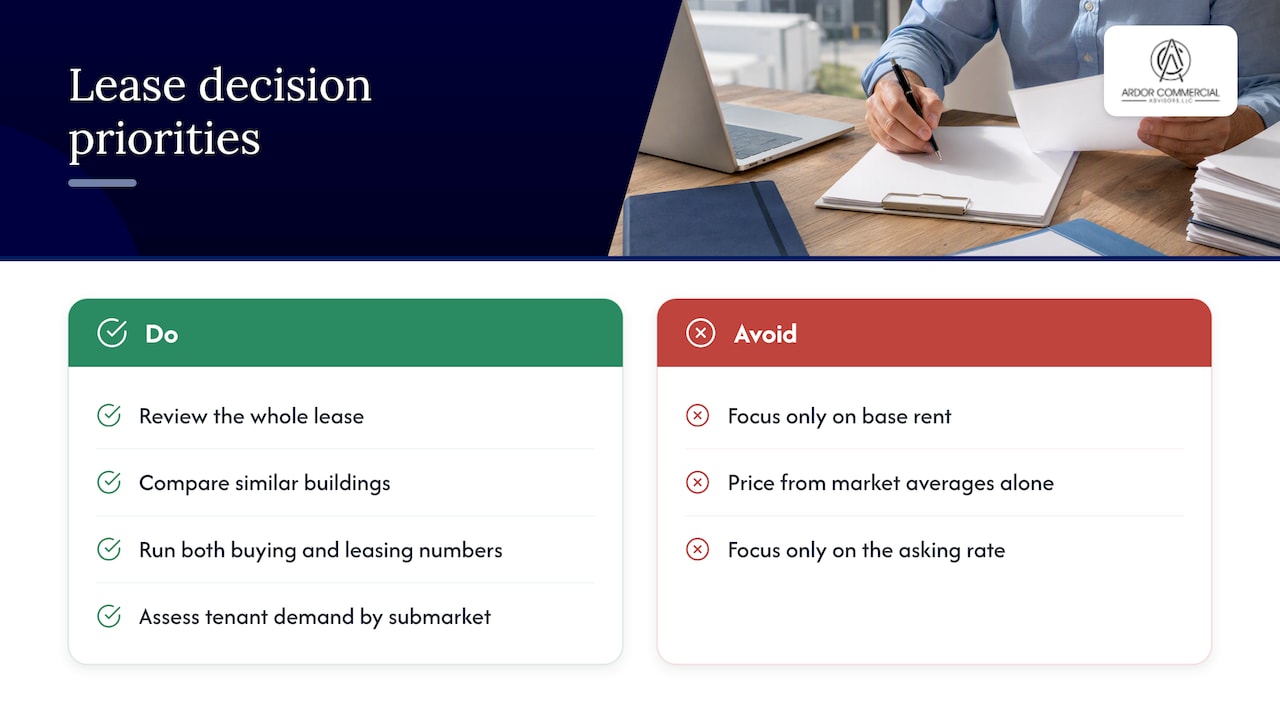
For landlords, an asking rate set from a market average can leave a building sitting empty. Pricing against comparable buildings of the same vintage, specs and submarket gets a deal done faster, and a signed lease at a fair rate beats a vacant building at a proud one. If you own the space, a valuation and a clear view of tenant demand in your submarket come before the sign goes up.
And if you are weighing buying against leasing, run both. Lease rates are one side of the decision. The other side is what the building would cost to own and finance, and what you would earn back by leasing out any extra space. If you want to look at an owner-occupied purchase, financing such as a DSCR refinance for industrial property shows how lenders look at the income a building produces.
— Jim
Lease or buy: when owning a warehouse makes sense
When rent is low per square foot, it is easy to assume leasing wins. Owning starts to compete when you plan to stay a long time, your space needs are stable, and your business can handle the down payment and the debt service. Think of it as a few questions:
- How long will you stay? A five-year horizon usually favors leasing. A ten-year horizon and beyond is where ownership begins to make sense.
- Is your growth predictable? If you may outgrow the space in three years, a lease with an expansion right gives you more flexibility.
- Can you use or lease out extra space? A multi-tenant or larger building can produce rental income that offsets your own occupancy cost.
- What will financing cost? Loan sizing depends on the income a building supports. Our DSCR guide for commercial real estate explains how lenders size those loans, and our look at commercial mortgage rates in 2026 covers the rate environment.
- What are the tax effects? If you sell an investment property and want to defer gains, review our 1031 exchange rules and speak with your CPA.
Owners considering a sale should also know what a building is worth before choosing between selling, refinancing or holding. Our commercial property valuation and DCF modeling service starts there.
How to approach a Charlotte warehouse search
The timing of a lease search matters more than people expect. For a typical space, plan several months from first tour to signed lease, and longer if the build-out is significant. Our commercial leasing timeline lays out the stages for medical and office tenants, and the same sequence applies to industrial users with different tasks inside each step.
A practical order of operations:
- Define the need. Square footage, clear height, dock and drive-in doors, power, parking, office share, and the date you need to be in.
- Pick two or three submarkets. Use drive times for your trucks and employees, not just rent.
- Tour with a checklist. Check roof condition, truck court, sprinklers, HVAC, and the lease history of the building.
- Request a proposal from more than one landlord. Competing offers give you leverage on rate, free rent and improvement allowance.
- Negotiate the lease, not just the rate. Escalations, CAM definitions, renewal rights, assignment and subletting, and termination terms.
- Have the lease reviewed. Before signature, have someone who reads leases for a living check what you owe and when.
If you may need to leave before the term ends, read about exiting a commercial lease early before you agree to the termination clause.
Work with Ardorcre on your Charlotte industrial lease
We represent tenants and landlords across the Charlotte MSA and handle industrial, office, medical and retail leasing and sales. For tenants, tenant representation means we run the search, compare proposals against the same total-cost model, and negotiate the lease. For owners, we price the space, market it and advise on whether to lease, sell or refinance. Start on our services page or contact us with your space requirements.
FAQ
What is the average warehouse lease rate in Charlotte?
Savills Research reported an average asking rent of $8.21 per square foot for Charlotte industrial space in Q2 2026, quoted NNN. Individual buildings can be far above or below that figure depending on submarket, age and specs.
Which Charlotte submarket has the cheapest warehouse rents?
In the same Q2 2026 Savills data, Northwest had the lowest average at $4.78 per square foot and Iredell County followed at $5.94. Lower rent can reflect older buildings or fewer amenities nearby, so compare building quality and drive times as well as the rate.
Does the quoted rate include taxes, insurance and CAM?
Not under an NNN lease. The quoted base rent is separate from your share of property taxes, insurance and common area maintenance. Ask the landlord for the last two years of actual charges so you can build a realistic monthly cost.
Should I lease or buy a warehouse in Charlotte?
Leasing generally suits shorter horizons and uncertain growth, while ownership fits longer stays and stable space needs. Run a total-cost comparison of both, including financing, taxes and maintenance, and talk with your lender and CPA before deciding.
Sources
- Savills Research, Charlotte Industrial Market Report, Q2 2026
- Savills Research and Data Services, Charlotte Industrial Market Report, Q4 2025