
A 1031 exchange lets you defer federal capital gains tax on real estate by reinvesting the proceeds from a sale into like-kind replacement property — but the IRS enforces two hard deadlines: 45 calendar days to identify a replacement property and 180 calendar days to close on it. Miss either clock, and the exchange fails. No routine extensions, no grace periods.
Before you go further, run three quick checks:
- Is the property real estate held for investment or business use? Personal residences and dealer inventory don’t qualify under IRC §1031.
- Will the sale proceeds be held by a Qualified Intermediary (QI)? You cannot touch the money yourself — constructive receipt kills the exchange.
- Is the same taxpayer selling and buying? The name on the deed at closing must match the name on the relinquished property title.
Done right, a 1031 exchange offers indefinite federal tax deferral. Investors who keep reinvesting through successive exchanges can defer capital gains for decades — and if the property passes to heirs, the deferred gain may be eliminated entirely through a stepped-up basis at death.
Table of Contents
- What is a 1031 exchange and why do investors use it?
- Which properties qualify as like-kind under current rules?
- What are the main types of 1031 exchange structures?
- How do the 45-day and 180-day timing rules actually work?
- How does tax deferral work, and what happens when you receive boot?
- What does a Qualified Intermediary do, and how do you choose one?
- What are the related-party rules and holding requirements?
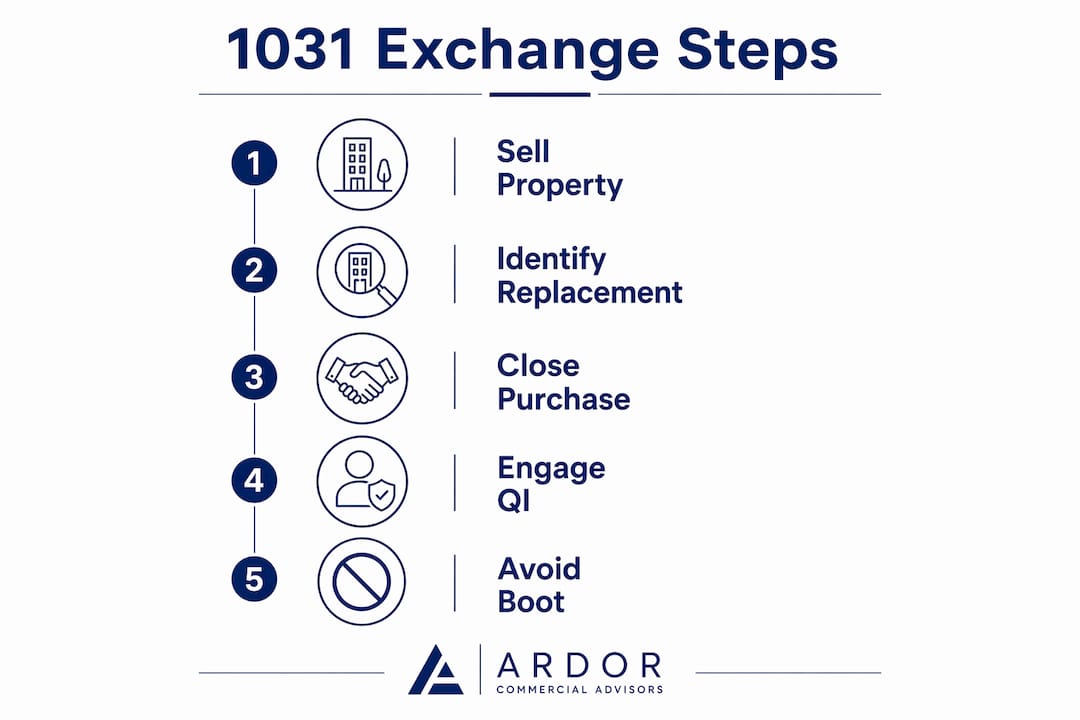
- Step-by-step checklist for executing a 1031 exchange
- What are the most common 1031 exchange pitfalls?
- 1031 exchange vs. Opportunity Zone: which one fits your situation?
- Worked example: sale price, boot, and carried basis
- Key Takeaways
- The part most investors get wrong about 1031 exchanges
- How Ardorcre supports your 1031 exchange from search to close
- Useful sources and further reading
What is a 1031 exchange and why do investors use it?
Under 26 U.S.C. §1031, no gain or loss is recognized when real property held for productive use in a trade or business or for investment is exchanged for real property of like kind to be held for the same purpose. The IRS requires Form 8824 to report the exchange in the tax year it occurs — that filing is not optional.
Three types of investors use this tool most:
- Rental real estate investors trading up to larger or better-located properties without triggering a tax bill on accumulated appreciation.
- Operating-business property owners swapping a building they’ve outgrown for one that fits current operations.
- Portfolio repositioners consolidating multiple smaller assets into one larger one, or shifting geography — say, moving from a Midwest industrial property into a Charlotte-area medical office building.
The high-level benefits go beyond simple deferral. A 1031 exchange postpones depreciation recapture (taxed at up to 25% under current rates), defers the 3.8% Net Investment Income Tax on gains, and preserves capital that would otherwise go to the IRS for reinvestment. The estate-planning angle is the one most investors overlook: heirs who inherit a property receive a stepped-up basis to fair market value at the date of death, potentially wiping out decades of deferred gain in a single generation.
Which properties qualify as like-kind under current rules?
The 2017 Tax Cuts and Jobs Act narrowed §1031 to real property only. Personal property exchanges — equipment, aircraft, artwork, vehicles — no longer qualify. What remains is a broad category: any U.S. real property held for investment or business use can generally be exchanged for any other U.S. real property held for the same purpose, regardless of property type.
Eligible properties include:
- Rental single-family homes and multifamily buildings
- Commercial office, retail, and industrial buildings
- Raw land held for investment (not development inventory)
- Medical office buildings and net-lease properties
- Tenant-in-common interests in qualifying real estate
Common exclusions:
- Property held primarily for sale (dealer property) — intent at acquisition matters, and evidence of a quick-flip strategy can disqualify an otherwise eligible exchange
- Personal residences not properly converted to investment use
- Stocks, bonds, partnership interests, and cryptocurrency
- Foreign real property (U.S. and non-U.S. real property are not like-kind to each other under §1031(h))
One practical trap: a property you bought intending to renovate and sell fast looks like dealer property to the IRS even if you later change your mind. Document your investment intent from day one — hold the property for a reasonable period, collect rent, and avoid marketing it as a flip.
What are the main types of 1031 exchange structures?
Most investors use a delayed (forward) exchange, which is the standard structure. You sell the relinquished property, the QI holds the proceeds, and you have 45 days to identify and 180 days to close on the replacement. The QI steps into the chain of title through assignment of the purchase and sale contracts, so you never have actual or constructive receipt of the funds.

A simultaneous exchange closes both legs on the same day. It’s rare in practice because coordinating two closings to the minute is logistically difficult, and any gap in timing can trigger a failed exchange.
A reverse exchange flips the sequence: you acquire the replacement property first, then sell the relinquished property within 180 days. An Exchange Accommodation Titleholder (EAT) holds title to one of the properties during the exchange period. Reverse exchanges cost more, carry higher audit scrutiny, and require careful pre-planning — but they’re the right tool when you find the replacement before you’ve sold the old property.
An improvement (build-to-suit) exchange lets you use exchange proceeds to fund construction or improvements on the replacement property before taking title. The QI or EAT holds the property during construction, and improvements must be substantially complete within the 180-day window. This structure works well for investors who want to customize a replacement asset, but the time pressure is real — construction delays don’t extend the clock.
How do the 45-day and 180-day timing rules actually work?
The two clocks start on Day 0: the date you close on the relinquished property.
- Day 1–45: Identify the replacement property in writing, signed by you, and delivered to the QI or another qualified party. No weekends, no holidays, no extensions — Day 45 is Day 45.
- Day 1–180: Close on the replacement property. The 180-day deadline is also capped by the due date of your tax return for the year of the sale, so if you sell in November or December, filing a tax extension (Form 4868 for individuals) restores the full 180 days.
The three identification safe-harbors
| Rule | What it allows | Example |
|---|---|---|
| 3-Property Rule | Identify up to 3 properties, any value | List 3 candidate buildings regardless of price |
| 200% Rule | Identify any number of properties, total FMV ≤ 200% of relinquished property’s sale price | Sold for $1M; identify properties totaling ≤ $2M |
| 95% Rule | Identify any number of properties at any value, but you must acquire at least 95% of the total identified value | Rarely used; high compliance risk |
Most investors use the 3-property rule. It’s the cleanest and easiest to document. The 200% rule gives flexibility when you’re uncertain which of several properties will close in time. The 95% rule is a last resort — if you identify $5M in property and only close on $4.5M, you’ve failed the rule.
Identification delivery requirements: The written identification must include an unambiguous description of the property — street address, legal description, or parcel ID. Delivering it to your own attorney or accountant does not satisfy the requirement; it must go to the QI or another non-disqualified party.
Pro Tip: Prepare your identification list before Day 30 and deliver it to your QI with a signed identification form. Waiting until Day 44 leaves no margin for delivery errors or last-minute property changes.
How does tax deferral work, and what happens when you receive boot?
The exchange defers your realized gain — the difference between your adjusted basis and the sale price. As long as you reinvest all proceeds into like-kind property and carry no net debt relief, you recognize zero gain. The moment you receive something that isn’t like-kind real property, you’ve received boot, and boot is taxable up to the amount of your realized gain.
Boot comes in three forms:
- Cash boot: Proceeds not reinvested (e.g., you pocket $50,000 from the sale)
- Mortgage boot: Net debt relief — if your relinquished property had a $400,000 mortgage and the replacement has a $300,000 mortgage, the $100,000 difference is boot
- Personal property boot: Non-real-estate assets received as part of the deal
Basis calculation after an exchange
Your basis in the replacement property is not its purchase price. Under §1031(d), the basis carries over from the relinquished property, adjusted for recognized gain, boot received, and exchange expenses.
| Line item | Amount |
|---|---|
| Adjusted basis of relinquished property | $300,000 |
| Plus: gain recognized (boot) | $0 |
| Less: boot received | $0 |
| Less: liabilities assumed by buyer | $0 |
| Plus: liabilities assumed by you on replacement | $0 |
| Carried basis in replacement property | $300,000 |
Depreciation recapture doesn’t disappear — it defers. The replacement property inherits the depreciation history of the relinquished property, and when you eventually sell without exchanging, recapture is taxed at up to 25% on the accumulated amount. Some states don’t conform to federal §1031 rules, which means a state tax bill can arise even when federal gain is fully deferred. California, for instance, has a clawback provision for investors who exchange out of California property into out-of-state property.
What does a Qualified Intermediary do, and how do you choose one?
The QI is not optional — it’s the mechanism that keeps you from having constructive receipt of the proceeds. Under Treas. Reg. 1.1031(k)-1(g)(4), the QI must be independent (not your attorney, accountant, agent, or employee within the prior two years), enter a written exchange agreement before the relinquished property closes, and hold the proceeds in a segregated account until the replacement closing.
QI selection checklist:
- Confirm independence — no prior agency relationship with you within two years
- Verify the QI uses segregated, insured escrow accounts (not commingled funds)
- Ask for proof of fidelity bond and errors-and-omissions insurance
- Review the exchange agreement for assignment language covering both the relinquished and replacement contracts
- Check references and confirm the QI has handled exchanges of similar size and complexity
- Understand the fee structure upfront — QI fees typically range from a few hundred to several thousand dollars depending on transaction complexity, though exact fees vary by provider
Engage the QI before you close on the relinquished property. The exchange agreement must be in place, and the purchase contract must include an assignment clause allowing the QI to step in. If you close without a QI in place, the exchange cannot be retroactively structured.

What are the related-party rules and holding requirements?
The same-taxpayer rule is straightforward: the entity or individual that sells the relinquished property must be the same entity or individual that acquires the replacement. Changing from a personal name to an LLC between the two closings breaks the exchange. Plan your title and entity structure with your attorney before the sale.
Related-party exchanges carry an additional restriction under §1031(f). If you exchange property with a related party (a family member, a controlled entity, or a partnership in which you hold more than 50%), both you and the related party must hold the exchanged properties for at least two years after the last transfer. If either party disposes of the property within that window, the deferred gain becomes immediately taxable.
Common related-party traps:
- Swapping properties between siblings or between a taxpayer and their wholly owned LLC
- Selling to a related party and then having that party quickly resell to a third party
- Structuring a series of transactions that effectively routes around the related-party rules
The IRS looks at substance over form. A transaction designed to avoid the related-party rules — even if technically structured to appear compliant — can be unwound under §1031(f)(4). Get a tax attorney’s opinion before any exchange involving a related party.
Step-by-step checklist for executing a 1031 exchange
- Confirm eligibility before listing. Verify the property is held for investment or business use, not primarily for sale. Review your entity structure and title with a CPA and attorney.
- Select and engage a QI. Sign the exchange agreement before the relinquished property closes. Confirm the QI’s independence, insurance, and escrow practices.
- Add assignment language to the sale contract. The purchase and sale agreement for the relinquished property must include a clause allowing assignment to the QI.
- Close on the relinquished property. Proceeds go directly to the QI — never to you. Confirm the wire instructions before closing day.
- Start the identification clock. Day 1 begins on the closing date. Prepare your written identification list immediately; aim to deliver it to the QI by Day 30.
- Deliver the identification in writing. Sign the identification form and send it to the QI before Day 45. Include street addresses or legal descriptions for each identified property.
- Negotiate and execute the replacement purchase contract. Include an assignment clause for the QI. Coordinate the replacement closing to occur before Day 180.
- Close on the replacement property. The QI wires proceeds directly to the closing. Confirm the chain of title reflects the correct taxpayer name.
- File Form 8824. Report the exchange on your federal return for the tax year in which the relinquished property closed. Attach supporting documentation.
- Maintain records. Keep the exchange agreement, identification letters, closing statements, and basis calculations for at least seven years — longer if the replacement property is later exchanged again.
What are the most common 1031 exchange pitfalls?
Missed identification deadlines are the single most common failure. Day 45 is absolute. Investors who wait to identify until they have a signed purchase contract on the replacement often run out of time. The fix: identify conservatively early, using the 3-property rule, and include backup properties.
Constructive receipt happens when the investor has access to the proceeds — even briefly. A closing agent who holds funds “for your benefit” rather than for the QI can trigger constructive receipt. Always confirm the wire goes directly to the QI’s segregated account.
Insufficient reinvestment (boot) catches investors who don’t account for closing costs, debt payoff, or prorations. If your net equity from the sale is $800,000 and you only reinvest $750,000, you’ve recognized $50,000 in boot. Model the numbers before closing.
Title and entity mismatches are avoidable but common. An investor who sells as an individual and tries to take title in a new LLC has broken the same-taxpayer requirement. Decide on your entity structure before the sale.
Liquidity constraints are a real planning risk. Once the proceeds are with the QI, you can’t access them for emergencies. Investors who are cash-tight should model their liquidity needs before committing to an exchange. For context on how broader market pressures affect investor liquidity decisions, commercial loan delinquency trends in the current cycle are worth reviewing.
State tax decoupling is a hidden cost. Several states don’t conform to federal §1031 rules, meaning a state-level gain recognition event occurs even when the federal exchange is clean. Check your state’s conformity before closing.
1031 exchange vs. Opportunity Zone: which one fits your situation?
These two tools are not interchangeable. A 1031 exchange offers indefinite deferral for real-estate-to-real-estate swaps, while a Qualified Opportunity Fund (QOF) accepts any capital gain and can exclude the fund’s appreciation after a 10-year hold. The mechanics, timelines, and investor profiles differ significantly.
Charlotte-area investors sometimes ask about Charlotte Opportunity Zones when evaluating where to deploy exchange proceeds. The Charlotte opportunity zones map covers designated census tracts where QOF investments can qualify for the appreciation exclusion — but that’s a separate decision from whether to use a 1031 exchange at all.
| Factor | 1031 Exchange | Opportunity Zone (QOF) |
|---|---|---|
| Eligible gain | Real estate capital gain only | Any capital gain (real estate, stocks, business) |
| Timing to invest | 45 days identify / 180 days close | 180 days to invest the gain in a QOF |
| Deferral period | Indefinite (until sale without exchange) | Deferred gain recognized by year-end for most original OZ investments |
| Appreciation treatment | Deferred; taxable on eventual sale | Excluded after 10-year QOF hold |
| Control over asset | Full ownership of specific property | Fund interest; less direct control |
| Estate planning | Step-up in basis at death eliminates deferred gain | Step-up applies to QOF interest |
When to choose a 1031 exchange:
- You’re selling real estate and reinvesting into real estate
- You want indefinite deferral and direct ownership of the replacement asset
- Your estate plan relies on the step-up in basis strategy
When an Opportunity Zone investment may fit better:
- You have a non-real-estate capital gain (stock sale, business sale) that doesn’t qualify for 1031
- You want to exclude appreciation on a long-term fund investment after 10 years
- You’re comfortable with a fund structure and less direct control
One important timing note: OZ program rules affecting recognition dates were updated through 2025–2026, and some original OZ deferrals require gain recognition on December 31, 2026. Investors with existing OZ positions should confirm their recognition dates with a tax advisor before year-end.
From Ardorcre’s perspective working with Charlotte-area commercial investors, for investors focused on pure real estate seeking indefinite deferral and direct asset control, the 1031 exchange remains the stronger tool. The 1031 exchange’s impact on commercial real estate markets is also worth understanding before choosing between structures.
Worked example: sale price, boot, and carried basis
Here’s a straightforward calculation you can use as a template. Verify every number with your CPA before relying on it for your own transaction.
Scenario: You sell a rental warehouse for $1,200,000. Your adjusted basis (original cost minus accumulated depreciation) is $400,000. You had a $300,000 mortgage on the property. You reinvest $1,100,000 into a replacement office building and take on a $250,000 mortgage on the replacement.
- Realized gain: $1,200,000 sale price minus $400,000 adjusted basis = $800,000 realized gain
- Mortgage boot: $300,000 mortgage paid off minus $250,000 mortgage assumed on replacement = $50,000 net debt relief (boot)
- Cash boot: $1,200,000 proceeds minus $300,000 mortgage payoff = $900,000 net equity; reinvested $1,100,000 minus $250,000 new mortgage = $850,000 equity deployed. Assuming $50,000 in closing costs paid from proceeds: $0 additional cash boot (all equity reinvested)
- Gain recognized: Equal to boot received = $50,000 taxable
- Deferred gain: $800,000 minus $50,000 = $750,000 deferred
- Basis in replacement property: $400,000 carried basis, plus $50,000 gain recognized, minus $50,000 boot received = $400,000 carried basis in the replacement property
The depreciation recapture embedded in that $800,000 gain doesn’t disappear — it carries into the replacement property and will be taxed at up to 25% when you eventually sell without exchanging. The $400,000 carried basis also means your depreciation deductions on the replacement property start from a lower base than its purchase price.
This example is illustrative only. Consult your CPA for calculations specific to your transaction.
Key Takeaways
A 1031 exchange defers federal capital gains tax indefinitely for real estate investors who reinvest fully into like-kind property, meet the 45-day identification and 180-day closing deadlines, and use a qualified intermediary to hold proceeds.
| Point | Details |
|---|---|
| Two hard deadlines | Identify replacement property within 45 calendar days; close within 180 calendar days — no extensions. |
| QI is non-negotiable | Engage a Qualified Intermediary before the relinquished property closes to avoid constructive receipt. |
| Boot triggers tax | Any cash, net debt relief, or non-like-kind property received is taxable up to the amount of realized gain. |
| Estate planning upside | Heirs receive a stepped-up basis at death, potentially eliminating decades of deferred gain. |
| Ardorcre advisory | Ardorcre helps Charlotte-area investors source replacement properties and coordinate advisors for 1031 execution. |
The part most investors get wrong about 1031 exchanges
The conventional advice is to focus on the 45-day deadline. That’s correct — but it’s not where most exchanges actually break down. The real failure point is earlier: investors who haven’t engaged a QI before the relinquished property closes, or who haven’t modeled their boot exposure before they’re sitting at the closing table.
The 45-day clock is visible. The constructive receipt problem is invisible until it’s too late. A closing agent who holds proceeds “pending wire instructions” for even a day can create a constructive receipt argument the IRS will pursue. The QI agreement needs to be signed, the wire instructions need to be confirmed, and the assignment clause needs to be in the purchase contract — all before you hand over the keys.
The other underrated risk is the state tax trap. Investors who execute a clean federal exchange and then discover their state doesn’t conform — or that they owe California’s clawback tax on an out-of-state replacement — are genuinely surprised. That’s a planning failure, not a tax law complexity. A 30-minute conversation with a CPA before listing the property would catch it every time.
One more thing: the step-up in basis at death is the most powerful feature of a 1031 exchange, and it’s the one most investors treat as a footnote. If you’re in your 60s or 70s, holding a highly appreciated property through successive exchanges and passing it to heirs is a legitimate wealth-transfer strategy. The deferred gain disappears. That’s not a loophole — it’s the statute working exactly as Congress designed it.
This article is general information, not individual tax or legal advice. Confirm current rules with a qualified CPA or tax attorney for your specific situation.
How Ardorcre supports your 1031 exchange from search to close
Finding a replacement property that closes within 180 days in a competitive market is where most exchanges get stuck. Ardorcre works with Charlotte-area commercial investors to identify qualifying replacement properties across office, medical, retail, industrial, and land categories — and to move fast enough to meet the exchange timeline.

The advisory team coordinates directly with your QI, CPA, and legal counsel so the transaction chain stays intact from the relinquished sale through the replacement closing. Whether you’re consolidating a portfolio, swapping asset classes, or repositioning into a higher-yield property type, Ardorcre can source and structure the replacement side of your exchange. Browse available commercial properties currently listed in the Charlotte MSA, or reach out to the Ardorcre team directly to discuss your exchange timeline and replacement criteria. This is not tax advice — always consult a qualified CPA or attorney for your specific exchange.
Useful sources and further reading
- 26 U.S.C. §1031 — Official Statute: The primary federal law governing like-kind exchanges; the authoritative source for eligibility, timing, basis, and related-party rules.
- IRS — Like-Kind Exchanges (Real Estate Tax Tips): IRS plain-language guidance on how like-kind exchanges work, who qualifies, and key compliance points.
- IRS Form 8824 — Like-Kind Exchanges: The required form for reporting a 1031 exchange; includes instructions for calculating deferred gain and basis.
- IRS Fact Sheet FS-08-18 — Like-Kind Exchanges: Official IRS publication covering the 45-day and 180-day deadlines, identification delivery requirements, and QI mechanics.
- Legal Information Institute — 26 U.S.C. §1031: Cornell Law’s annotated version of the statute, useful for cross-referencing subsections and legislative history.
- Charlotte Opportunity Zones — City of Charlotte Open Data: Official Charlotte opportunity zones map and dataset for investors evaluating QOF investments in the Charlotte MSA.
- Ardorcre — How 1031 Exchanges Support Commercial Real Estate Growth: Ardorcre’s analysis of how 1031 exchanges affect commercial market activity and investor strategy in the Charlotte area.