
Commercial mortgage rates in 2026 are tracking close to where the 10-year Treasury and SOFR have settled this year, and the most useful thing a borrower can do is underwrite to today’s benchmark levels rather than bet on cuts. The Federal Reserve’s July 2026 SLOOS survey shows lending standards for commercial real estate loans were largely unchanged on net, with some lenders easing spreads on select categories. That means pricing is less about whether banks will lend and more about how tightly you can negotiate the spread on top of the index. Deals that close fastest are the ones built on current numbers, not hoped-for rate relief.
TL;DR:
- Request written term sheets from a bank, debt fund, and CMBS shop or life insurance company, with each lender’s index and spread itemized.
- A seasoned sponsor, DSCR cushion, and leverage below 65% to 70% can tighten spreads; industrial and medical office often price better than traditional office.
- For holds under three years, a floating loan tied to SOFR may cost less despite its wider margin because it can avoid prepayment penalties.
- Fees, prepayment terms, and rate cap premiums change a loan’s true cost; stronger net operating income can unlock more proceeds than a lower rate.
- The July 4, 2026, SBA change lets eligible projects combine up to $5 million each in 7(a) and 504 financing; consult a CDC early.
Table of Contents
- Where do benchmark rates stand right now?
- How a commercial mortgage rate actually gets built
- Which lenders use which index, and what it means for your loan term
- What actually moves your spread
- Three worked examples: same benchmark, different outcomes
- The real cost of a loan beyond the quoted rate
- A new SBA rule change worth knowing about
- How to get a real quote, not a rate sheet guess
- What we’re seeing in Charlotte’s medical office and office market
- What the data actually tells underwriters
- Where Ardor CRE fits into your next move
- FAQ
- Sources
Where do benchmark rates stand right now?
Every commercial quote starts with a public index, and knowing where to check it yourself saves time in lender conversations. Fixed-rate loans typically reference a matched-tenor Treasury yield, floating-rate and bridge loans reference SOFR, and many smaller bank loans still price off prime.
- The U.S. Treasury’s daily par yield curve publishes 10-year and 20-year rates that lenders use for matched-tenor fixed pricing.
- SOFR, tracked on FRED, is the standard floating index for bridge loans and many bank facilities.
- Prime rate still anchors a portion of smaller bank term loans, usually with a spread added on top.
- Intra-day and week-to-week moves in these indexes can shift a quote before you even get to the term sheet, so pulling a fresh rate the same week you apply matters.
Treasury and SOFR data for 2026 show meaningful week-to-week movement, which is why a quote you saw last month may not hold today. Daily Treasury yield data is the fastest way to confirm the fixed-rate base before you negotiate a spread.
How a commercial mortgage rate actually gets built
Every commercial mortgage rate is index plus spread. The index is the public benchmark, and the spread is what the lender adds for risk, profit, and servicing cost. Understanding this split tells you exactly where you have room to negotiate.
- Index: a matched-tenor Treasury yield or swap rate for fixed loans, or SOFR for floating loans.
- Spread: the lender’s margin, driven by debt service coverage ratio (DSCR), loan-to-value (LTV), sponsor strength, property type, and loan size.
- Fees and structure: origination points, prepayment terms, and reserve requirements layer on top of the quoted rate.
The index side is largely outside your control: it reflects broader liquidity and tenor matching, which is why a 10-year fixed loan prices off the 10-year Treasury rather than SOFR. The spread side is where your deal quality shows up, and it’s the only part of the rate you can actually move through negotiation or by improving the deal’s fundamentals before you apply.
Advertised rate sheets almost always undersell the real spread a middle-market borrower will pay, since published sheets tend to reflect best-case, large-loan pricing rather than the realized rate on a $3 million to $8 million deal.

Pro Tip: Ask every lender to quote both the index source and the spread separately. Lenders who won’t break it out are usually hiding room to negotiate.
Which lenders use which index, and what it means for your loan term
Lender type drives which index applies to your loan, and that in turn shapes whether fixed or floating makes sense for your hold period. Banks, CMBS shops, life companies, and debt funds each default to different pricing conventions.
- Banks typically price shorter-term loans off prime or a spread to SOFR, often with a rate floor built in.
- CMBS lenders and life insurance companies use matched-tenor Treasury yields or swap curves for long-term fixed pricing, usually 10-year terms or longer.
- Debt funds and bridge lenders reference SOFR with wider spreads in exchange for faster closings and more flexible underwriting.
If you plan to hold a property under three years, a floating structure tied to SOFR often costs less overall even with a higher margin, since you avoid prepayment penalties on a fixed loan you’ll refinance early. Our guide to fixed versus floating decisions walks through the breakeven math for different hold periods.
What actually moves your spread
Lenders focus on a short list of factors when setting your spread, and borrowers who address these directly tend to get sharper quotes.
- Sponsor track record: a borrower with multiple completed deals and clean financials gets priced tighter than a first-time buyer.
- DSCR: most lenders want a minimum debt service coverage ratio above one, and anything above that cushion can shave basis points off the spread.
- Loan-to-value: lower leverage, generally under 65% to 70%, signals less risk and narrows the spread.
- Property type: medical office and industrial properties often command tighter spreads than traditional office right now, reflecting stronger tenant demand and lower vacancy in those sectors.
- Loan structure: recourse, amortization schedule, and exit flexibility all factor into the final number a lender offers.
Our DSCR loan sizing guide breaks down exactly how lenders calculate that ratio and where the common pressure points sit for refinances.
Pro Tip: If your DSCR sits right at a lender’s minimum, offer a modest paydown at closing. Even a small cushion above the threshold can unlock a better spread.
Three worked examples: same benchmark, different outcomes
These figures are illustrative only, built to show how index plus spread plays out across property types.
- Stabilized industrial, $4 million loan: say the 10-year Treasury sits at 4.2%, with a 2.0% spread for a strong sponsor and 65% LTV, producing a 6.2% note rate and a monthly payment near $26,400 on a 25-year amortization.
- Medical office acquisition, $2.5 million loan: same 4.2% index with a 2.3% spread reflecting smaller loan size, yielding a 6.5% rate and a payment near $16,900.
- Value-add office, $5 million loan: same 4.2% index with a wider 3.0% spread for lease-up risk, producing a 7.2% rate and a payment near $35,600.
The stabilized industrial deal earned the tightest spread because of low leverage and a seasoned sponsor, while the value-add office carried the widest spread due to lease-up uncertainty.
The real cost of a loan beyond the quoted rate
The headline rate is only part of what a loan actually costs. Fees, prepayment terms, and reserve requirements all affect the money you keep.
- Origination fees commonly run a percentage point or more of the loan amount, paid at closing.
- Prepayment penalties, whether yield maintenance or a stepped-down schedule, can cost tens of thousands of dollars if you refinance or sell early.
- Rate caps for floating-rate loans carry an upfront premium but protect against a sharp SOFR increase during your hold period.
- DSCR math directly caps your loan size: lenders divide your net operating income by the minimum DSCR to find the maximum debt service they’ll allow, then size the loan backward from there, which is why a stronger NOI often unlocks more proceeds than a lower rate does.
Budgeting for these items up front avoids the surprise of a smaller net check at closing than the rate sheet implied.
A new SBA rule change worth knowing about
The U.S. Small Business Administration raised the combined cap on 7(a) and 504 loans to $10 million, effective July 4, 2026. Borrowers can now access up to $5 million through 7(a) and up to $5 million through 504 for the same project, rather than sharing one combined limit.
- Owner-occupiers, medical practices, and other capital-intensive small businesses gain meaningfully more borrowing room for real estate and equipment combined.
- Pairing a long-term fixed 504 loan with 7(a) working capital can now happen at a larger scale without hitting the old ceiling.
- Check eligibility with a Certified Development Company (CDC) early, since project structuring affects how the two programs combine.
Our breakdown of SBA 504 versus 7(a) financing walks through how Charlotte-area owners have used both programs together.
How to get a real quote, not a rate sheet guess
Getting an accurate quote comes down to preparation and running multiple lenders in parallel.
- Gather your package first: rent roll, trailing twelve-month operating statements, sponsor financial statements, comparable rent data, and a pro forma for any value-add plan.
- Shop three lender types at once: a bank, a debt fund, and either a CMBS shop or life company, so you compare true apples-to-apples spreads rather than one lender’s opinion.
- Confirm the timeline: expect four to eight weeks from application to closing for most bank and agency loans, faster for bridge debt.
- Negotiate the right levers: push for DSCR cushion flexibility, a shorter prepayment window, and limited recourse rather than fixating on the headline rate alone.
Private capital lenders can also fill gaps for borrowers with credit challenges or first-time deals. Mayday Private Capital’s DSCR requirements guide outlines current overlays and FICO ranges for that channel.
Pro Tip: Request every lender’s term sheet in writing before you pick one. Verbal quotes change once underwriting digs into your actual numbers.
What we’re seeing in Charlotte’s medical office and office market
Medical office cap rates in the Charlotte MSA have held tighter than many national office benchmarks, a trend we track closely in our medical office cap rate data. That compression is pushing more owners to ask whether they should sell now or refinance through a new term.
- Owners carrying CMBS loans originated under older covenants often find refinancing into a DSCR-focused loan simplifies compliance and frees up cash flow.
- Selling makes more sense when cap rate compression has pushed value up faster than a refinance would recover in proceeds.
- A cashout refinance fits owners who need liquidity for another acquisition, while extending the term at a lower payment fits owners planning to hold.
- Owners should run the valuation, connect with the right lender for their property type, and prepare a complete package before approaching the market.
What the data actually tells underwriters
The biggest mistake we see is borrowers anchoring to a rate they heard about months ago instead of the benchmark sitting in front of them today. The SLOOS survey and Treasury yield data both point to a market that is stable, not cheap, and that stability is the opportunity: lenders are competing on spread because the index isn’t moving dramatically in either direction.
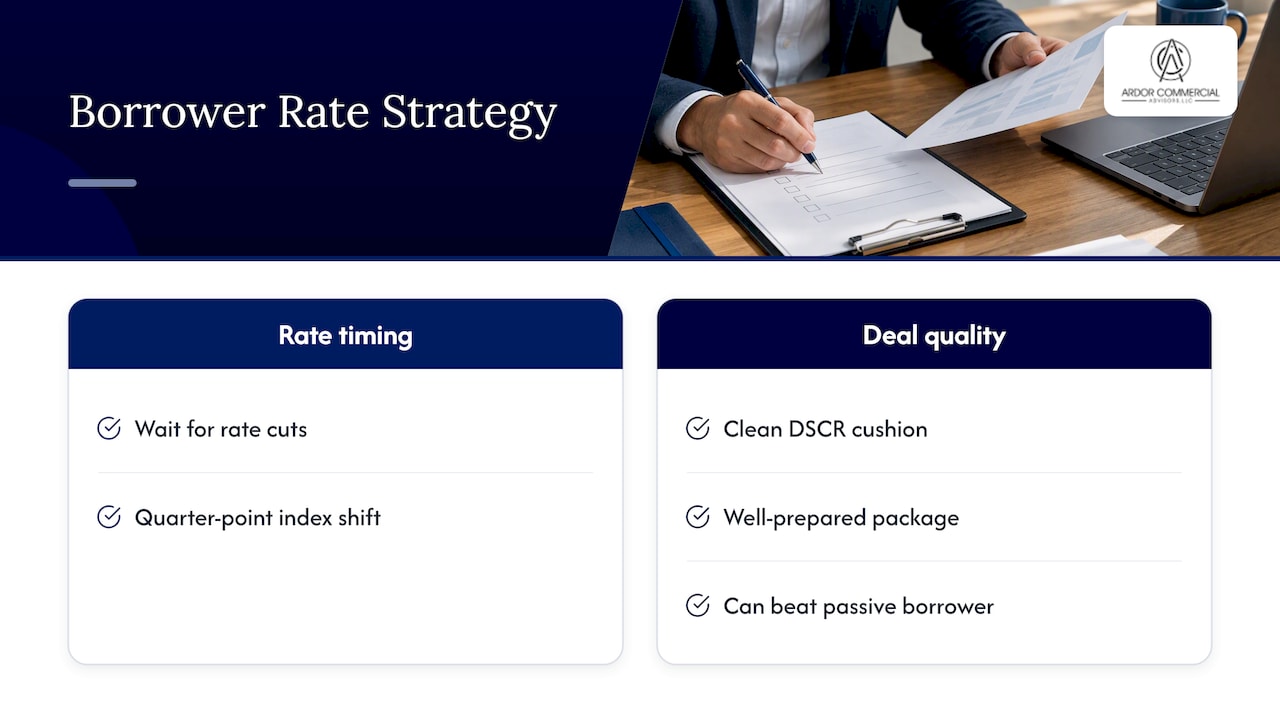
Conventional advice tells borrowers to wait for rate cuts before refinancing or buying. That advice undersells how much control a sponsor has over the spread, which often matters more than a quarter-point index shift. A borrower with a clean DSCR cushion and a well-prepared package can beat a passive borrower who waited for lower rates and still gets quoted a wide spread.
Prioritize your package and your numbers first. Rate timing is secondary to deal quality, and in medical office and industrial properties especially, the spread gap between a strong and weak submission is often wider than the index moves in a given quarter.
— Jim
Where Ardor CRE fits into your next move
Whether you’re weighing a sale against a refinance, sizing a DSCR loan, or negotiating a lease as a medical professional, we handle the valuation, lender introductions, and package preparation that get deals across the finish line. Our services cover commercial property valuation and DCF modeling, tenant and landlord representation, and property management across the Charlotte MSA.
Start with our full services overview to see where we can plug in for your next transaction.
FAQ
Are interest rates going up or down in 2026?
Rates have stayed range-bound through 2026 rather than trending sharply in either direction, based on Federal Reserve SLOOS data showing largely unchanged lending standards. Borrowers should underwrite to current benchmark levels rather than assume near-term cuts.
Do you have to put 20% down on a commercial loan?
Your down payment requirement depends on property type, sponsor strength, and the loan program you use.
What is the payment on a $1,000,000 business loan?
The payment depends entirely on the rate, term, and amortization schedule, so there’s no single answer without those inputs.
What are the current mortgage interest rates in the US?
Commercial mortgage rates track the index plus a lender spread, with the 10-year Treasury yield serving as the base for most long-term fixed loans. Checking that yield alongside SOFR for floating loans gives the most current picture before you request a quote.
Sources
- SBA Doubles Cumulative 7(a) and 504 Loan Limit to $10 Million
- Senior Loan Officer Opinion Survey on Bank Lending Practices — July 2026
- SOFR (Federal Reserve Bank of St. Louis FRED)