
Most U.S. commercial leases pay brokers a percentage of the total lease value, and the going rate lands between 4% and 6% of gross rent over the full term. Landlords cover it, not tenants, and when two brokers work the deal, the fee typically splits 50/50 between the listing broker and the tenant rep. Alternatives exist: per-square-foot fees for large industrial and retail spaces, and tiered percentages that pay more in the early lease years.
Before you sign anything, get the math and the mechanics on paper.
- Percentage of aggregate lease value: 4% to 6% is the standard range across major U.S. metros
- Per-square-foot fees for low-rent, high-volume spaces (industrial, big-box retail)
- Tiered or sliding-scale rates that front-load compensation into year one and two
- The action item: require a signed commission agreement that names the calculation basis (gross vs. net-effective) and spells out exactly when payment is triggered
Pro Tip: Before you negotiate anything else on a lease, nail down the commission basis in writing. Everything downstream, splits, renewals, clawbacks, depends on that one definition.
Key Takeaways
A leasing commission structure works when the agreement names the calculation basis, the exact rate or tier schedule, and the payment triggers in writing before the lease gets signed.
| Point | Details |
|---|---|
| Standard rate range | Most U.S. commercial leases pay 4% to 6% of aggregate gross rent over the full term. |
| Landlord pays, brokers split | Landlords fund the commission; a 50/50 split between listing broker and tenant rep is the default. |
| Calculate year by year | Apply the rate to each year’s rent separately when escalations exist, then sum the total. |
| Stage the payment | A common schedule pays 50% at execution and 50% at occupancy, with clawback language for pre-occupancy default. |
| Get it in writing | Statute-of-frauds rules in most states make oral commission promises unenforceable; use a signed agreement. |
| Ardorcre helps draft agreements | Ardorcre reviews and drafts commission and lease abstraction documents for Charlotte MSA landlords, brokers, and tenants. |
Table of Contents
- What Are the Common Leasing Commission Structures?
- Who Pays the Commission, and How Is It Split?
- How Do You Calculate a Leasing Commission?
- When Does the Commission Get Earned and Paid?
- What Happens on Renewals, Expansions, and Tenant Changes?
- What Belongs in a Written Commission Agreement?
- A Charlotte Broker’s Take on Commission Negotiations
- Get Your Commission Agreement Reviewed Before You Sign
- Sources
What Are the Common Leasing Commission Structures?
Percentage-of-aggregate-rent is the default because it scales naturally with deal size and gives brokers a direct stake in negotiating stronger terms for their client. You calculate it against the total rent a tenant will pay over the entire lease term, not just the first year, which is why a 10-year deal generates a dramatically bigger fee than a 3-year one at the same square footage.
Per-square-foot fees show up in a different context. When a lease carries a low headline rent per square foot but covers enormous square footage, industrial buildings and large-format retail boxes are the usual suspects, a flat per-square-foot rate makes more sense than a thin percentage. Cove’s glossary of leasing commission structures lists this as a standard variation alongside percentage and tiered models, and it’s common enough in industrial deals that Charlotte-area landlords should expect to see it proposed.
Tiered or sliding-scale structures pay a higher percentage on the first few years of rent and step down afterward. The logic: brokers take on the most risk and do the most work upfront, so weighting the fee toward early years aligns broker incentives with closing speed and lease performance rather than just the total contract value.
- Percentage of aggregate rent: standard for office, medical, and most retail deals
- Per-square-foot: common for industrial and large-format retail
- Tiered/sliding scale: weights compensation toward the first one to three years
- Flat or negotiated fees: reserved for institutional portfolios or unusually large single transactions
Who Pays the Commission, and How Is It Split?
The landlord pays. That’s the norm across nearly every U.S. commercial market, and it holds whether the tenant used a broker or not. The listing broker, who represents the landlord and markets the space, carves out a portion of that commission for the tenant’s representative when one is involved.
Splits vary by scenario:
- 50/50 is the default split when a listing broker and a tenant rep broker both work the deal.
- 60/40 or other uneven splits happen when one side did significantly more legwork, or when local market convention favors one role.
- A single broker representing both landlord and tenant (or bringing a tenant with no outside rep) may keep the entire commission.
Tenants sometimes assume representation is “free” because they never write a check for it. That’s a costly misread. The landlord funds the fee, but it’s baked into the lease economics, reflected in rent or concessions one way or another. Off-market deals or tenant-direct negotiations without a broker can shift that math, sometimes freeing up room for better terms elsewhere in the lease.
How Do You Calculate a Leasing Commission?
The math itself isn’t complicated, but escalations and tiered rates trip people up constantly. Here’s the repeatable process.
- Determine the basis. Decide whether the commission calculates against gross rent or net-effective rent (after free rent and concessions), and pull the year-by-year rent schedule, including any annual escalations.
- Apply the rate. Multiply each year’s rent by the agreed percentage, or by the per-square-foot rate if that’s the structure. If the agreement uses tiers, apply the higher rate to the specified early years and the lower rate to the remainder, then sum every block.
- Split if needed. If a listing broker and tenant rep both worked the deal, divide the total per the agreed split (50/50, 60/40, or otherwise) and document it in writing.
Here’s a worked example. Say a tenant signs a 5-year lease at $20 per square foot on 10,000 square feet, with a 3% annual escalation, and the commission rate is a commonly agreed-upon percentage of gross rent.
- Year 1: $200,000 rent → $10,000 commission
- Year 2: $206,000 rent → $10,300 commission
- Year 3: $212,180 rent → $10,609 commission
- Year 4: $218,545 rent → $10,927 commission
- Year 5: $225,102 rent → $11,255 commission
Total aggregate commission: $53,091, calculated on the sum of each year’s rent rather than a flat multiple of the first year. Split 50/50 between listing and tenant rep, each broker walks away with roughly $26,545.
When Does the Commission Get Earned and Paid?
“Earned” and “paid” aren’t the same moment, and that gap matters for cash flow planning. Some agreements treat the commission as earned the day the lease gets executed. Others tie it to the tenant actually taking occupancy or rent commencement, since a signed lease can still fall apart before move-in.
The compromise most landlords and brokers land on:
- 50% due at lease execution, 50% due at occupancy or rent commencement, with clawback language that can let the landlord recover part of the upfront payment if the tenant defaults before moving in.
This staged structure protects landlords from paying full commission on a deal that never actually generates rent.
Pro Tip: Write the clawback formula into the agreement before you need it, not after a tenant walks. A vague “reasonable refund” clause invites a dispute; a specific percentage tied to a specific default event doesn’t.

What Happens on Renewals, Expansions, and Tenant Changes?
Renewal commissions generally reduce compared to the original rate. Common defaults include around half the original percentage or a lower flat rate, but such reductions depend on explicit contract terms. Absent explicit contract language, a broker may have no clear claim to a renewal fee at all.
- Renewals: typically 1% to 3%, or half the original rate
- Expansions: calculated the same way as a new deal, but only against the incremental rent or added square footage
- Tail provisions: protect a broker for a set window (often 6 to 12 months) after a listing ends, if a tenant they introduced signs later
- Subleases and assignments: often carry separate, lower commission terms, and sometimes shift payment responsibility to the tenant directly
What Belongs in a Written Commission Agreement?
Verbal promises about commission rates don’t hold up well in court. Most states enforce a statute of frauds for real estate transactions, meaning oral commission agreements are often unenforceable. Get it signed, every time.
Build the agreement around these elements:
- Basis and rent treatment. State whether the calculation runs on gross or net-effective rent, and spell out how free rent, tenant improvement allowances, and escalations factor in.
- Rate structure. Name the exact percentage, per-square-foot rate, or tier schedule, plus any minimum fee or “greater-of” clause that guarantees a floor.
- Earning event and payment schedule. Define the moment the commission is earned (execution, occupancy, or both) and lay out the installment schedule.
- Clawback and split mechanics. Include the refund formula for pre-occupancy default, and name which party is responsible for paying if a co-broker split is involved.
- Renewal, expansion, and tail terms. Lock in the reduced renewal rate, the expansion calculation method, and the length of the tail period in writing.
Sample brokerage agreements often use language like “5% of total rent for the first 60 months, 3% thereafter,” paired with a stated minimum fee. That kind of specificity is exactly what keeps a deal out of a dispute later. Firms handling payment logistics across multiple co-broker deals, such as BrokerPay, have built entire workflows around exactly this kind of split and timing complexity.
A Charlotte Broker’s Take on Commission Negotiations
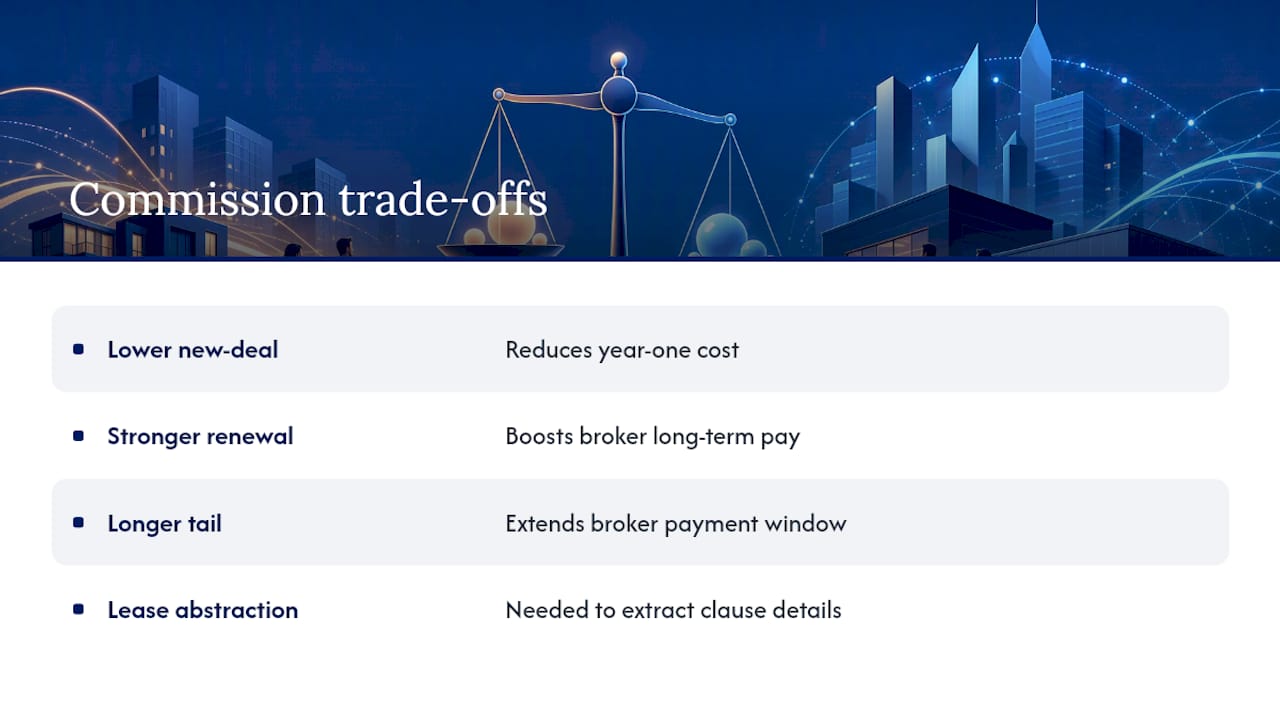
Ardorcre’s advisors regularly see landlords accept a slightly lower new-deal rate in exchange for a stronger renewal commission or a longer tail period, a trade that protects the broker’s long-term economics without inflating year-one costs.
The lease abstraction work behind these agreements matters more than most landlords expect. If you want a closer look at how commission clauses interact with the rest of a lease, our lease abstraction guide breaks down what to extract and why.
— Jim
Get Your Commission Agreement Reviewed Before You Sign
A commission structure only works if the paperwork behind it is airtight, and that’s precisely where most disputes originate: vague basis language, missing clawback formulas, renewal terms nobody wrote down. Ardorcre works directly with landlords, brokers, and tenants across the Charlotte MSA to draft and review commission agreements before they become a problem instead of after.

Ardorcre’s advisors also handle full landlord and tenant representation, so if you’re negotiating a lease right now and want someone checking the commission math alongside the rent schedule, that’s a service you can bring in immediately rather than reconstruct later. Our lease abstraction guide walks through exactly what a properly documented commission clause should include, and it’s the fastest starting point if you’re drafting or reviewing an agreement this quarter. Reach out through our contact page to get a commission agreement reviewed before your next lease signing.
Sources
- Commercial Lease Broker Fee: Who Pays & How Much (2026)
- How to Calculate Commercial Lease Commission: Rates and Splits – LegalClarity
- Leasing Commissions – Cove