
A commercial lease LOI is a short term sheet that pins down the business terms of a deal before anyone drafts a lease. It states rent, size, term, and use. It is not the lease itself, and getting it wrong can either kill a good deal or lock you into terms you never meant to accept.
Before you write or sign one, do two things. First, identify what actually drives your cost: the rent structure, the tenant improvement (TI) allowance, and how operating expenses get passed through. Second, list your absolute dealbreakers in plain language so nobody can claim later that you agreed to something you didn’t.
Pro Tip: Say explicitly that the LOI is nonbinding except for whatever carve-outs you intend to enforce, like confidentiality or exclusivity. Silence on this point is how LOIs end up in litigation.
Key Takeaways
A commercial lease LOI works because it locks in the economic and control terms that drive total occupancy cost before anyone drafts the lease.
| Point | Details |
|---|---|
| Define nonbinding intent explicitly | State which sections bind and which don’t; silence invites a court to enforce the whole document. |
| Capture cost drivers first | Base rent, rent type, escalation method, and TI allowance belong in the LOI, not left for the lease. |
| Mark binding carve-outs separately | Number and label confidentiality, exclusivity, and deposit clauses as binding to avoid ambiguity. |
| Respond in writing, always | Ignoring an unfavorable LOI can create an impression of acceptance that complicates negotiation. |
| Get review before signing | Ardorcre’s tenant and landlord representation and lease abstract services help convert LOI terms into a clean lease draft. |
Table of Contents
- What Is a Commercial Lease LOI and When Do You Use It?
- The Checklist: What Every Commercial Real Estate LOI Should Cover
- Which LOI Terms Are Binding and Which Aren’t?
- How to Draft and Respond to a Commercial Lease LOI
- Common LOI Mistakes That Derail Deals
- A Sample LOI Structure You Can Adapt
- How We Apply This Checklist in Real Deals
- What Actually Goes Wrong With LOIs
- Get Help Turning Your LOI Into a Signed Lease
- Frequently Asked Questions
- Sources
What Is a Commercial Lease LOI and When Do You Use It?
Some call it a term sheet. Others call it a memorandum of understanding. All three describe the same document: a short outline of deal terms that both sides sign before anyone spends real money on legal drafting.
A tenant, a tenant’s broker, or an attorney usually prepares the first draft, though landlords write them too, especially in a landlord’s market. The point is to keep negotiations focused before either side pays for full lease abstracting or legal review on a deal that might not close, an idea Nolo describes as a kind of test drive for the lease.
The LOI sits in a predictable sequence:
- Site tour and initial interest. You walk the space, confirm it fits your use, and get a sense of asking terms.
- LOI negotiation. Both sides trade drafts until the core economics and dates are settled.
- Due diligence. Financing, zoning, and third-party consents get checked once the business terms are locked.
- Lease drafting. Attorneys turn the LOI into a full lease, filling in remedies and boilerplate the LOI never covered.
The Checklist: What Every Commercial Real Estate LOI Should Cover
An LOI earns its keep by capturing the terms that actually move your total cost and your control over the space. Everything else belongs in the lease.
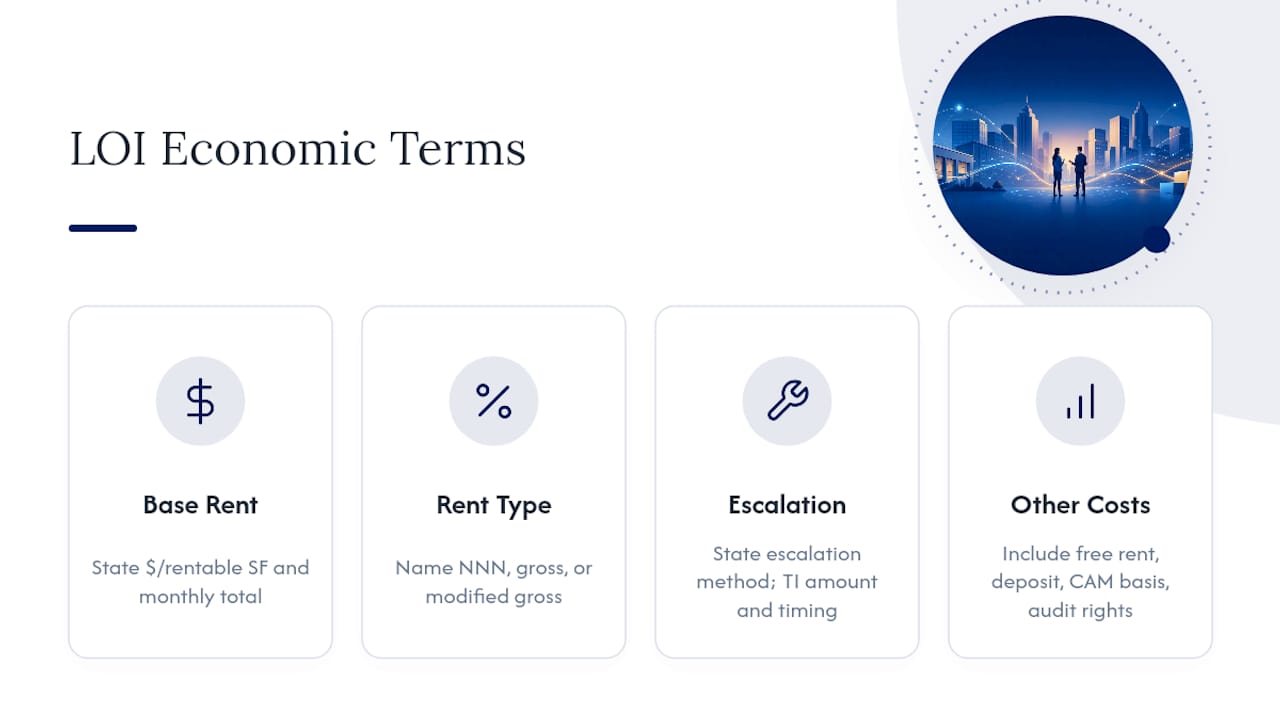
Economics. State base rent both as dollars per rentable square foot and as a monthly total. Name the rent type (NNN, gross, or modified gross), the escalation method, the TI allowance and when it gets funded, any free rent or concessions, and the security deposit amount and form. Dean CRE’s guidance on commercial lease LOIs recommends defining the operating expense structure and CAM estimate basis here too, along with audit rights, so nobody discovers a surprise pass-through six months into the lease.
Timing and scope. Nail down the premises description in rentable or usable square feet, the lease term, what triggers commencement, the rent commencement date, and delivery or buildout timing. If the space hasn’t been formally measured, note remeasurement rights.
Operational control. Permitted use, exclusivity, signage rights, parking allocation and cost, access hours, and your rights to sublease or assign all belong here, along with any renewal or expansion options.
Conditions precedent. List anything that could unwind the deal: financing or lender approval, zoning, permits, or required third-party consents such as an estoppel certificate.
Roughly a third of LOI disputes trace back to vague economic terms rather than disagreements over use or control, which is why Troutman Pepper’s guidance on LOIs stresses stating rent type and escalation method in the same document, not left for the lease to define later.
Pro Tip: Build one table with every dollar figure and date in it. If a term changes your total occupancy cost or your ability to walk away, it goes in that table. Remedies, notice provisions, and default language wait for the lease.
Which LOI Terms Are Binding and Which Aren’t?
Most commercial LOIs are meant to be nonbinding on the big-ticket items like rent and term, letting either party walk away before signing a lease. But “meant to be” and “legally are” are two different things.
Courts have enforced LOIs that included all the essential terms of a deal, especially when the document lacked a clear nonbinding statement, according to Nolo’s overview of letter of intent disputes. That’s the trap: the more complete your LOI looks, the more it starts to resemble a contract in a judge’s eyes.
Certain clauses are usually meant to bind immediately, even inside an otherwise nonbinding LOI:
- Confidentiality — protecting financial details shared during negotiation.
- Exclusivity or marketing stop — the landlord agrees not to shop the space to other tenants for a set window.
- Deposit handling — what happens to earnest money if the deal falls through.
- Reimbursement obligations — who pays for third-party reports if negotiations end.
Sample nonbinding language reads something like: “Except for Sections 8 and 9 below, this Letter of Intent is nonbinding and does not obligate either party to execute a lease.” Binding language for a carve-out might say: “Section 8 (Confidentiality) shall be binding upon execution of this Letter of Intent, regardless of whether a lease is ultimately signed.”
A well-drafted LOI states plainly which numbered sections bind the parties and which don’t, rather than relying on one blanket sentence to do all the work. Removing loose phrases like “the parties agree to negotiate in good faith” matters too. That language has been read by courts as evidence of intent to be bound. Get a real estate attorney to review any binding carve-out before you sign, per Troutman Pepper’s analysis.
Pro Tip: Never bury a binding clause in a paragraph of general terms. Number it, label it “Binding,” and keep it separate from the rest of the document.
How to Draft and Respond to a Commercial Lease LOI
If you’re the tenant preparing the first draft:
- Lock in your cost drivers first: rent, rent type, TI allowance, and escalation method.
- State your intent to be nonbinding explicitly, except for any carve-outs you want enforced.
- List your dealbreakers by name. If a personal guarantee is a nonstarter, say so in the LOI, not after the lease is drafted.
- Reference any survey, floor plan, or measurement standard you’re relying on for square footage.
If you’re the landlord responding:
- Correct factual errors in the tenant’s draft immediately. Silence can look like agreement.
- Flag any binding language the tenant snuck into general terms.
- Propose alternatives rather than a flat rejection when the ask is close to workable.
- Set a response deadline, typically five to ten business days, so the deal doesn’t stall.
Anchor negotiations around economic certainty. Define exactly how “market rent” gets determined at renewal, rather than leaving it open. Market conditions, tenant financial strength, and even tenant type shift what a landlord will concede. A restaurant tenant often negotiates different exclusivity terms than an office tenant, because the landlord’s lender obligations differ by property type.
Common LOI Mistakes That Derail Deals
Most LOI problems trace back to vagueness, not malice.
- Vague commencement triggers. “Upon delivery of the space” means nothing without a defined delivery condition.
- Missing square footage basis. Rentable versus usable square footage changes your effective rent significantly. Say which one you’re using.
- Undefined market rent. If a renewal option references “market rent,” define how that gets determined, or you’re negotiating blind years from now.
- Ambiguous TI scope. “Landlord will provide a reasonable improvement allowance” is not a number. Put a dollar figure or a per-square-foot rate in writing.
- Silence equals acceptance. Ignoring an LOI you disagree with, rather than responding in writing, can create the impression you accepted its terms, a risk Nolo flags directly in its guide to negotiating commercial leases.
- No mention of broker fees. If commission responsibility isn’t addressed, expect a fight over it later.
A Sample LOI Structure You Can Adapt
A working LOI template doesn’t need to be long. It needs to hit every line item that changes cost or control, then stop.
- Parties and property. Full legal names, the address, and suite number.
- Premises. Square footage (state RSF or USF) and floor plan reference.
- Rent. Base rent per RSF and monthly total, rent type (NNN/gross/modified gross), and escalation schedule.
- TI allowance. Dollar amount, per-square-foot rate, and funding timing.
- Security deposit. Amount and form (cash, letter of credit).
- Term and dates. Lease term length, commencement trigger, and rent commencement date.
- Permitted use and exclusivity. What the tenant can operate, and whether the landlord restricts competing uses.
- Renewal and expansion options. Any preemptive rights, similar in spirit to a right of first refusal, should be spelled out with notice periods.
- Confidentiality and nonbinding statement. Which sections bind, and which don’t.
“This Letter of Intent outlines proposed terms for a commercial lease and, except for Sections [X] and [Y], is nonbinding on either party.” That single sentence, according to LegalTemplates’ commercial LOI form, is the most commonly missing piece in disputed LOIs pulled into court.
How We Apply This Checklist in Real Deals
In retail deals, exclusivity usually matters more than TI dollars. A restaurant tenant needs a use restriction more than an extra $5 per square foot. In office deals, it flips: tenants care more about expense structure and escalation caps than about who else leases in the building.
Pro Tip: Running rent scenarios against a triple net versus modified gross structure before the LOI goes out changes what you ask for. Tenants who model expenses early negotiate cleaner escalation language.
What Actually Goes Wrong With LOIs
The recurring problem I see isn’t bad faith. It’s vagueness dressed up as flexibility. A landlord promises a “reasonable” TI allowance, a tenant doesn’t respond to a draft for three weeks, and both sides later disagree about what was actually agreed. Exclusivity clauses written too broadly or too narrowly cause the same friction months later.
The fix is boring but effective: get your broker and an attorney reviewing the LOI before you sign, not after a dispute starts.
Get Help Turning Your LOI Into a Signed Lease
Ardorcre works both sides of Charlotte MSA lease deals, representing tenants and landlords in office, medical, retail, and industrial transactions. Where a generic template leaves you guessing at market rent formulas or TI scope, our advisors model the numbers against actual comparable deals in your submarket before you ever send a draft.
A short LOI review engagement typically covers your economics table, flags any binding language hiding in the general terms, and checks your TI and expense assumptions against current market data. If you’re past the LOI stage and need the deal terms converted into a lease-ready summary, our lease abstract service turns your signed LOI into the document your attorney actually drafts from. Reach out to get your current LOI reviewed before you sign it.
Frequently Asked Questions
Is a commercial lease LOI legally binding?
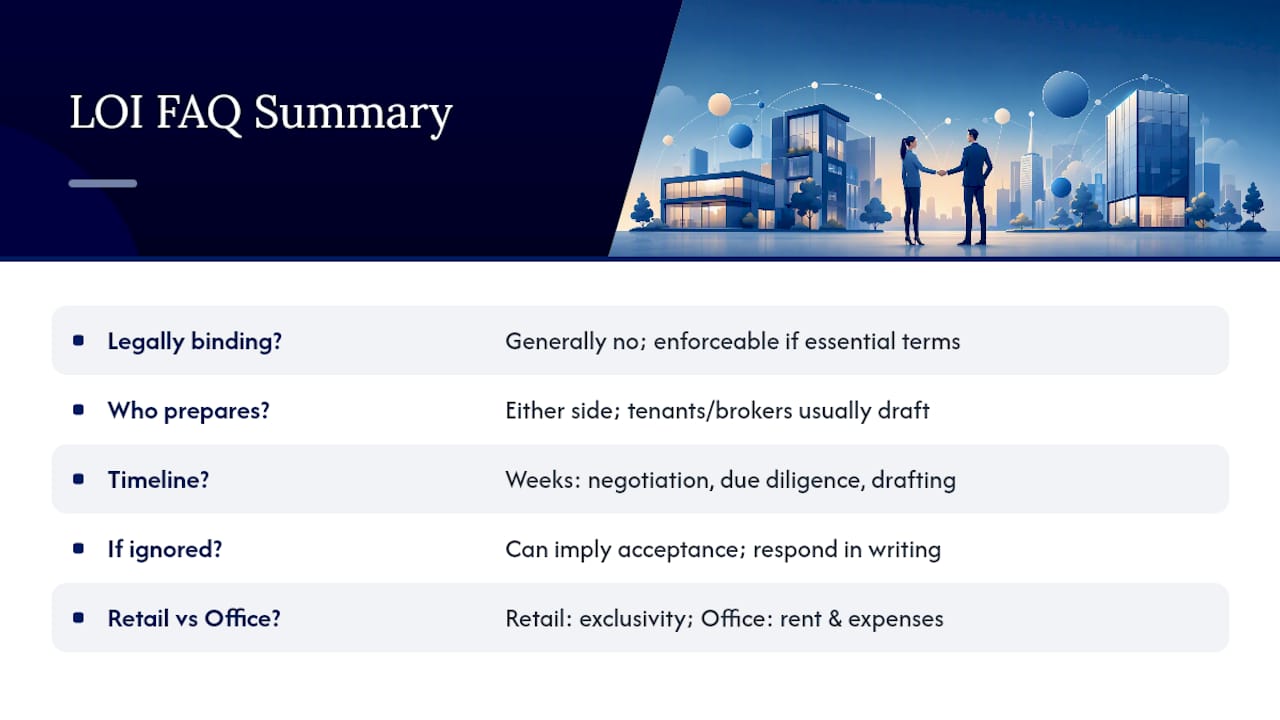
Generally no, but courts have enforced LOIs that contain all essential deal terms or lack clear nonbinding language. Any carve-outs you want enforced, like confidentiality, should be labeled as binding explicitly.
Who typically prepares the LOI: the tenant or the landlord?
Either side can, though tenants, tenant brokers, or attorneys draft the first version most often. Landlords sometimes prepare the initial LOI in a strong leasing market.
How long does the LOI-to-lease process usually take?
Expect a few weeks for LOI negotiation, followed by additional weeks for due diligence and lease drafting, varying with deal complexity and counsel responsiveness.
What happens if I ignore an LOI I disagree with?
Ignoring it can look like acceptance. Respond in writing rejecting or proposing specific changes rather than letting the draft sit unanswered.
Do retail and office LOIs differ in what they prioritize?
Yes. Retail tenants typically focus on exclusivity and use restrictions, while office tenants weigh expense structure and rent escalation more heavily.
This article is general information, not a substitute for advice from a qualified lawyer. Consult a qualified legal professional about your own circumstances before acting on anything here.
Sources
- Letters of Intent in Commercial Real Estate Leases — Troutman Pepper
- The Letter of Intent: Why What You Agree to Before the Lease Gets Drafted Can Make or Break Your Deal — Nolo
- Commercial Lease LOI: What to Include and Avoid — Dean CRE