
A sale-leaseback lets an owner-operator convert real estate into cash while staying in the building under a long-term lease. It replaces ownership upside with a fixed occupancy cost, so it works best for owners with trapped equity and a clear plan for the proceeds. The tradeoff is real: you give up appreciation and future control, and you take on a rent obligation with tax and accounting consequences that need to be modeled before you sign anything.
TL;DR:
- Sale-leasebacks can unlock up to 100% of a property’s fair market value, compared to 50-80% with traditional mortgage refinancing.
- They are most suitable for properties critical to operations, such as industrial, retail, medical, or distribution centers, with a strong incentive to stay.
- Long-term lease payments, often structured as triple net, are fixed and must be carefully modeled against business cash flows and tax implications before signing.
- The process typically takes two to eight months, with faster closings achievable through all-equity buyers and clearer due diligence.
- Owners should understand they are trading property appreciation for a fixed lease obligation and ensure proceeds are redeployed into higher-return ventures.
Table of Contents
- What Is a Sale Leaseback in Commercial Real Estate?
- Who Qualifies for a Sale-Leaseback and When Does It Make Sense?
- How Does the Deal Structure and Tax Treatment Work?
- What Are the Pros and Cons of a Sale-Leaseback?
- What Should You Look for in a Sale-Leaseback Investor?
- What Contract Terms Should You Negotiate Before Closing?
- How Long Does a Sale-Leaseback Take From Start to Close?
- What Do Sale-Leasebacks Look Like Across Different Property Types?
- The Real Tradeoff Nobody Talks About Enough
- How Ardorcre Helps Owner-Operators Evaluate a Sale-Leaseback
- Sources
What Is a Sale Leaseback in Commercial Real Estate?
A sale-leaseback is a transaction where a business that owns its facility sells the property to an investor, then immediately signs a lease to keep operating there, typically for 15 to 30 years. The company never moves. It just swaps a hard asset on the balance sheet for cash in the bank and a rent line on the income statement.
The appeal comes down to how much cash actually reaches you. A conventional mortgage refinance usually advances somewhere between 50% and 80% loan-to-value, leaving a meaningful chunk of your equity locked in the building. A sale-leaseback can unlock up to 100% of fair market value, because you’re not borrowing against the asset, you’re selling it outright.
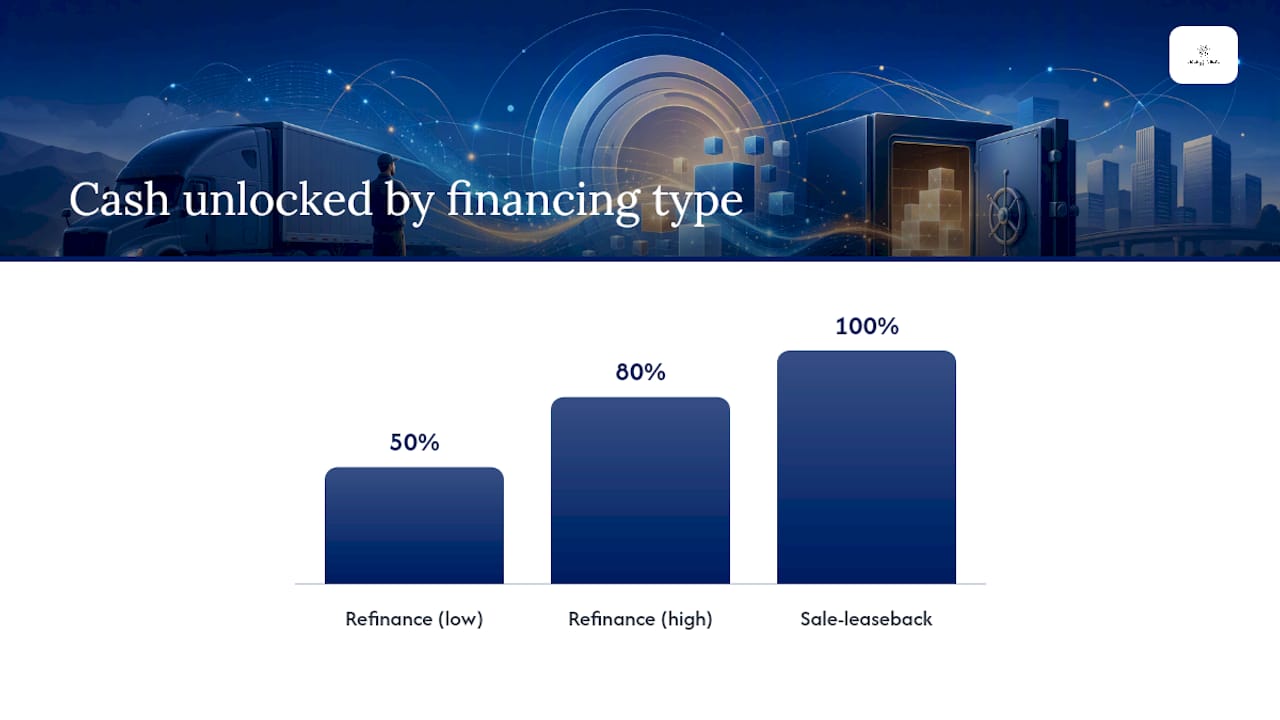
Running an example on a facility valued in the millions shows how a mortgage refinance advances less cash and retains debt, while a sale-leaseback can free up the entire value as cash to be used elsewhere without increasing liabilities.
Other advantages worth knowing:
- Avoiding restrictive loan covenants that come with traditional bank financing
- Improving liquidity ratios that lenders and investors scrutinize
- Potential tax deductibility of lease payments, depending on your entity structure and how the lease is classified
Who Qualifies for a Sale-Leaseback and When Does It Make Sense?
Not every owner-occupied building is a good candidate. The transactions that attract serious investor interest tend to involve mission-critical facilities, industrial buildings, retail locations, medical offices, and distribution centers where relocating would be prohibitively expensive or disruptive. Investors want a tenant who has strong incentive to stay put for decades, not one who might walk in year three.
Ask yourself these questions before pursuing one:
- Do you have significant equity trapped in a property that’s earning zero return on the balance sheet?
- Can your operation comfortably support a fixed rent payment for the next 15 to 20 years, even in a slow year?
- Do you have a specific, higher-return use for the proceeds, such as an acquisition, equipment upgrade, or debt paydown?
- Is your property attractive to institutional buyers, meaning well-located, well-maintained, and leased at market rent?
If you’re planning to sell the entire business, including the real estate, within the next few years, a sale-leaseback probably isn’t the right tool. You’d be locking in a long lease obligation right before a sale, which complicates the deal for a buyer.
Pro Tip: *Model your rent-to-revenue ratio before you shop the deal.
How Does the Deal Structure and Tax Treatment Work?
The lease terms drive the economics of the entire transaction, so this is where owners need to slow down. Core deal elements include the purchase price, lease length, rent basis (often triple net, meaning you cover taxes, insurance, and maintenance), annual rent escalations, and any renewal or repurchase options.
Key structural components to negotiate:
- Base rent and how it’s calculated relative to the sale price
- NNN versus gross lease responsibilities
- Annual escalation percentage
- Renewal option terms and repurchase rights, if any
The accounting side has gotten more complicated since Topic 842 took effect. Many sale-leasebacks no longer achieve off-balance-sheet treatment for the seller-lessee. Instead, you’ll typically record a right-of-use asset and a corresponding lease liability, which changes how your balance sheet looks to lenders and investors evaluating your business. Some transactions fail to qualify as a true sale under GAAP and get accounted for as a financing arrangement instead, which changes the tax and reporting picture entirely.
Depreciation recapture is the other piece owners underestimate. If you’ve depreciated the building for years, selling it can trigger a recapture tax bill that eats into your proceeds. Before you sign a letter of intent, get a CPA to model after-tax proceeds under a few different structures. The gap between gross sale price and what actually lands in your account can be larger than owners expect.
What Are the Pros and Cons of a Sale-Leaseback?
The upside is straightforward: full equity monetization, uninterrupted operations, a wider pool of potential buyers than a traditional sale would attract, and in many cases, favorable tax treatment on lease payments. You keep running your business exactly as before, just without the asset tying up your balance sheet.
The downsides are just as real and often surface years later:
- You permanently give up any future appreciation on the property
- You’re locked into a fixed rent obligation regardless of how your business performs
- Depreciation deductions disappear once you no longer own the asset
- You may face new restrictions on alterations, subletting, or capital improvements
Most failed or regretted sale-leasebacks trace back to one of three mistakes: a valuation gap where the seller expected more than the market would pay, lease terms that didn’t match the operator’s actual growth plans, or proceeds that got redeployed into something earning less than the rent now costs. Redeploying capital at a return above your lease cost isn’t optional. It’s the entire point of doing the deal.
What Should You Look for in a Sale-Leaseback Investor?
Not all buyers are equal, and the wrong one can turn a clean transaction into a drawn-out headache. Prioritize these qualities:
- All-equity capital. Buyers who don’t need financing close faster and rarely re-trade the price after you’re deep into due diligence.
- A demonstrated sale-leaseback track record. An investor who’s done dozens of these deals understands your operational needs better than a generalist buyer.
- Underwriting transparency. They should walk you through exactly how they arrived at valuation and rent, not just hand you a number.
- Speed and certainty to close. All-equity buyers reduce execution risk significantly compared to leveraged buyers who might fall through if their financing falls apart.
Red flags include buyers relying on contingent debt they haven’t secured, a pattern of re-trading terms late in the process, vague answers about their financing structure, or lease demands that go well beyond standard NNN terms. An investor’s own return requirements shape everything from your rent escalations to how much flexibility you get on renewals, so understand their objectives before you sign a letter of intent.
Pro Tip: Ask any prospective buyer for two or three references from tenants they’ve closed sale-leasebacks with in the past three years. A confident, established buyer will hand these over without hesitation.
What Contract Terms Should You Negotiate Before Closing?
Protecting your operational control starts with the lease document, not the purchase agreement. Work through these priorities in order:
- Base rent formula and how future escalations are calculated
- NNN expense pass-throughs, with caps on common area maintenance charges where possible
- Repair and capital expenditure responsibilities, spelled out clearly for both parties
- Assignment and subletting rights, especially if you might restructure or downsize later
- Renewal pricing mechanics, ideally tied to a fair-market formula, not the landlord’s discretion
- Repurchase options, if you want the right to buy the property back down the road
On the due diligence side, insist on a clean title review, environmental assessment, lender consent documentation, an estoppel certificate confirming lease terms, zoning verification, and a property condition report. Loop in your broker at the outset, a CPA once you have a preliminary offer, and specialized real estate counsel before you sign the letter of intent. A well-drafted lease abstract makes it far easier to compare competing offers clause by clause instead of just comparing headline rent numbers.
How Long Does a Sale-Leaseback Take From Start to Close?
Expect the full process to run somewhere between two and eight months, depending heavily on buyer type and property complexity. Valuation and marketing typically take 2 to 8 weeks, letter of intent and underwriting run another 4 to 12 weeks, due diligence and lease negotiation add 2 to 8 weeks, and closing itself usually wraps in 1 to 4 weeks.
Factors that speed things up or slow them down:
- All-equity buyers close noticeably faster than leveraged ones, since there’s no lender approval to wait on
- Existing mortgage lender consents can add weeks if your current loan has restrictive covenants
- Environmental findings, even minor ones, routinely add time for remediation review
Timing the market matters too. Selling into a strong investment sales market tends to yield better pricing, though rising rents in that same environment can offset some of the benefit on the lease side.
What Do Sale-Leasebacks Look Like Across Different Property Types?
The mechanics shift depending on the asset. An industrial owner running a manufacturing plant might sell the facility to an investor and sign a 20-year NNN lease with modest annual escalations, using proceeds to fund new equipment or acquire a competitor. Because relocating heavy machinery is costly and disruptive, these tenants are considered lower-risk by investors, which often translates into more favorable rent terms.

Retail sale-leasebacks work differently. A single-tenant retailer in a strong trade area might command a premium price precisely because the real estate itself has strong resale value to a future buyer, even if that tenant eventually leaves. Retail leases in this category often run shorter, in the 10 to 15 year range, with multiple renewal options built in.
Medical office sale-leasebacks tend to attract investors specifically because of tenant stickiness. A physician group with a built-out surgical suite or imaging center faces enormous switching costs to relocate, which makes them a dependable long-term tenant and often results in more competitive pricing from buyers.
Distribution and logistics properties have become one of the more active sale-leaseback categories as operators look to fund fleet expansion or automation upgrades. These deals frequently involve larger transaction sizes and longer lease terms, given the specialized nature of warehouse buildouts and their limited resale flexibility to a different type of user.
The Real Tradeoff Nobody Talks About Enough
Most articles on this topic treat sale-leasebacks as a clean win. It isn’t one. It’s a trade: you’re exchanging a volatile, illiquid asset for a predictable, contractual liability. That’s not a bad trade if you’re disciplined about where the cash goes, but plenty of owners treat the proceeds like a windfall instead of a fixed obligation lasting many years.
The owners who do well with this structure treat the lease payment the way they’d treat any other fixed cost, then hold their capital deployment to a higher bar than the lease rate. The ones who struggle usually made one of two mistakes: they underpriced the long-term rent burden, or they redeployed the cash into something that never generated returns above what the lease now costs them every month. Neither mistake shows up in year one. Both show up by year five.
If there’s one thing worth pushing back on in conventional advice, it’s the framing of a sale-leaseback as “unlocking capital” without equal emphasis on what you’re locking in. You’re not just freeing equity, you’re committing to a rent number for longer than most bank loans run. Treat it with that seriousness and the tool works exactly as intended.
— Jim
How Ardorcre Helps Owner-Operators Evaluate a Sale-Leaseback
Ardorcre advises building owners and investors across the Charlotte MSA on medical, office, retail, and industrial properties, handling both sides of these deals through leasing and sales expertise. When a client considers a sale-leaseback, that means running a real valuation against current market comps, not a guess, and stress-testing whether the proposed rent actually pencils against your operating cash flow.
Part of that work involves DSCR loan sizing to confirm your business can comfortably support the lease payment under different revenue scenarios, alongside a full lease abstract review so you understand every clause before you sign. If you’re weighing a sale-leaseback against a refinance or a traditional sale, the right first step is getting your property valued and your lease terms modeled by someone who does this regularly in your market. Start with Ardorcre’s DSCR loan sizing guide to see how your numbers hold up, or reach out directly for a site review and support drafting your letter of intent.