
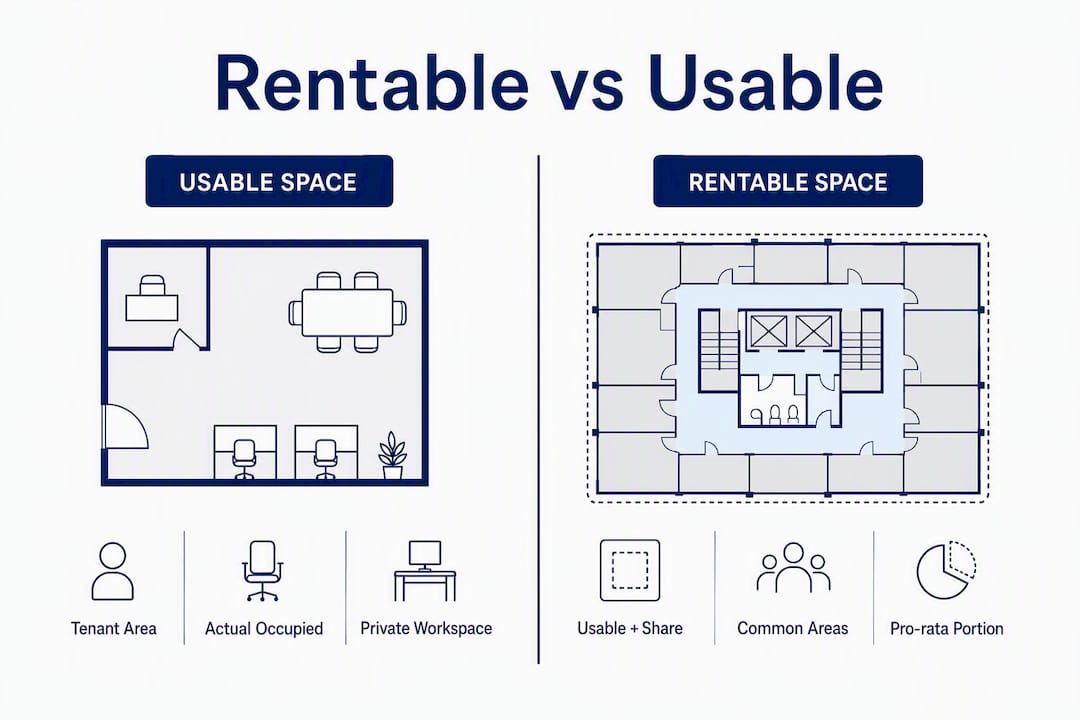
Rentable square feet (RSF) is the usable square feet (USF) a tenant occupies plus that tenant’s pro-rata share of the building’s common areas. The one-line formula: RSF = USF × load factor. That distinction matters because your base rent is calculated on RSF, not USF. A suite quoted at 10,000 RSF with a certain load factor means you are paying for that total square footage but only working in a smaller exclusive area. Getting that number wrong in a budget is a real problem.
Table of Contents
- What is usable square footage and how is it measured?
- What is rentable square footage and why do landlords quote it?
- How does the load factor work, and what drives it up?
- Gross, rentable, and usable: how do the three relate?
- Worked example: converting usable to rentable and calculating monthly rent
- Why does the RSF/USF gap affect your budget and negotiation?
- Common measurement mistakes and lease pitfalls to watch for
- When should you call a broker, space planner, or lease advisor?
- Key Takeaways
- The number landlords count on you not to check
- Ardorcre’s lease advisory services for Charlotte tenants and landlords
- Useful references and standards
What is usable square footage and how is it measured?
Usable square feet is the space that belongs exclusively to you as a tenant. Desks, private offices, storage rooms, private restrooms, built-in closets, and any enclosed area within your suite boundary all count. The moment you step into a shared lobby, a common corridor, or a building restroom, you have left your USF behind.
Measurement gets more nuanced depending on whether you lease a partial floor or an entire floor:
- Partial-floor tenants typically have USF measured to the interior face of the demising walls, excluding floor-common corridors, shared pantries, and any circulation that serves other tenants on the same floor.
- Full-floor tenants often see floor-specific corridors and pantry areas folded into their USF, depending on the measurement method the lease references.
- Columns and recessed entries are typically included in USF even though they eat into functional space.
- Suite boundaries in the lease exhibit should reference a specific measurement standard. If none is cited, ask.
When you review a lease exhibit, check the plan scale against the stated square footage, confirm the suite boundary lines, and verify which measurement method is referenced. A plan that says “1 inch = 20 feet” but shows a suite that measures out to 9,200 square feet when the lease says 10,000 is a flag worth raising before you sign.
What is rentable square footage and why do landlords quote it?

RSF equals USF plus the tenant’s pro-rata share of building common areas — lobbies, elevator banks, mechanical rooms, shared restrooms, and building corridors. It is the single billing unit landlords use to calculate base rent, compare suites across a portfolio, and budget operating expense recoveries.
Landlords quote RSF because it lets them recover the cost of shared infrastructure from every tenant proportionally. If a building has 100,000 total square feet and you lease 10,000 USF, you are assigned 10% of the common area. That 10% gets added to your USF to produce your RSF, and your annual base rent is calculated on that RSF figure.
In lease language, watch for how RSF is defined. Some leases specify the measurement standard (BOMA 2017 Office is common). Others define load factor or the “add-on factor” in a separate clause. The amenities included in the common area calculation can vary: one landlord might include a rooftop terrace; another excludes it. Those choices directly change your load factor and, by extension, your rent.
Pro Tip: Ask the landlord to attach the load-factor calculation as a lease exhibit. A landlord confident in their numbers will provide it. One who hesitates is worth pressing.
How does the load factor work, and what drives it up?
The load factor (also called the common area factor or add-on factor) is the multiplier that converts USF into RSF:
Load factor = RSF ÷ USF
RSF = USF × load factor
BOMA International sets the measurement standards most U.S. office leases reference, and typical office load factors generally fall between 1.05 and 1.25, with some high-rise amenity buildings occasionally exceeding 1.30. A load factor represents the proportion of rentable square footage that is allocated to common areas shared among tenants.
Several building design and lease decisions push the load factor higher:
- Large central lobbies with premium finishes
- Extensive building corridors and tenant-floor circulation
- Vertical cores (elevator banks, stairwells, mechanical shafts)
- Shared amenity spaces: conference centers, fitness rooms, rooftop terraces
- Tenant-specific floor corridors counted in the building common area
Partial-floor geometry matters here. A tenant taking 3,000 USF on a floor with an inefficient layout and long corridors will carry a higher effective load factor than a full-floor tenant on a compact, efficient floorplate. Two suites with identical USF in the same building can produce different RSF figures if one sits on a more efficiently designed floor. That is not a technicality; it is a real cost difference.
Gross, rentable, and usable: how do the three relate?
These three metrics form a hierarchy, and confusing them is one of the most common errors in lease review.
Gross square feet is the total building footprint measured to the outside face of exterior walls. It includes everything: structural elements, elevator shafts, mechanical rooms, parking decks, rooftop equipment areas, and exterior walls themselves. No tenant ever pays rent on gross square footage directly.
Rentable square feet sits below gross. It strips out elements like parking structures and rooftop mechanical penthouses that are not part of the leasable building area, then allocates the remaining common areas to tenants through the load factor.
Usable square feet is the smallest of the three: only the space a tenant actually occupies.
A quick comparison:
| Metric | What it includes | What it excludes |
|---|---|---|
| Gross SF | Everything inside exterior walls | Nothing |
| Rentable SF | USF + pro-rata common areas | Parking, rooftop mechanicals, exterior walls |
| Usable SF | Tenant-exclusive space only | All common areas, building core |
“Net area” and “livable area” appear in some leases and appraisals. Different standards treat net area and circulation differently, so always confirm which standard a lease references before assuming net equals usable. BOMA publishes the most widely adopted office measurement standards in the U.S., but some leases reference ANSI, ASTM, or older BOMA editions. When in doubt, the lease document controls.
Worked example: converting usable to rentable and calculating monthly rent
Here is a step-by-step conversion you can reuse for any suite you are evaluating.
Inputs:
- Usable square feet (USF): 8,000
- Load factor: 1.15
- Quoted rent: $30 per RSF per year
Steps:
- Calculate RSF: 8,000 × 1.15 = 9,200 RSF
- Calculate annual base rent: 9,200 × $30 = $276,000/year
- Calculate monthly base rent: $276,000 ÷ 12 = $23,000/month
- Convert to effective rent per USF: $276,000 ÷ 8,000 = $34.50 per USF per year
| Input / Output | Value |
|---|---|
| Usable square feet (USF) | 8,000 SF |
| Load factor | 1.15 |
| Rentable square feet (RSF) | 9,200 SF |
| Quoted rent per RSF | $30.00/year |
| Annual base rent | $276,000 |
| Monthly base rent | $23,000 |
| Effective rent per USF | $34.50/year |
That last line is the one most tenants skip. When rent is quoted at $30/RSF and the R/U ratio is 1.15, the effective cost per usable square foot is $34.50. Use effective rent per USF to compare two suites with different load factors. A suite quoted at $28/RSF with a 1.22 load factor costs $34.16 per USF — nearly identical to the example above, even though the headline rate looks cheaper.
Why does the RSF/USF gap affect your budget and negotiation?
The spread between RSF and USF touches almost every line item in an occupancy cost model. Here is where it shows up in practice:
- Base rent: Calculated on RSF, so a higher load factor means higher rent for the same functional space.
- Operating expense (OpEx) recoveries: Many leases calculate OpEx on a per-RSF basis, so a higher RSF amplifies your share of building operating costs.
- Tenant improvement allowances: Sometimes quoted per RSF; a high load factor means your TI dollars cover less actual buildout area.
- Comparing two spaces: Two suites at 8,000 USF with load factors of 1.10 and 1.22 produce RSF of 8,800 and 9,760 respectively. At $30/RSF, that is a $28,800 annual difference for identical functional space.
Negotiation questions worth asking on every tour or RFP:
- What is the load factor, and how is it calculated?
- Which BOMA standard or measurement method does the lease reference?
- Are any amenity spaces (fitness center, conference room, rooftop) included in the common area calculation?
- Can you provide the floor plan with dimensions and the load-factor calculation as a lease exhibit?
- Has the building been remeasured recently, and under which standard?
Amenity-rich buildings sometimes justify a higher load factor, but only when you will actually use those amenities and when the effective rent per USF still competes with alternatives. A rooftop terrace that adds 0.08 to the load factor is worth something to a company that hosts client events. For a back-office operation, it is pure cost. Local Charlotte market context matters here: what counts as a competitive load factor in Uptown Charlotte differs from what the suburban Ballantyne corridor typically offers.
Common measurement mistakes and lease pitfalls to watch for
Most measurement disputes are avoidable. They tend to come from a handful of recurring errors:
- Missing the measurement standard reference — A lease that says “per BOMA 1996” and a lease that says “per BOMA 2017” can produce different RSF figures for the same physical space.
Red flags in lease exhibits: no measurement standard cited, RSF that rounds to a suspiciously clean number, or a floor plan with no scale bar.
Pro Tip: Compare the plan’s stated scale to an independent measurement of one known dimension (a corridor width, a window bay). If the scale is off, the square footage is off. This single check catches more errors than any other step in lease review.
If the numbers do not match, ask the landlord for the full load-factor calculation in writing, request a dimensioned floor plan, and consider adding a measurement verification condition to the lease before execution. A lease abstract that captures the measurement basis, RSF/USF figures, and any measurement-related conditions gives you a clean record if a dispute arises later.
When should you call a broker, space planner, or lease advisor?
Some tenants can verify a load factor on their own. Others are walking into a situation where a mistake costs six figures over a lease term. Here is how to decide:
- Ambiguous or non-standard measurement methods — If the lease references an older BOMA edition, a proprietary standard, or no standard at all, a lease advisor can flag the risk and negotiate a remedy.
Each advisor type brings something different. A tenant rep broker brings market context and negotiation leverage: they know what load factors are trading at in your submarket and can push back with data. A space planner or architect focuses on workplace efficiency, layout, and whether the USF actually supports your headcount. A lease advisor or attorney focuses on the legal language: how RSF is defined, what triggers a remeasurement, and whether the landlord can add amenities to the common area pool after you sign.
When hiring, share the lease draft, the floor plan with dimensions, and the landlord’s load-factor calculation. Ask for a written deliverable: a lease abstract, a measurement memo, or a marked-up lease exhibit. Budget for advisory fees as a line item in your occupancy cost model, not as an afterthought. An in-person field measurement is warranted any time the plan dimensions do not reconcile with the stated square footage or when you are negotiating a large, long-term lease where even a 2% measurement error compounds over years.
Key Takeaways
Rentable square feet always exceeds usable square feet because it adds your pro-rata share of common areas, and that gap directly determines how much rent you pay for space you may never sit in.
| Point | Details |
|---|---|
| Core formula | RSF = USF × load factor; typical office load factors generally fall between 1.05 and 1.25, with some high-rise amenity buildings occasionally exceeding 1.30. |
| Effective rent conversion | Divide annual rent by USF (not RSF) to compare spaces with different load factors. |
| Verify before signing | Request the landlord’s load-factor calculation in writing and confirm the measurement standard in the lease. |
| Partial-floor risk | Partial-floor tenants can carry a higher load factor than the building average; always ask for the floor-specific figure. |
| Ardorcre advisory | Ardorcre’s tenant and landlord representation in the Charlotte MSA includes lease abstract review and load-factor verification. |
The number landlords count on you not to check
Most tenants negotiate hard on the rent rate per RSF and never look at the load factor. That is exactly the wrong order of operations. A landlord can hold the headline rate firm and quietly deliver a higher load factor, and the tenant walks away thinking they won a concession. The effective rent per USF tells the real story, and it is the only number that lets you compare two spaces honestly.
There is also a subtler issue that rarely gets discussed: the amenity premium. A building with a fitness center, a rooftop terrace, and a conference suite will carry a higher load factor than a plain-vanilla suburban office park. That premium is sometimes worth paying, but only if your team will actually use those amenities. Tenants who sign into amenity-heavy buildings for the optics and then use none of the shared spaces are paying a load-factor tax with no return.
The practical rule: before you tour a second space, calculate the effective rent per USF for the first one. Then do the same for every option. The suite with the lowest load factor and the best floorplate efficiency will almost always outperform a flashier option over a five-year term, even if the headline rate is a dollar or two higher per RSF.
Ardorcre’s lease advisory services for Charlotte tenants and landlords
Sorting out RSF from USF is straightforward on paper. In an actual lease negotiation, the measurement method, the load-factor calculation, and the lease language all interact in ways that can shift your occupancy cost by tens of thousands of dollars over a term. Ardorcre’s advisors handle tenant and landlord representation across the Charlotte MSA, including office, medical, retail, and industrial properties, and that work routinely includes pulling apart a landlord’s square footage claims before a client signs.

A lease abstract from Ardorcre captures the measurement basis, RSF/USF figures, load-factor calculation, and any measurement-related conditions in a single document, so nothing gets buried in a 60-page lease. For tenants who need to verify whether a quoted load factor is competitive in the current Charlotte market, Ardorcre’s advisors bring local transaction data that generic online calculators cannot replicate. To request a lease abstract review or a tenant representation consultation, contact Ardorcre directly through the website.
Useful references and standards
- BOMA International measurement standards — the primary authority for office area measurement in U.S. commercial leases; use this to identify which BOMA edition your lease references.
- BOMA best practices for floor measurement — practical guidance on applying BOMA standards to floor plans and lease exhibits.
- RSF formula and calculator — Wall Street Prep — clear formula reference and worked examples for converting USF to RSF.
- Net area vs. gross area — HelloData — explains how different standards define net, usable, and circulation area, and why the lease’s referenced standard matters.
- Net area vs. net floor area — Tango Analytics — covers partial-floor measurement nuances and how full-floor vs. partial-floor treatment affects USF.
- Lease abstract guide — Ardorcre — practical resource for capturing measurement terms, RSF/USF figures, and load-factor conditions during lease review.
- Charlotte office market analysis — Ardorcre — local market context for evaluating whether a quoted load factor is competitive in the Charlotte MSA.