
In most U.S. commercial leases, the landlord funds improvements through a tenant improvement allowance (TIA) or a turnkey buildout, but the landlord typically owns those improvements the moment they are installed — unless the lease explicitly says otherwise. Tenants who sign without negotiating ownership, removal rights, and draw mechanics often discover that six-figure buildout costs become the landlord’s asset at no cost to them.
Two situations where tenants can own improvements:
- The lease contains explicit language granting the tenant title to specific improvements on installation or at lease expiration.
- The items qualify as trade fixtures (equipment installed to operate the business, such as dental chairs or commercial ovens) and the lease or state law preserves the tenant’s removal rights.
Three things to do before you sign:
- Read the Work Letter exhibit in full — it controls scope, budget, draw mechanics, and ownership more than any other lease section.
- Get an independent contractor estimate before negotiating the TIA cap; you cannot evaluate a $45/RSF offer without knowing your actual build cost.
- Confirm draw timing, lien waiver requirements, and the sunset date for unused allowance so you do not forfeit money you earned in negotiation.
Pro Tip: If the lease says nothing about who owns improvements, common law defaults to the landlord. Silence is not neutral — it is a concession.
Key Takeaways
In commercial leases, the landlord typically funds improvements but owns them by default — tenants must negotiate ownership, removal rights, and draw mechanics in writing or risk losing both their buildout investment and their exit flexibility.
| Point | Details |
|---|---|
| Lease language controls ownership | Absent explicit terms, common law fixtures doctrine gives permanent improvements to the landlord. |
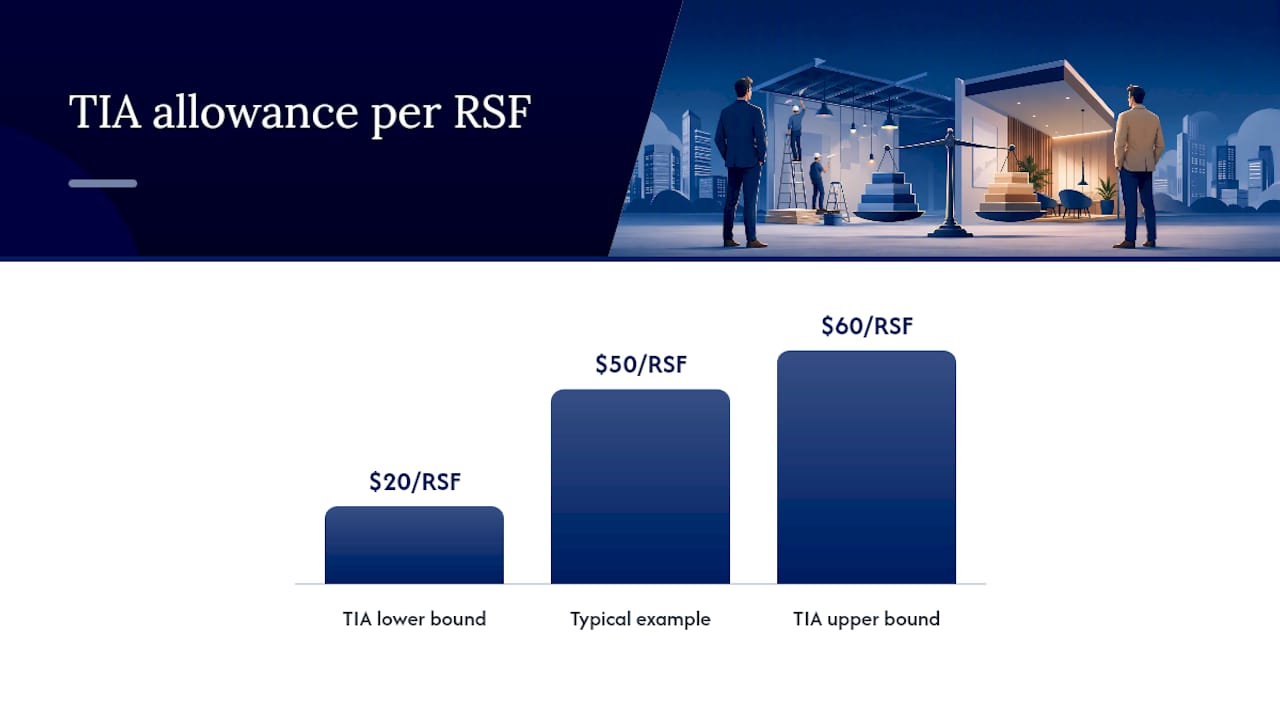
| TIA benchmarks vary widely | National ranges run $20–$60/RSF; Charlotte MSA deals depend on submarket, building class, and market conditions. |
| QIP accelerates depreciation | Interior improvements qualifying as QIP use a 15-year recovery period versus 39 years for the building schedule. |
| Work letter is the critical exhibit | Scope, draw timing, lien waivers, and sunset dates in the work letter determine cash-flow risk more than the TIA dollar amount. |
| Ardorcre advises on TI economics | Ardorcre’s tenant and landlord representatives in the Charlotte MSA help clients negotiate work-letter terms, model amortization costs, and abstract lease obligations. |
Table of Contents
- What “tenant improvements” actually means, and why the definition matters
- How landlords and tenants actually pay for buildouts
- Who actually owns tenant improvements, and how lease language decides it
- Tax and accounting consequences: who depreciates, QIP, and ASC 842
- Insurance and casualty risk: who covers improvements when something goes wrong
- What happens at lease end: removal, restoration, and abandonment
- Six quick scenarios: who pays, who owns, and what to negotiate
- The clause that costs more than the rent
- Work with Ardorcre on your next lease negotiation
- Authoritative sources and recommended reading
What “tenant improvements” actually means, and why the definition matters
The terms get used interchangeably in the market, but they carry different legal and tax consequences depending on who pays and what gets built.
Leasehold (tenant) improvements are alterations made to a rented space to suit a specific tenant’s use: partition walls, dropped ceilings, flooring, millwork, HVAC modifications, and lighting upgrades. The party who funds them usually capitalizes and depreciates them, though ownership at lease end depends entirely on the lease.
Building improvements are owner-funded capital expenditures that benefit the property broadly — a new roof, elevator modernization, or central HVAC replacement. These stay with the building, are depreciated by the landlord over 39 years under the nonresidential real property schedule, and are never subject to tenant removal rights.
Trade fixtures are a distinct category. A trade fixture is equipment a tenant installs specifically to operate its business: a restaurant’s commercial oven, a dental practice’s chair and X-ray unit, a retailer’s display cases. Trade fixtures typically remain tenant property and must be removed at lease end, with the tenant responsible for repairing any damage caused by removal.

The practical test courts apply when the lease is silent: annexation (how permanently is it attached?), adaptation (how specifically is it suited to this tenant’s use?), and intent (did the parties mean for it to stay?). Absent a negotiated exception, courts favor the landlord when an item is permanently affixed.
| Item | Category | Typical Ownership at Lease End |
|---|---|---|
| Partition walls | Leasehold improvement | Landlord |
| Dropped ceiling tiles | Leasehold improvement | Landlord |
| Custom millwork / cabinetry | Leasehold improvement | Landlord (unless negotiated) |
| Flooring (carpet, tile) | Leasehold improvement | Landlord |
| Commercial oven (restaurant) | Trade fixture | Tenant |
| Dental chair / X-ray unit | Trade fixture | Tenant |
| Retail display cases (freestanding) | Trade fixture | Tenant |
| Roof replacement | Building improvement | Landlord |
How landlords and tenants actually pay for buildouts
There is no single standard. The market uses four primary delivery models, and each shifts cash flow, construction control, and lien risk differently.
1. Landlord turnkey buildout. The landlord hires the contractor, manages construction, and delivers a finished space. The tenant gets a move-in-ready suite; the landlord controls quality and timeline. Tenants lose input on finishes and contractor selection. Landlords bear construction risk and cost overruns.
2. Tenant-controlled buildout with a TIA cap. The tenant manages construction and the landlord reimburses up to a negotiated dollar-per-rentable-square-foot cap. TIAs are typically quoted as a $/RSF amount, and a common national benchmark range runs $20–$60 per rentable square foot, though Charlotte MSA deals vary by submarket and building class. The tenant controls quality and contractor selection but carries lien-waiver collection, permit closure, and final inspection responsibilities. Missing any required document can legally delay or forfeit a draw.
3. Tenant pays, landlord amortizes the overage into rent. When the buildout cost exceeds the TIA, the landlord can fund the gap and recover it through a rent premium over the lease term. When landlords amortize TI overages into rent, they effectively act as a lender — and the implied interest rate is frequently higher than what a tenant could obtain through a conventional credit line. Always calculate the effective rate before accepting this structure.
4. Tenant self-funds with no landlord contribution. Common in short-term leases or second-generation spaces. The tenant pays everything, owns the improvements during the lease term, but still typically surrenders them at expiration unless the lease says otherwise.
Quick math example: A 3,000 RSF office suite with a $50/RSF TIA yields a $150,000 allowance. If the actual buildout costs $195,000, the $45,000 overage amortized over a 60-month lease at a 7% implied rate adds roughly $891/month to effective rent — about $0.30/RSF/month on top of the base rate. Run that math before you agree to it.
| Model | Who Pays Upfront | Who Manages Construction | Who Bears Lien Risk | Cash-Flow Impact on Tenant |
|---|---|---|---|---|
| Landlord turnkey | Landlord | Landlord | Landlord | None upfront; cost baked into rent |
| TIA with tenant buildout | Tenant (reimbursed) | Tenant | Tenant | Negative until draw received |
| Amortized overage | Landlord funds gap | Tenant or Landlord | Shared | Higher monthly rent over term |
| Tenant self-fund | Tenant | Tenant | Tenant | Full upfront exposure |
Who actually owns tenant improvements, and how lease language decides it
Lease language controls ownership; absent specific language, the common law fixtures doctrine typically gives ownership to the landlord. That hierarchy matters because most standard lease forms default to landlord ownership, and many tenants never push back.
The rule of priority: express lease language overrides everything. If the lease says “all improvements become landlord property upon installation,” that is the rule. If it says “tenant retains title to improvements funded solely by tenant,” that is also the rule. Landlord consent letters and side agreements rank second. Common law fixtures doctrine applies only when the lease is silent.
Lease-clause checklist for ownership and removal:
- Does the lease define which improvements require landlord consent?
- Does it specify who owns improvements on installation versus at lease expiration?
- Does it list which items must be removed at lease end (a “removal list”) versus which can be left behind (a “leave-behind list”)?
- Does it require the tenant to restore the space to its original condition, or to “building standard” condition?
- Does it give the landlord the right to elect removal or retention at lease expiration?
Sample clause language (illustrative):
Ownership on installation: “All alterations, additions, and improvements made to the Premises shall, upon installation, become the property of Landlord and shall remain upon and be surrendered with the Premises at the expiration of the Term.”
Tenant-retained title: “Notwithstanding the foregoing, Tenant’s trade fixtures and personal property, as listed on Exhibit C, shall remain the property of Tenant and shall be removed by Tenant prior to the expiration of the Term.”
Restoration obligation: “Landlord may, at its option, require Tenant to remove any or all alterations and restore the Premises to their condition prior to such alterations, at Tenant’s sole cost and expense.”
Pro Tip: Negotiate a written “leave-behind list” and a separate “removal list” as exhibits to the lease. Attaching them as exhibits makes the agreement enforceable and eliminates the most common source of end-of-lease disputes.
Tax and accounting consequences: who depreciates, QIP, and ASC 842
The party who pays for improvements generally capitalizes and depreciates them — but ownership documentation in the lease determines who actually has the right to claim depreciation. A mismatch between who paid and who the lease says owns the improvements creates a tax problem.
Depreciation basics:
- Landlord-funded improvements to nonresidential real property are depreciated over 39 years under the standard building schedule.
- Building improvements are depreciated over 39 years while certain interior improvements (QIP) may have shorter recovery periods and more favorable depreciation rules.
- Qualified Improvement Property (QIP) covers interior improvements to nonresidential buildings made after the building was placed in service. QIP carries a 15-year recovery period under MACRS, which makes it eligible for bonus depreciation under current federal rules. Confirm the current bonus depreciation percentage with your tax advisor, as it has been subject to phase-down schedules under the Tax Cuts and Jobs Act.
- Tenant-funded improvements the tenant owns are also depreciated over 15 years as QIP (if they qualify) or over the remaining lease term, whichever is shorter — though the shorter-of-lease-term rule was effectively eliminated for QIP after the TCJA.
Illustrative depreciation comparison: A $150,000 buildout depreciated over 39 years yields roughly $3,846/year in deductions. The same $150,000 treated as QIP with a 15-year schedule yields $10,000/year — and with bonus depreciation, potentially a much larger first-year deduction. The difference in present-value tax benefit is substantial over a 10-year lease.
ASC 842 note for tenants: Under ASC 842, a TIA received from the landlord is treated as a lease incentive and reduces the tenant’s initial right-of-use (ROU) asset. The timing of disbursement matters: a TIA received before or at lease commencement reduces the ROU asset directly; one received after commencement may be treated differently. Tenants subject to ASC 842 should capture TI allowance amounts, draw dates, and ownership language in their lease abstract to support accurate ROU asset measurement.
This section is general information, not tax or accounting advice. Consult a qualified CPA or tax attorney for deal-specific treatment.
Insurance and casualty risk: who covers improvements when something goes wrong
Improvements create overlapping insurable interests, and most standard leases do not resolve the overlap clearly enough to avoid a dispute after a loss.
The basic split: The landlord’s building policy covers the structure and, typically, base building systems. It may or may not cover tenant improvements, depending on whether the policy is written on an “as-built” or “original construction” basis. The tenant’s business personal property policy covers furniture, equipment, and inventory — but improvements that become fixtures are often excluded because they are no longer “personal property.”
Insurance checklist for improvements:
- Confirm whether the landlord’s policy covers improvements on an “as-built” basis (covering the current improved condition) or “original construction” basis (covering only the shell).
- If the landlord’s policy covers only original construction, the tenant needs a separate “improvements and betterments” endorsement on its commercial property policy.
- Verify that the tenant’s policy values improvements at replacement cost, not actual cash value — depreciated ACV payouts rarely cover rebuild costs.
- Confirm who is named as loss payee on insurance proceeds for improvements: the landlord, the tenant, or both.
- Require the general contractor to carry builder’s risk insurance during construction, with both landlord and tenant named as additional insureds.
- Collect certificates of insurance and additional insured endorsements before construction begins.
Casualty scenarios: In a total loss, if the landlord’s policy covers improvements and the lease requires restoration, the landlord rebuilds using insurance proceeds and the tenant’s rent obligation typically abates during the restoration period. In a partial loss where the tenant’s improvements are not covered by either policy, the tenant may face out-of-pocket rebuild costs while still paying rent — a gap that a properly structured improvements and betterments endorsement prevents.
What happens at lease end: removal, restoration, and abandonment
Lease expiration is where vague improvement language becomes expensive. Tenants who never negotiated a leave-behind list may face restoration demands they cannot afford; landlords who never specified a removal list may inherit a space they cannot re-lease without a gut renovation.
Removal window: Most leases require removal to be completed by the last day of the lease term. Some allow a short holdover period for removal, but holdover rent is typically punitive (125%–150% of the last month’s rent). Confirm the exact removal deadline in the lease and build it into your project timeline.
Restoration standard: Leases typically require restoration to either “original condition” or “building standard condition.” Original condition is more demanding and can mean removing all improvements, patching floors, and repainting. Building standard is more common and usually means returning the space to a neutral, re-leasable state.
Pre-expiration checklist:
- Notify the landlord in writing of your intent to remove specific items at least 30–60 days before lease expiration (check the lease for the required notice period).
- Schedule licensed contractors for removal work and secure any required permits before the lease ends.
- Document the space condition with timestamped photos before and after removal.
- Collect final lien waivers from removal contractors to protect against mechanics’ liens on the landlord’s property.
- Confirm in writing with the landlord which items are being left behind and obtain written acknowledgment that they are accepted.
Abandonment consequences: If a tenant leaves improvements behind without landlord consent and without a leave-behind agreement, the landlord can treat them as abandoned property, remove them at the tenant’s expense, and pursue the cost as a lease default. In some states, the landlord can also retain the security deposit and pursue damages beyond it.
Six quick scenarios: who pays, who owns, and what to negotiate
| Scenario | Who Pays | Who Owns | Who Manages Construction | Tax Headline | #1 Negotiation Priority |
|---|---|---|---|---|---|
| Warm shell + TIA | Tenant (reimbursed to cap) | Landlord (default) | Tenant | Tenant depreciates if lease grants title; landlord otherwise | Negotiate explicit tenant title for funded improvements |
| Cold shell + landlord turnkey | Landlord | Landlord | Landlord | Landlord depreciates; QIP if interior | Negotiate detailed scope and change-order approval rights |
| Tenant-controlled + reimbursement | Tenant (reimbursed) | Landlord (default) | Tenant | Same as warm shell | Confirm draw timeline and lien waiver requirements in writing |
| Overage amortized into rent | Landlord funds gap | Landlord | Tenant or Landlord | Landlord depreciates overage amount | Calculate implied interest rate; compare to market financing |
| Landlord funds overage as loan | Landlord | Landlord | Tenant | Landlord depreciates; tenant deducts interest if structured as debt | Confirm loan terms, rate, and prepayment rights in lease |
| Specialized tenant equipment (trade fixtures) | Tenant | Tenant | Tenant | Tenant depreciates as personal property or QIP | List items explicitly as trade fixtures in lease exhibit |
Three things every scenario has in common: the work letter controls the outcome, ownership must be stated in writing, and the draw or reimbursement mechanics determine cash-flow risk more than the TIA amount itself.
The clause that costs more than the rent
Most tenants spend weeks negotiating the base rent and sign the work letter in an afternoon. That is the wrong order of operations.
The work letter and the alterations clause together determine three things that matter more than the rent rate over a long lease: how much cash you deploy before you open for business, whether you own anything at the end of the term, and what it costs you to leave. A tenant who negotiates $2/RSF off the base rent on a 3,000 RSF suite saves $72,000 over a 10-year lease. That same tenant who forfeits a $150,000 buildout to the landlord at expiration and pays $40,000 in restoration costs has given back far more than they saved.
The landlord side has its own blind spot. Landlords who use vague work letters to preserve flexibility often end up in disputes over scope, draw timing, and what “building standard” means — disputes that delay occupancy, damage the tenant relationship, and sometimes end in litigation. A detailed work letter costs a few hours of attorney time. A construction dispute costs multiples of that.
The one clause change I see make the biggest practical difference: a written leave-behind list attached as a lease exhibit. It takes 20 minutes to draft and eliminates the single most common end-of-lease argument. Landlords who accept it get certainty about what they are inheriting; tenants who negotiate it avoid a restoration bill they never budgeted for.
For Charlotte office and medical tenants specifically, the TIA gap between what landlords are offering and what a quality buildout actually costs has widened in recent years. Tenants who walk in without a contractor estimate are negotiating blind. The landlord’s leasing team has done this deal dozens of times. You probably have not. That asymmetry is where preparation pays.
Work with Ardorcre on your next lease negotiation
Tenant improvement economics are where commercial leases get won or lost, and the details live in exhibits most tenants never read carefully enough. Ardorcre’s advisors in the Charlotte MSA represent both landlords and tenants across office, medical, retail, and industrial properties, with direct experience negotiating TI allowances, work-letter terms, and lease structures that protect each side’s cash flow and exit position.
Whether you need a lease abstract to extract and track your TI draw dates and ownership language, or you want an advisor in the room when the work letter is being drafted, Ardorcre brings the market knowledge and deal experience to close the gap between what the landlord offers and what your buildout actually requires. If you are evaluating a Charlotte MSA lease and want a second set of eyes on the TI terms, reach out to the Ardorcre team to request a lease review or TI negotiation consultation.
Authoritative sources and recommended reading
- Who Owns Tenant Improvements: Landlord or Tenant? – LegalClarity
- Tenant Improvement Allowance: How It Works and What It’s Worth – LeaseAbstractors
- Leasehold improvements vs building improvements – Accounting Insights
- Tenant Improvement Allowance (TIA) in Commercial Real Estate – LoopNet
- Tenant Improvement (TI) | Definition + Examples – Wall Street Prep