
Fixed rates lock in one number for the life of the loan; floating rates move with a benchmark like SOFR or prime, adjusting your payment up or down as markets shift. The real decision is not which one is “better.” It’s whether you value predictability or you’re willing to trade some certainty for a lower starting rate and the chance rates fall. For most commercial borrowers, the answer hinges on hold period, cash flow cushion, and where the Fed is likely headed next.
TL;DR:
- Fixed rates are generally more expensive upfront due to lenders’ exposure to long-term interest rate risk, leading to higher initial premiums.
- Floating rates are typically lower initially because lenders shift interest rate risk to borrowers, but payments vary with benchmark rate movements.
- Borrowers holding long-term, stable-income assets or with a hold period exceeding five years tend to benefit more from fixed rates, especially if rate hikes are expected.
- Shorter hold periods, higher cash flow stress tolerance, or expectations of declining rates favor floating loans with the potential for savings.
- Hedging tools like caps, collars, and swaps can limit floating rate risk, but their cost-effectiveness depends on the loan size and remaining term.
Table of Contents
- Fixed vs Floating Rate: How Each One Actually Works
- How Lenders Price Fixed vs Floating Loans
- When Should You Choose Fixed vs Floating?
- What Does the Math Actually Look Like?
- Refinancing to Fixed: Is Switching Worth the Cost?
- Managing Floating-Rate Risk: Caps, Collars, and Swaps
- Fixed vs Floating for Medical Office, Multi-Tenant, and Industrial Owners
- How Rate History Shapes the Fixed vs Floating Decision
- How Credit Scores and Borrower Profiles Change Your Options
- Tax and Accounting Differences Between Fixed and Floating Rates
- An Advisor’s Take on Locking Versus Staying Flexible
- How Ardorcre Helps You Size the Right Rate Structure
- Sources
Fixed vs Floating Rate: How Each One Actually Works
A fixed-rate loan holds the same interest rate for the entire term. Your payment on month one looks identical to your payment in year ten, aside from amortization shifts. Lenders often reserve fixed pricing for long-term investments or borrowers who need budget certainty, and it shows up heavily in SBA loans, equipment financing, and long-term commercial term loans.
A floating rate, sometimes called variable or adjustable, resets periodically based on an index plus a margin the lender adds on top. In U.S. lending, that index is usually the Secured Overnight Financing Rate (SOFR), which took over from LIBOR, or the prime rate, which itself tracks the fed funds rate. Confirm which index your loan uses and how often it resets, since SOFR-linked products have become the dominant post-LIBOR standard in dollar-denominated lending.
You’ll see this split across products in predictable patterns:
- Mortgages: 30-year fixed vs a 5/1 ARM (fixed for five years, then adjusts annually)
- Lines of credit: almost always floating, tied to prime plus a spread
- CRE term loans: often floating during construction or bridge phases, fixed once stabilized
The label matters less than the mechanics. Ask what index it tracks, how often it resets, and what happens at each reset date.
How Lenders Price Fixed vs Floating Loans
Fixed rates almost always start higher than floating rates on the same loan, and that gap isn’t arbitrary. A lender holding a fixed-rate loan carries the interest-rate risk for the full term. If market rates rise after closing, the bank is stuck earning below-market yield. If rates fall, you can refinance and walk away, leaving the lender holding a loan nobody wants at that price. That asymmetry, known as prepayment optionality, gets baked into the fixed rate as a premium.
Floating-rate loans shift that risk back onto you. The lender prices it as benchmark plus margin, and as the benchmark moves, so does your payment. Because the lender isn’t stuck guessing where rates go over 10 or 20 years, it can offer a lower starting spread.
Behind the scenes, banks use models like risk-adjusted return on capital (RAROC) to price both structures, layering in assumed prepayment speeds and capital costs. The catch: many pricing models don’t fully capture embedded optionality and prepayment behavior, which means loans get mispriced in both directions more often than borrowers assume.
What this means for you:
- Fixed pricing bakes in a cushion for the lender’s long-term rate risk
- Floating pricing shifts short-term rate risk to you in exchange for a lower entry point
- Loan officers rarely explain the optionality premium, so ask directly what assumptions went into your quote
Pro Tip: Ask your lender what prepayment speed assumption they used to price your fixed rate. If they can’t answer clearly, you’re likely paying for optionality you may never use.
When Should You Choose Fixed vs Floating?
The decision usually comes down to three questions: how long will you hold this asset, how much cash-flow cushion do you have, and what direction you expect rates to move.
- Check your hold period. Under three years, floating often wins because you likely won’t sit through enough rate cycles for the fixed premium to pay off. Over five years, fixed usually looks better because it protects you from a full rate cycle turning against you.
- Stress-test your cash flow. If a payment increase of even 1 to 2 percentage points would strain your debt service coverage, fixed is the safer bet regardless of what rates are projected to do.
- Read the Fed’s signals. If cuts look likely over your hold period, floating captures the benefit automatically. If hikes look more probable, fixed protects you from that exposure.
- Match the rate structure to the asset. Long-lived, income-stable assets like a leased medical office favor fixed. Short-term bridge financing or a line of credit you’ll pay down quickly favors floating.
Borrowers with strong liquidity and short hold periods tend to do better with floating, while those prioritizing budget certainty or holding long-lived assets lean fixed. Homebuyers overwhelmingly prefer the predictability of fixed-rate mortgages for exactly this reason, and the same logic scales up to commercial term loans.
What Does the Math Actually Look Like?
- Rising rate path: SOFR climbs to 5.8% by year three. Your floating rate hits roughly 8.3%, and total interest paid over five years outpaces the fixed loan by a wide margin.
- Stable rate path: SOFR holds steady. The floating loan stays cheaper for the full term since it never had to overcome the fixed premium.
- Falling rate path: SOFR drops to 3.3% by year three. Floating wins decisively, and you never paid for protection you didn’t need.
Floating-rate debt has outperformed fixed since 2022 as short-term rates climbed, though Morningstar’s own analysis notes that outperformance is tied to a specific rate environment, not a permanent rule. The two variables that flip this decision are the magnitude of rate moves and how long you hold the loan. A small rate swing over a short hold period rarely changes the outcome much. A large swing over a long hold period changes everything.
Refinancing to Fixed: Is Switching Worth the Cost?
Refinancing out of a floating rate into a fixed one isn’t free, and the math only works if the breakeven point falls comfortably inside your remaining hold period. Refinance and closing costs typically run a few percentage points of the loan amount, covering appraisal, origination, title, and legal fees.
On a typical loan, closing costs can amount to tens of thousands of dollars upfront. Before you commit, walk through this checklist:
- Calculate total closing costs against monthly payment savings to find your breakeven month
- Check for prepayment penalties on your current floating loan
- Confirm your credit profile hasn’t weakened since your original loan, which would affect the new rate you’re offered
- Factor in forgone liquidity, since that cash could otherwise cover reserves or another investment
Borrowers frequently miscalculate this breakeven because they forget prepayment penalties or reserve requirements, understating the true cost of switching.
Managing Floating-Rate Risk: Caps, Collars, and Swaps
Floating exposure doesn’t have to mean unlimited risk. Rate caps set a ceiling on how high your rate can climb, protecting you from a payment shock while letting you keep the lower floating starting point. Collars pair a cap with a floor, limiting both upside risk and downside benefit. Caps and swaps are common tools for limiting payment shocks, though they come at a cost that eats into the savings floating was supposed to deliver.
For larger commercial loans, interest-rate swaps convert a floating exposure into a synthetic fixed rate without refinancing the underlying loan. These require counterparty documentation, credit support, and ongoing valuation, so they make more sense for larger balances where the hedging cost is proportionally smaller.
- Caps protect against upside without giving up your lower starting rate
- Collars trade away some potential savings for tighter payment predictability
- Swaps suit larger loans where hedging costs justify the added complexity
Pro Tip: If your floating loan is under $1 million, a simple rate cap usually beats a swap on cost-effectiveness. Swaps start making sense once loan size and remaining term justify the legal and counterparty overhead.
Fixed vs Floating for Medical Office, Multi-Tenant, and Industrial Owners
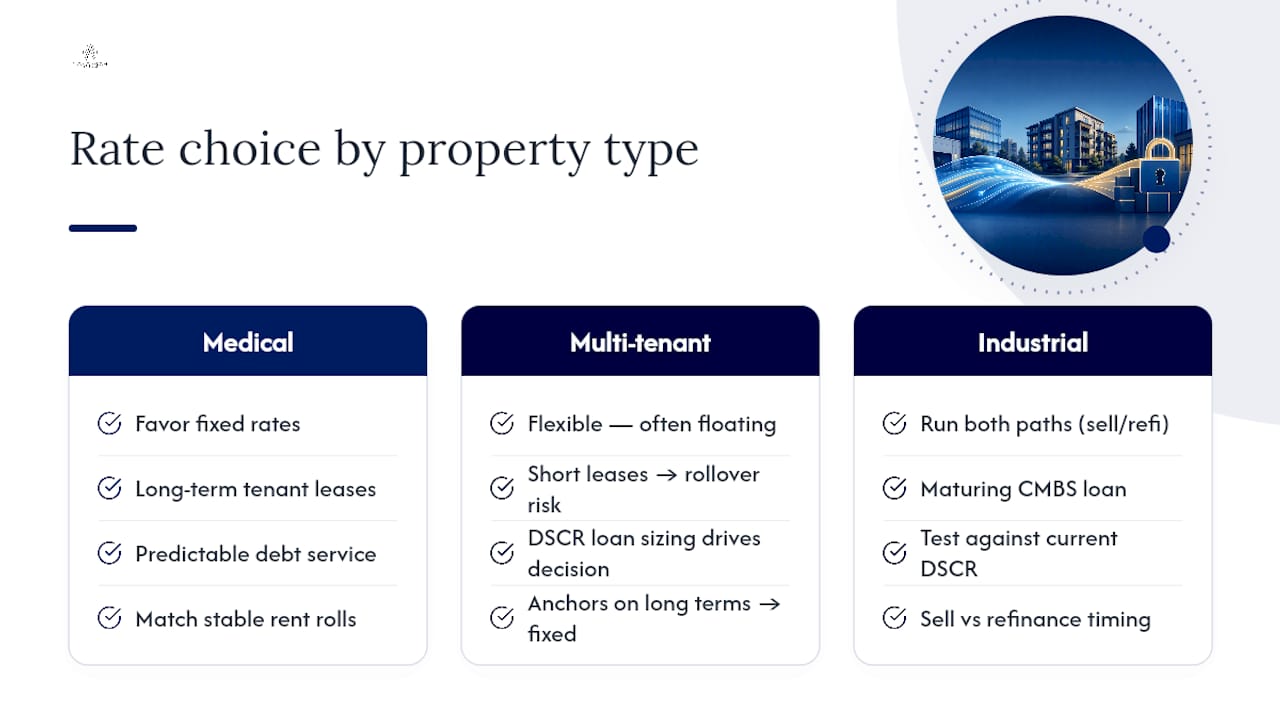
Medical office buildings with long-term tenant leases favor fixed rates, since stable rent rolls pair naturally with predictable debt service. Multi-tenant office owners weighing a DSCR loan sizing should let lease term length drive the decision: shorter leases with rollover risk argue for floating flexibility, while anchor tenants on long terms argue for fixed. Industrial owners facing a sell-versus-refinance choice on a maturing CMBS loan should run both paths against current DSCR before committing, since a multi-tenant structure often changes the answer entirely.
How Rate History Shapes the Fixed vs Floating Decision
The Fed held its benchmark rate near zero for most of the 2010s, which made floating rates attractive for years with almost no downside. That changed sharply starting in 2022, when the Fed raised the fed funds rate at the fastest pace in decades to fight inflation. Borrowers who had floating exposure going into that cycle watched payments climb fast, while those who had locked fixed rates in 2020 or 2021 rode out the increases untouched.
That episode is the clearest real-world lesson in this entire topic: floating rates work well during easing or flat cycles and turn painful fast during aggressive hiking cycles. The reverse is also true. Borrowers who locked in fixed rates during the peak of a hiking cycle overpaid once the Fed eventually cut, unless they refinanced.
Commercial borrowers watching the current environment need to track two things: where the Fed funds rate sits relative to its long-term average, and whether inflation data suggests more hikes, a pause, or cuts ahead. A lender’s floating quote is essentially a bet on where that path goes. A fixed quote is the lender charging you to remove that bet from your side of the table entirely.
None of this means one structure “wins” in a specific era. It means the fixed-vs-floating decision should never be made in isolation from where you are in the broader rate cycle at the time you sign.
How Credit Scores and Borrower Profiles Change Your Options
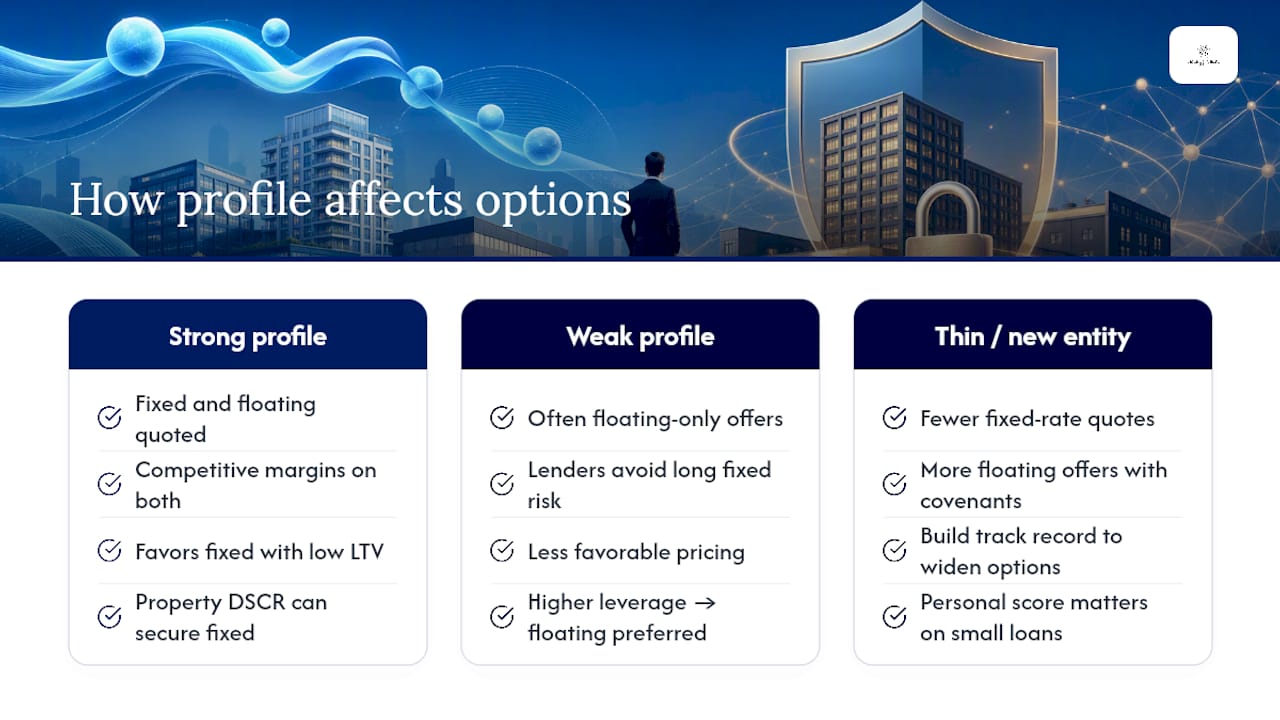
Your credit profile doesn’t just affect your rate. It affects which rate structures you’re even offered. Borrowers with strong credit, healthy debt service coverage, and clean financials typically get quoted both fixed and floating options with competitive margins on each. Weaker borrower profiles often see floating-only offers, since lenders don’t want to commit to a fixed long-term rate on a credit risk they’re uncertain about.
Personal credit score matters most for smaller commercial loans and SBA-backed products, where the borrower’s individual financial history still factors into underwriting. On larger CRE term loans, the property’s own financial performance, measured through DSCR, tends to matter more than the borrower’s personal score. A property throwing off strong, stable net operating income can qualify for fixed-rate treatment even if the sponsor’s personal credit is mixed, because the asset itself is what’s securing the debt.
Loan-to-value ratio plays into this too. Lower leverage generally opens up more favorable fixed-rate pricing, since the lender has more of a cushion if the borrower defaults. Higher leverage deals often get pushed toward floating structures with tighter covenants, since the lender wants more flexibility to reprice risk if the borrower’s situation deteriorates.
If you’re a borrower with a thinner credit file or a newer entity, expect fewer fixed-rate quotes and more floating offers loaded with covenants. Building a track record with a lender, even a short one, tends to widen your options considerably on the next deal.
Tax and Accounting Differences Between Fixed and Floating Rates
Interest paid on both fixed and floating commercial loans is generally deductible as a business expense, so the tax treatment of the interest itself doesn’t differ much between the two structures. Where the real difference shows up is in accounting for the debt instrument and any hedges attached to it.
Fixed-rate loans are straightforward on the books. The interest expense is predictable and booked evenly, with no valuation adjustments needed over the life of the loan.
Floating-rate loans get more complex, especially once hedging enters the picture. If you use an interest-rate swap to convert floating exposure into a synthetic fixed rate, that swap is a derivative instrument subject to its own accounting treatment, generally marked to market and requiring separate valuation on financial statements. Businesses using swaps often apply hedge accounting to reduce the earnings volatility that mark-to-market swings would otherwise create, but that requires specific documentation at the time the hedge is put in place, not after the fact.
Talk to your accountant before choosing a rate structure on any loan large enough that a swap or cap might come into play. The interest deduction is simple either way, but the instruments used to manage floating-rate risk carry accounting requirements that fixed-rate loans simply don’t have.
An Advisor’s Take on Locking Versus Staying Flexible
For most CRE owners with stable, long-leased assets, locking in a fixed rate removes a variable you can’t control anyway. Ardorcre generally steers clients toward hedging with a cap rather than staying fully exposed when the hold period stretches past five years and the underlying asset can’t absorb a payment shock.
— Jim
How Ardorcre Helps You Size the Right Rate Structure
If you’re weighing whether to sell, refinance, or restructure a maturing CMBS loan on a medical office, multi-tenant office, or industrial property, the fixed-versus-floating decision usually comes down to your DSCR headroom and lease rollover schedule. That’s a harder call to make alone than most owners expect, especially with a CMBS loan approaching maturity and a lender quoting terms that assume you already know your breakeven math.

Our advisors work directly with owners on these kinds of decisions. Our advisors help you run the DSCR numbers against both a refinance and a sale scenario, so you’re not guessing which path protects your cash flow better. Start with our DSCR loan sizing guide to see how lease terms and coverage ratios should shape your rate choice, then reach out through our contact page to walk through your specific property with an advisor who handles medical office, multi-tenant, and industrial deals across the Charlotte market every week.
Sources
- How to price fixed vs. floating-rate loans | SouthState Correspondent
- Fixed Versus Floating: The Great Income Debate | Morningstar
- Fixed-rate mortgage basics | Rocket Mortgage