
When a commercial lease says your renewal rent will be “fair market rent,” nobody has agreed on a number yet. The clause only promises a method for finding one. In Charlotte, North Carolina, that method, and the wording behind it, decides whether you renew at a reasonable rate or end up in a dispute as your term runs out. This guide explains how fair market rent renewals work for office, medical and retail tenants and their landlords, what to put in the lease, and how to negotiate when the numbers diverge.
One point first, because search results mix two unrelated topics. HUD’s “Fair Market Rents” are a housing-voucher tool. They have nothing to do with the renewal clause in your office or medical lease. We explain the difference below.
TL;DR
- Fair market rent in a commercial renewal means what a comparable space would lease for on the open market at renewal. It is an interpretation, not a published figure, and the lease language controls how it is found.
- HUD Fair Market Rents are a housing-assistance benchmark, not a commercial lease benchmark.
- North Carolina has no cap on commercial rent increases, so your renewal rent is whatever the lease and contract law say it is.
- Define comparables, treatment of tenant improvements, concessions, deadlines and a tie-break process (such as appraisal or baseball-style arbitration) before you sign.
- Start the process well before your notice deadline. A missed window can cost you the option itself.
Table of Contents
- What fair market rent means in a commercial renewal
- Not the same thing: HUD Fair Market Rents
- North Carolina has no cap on commercial renewal rent
- What the Charlotte market says about your leverage
- How fair market rent is actually determined
- The terms to define in the lease
- Step by step: running a renewal
- A worked example
- Our perspective
- Get help with a renewal or lease review
- FAQ
- Sources
What fair market rent means in a commercial renewal
A renewal option is the tenant’s right to extend the lease for a set period, usually by giving written notice inside a defined window. The option answers whether you can stay. The rent clause answers what you pay. Many leases give the tenant a generous renewal right and then leave the rate vague, or tie it to “then-current market rate” with no definition.
Fair market rent (sometimes called fair market rental value) is the rent a willing tenant would pay and a willing landlord would accept for comparable space, in a comparable building, for a comparable term, at the time of renewal. Every word in that sentence is open to argument. Legal commentators at Dentons note that clients often treat fair market rent as an objective truth when it is really subjective, and they advise spelling out the valuation terms, for example whether improvements the tenant paid for count toward the value, to avoid costly litigation.
Why enforceability matters
A renewal that says only “rent to be agreed” can be treated as an unenforceable agreement to agree. According to the same Dentons paper, an option is on firmer ground when it contains both a clear formula, such as fair market rent, and the procedural machinery to resolve a disagreement, such as a mandatory appraisal or arbitration process. If you are a tenant who has invested in a buildout, that machinery is what protects your right to stay. If you are a landlord, it is what keeps a renewal from stalling and leaving the space in limbo.
Not the same thing: HUD Fair Market Rents
The top search results for this phrase are largely about HUD. HUD’s Fair Market Rents are estimates of the 40th percentile of rents paid by recent movers in a housing market, and they feed programs such as the Housing Choice Voucher program and certain expiring project-based Section 8 contracts. They are calculated for residential assistance programs, using survey data with a built-in lag.
They are not a benchmark for a dental suite in Ballantyne, a retail bay in South End or a flex warehouse near the airport. If your lease or your landlord’s proposal cites HUD figures for a commercial renewal, ask what that has to do with comparable commercial space. The honest answer is usually nothing.
North Carolina has no cap on commercial renewal rent
Tenants sometimes assume some rule limits how far rent can rise at renewal. In North Carolina, it does not. There are no state-level statutory caps on the amount or frequency of commercial rent increases, and rent changes are governed by the written lease and general contract law. Local rent control is also off the table: a summary of NCGS 42-14.1 for Mecklenburg County says the statute preempts local rent control statewide, so Charlotte and Mecklenburg County cannot cap increases.
The practical consequence: the only protection you have is the one you negotiate into the lease. If the renewal clause is vague, the landlord’s opening number is the only number on the table. For ways to build a ceiling into the lease itself, see our guide on drafting CPI rent clauses that avoid rent spikes in office and medical leases.
What the Charlotte market says about your leverage
Fair market rent is driven by the market you are actually in, and Charlotte is split. A Charlotte market report for Q2 2026 put office vacancy at 22.9% with an asking effective rent of $25.51 per square foot, and industrial vacancy at 11.5% with annual rent growth of 1.2%. The same report noted positive net absorption, so office demand is stabilizing even with a lot of empty space.
What that means for a renewal depends on what you occupy:
- Older or mid-size office space. High vacancy generally gives tenants a credible alternative. A landlord facing a 23% vacant market has a real cost if you walk, and a landlord turnover checklist shows how many steps and weeks sit between a departing tenant and a re-leased suite.
- Prime Class A space. Quality buildings tend to hold rent better than the metro average, so a market-wide vacancy figure may overstate your leverage.
- Industrial. Charlotte’s industrial market has moved toward a more balanced phase as leasing demand improves, though new supply is still pressing on fundamentals. Large, modern distribution space is leading the recovery, so smaller or older bays may price differently.
- Medical office. Buildouts for plumbing, imaging, sterilization and cabinetry are expensive to replicate, which raises the cost of moving for the practice and changes the negotiation. See our look at Charlotte medical office demand for the investor side of that picture.
For submarket detail, our Charlotte office market analysis and submarket guide are the right next reads.
How fair market rent is actually determined
Most leases use one of a few methods. Each has trade-offs.
| Method | How it works | Best for | Watch out for |
|---|---|---|---|
| Direct negotiation | Parties exchange numbers using broker opinions and comparables | Smaller spaces, good relationships | No tie-break if you disagree |
| Single appraiser | One agreed appraiser sets the rent | Speed and low cost | Disagreement on who to pick |
| Three-appraiser panel | Each side names an appraiser; the two choose a third | Larger or higher-stakes deals | Time and cost |
| Baseball-style arbitration | Each side submits a final number; the arbitrator must choose one | Keeping both sides realistic | Risk of losing outright if your number is off |
Practitioners often favor baseball-style arbitration because it pushes each side toward a reasonable figure. In the approach described by Thompson Coburn, the arbitrator must pick one party’s final offer rather than split the difference. An inflated ask is no longer a harmless opening move, because it can lose.
The deadline problem
The most common failure is timing. The same Thompson Coburn guide points out that when a lease fails to set clear deadlines for the appraisal process, the parties can reach the start of the renewal term without a resolved rent figure. By then the tenant is already in the space, often paying an interim rent while the argument continues. Set dates for exchanging opinions, naming appraisers, delivering reports and resolving ties, and say what rent is paid in the meantime and whether it is trued up afterward.
The terms to define in the lease
When we review a renewal clause, these are the items that decide the outcome more than the phrase “fair market rent” itself:
- Comparable space. Specify building class, size range, location and age. Quality and type matter more than distance. A guide to selecting comps published by the University of California real estate services office shows that amenities, security and tenant improvement allowances must be accounted for, or the valuation drifts and can derail the renewal.
- Effective rent, not just face rent. A comp with a low face rate and a large improvement allowance or free rent is a different deal from one with a higher rate and nothing else. The comp worksheet should reflect tenant improvement cost, tenant-paid expenses and concessions.
- Tenant-paid improvements. State whether the value of your buildout is excluded. Without that, you can end up paying rent on improvements you funded.
- Lease structure. Compare like with like: gross, modified gross or triple net. Our triple net lease guide and CAM charge review explain how operating costs shift the real number.
- Term and concessions. A five-year renewal and a ten-year renewal price differently. Decide whether the market comparison assumes allowances, free rent or a refresh of the space.
- Appraiser qualifications. Require commercial appraisers or brokers with experience in your property type and in the Charlotte market.
- Process and timing. Fix notice dates, response windows, who pays for the appraiser, and what happens if someone misses a step.
One caution for tenants: renewal options are generally enforced strictly. The notice window and method in the lease are conditions of the option. Calendar the date, send notice the way the lease requires, and have your attorney confirm it. We are brokers, not your lawyer, and anything touching enforceability belongs with a North Carolina real estate attorney.
Step by step: running a renewal
For tenants
- Read the clause 12 to 18 months out. Find the notice window, the definition of market rent and the dispute process.
- Abstract the lease. Pull the renewal terms, rent steps, CAM caps and holdover provisions into one page. Our lease abstract guide shows the format.
- Build your own comp set. Gather recent deals in similar buildings, convert to effective rent, and note concessions.
- Model your alternatives. Price a move, including buildout, downtime and moving cost, against the renewal. Our 120 day renewal strategy walks through an NPV approach for medical and office tenants.
- Give notice correctly, then negotiate. Exercise the option on time and in the required form before you debate the rate.
- Avoid holdover. Staying past expiration without a signed renewal can trigger steep penalties. See holdover rent in office and medical leases.
For landlords
- Open the conversation early. Tenant retention is cheaper than lease-up. Our NPV-based tenant retention piece shows how to weigh a concession against vacancy.
- Document comps by effective rent. A proposal that shows its math is far harder to dispute.
- Respect the process in the lease. If the lease calls for appraisal, a landlord who skips it invites a challenge.
- Estoppel and diligence. If you are selling or refinancing, buyers and lenders will test the renewal terms. Review what an estoppel certificate should confirm.
A worked example
Imagine a dental practice in a 3,000-square-foot suite with a five-year renewal at fair market rent. The landlord proposes $32.00 per square foot on a triple-net basis. The practice’s broker finds three recent comparable deals: one at $30.00 with a $15 allowance, one at $31.50 with no allowance, and one at $29.00 with two months free. These figures are illustrative, not market data.
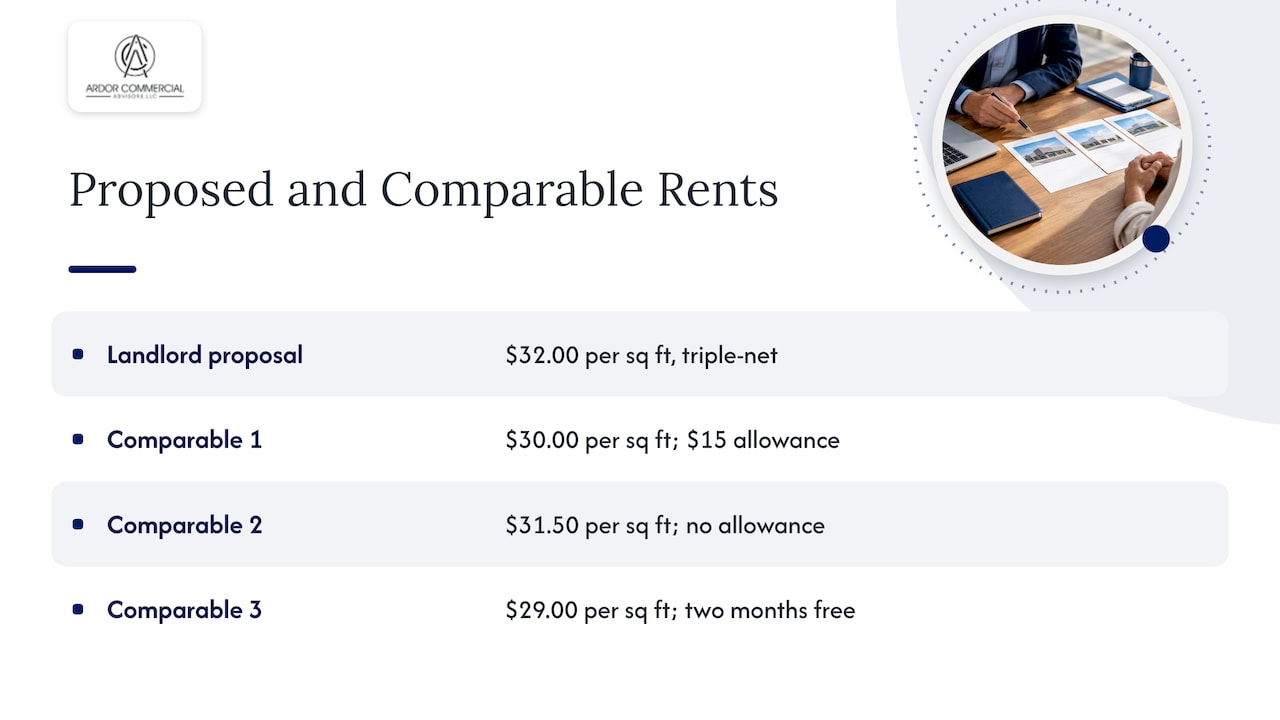
On face rent alone, the landlord’s number looks close. Once you convert to effective rent, the comps with concessions land lower. If the lease excludes the value of the practice’s own plumbing and cabinetry, the landlord’s number has to come down further, because part of what makes the suite attractive was paid for by the tenant. That is the whole negotiation: not who guesses a number first, but whose comps and definitions survive scrutiny.
Our perspective
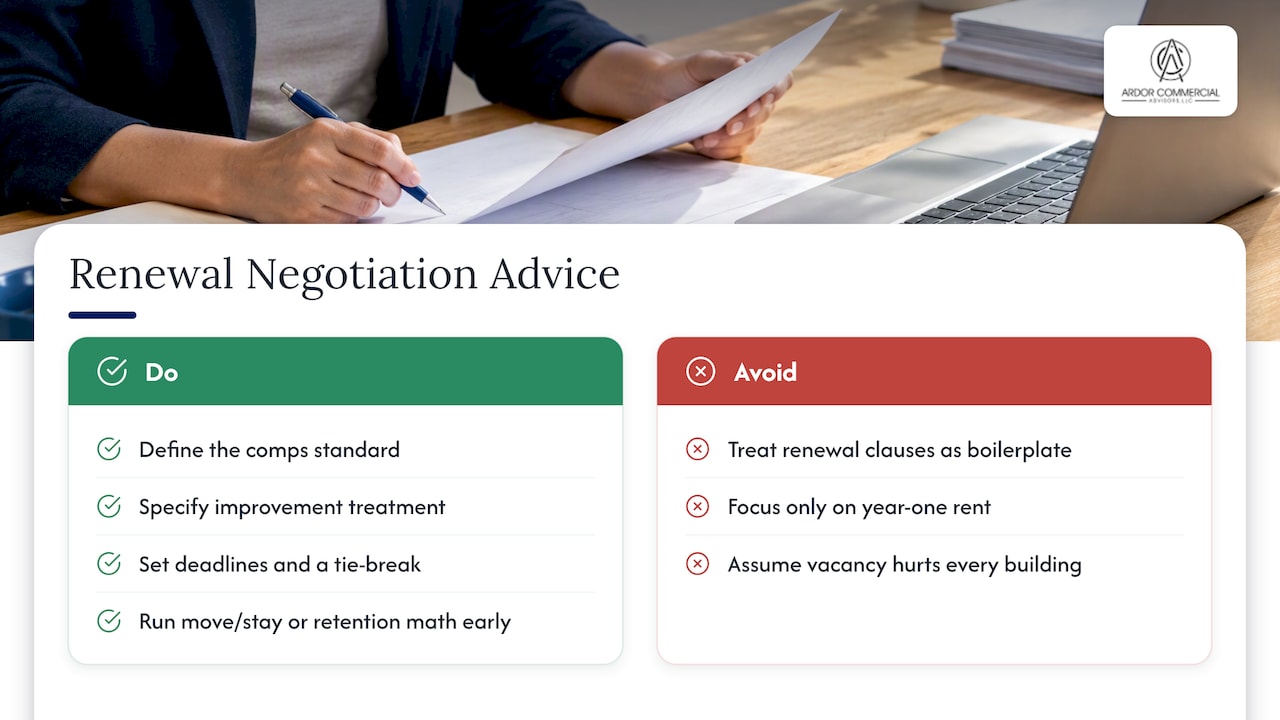
We see renewals go wrong in the same few ways. A clause sounds balanced and then fails at the moment of use because it never said what a comparable is, who decides or by when. Medical and office tenants in particular tend to focus on the rent number in year one and treat the renewal clause as boilerplate. Landlords, for their part, sometimes assume that high Charlotte office vacancy hurts them everywhere, when a well-located, well-maintained building can hold its ground.
Our advice is to treat the renewal clause as a pricing negotiation you are having today for a decision you will make years from now. Write down the comps standard, the treatment of improvements, the deadlines and the tie-break. If you are the tenant, run the move-versus-stay numbers before you talk to the landlord, not after. If you are the landlord, decide what a retained tenant is worth against downtime and concessions. We advise on both sides of these deals, and the best outcomes come when both parties can see the same math.
— Jim
Get help with a renewal or lease review
If you have a renewal coming up, we can review the lease language, analyze comparables and represent you in the negotiation. Our team handles tenant representation, lease review and CAM reconciliation analysis and landlord-side advisory across the Charlotte area. See all of our commercial real estate services or contact us through Ardorcre.
FAQ
How does a commercial rent renewal work?
The tenant exercises a renewal option in writing within the notice window in the lease. The rent for the new term is then either fixed by a schedule in the lease or set by a formula such as fair market rent. If the parties cannot agree on a formula-based rent, the lease’s appraisal or arbitration process decides it.
Can a Charlotte landlord raise rent as much as it wants at renewal?
Generally, yes, unless the lease limits it. North Carolina has no statutory cap on commercial rent increases, and local governments are barred from adopting rent control. Any limit, such as a fixed step, a CPI cap or a market-rent definition with a dispute process, has to come from the lease.
Do HUD Fair Market Rents apply to my office or retail lease?
No. HUD publishes them for housing assistance programs, and they estimate the 40th percentile of residential rents. A commercial renewal should rely on comparable commercial deals, adjusted for concessions and building quality.
What if the lease says only “market rent” with no process?
That is a weak position for both sides, because a clause without a formula and a procedure may be hard to enforce. Talk to a North Carolina real estate attorney before the notice deadline, and consider negotiating an amendment that defines comps, timing and a tie-break method.
Sources
- Appraisals for commercial lease extensions: a step-by-step guide, Thompson Coburn LLP
- Simplifying the Arbitration Process for Renewal or Extension Rent, Dentons
- What’s a Good Comparable, University of California Office of the President
- Calculation of HUD Fair Market Rents, HUD USER
- Market Momentum, April 2026
- Charlotte industrial market report, Q2 2026, Savills
- Commercial Rent Increases in NC, Landager