
An exclusive agency listing gives one broker the right to market your property, but you keep the right to sell it yourself. You pay no commission if you find the buyer. It usually suits sellers who already have a likely buyer lined up, own the deal-making experience to run a sale, or want leverage over commission cost. For most sellers, though, the tradeoff in agent motivation outweighs the savings. Keep reading to see exactly how it differs from the far more common alternative.
TL;DR:
- An exclusive agency listing allows sellers to avoid paying a commission if they find their own buyer, but brokers may invest less effort due to the lack of guaranteed payment.
- The main difference from an exclusive right-to-sell is that the broker earns a commission only if they or the seller do not supply the buyer, impacting marketing quality.
- This setup benefits sellers with known buyers or deal experience, but often results in reduced broker marketing efforts and lower buyer reach.
- Contract terms generally include 3 to 6 months duration, with a 30 to 90-day tail period, and should specify how buyer introductions are documented.
- Negotiations should demand detailed marketing schedules, written documentation of buyer leads, and shorter tail periods to protect seller interests.
Table of Contents
- Exclusive Agency Listing vs. Exclusive Right-to-Sell: What Actually Changes
- The Real Tradeoffs: What You Save, What You Risk
- How This Changes Agent Behavior, Marketing Effort, and Buyer Reach
- Contract Mechanics: Duration, Termination, and Protection Clauses
- When Exclusive Agency Actually Makes Sense for You
- Negotiating an Exclusive Agency Agreement: What to Ask For
- What We Tell Sellers and Investors Weighing This Option
- Get Help Reviewing or Structuring Your Listing Agreement
- Primary Sources and Further Reading
- Sources
Exclusive Agency Listing vs. Exclusive Right-to-Sell: What Actually Changes
The whole distinction comes down to one question: who gets paid, and when? Under an exclusive agency listing, you hire one broker to represent the property, but you retain the right to sell it yourself without owing that broker a dime. Find your own buyer, an old colleague, a neighbor, a former tenant, and the commission simply doesn’t trigger.
Under an exclusive right-to-sell agreement, the far more standard arrangement, the listing broker earns a commission no matter who produces the buyer, even you. That single difference in the commission trigger is the entire reason the two contracts feel so different in practice.
A few related terms get confused with this compensation question, but they’re not the same thing:
- Office exclusive: the listing stays inside one brokerage and isn’t shared on the open market. That’s a marketing decision, not a payment structure.
- MLS withholding: temporarily keeping a listing off the MLS. Also a marketing choice, unrelated to who owes commission.
- Exclusive agency: purely about compensation. Who pays, and under what conditions.
The Real Tradeoffs: What You Save, What You Risk
The appeal is straightforward math. Say your property sells for $850,000 and a typical full-service commission runs 5% to 6%. If you personally bring the buyer under an exclusive agency deal, you could avoid paying that fee entirely, a swing of $42,500 to $51,000 kept in your pocket instead of split between brokers.

Pro Tip: Run that math before you sign anything. If you don’t have a realistic lead on a buyer already, the savings are theoretical and the marketing risk is not.
Here’s what you’re weighing:
- Upside: real commission savings if you supply the buyer, plus leverage to negotiate a lower overall rate since the broker’s guaranteed payout is smaller.
- Downside: brokers without a guaranteed commission tend to invest less time, ad spend, and priority into your listing, since exclusive agency deals are uncommon and agents often deprioritize them.
- Who accepts these terms: sellers with an active professional network, owner-operators of investment property, or agents newer to the business who are willing to take on the risk in exchange for a shot at the listing.
Sellers who already know a buyer often do fine here. Sellers hoping for broad market exposure usually don’t.
How This Changes Agent Behavior, Marketing Effort, and Buyer Reach
Compensation structure shapes broker priorities more than most sellers expect. A broker with a guaranteed fee under exclusive right-to-sell has every reason to spend on professional photography, paid promotion, and open houses. Take that guarantee away, and the calculation shifts.
Agents working exclusive agency listings commonly pull back on:
- Paid advertising and premium listing placement
- Broker open houses and networking pushes to other agents
- Proactive follow-up with prospective buyers who tour the property
None of that is spite. It’s risk management on the broker’s part, and it’s a documented pattern in how exclusive listings tend to perform compared to standard agreements.
You can push back on this. Ask for a co-broke compensation offer in the MLS so cooperating agents outside your brokerage still have a reason to bring buyers, and get a written marketing schedule with dates attached, not vague promises.
Pro Tip: A small cooperating broker fee listed in the MLS keeps outside agents engaged even when your own listing broker has less skin in the game.
Contract Mechanics: Duration, Termination, and Protection Clauses
Most exclusive agency agreements run for a set term, and you should know exactly what that term commits you to before signing.
- Duration: most listing agreements run 3 to 6 months, with some brokers pushing for longer terms and sellers usually able to negotiate shorter ones.
- Protection or tail periods: a clause that keeps you liable for commission for a set window (often 30 to 90 days) after the contract ends, if the buyer was introduced during the listing term. Ask exactly how “introduced” gets proven.
- Termination language: look for what counts as nonperformance, missed marketing deadlines, no MLS entry, no showings, and what evidence triggers your right to walk early.
- MLS/office-exclusive language: confirm this section separately from the compensation section. They’re often addressed in different parts of the same document, and conflating them is how sellers get surprised later.
When Exclusive Agency Actually Makes Sense for You
This model fits a narrow slice of sellers well. It fits most sellers poorly.
- You already have a buyer, a relative, a tenant looking to purchase, a business partner. If a sale is basically pre-arranged, exclusive agency lets you formalize it while still having professional backup.
- You have deal experience, meaning you’ve bought or sold property before and understand contracts, disclosures, and negotiation well enough to run part of the process yourself.
- You need broad exposure or a fast sale. If neither applies, you’re better served by exclusive right-to-sell or a full-service agreement at a negotiated rate.
Ask yourself three questions before choosing this path: Do you have a specific, named buyer in mind right now? Have you sold property directly before, without an agent doing all the legwork? Are you comfortable if the listing gets less marketing attention than a standard deal? Two or more “no” answers point away from exclusive agency.
Negotiating an Exclusive Agency Agreement: What to Ask For
Walk into the listing conversation with specific asks, not vague concerns.
- Request a written marketing plan with dates: photography, MLS entry, showing schedule, ad spend, and open house count.
- Cap the protection or tail period at 30 to 60 days, and require it to only apply to buyers documented through dated showing records or written introductions, not verbal claims made after the fact.
- Ask your agent directly: What happens if I bring my own buyer mid-contract? How will you document buyer introductions? What’s your marketing budget for this listing specifically? How many similar exclusive agency deals have you closed?
Pro Tip: Get buyer introductions in writing as they happen, dated emails, recorded showing logs, not reconstructed after a dispute starts. Documenting introductions protects both sides.
If the answers feel thin, ask about a short-term exclusive right-to-sell instead, sometimes 60 to 90 days at a negotiated lower rate. You get guaranteed agent effort with less commitment than a standard six-month deal, and commission rates themselves are always negotiable, regardless of which agreement type you choose.
What We Tell Sellers and Investors Weighing This Option
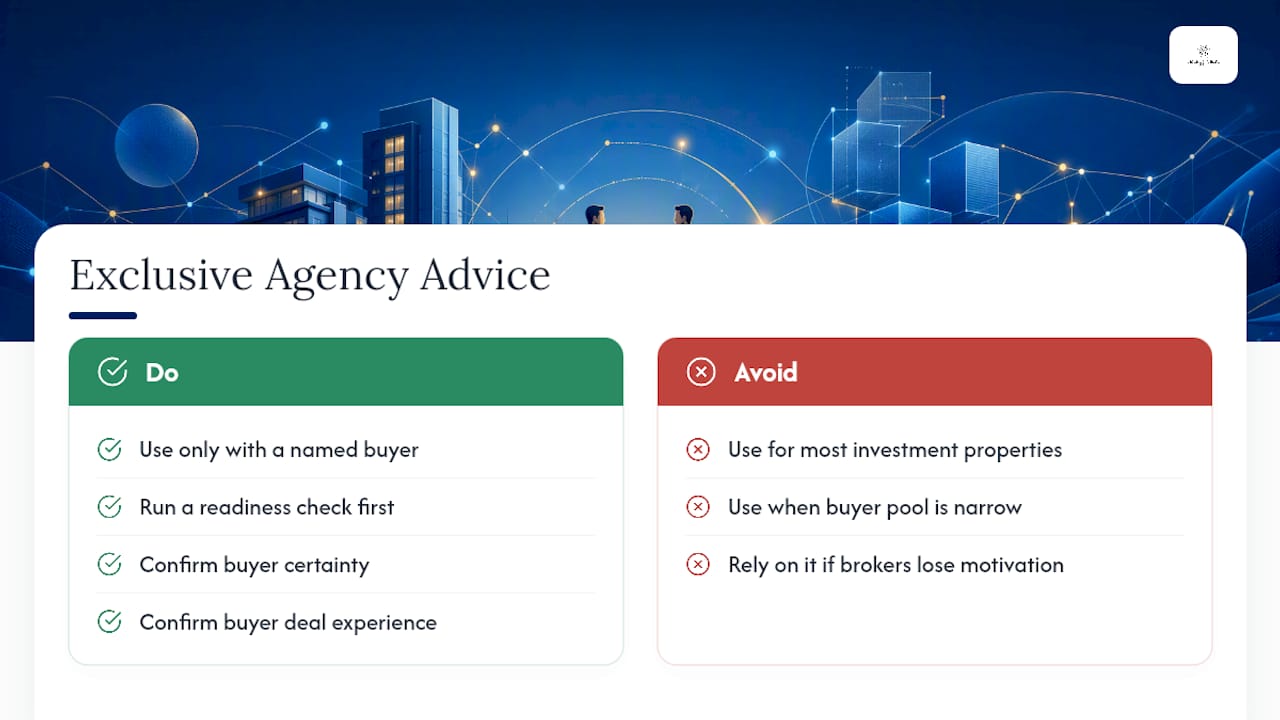
Exclusive agency is rarely recommended for owners of investment or commercial property because buyer pools for medical office, retail, and industrial assets tend to be narrower and more relationship-driven than residential, so losing broker motivation can cost more than it saves.
We do recommend it when a seller has a documented, named buyer already at the table. Our advisors walk sellers through a short readiness check: buyer certainty, deal experience, and timeline pressure, before recommending any contract structure. Our company background covers how we approach this work across the Charlotte MSA.
— Jim
Get Help Reviewing or Structuring Your Listing Agreement
If you’re weighing an exclusive agency listing against a full-service agreement, this is the kind of contract-level decision that commercial real estate advisors typically handle. Such advisors review draft listing language, flag protection clauses that run longer than they should, and help negotiate marketing deliverables before signing, not after a dispute starts.
An engagement typically starts with a conversation about your property, your timeline, and whether you’re leaning toward a sale, a refinance, or holding and leasing instead. From there we can walk through comparable deal terms, help structure buyer-introduction documentation, or connect you with our team’s broader advisory services, including guidance on DSCR loan sizing for owners weighing a sale against refinancing an income-producing property. If contract review is what you need first, our lease abstract resource shows the level of document detail we bring to every engagement. Reach out and tell us where you are in the process, we’ll tell you straight whether exclusive agency fits your situation or not.
Primary Sources and Further Reading
The definitions and figures in this article draw directly from a handful of sources worth reading in full if you want the underlying legal language. The NAR consumer guide on listing agreements covers how exclusive agency and exclusive right-to-sell are structured at the national level, including documentation practices for buyer introductions.
For the specific legal distinction between the two contract types, UpCounsel’s breakdown walks through the commission trigger in plain language. On contract duration and glossary definitions, the Brown Firm’s legal glossary entry is a solid reference for typical term lengths. Finally, List With Clever’s practitioner-level article covers why these agreements remain uncommon and what that means for the level of service you can expect.
Sources
- Consumer guide: listing agreements — NAR
- Difference between exclusive right to sell and exclusive agency — UpCounsel
- Exclusive agency listing agreement — Brown Firm
- What Is an Exclusive Agency Listing in Real Estate? — List With Clever