
Most commercial leases don’t hand tenants a unilateral right to walk away early. Absent an express break clause, ending one usually means negotiating a surrender or assignment, or facing damages for the remaining rent, reduced by whatever the landlord recovers from a replacement tenant. The cost is real, but it’s almost always negotiable, and often less than the total rent left on the lease.
TL;DR:
- Exercising a break clause requires strict compliance with notice timing, delivery method, and default resolution to avoid invalidation by courts.
- Without a break clause, tenants often negotiate surrender, assignment, or sublease options, with leverage influenced by financial strength and market conditions.
- Damages for lease breakage typically include remaining rent, unamortized TIA and commissions, and re-leasing costs, often subject to negotiation.
- Proper service of a termination notice, including written proof and legal review, is crucial to prevent technical invalidations and costly disputes.
- A lease abstract and professional review help tenants accurately quantify exposure and develop effective negotiation strategies before approaching landlords.
Table of Contents
- Common grounds and contractual paths for ending a commercial lease
- How to exercise a break clause without blowing it
- What if there’s no break clause? Surrender, assignment, or sublease
- How landlords calculate damages, and what mitigation actually means
- Notice, service, and strict compliance: avoid the pitfalls that kill a termination
- A negotiation checklist for tenants seeking an early exit
- How Ardorcre helps tenants and landlords navigate a lease exit
- What tenants get wrong about early termination
- Get a lease review before you approach your landlord
- Sources
Common grounds and contractual paths for ending a commercial lease
Whether you have any leverage to exit early depends entirely on what your lease actually says. A break clause (also called an early termination clause) gives you a contractual right to end the lease before its natural expiration, but almost always with strings attached: a specific notice window, a requirement that you’re not in default, and often a fee.
Outside of a break clause, a handful of other triggers can justify termination:
- Casualty: fire or storm damage that makes the space unusable, though most clauses only allow termination if repairs stretch beyond a set period.
- Condemnation: government seizure of the property through eminent domain.
- Landlord breach: failure to maintain the premises or provide agreed services.
- Constructive eviction: conditions so bad the space is effectively unusable, even without a formal eviction.
Force majeure clauses rarely create a rent-free exit either. They typically excuse delayed performance, not the obligation to pay, unless the lease explicitly ties casualty to a termination right. Breaking a lease for landlord breach is a different legal theory than exercising a break option. One argues the landlord failed first; the other simply exercises a right you already negotiated.
How to exercise a break clause without blowing it
A break clause is only as good as your compliance with its fine print. Courts read these provisions strictly, and a landlord looking to avoid an early exit will hunt for any technical excuse to call your notice invalid.
- Read the clause literally. Who can exercise it (tenant only, or also guarantors)? What’s the exact notice window? Are there conditions like vacant possession or “no outstanding breach”?
- Use the exact notice method specified. If the lease says certified mail or courier to a named address, that’s what you use. Don’t substitute email unless the lease allows it.
- Clear any defaults first. Outstanding rent, unpaid CAM charges, or unresolved violations can void your break rights even if your notice timing is perfect.
- Confirm vacant possession requirements. Some clauses require the space empty and broom clean by the break date, not just notice given.
The most common failure points are late notice, notice sent to the wrong address or by the wrong method, and defaults left unresolved at the time of service. Courts have repeatedly voided break attempts over these exact technicalities.
Pro Tip: Pull your lease abstract and highlight the break clause language six months before your earliest possible exercise date, not six weeks. Notice windows of 180 to 365 days are common, and missing one by a week can cost you the entire option.
What if there’s no break clause? Surrender, assignment, or sublease
Without a contractual exit, a negotiated surrender is usually the most direct path. The landlord agrees to take the space back early, typically in exchange for a lump sum or staged payments, with a signed release closing out both sides’ obligations. This works best when you frame it as a clean economic trade rather than a request for a favor.
Assignment and subleasing are the other main routes:
- Assignment transfers your entire lease to a new tenant, though you often remain secondarily liable unless the landlord agrees to release you.
- Sublease keeps you on the hook as the original tenant while someone else occupies and pays rent, which limits your risk reduction compared to a full release.
- Guarantors frequently stay exposed under either structure unless the termination agreement specifically releases them.
Your leverage here depends heavily on tenant creditworthiness and current market rents. A strong balance sheet and a tight local market for your space type both push landlords toward a faster yes. A broker or tenant representative can materially speed this up by pricing the space accurately and sourcing replacement tenants before you even make your ask.
How landlords calculate damages, and what mitigation actually means
If you break a lease with no contractual right to do so, you’re generally liable for the remaining rent through the end of the term, reduced by whatever the landlord recovers from a new tenant. Landlords also carry a legal duty to mitigate damages, meaning they can’t just let the space sit dark and bill you for the full term. Proving a landlord failed to mitigate is difficult but not impossible, especially if the space sat vacant for months with no visible marketing effort.
Here’s roughly what a landlord’s demand tends to include:
| Damage component | What it covers |
|---|---|
| Remaining base rent | Rent owed through the natural lease expiration |
| Estimated NNN/CAM | Projected common area and operating cost pass-throughs |
| Unamortized TIA | The unrecovered portion of tenant improvement allowance the landlord fronted |
| Leasing commissions | Unamortized broker fees paid on the original deal |
| Re-leasing costs | New broker commissions, concessions, and TIA for a replacement tenant |
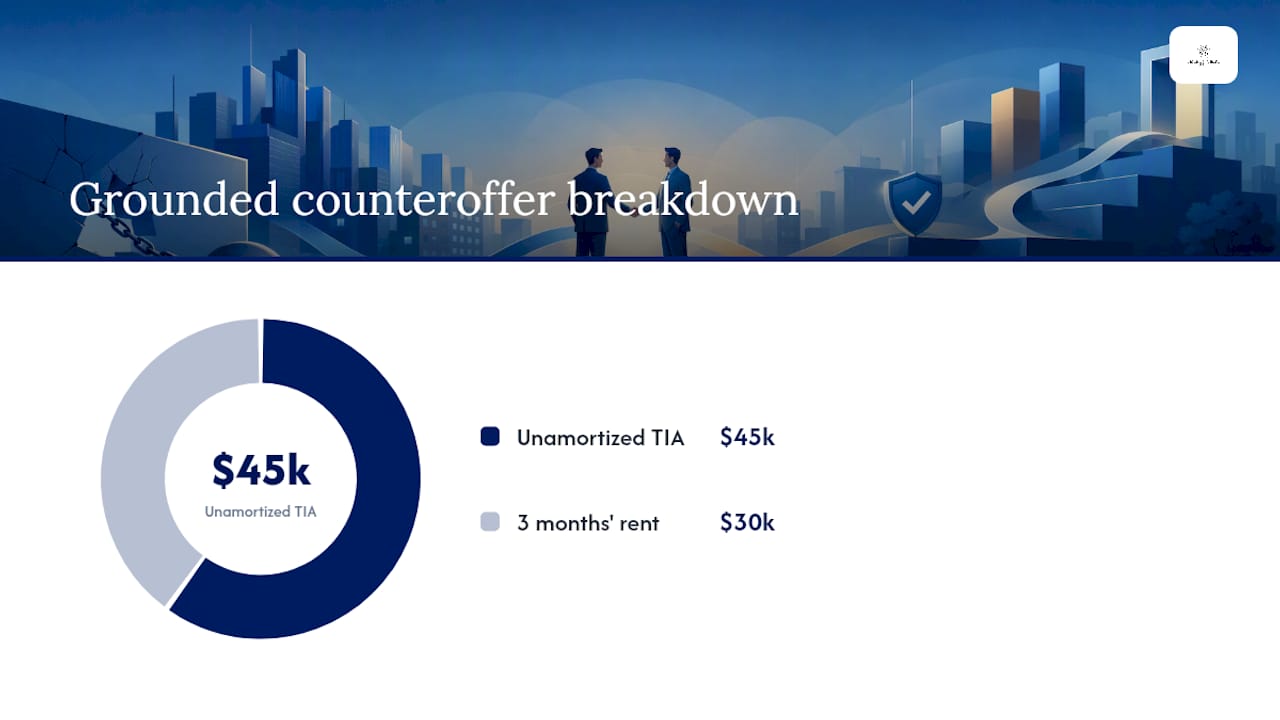
Early termination demands commonly stack unamortized TIA and commissions on top of three to six months of base rent, but negotiated outcomes often land closer to unamortized TIA plus roughly three months’ rent when market conditions support it.
Say a tenant has 30 months left at $10,000 a month base rent, with $45,000 in unamortized TIA and $8,000 in unamortized commissions. A landlord’s opening demand might approach $100,000 or more once NNN and re-leasing costs are folded in. A grounded counteroffer, built on the TIA balance plus three months’ rent, lands closer to $75,000. That gap is exactly where negotiation happens.
Notice, service, and strict compliance: avoid the pitfalls that kill a termination
Getting the substance of your termination right doesn’t matter if the delivery mechanics fail. Courts have thrown out otherwise-valid break notices over nothing more than a wrong delivery method.
- Use certified mail with return receipt, a tracked courier, or hand delivery with a signed acknowledgment. Email alone is rarely sufficient unless your lease explicitly permits it as a notice method.
- Keep a complete paper trail. Save copies of every notice sent, delivery receipts, dated photos of the premises’ condition, and any related emails or letters exchanged with the landlord.
- Loop in counsel before serving a break notice on a high-value lease. A short legal review to confirm your notice tracks the lease’s exact language can prevent a costly technical invalidation later.
A negotiation checklist for tenants seeking an early exit
Walking into a landlord conversation prepared changes the entire tone of the discussion. Before you make an offer, gather:
- Your full lease file, including any amendments and the original TIA and commission figures.
- Current market rent for comparable space in your submarket.
- A realistic estimate of vacancy downtime the landlord would face without your cooperation.
From there, structure a simple proposal: a specific surrender date, a payment structure (lump sum or staged), and clear release terms for you and any guarantors. Offering to help re-market the space, allow showings during your remaining occupancy, or hand back the premises in clean, move-in condition all give the landlord real reasons to say yes to less money. Quantifying the landlord’s projected loss before you propose a number is what turns a guess into a negotiation.
Pro Tip: Never hand over keys or vacate before the termination agreement is signed. A verbal understanding with a property manager means nothing if the landlord later claims you abandoned the lease without a release.
Insist on a written termination agreement covering the security deposit’s disposition, mutual releases, indemnities, and any environmental or condition-related liabilities. Practice guidance is consistent on this point: a handshake deal without documentation leaves both sides exposed later.
How Ardorcre helps tenants and landlords navigate a lease exit
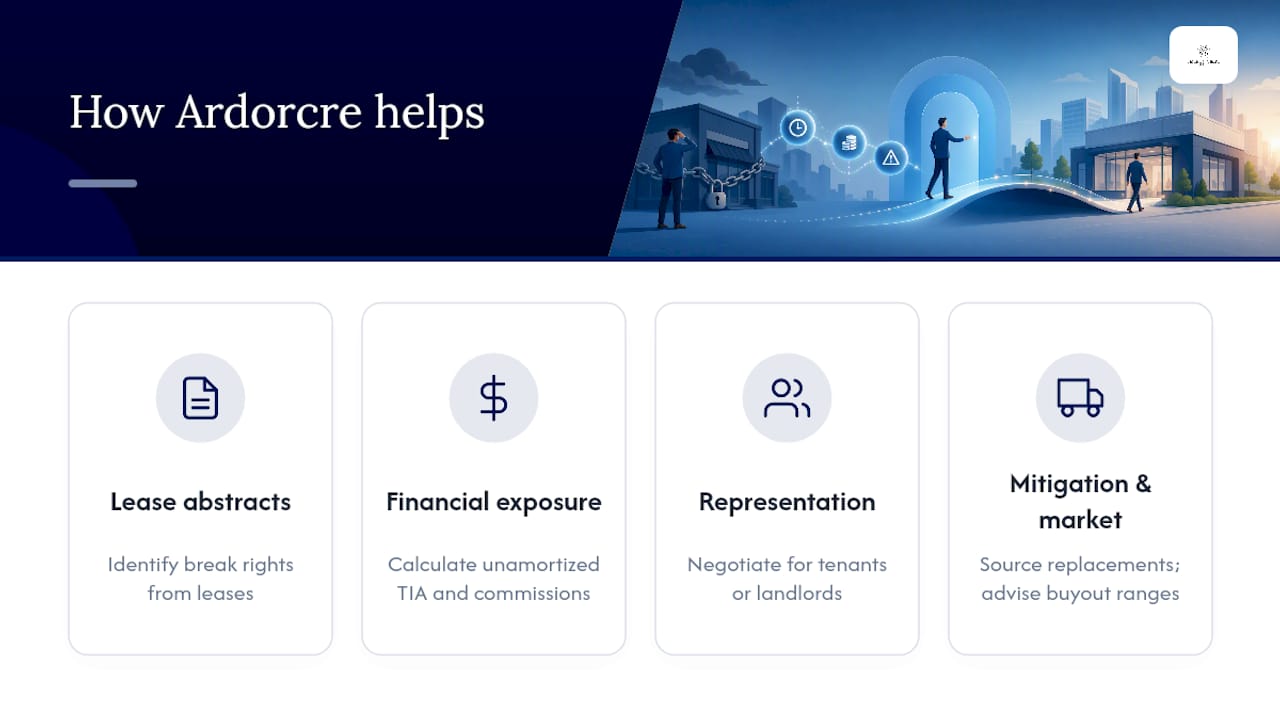
Ardorcre works with tenants and landlords across the Charlotte MSA on exactly these situations, pulling lease abstracts to identify break rights, calculating unamortized TIA and commission exposure, and representing either side through negotiation. That includes sourcing replacement tenants when a sublease or assignment is the better path, and advising on realistic buyout ranges based on current market rents for office, medical, retail, and industrial space.
Simple break clause exercises with no defaults and clean timing are often manageable without outside help. Complex damage disputes, guarantor exposure, or contested mitigation claims usually call for counsel alongside brokerage advice. If you’re weighing an early exit, request a lease review before you contact your landlord, not after.
What tenants get wrong about early termination
Most tenants treat a lease exit as a legal problem first. It’s usually a math problem first and a legal problem second. Quantify your actual exposure, unamortized TIA, commissions, remaining rent net of likely mitigation, before you say a word to your landlord. That number is your entire negotiating position.
A negotiated buyout beats litigation almost every time it’s economically comparable, because certainty has value and legal fees erode any win. Watch guarantor exposure and environmental conditions closely. Both tend to survive a termination agreement that isn’t drafted carefully.
— Jim
Get a lease review before you approach your landlord
Ardorcre gives tenants something a generic legal template can’t: local knowledge of what Charlotte MSA landlords actually accept in a buyout, because our advisors negotiate these deals from both sides of the table.

If you’re sitting on a lease with years left and no clear break right, the smartest first move is a professional lease abstract that flags every notice deadline, TIA balance, and condition buried in your document, before you send anything to your landlord. Request a lease review with Ardorcre and walk into your negotiation with real numbers instead of guesses.
Sources
- Breaking a commercial lease in Texas | JBaker Law Group
- Break free? Not so fast: strict compliance and the hidden traps in commercial lease breaks | Katten
- Early termination clause explained | LeaseLens
- How to terminate a commercial lease – A guide for tenants | Hollander PLLC
- Key considerations for terminating commercial leases: Practical Law Practice Note