
Charlotte’s industrial vacancy rate reached 11.1% in August 2026, against 9.3% nationally, and the construction pipeline is growing. The metro is no longer the tight, landlord-dominated market of 2021 and 2022. It is also not a glut for every building. The number you see depends on who counts it, what size of building you need, and which submarket you are in.
This guide explains what vacancy measures, why published Charlotte figures disagree, what is driving the rate, and how owners, buyers and tenants can use it.
TL;DR
- One tracker put Charlotte industrial vacancy at 11.1% in August 2026, above the 9.3% national rate. Other trackers publish lower figures for the same period because they count different buildings.
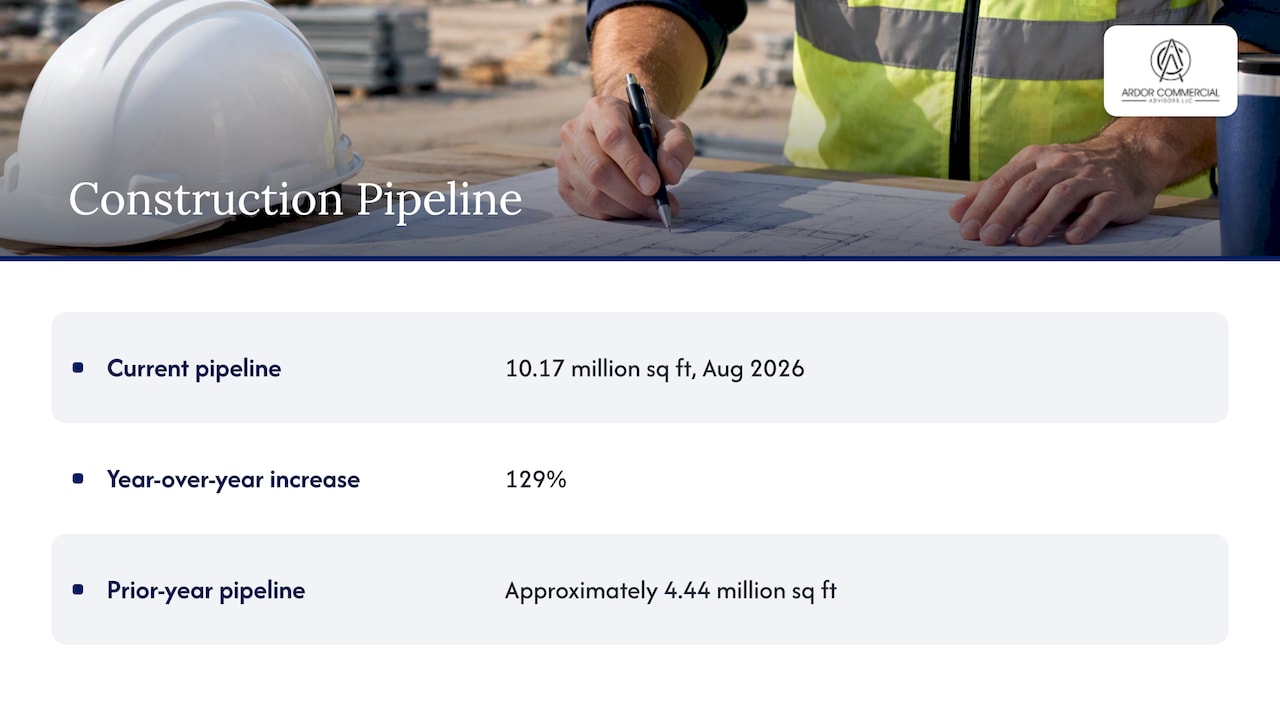
- About 10.17 million square feet was under construction in August 2026, up 129% year over year. New supply is the main pressure on vacancy.
- Vacancy is a metro average. Large new big-box buildings and small, older, well-located bays can behave like two different markets.
- Tenants have leverage on large, new space. Owners of small-bay and infill product still have pricing power. Buyers should underwrite the specific building, not the headline.
Table of Contents
- What vacancy measures, and what it leaves out
- Why Charlotte vacancy figures disagree
- What is pushing Charlotte vacancy up
- Vacancy by submarket and size
- What vacancy means for your position
- Where Charlotte industrial vacancy may go next
- Our perspective
- How Ardorcre can help
- FAQ
- Sources
What vacancy measures, and what it leaves out
The vacancy rate is the share of industrial inventory that is physically empty today. It says nothing about space that is still occupied but already on the market.
That is what the availability rate captures. It includes all space marketed for lease, even if a tenant is still in place. Availability is a forward-looking indicator that typically leads vacancy by two to four quarters. First American’s analysts note that when availability runs above vacancy, vacancy tends to rise as marketed space empties out. When the two rates converge, a market may be near its peak vacancy.
So read both numbers together:
| Measure | What it counts | What it tells you |
|---|---|---|
| Vacancy rate | Space empty right now | Where the market is today |
| Availability rate | All space marketed, occupied or not | Where vacancy is likely headed |
| Net absorption | Change in occupied space over a period | Whether demand is keeping up with supply |
| Under construction | Square feet being built | How much future competition exists |
A rising vacancy rate with a narrowing gap to availability is a very different story from a flat vacancy rate with availability climbing.
Why Charlotte vacancy figures disagree
If you search for the Charlotte industrial vacancy rate, you will find numbers from roughly the high 7% range to 12% for recent quarters. They are not all wrong. Trackers differ in four ways:
- Building set. Some count only buildings above a minimum size, such as 20,000 or 50,000 square feet. Others include small-bay flex product.
- Geography. The Charlotte MSA spans Mecklenburg, Cabarrus, Union, Gaston, Iredell, Rowan and York County in South Carolina. Whether outer counties are in the metro changes the average.
- Space type. Direct vacancy excludes sublease space. Total vacancy includes it.
- Timing. Quarterly reports lag. A monthly figure such as the August 2026 reading is closer to today.
The practical rule: never compare a figure from one source with a figure from another. Pick one source and compare it with its own earlier readings. When a broker quotes you a number, ask what building set it covers.
What is pushing Charlotte vacancy up
A heavy construction pipeline
Developers had 10.17 million square feet under construction as of August 2026, a 129% jump from a year earlier. Much of it is speculative big-box and mid-size distribution space along the I-85, I-77 and I-485 corridors and in the outer counties, where land is cheaper and truck access is good.
Speculative buildings deliver empty. Each delivery adds to vacancy on day one, even in a month when absorption is healthy. This is why vacancy can rise while tenants are still signing leases.
Demand that is solid but uneven
Charlotte keeps adding people, and with them distribution, last-mile, light manufacturing and building-trades users. But tenants are more selective than they were. Many are downsizing, consolidating or waiting for better terms on large blocks. Mid-size users, roughly 20,000 to 100,000 square feet, have been the steadier source of leasing in recent trackers, while very large blocks take longer to fill.
Financing costs
Higher borrowing costs have slowed new starts in some places, but projects already underway still deliver. They also make some owners slower to cut asking rents, because a lower rent can break the loan math. If you own or are buying with debt, our commercial mortgage rates outlook for Charlotte owners walks through what lenders are pricing in.
Vacancy by submarket and size
The metro average hides a wide spread. Broadly, in Charlotte:
- Airport/West and the I-85 corridor carry most of the new large-scale deliveries, so vacancy there swings with each building that opens.
- Outer counties such as Union, York, Gaston, Rowan and Cabarrus have attracted new speculative supply. Pricing is lower, and tenants often get more concession on large spaces.
- Infill and close-in submarkets, such as Steele Creek and parts of the south and east, have less land to build on. Small-bay space under about 10,000 square feet is hard to find, and older buildings there often lease faster than the metro rate suggests.
For a closer look at where each area fits an owner, buyer or tenant, see our Charlotte submarket guide. For rents by building type, see our Charlotte warehouse lease rates page.
What vacancy means for your position
If you are a tenant
Higher vacancy on large, newer space means more bargaining room. Things to push on:
- Free rent and tenant improvement allowances. These are the usual concessions in a softer market, and they often matter more than the headline rate.
- Lease length and renewal options. A shorter term or a fixed-rate renewal protects you if the market tightens when the pipeline clears.
- Operating expenses. On a triple net lease, taxes, insurance and common area charges are passed through. Read our industrial lease types guide and triple net lease explainer before you compare two quotes.
- Timing. Start early. Tight small-bay inventory can mean few options for spaces under 10,000 square feet, while big-box tenants have time.
A tenant representative works only for you in these negotiations. See how that works on our tenant representation page.
If you own industrial property
The question is whether your building competes with the new product. A 2024-vintage 32-foot-clear distribution building across town is your real competitor if you own a similar one. A well-located 8,000-square-foot bay with dock access is not.
Match your strategy to the building:
- Competing with new supply: price to the market, offer concessions early, and avoid a long vacancy that costs more than a rent cut.
- Scarce product: hold rate, keep leases at market, and look for annual escalators.
- Older buildings with rollover: weigh a renovation against the concessions you would pay a new tenant anyway.
A landlord representative can model those choices. Our landlord representation overview explains the process.
If you are buying
Vacancy raises two questions: how long will it take to fill, and at what rent? Underwrite with a realistic lease-up time, a concession package and a rent that matches the nearest competing buildings, not the building’s former rent. Debt sizing also matters. Lenders size to the debt service coverage ratio, so a lower rent or longer vacancy means a smaller loan. Our guide to DSCR for commercial real estate shows how that calculation works.
Financing terms swing the math as much as vacancy does. For a walk-through of how lenders price investment property loans, see this overview of commercial mortgage rates for investors.
What to check on any industrial acquisition:
- Rent roll and lease expirations over the next 36 months.
- Vacancy and availability for buildings of the same size and clear height within a few miles.
- New deliveries and planned projects nearby.
- Truck court depth, dock-to-door ratio and clear height against what tenants in that size range require.
- Operating expenses and reimbursements, via an estoppel certificate when a tenant is in place.
Where Charlotte industrial vacancy may go next
No one can promise a direction, but the signals to watch are straightforward:
- Availability versus vacancy. If availability keeps running above vacancy, expect vacancy to keep rising over the next two to four quarters.
- Deliveries versus absorption. With 10 million square feet under construction, absorption has to run well ahead of historical norms to hold the rate flat.
- Starts. A drop in new construction starts is the earliest sign vacancy is peaking, since new supply takes about a year to deliver.
- Preleasing. Buildings that lease before completion are a healthy sign. Empty shells are not.
- Rents and concessions. Rising free-rent months usually come before falling asking rents.
The pipeline will deliver over the next several quarters. Owners and tenants who plan around that timing do better than those who react to a single headline number.
Our perspective
We work with industrial owners, buyers and tenants in the Charlotte MSA, and the same mistake shows up on both sides: treating the metro vacancy rate as if it describes one building.
Tenants hear “11% vacancy” and expect a bargain on any space, then discover that the small bay they need has three competing bids. Owners hear it and cut rent on a building that is scarce in its size range. Both would have been better served by looking at the specific submarket, size band and building class.
Our approach is to start from the building and the decision. For an owner weighing a sale, we run a valuation and a lease-up scenario. For a buyer, we check the rent roll, the nearest competing space and the financing. For a tenant, we map the options by size and submarket and negotiate the economics, not just the rate. A single number never settles that conversation.
— Jim
How Ardorcre can help
Ardorcre is a commercial real estate brokerage serving the Charlotte MSA. We handle sales and leasing of industrial, office, medical and retail property, plus tenant and landlord representation, lease review and property valuation. If you are deciding whether to sell, buy or lease industrial space, our services page shows how we work. We can run a commercial property valuation that reflects current vacancy and supply nearby.
FAQ
What is the industrial vacancy rate in Charlotte?
One August 2026 report put it at 11.1%, compared with 9.3% nationally. Other trackers publish different numbers because they count different building sizes and geographies. Always compare a source with its own earlier readings.
Is vacancy the same as availability?
No. Vacancy counts space that is empty now. Availability also includes occupied space that is being marketed, so it tends to lead vacancy by two to four quarters.
Is it a good time to lease industrial space in Charlotte?
For larger, newer buildings, tenants generally have more leverage than in recent years, with more concessions and options. For small-bay space, supply is tighter and you should start your search early. A tenant representative can tell you which situation applies to your size range.
Should I buy industrial property in Charlotte with vacancy rising?
It can still work, but underwrite the specific building. Use realistic lease-up time, concessions and current competing rents, and size the loan against your DSCR. Buildings in scarce size ranges and strong locations behave differently from the metro average.
Sources
- September 2026 Industrial Report: Charlotte Pipeline Grows 129% YoY, Charlotte Stories
- Absorption, Vacancy and Availability: Reading Market Signals, RealStar
- Industrial Supply Wave Forces Region-Wide Rebalancing, First American
- Commercial Mortgage Rates for CRE Investors, Formosity Funding