
Charlotte industrial asking rents sit in the high single digits per square foot per year, roughly $8 to $10 depending on who measures and what they count. Rents are still edging up while vacancy has fallen for several quarters. The number on a listing is only the starting point: the building’s class, its submarket, the lease structure and the concessions on the table decide what you actually pay.
TL;DR
- Recent brokerage reports put Charlotte’s average industrial asking rent between about $8.53 and $9.13 per square foot per year, with Q3 2026 asking rates up 0.5% from the prior quarter.
- Different reports disagree on vacancy (7.1% to 11.7%) because they define the market and the inventory differently. Compare figures from one source over time, not across sources.
- Asking rent is not effective rent. Free rent and tenant improvement packages are becoming more common, and NNN charges sit on top of base rent.
- Newer, well-located space commands the premium, and older space is cheaper but may carry more repair exposure.
- Before you sign, model total occupancy cost, not base rent alone.
Table of Contents
- What Charlotte industrial rents look like right now
- Which direction rents are moving
- Why the numbers differ: asking rent versus what tenants pay
- What moves rent from building to building
- Vacancy and supply: what they say about leverage
- What to budget beyond the quoted rent
- Perspective
- Get a Charlotte industrial lease or sale priced right
- If you own: what rents mean for a sale or refinance
- A practical timeline for tenants
- FAQ
- Sources
What Charlotte industrial rents look like right now
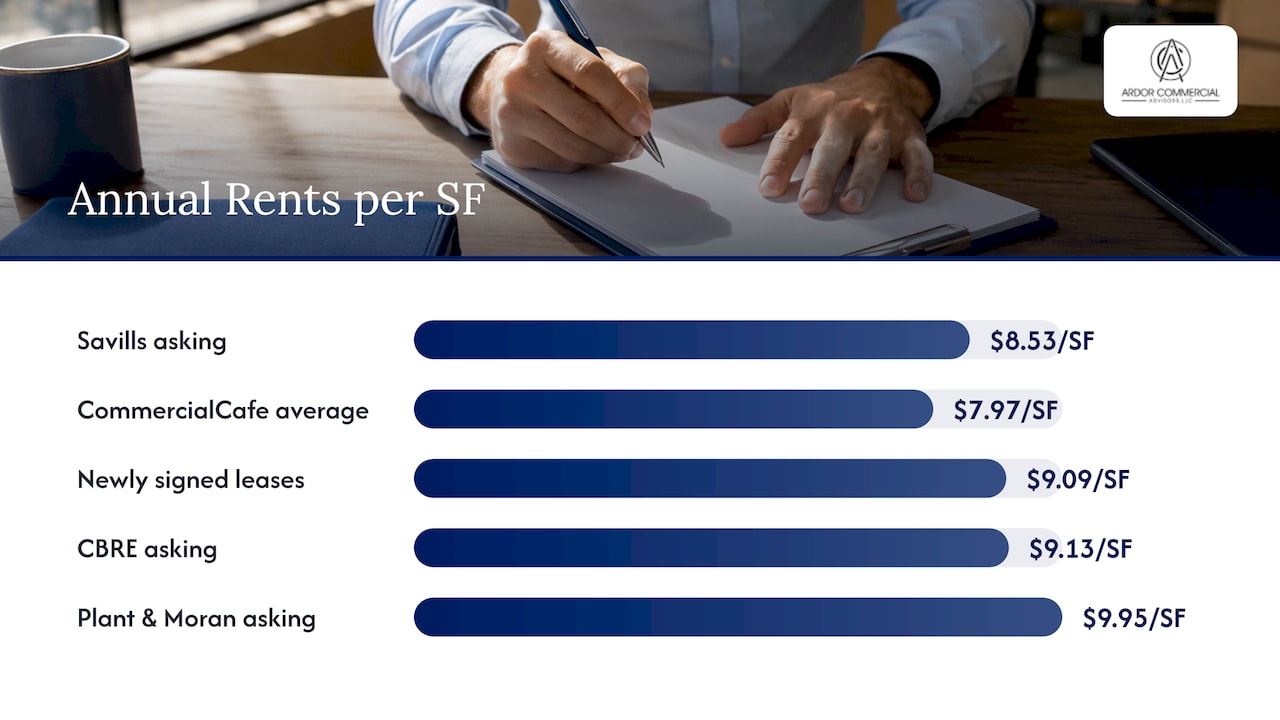
There is no single “Charlotte industrial rent.” Every research firm draws the market boundary and building filters a little differently, so the headline numbers land in a band. Here is what the recent reports show:
| Source | Period | Figure | Vacancy |
|---|---|---|---|
| Savills | Q3 2026 | $8.53/SF asking, up 6.0% year over year | 11.7% |
| CommercialCafe, as reported by Charlotte Stories | September 2026 | $7.97/SF average, $9.09/SF on newly signed leases | 11.1% |
| CBRE, as reported by Charlotte Stories | Mid-2026 | $9.13/SF asking, up 6.5% year over year | 7.1% |
| Plant & Moran | Q1 2026 | $9.95/SF asking | 10.4% (12-month) |
All figures are per square foot per year. The pattern worth noticing: the lease rates on newly signed deals ($9.09 in the CommercialCafe data) run above the all-in average ($7.97), which tells you that what a tenant signs today is typically higher than what the older stock in the average pays.
Our own read on how this translates to the street is in our guide to warehouse lease rates in Charlotte.
Which direction rents are moving
The growth story has shifted from fast to steady. CBRE’s Charlotte Industrial Figures for Q3 2026 reports asking rates up 0.5% quarter over quarter, which it describes as a relatively stable trend, with vacancy down for the seventh consecutive quarter and 80 basis points lower than a year earlier.
Over a longer window the picture is stronger. Charlotte Stories, citing CBRE data, reports industrial rents up roughly 25% over the five years since 2021. And CompStak’s rent index update from June 2026 shows Charlotte leading national industrial rent growth over the year to Q1 2026 at +17.7%, against +0.24% for the national industrial index. CompStak notes its index controls for quality mix and includes concessions, which makes it a useful check on asking-rent headlines.
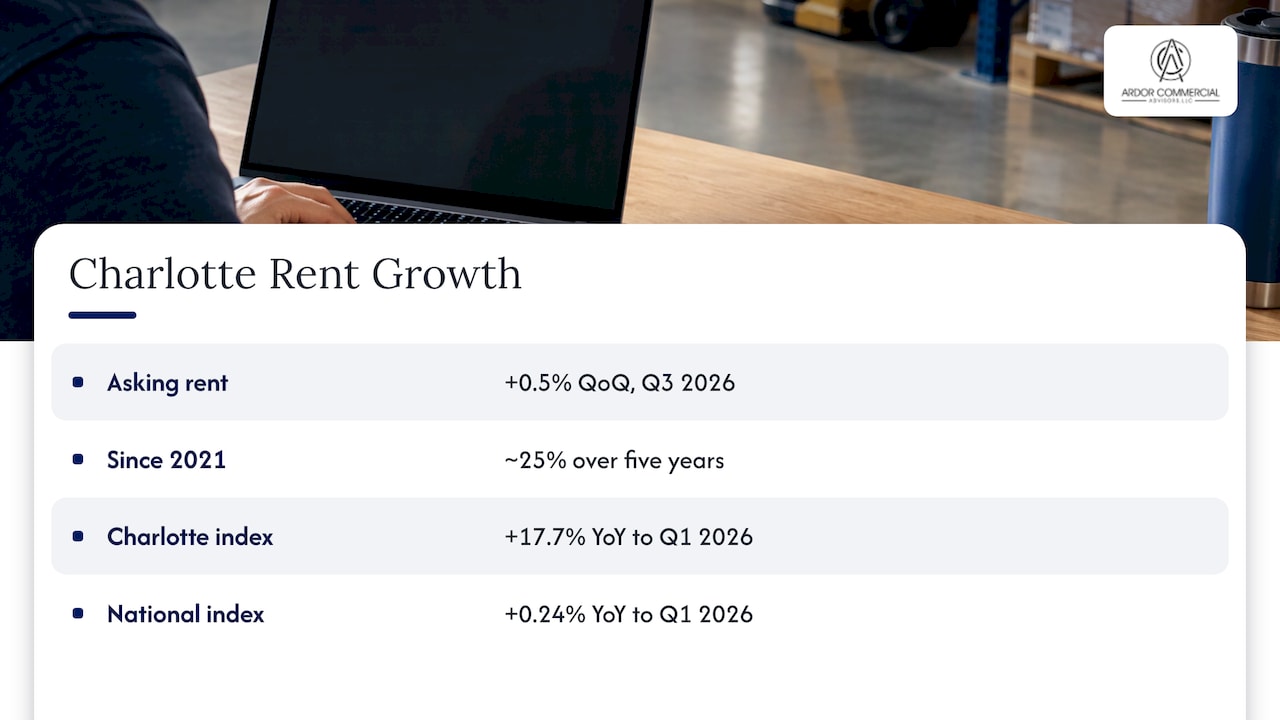
What this means in practice: Charlotte is no longer in a sprint, but it has not given back its gains. A tenant with a lease expiring in the next 12 to 18 months should plan for renewal rates above what they pay today.
Why the numbers differ: asking rent versus what tenants pay
Asking rent is what a landlord lists. Effective rent is what the lease costs after free rent, tenant improvement dollars and escalations are averaged across the term. Savills notes that although asking rents rose 6.0% year over year, effective rent growth is more modest because free rent and tenant improvement packages are becoming more common.
That gap is your negotiating room. A landlord holding a firm $9.00 asking rate may still give you several months of free rent or a build-out allowance. We lay out what is realistic in what commercial tenants can win in Charlotte rent concessions.
A simple way to compare two offers:
- Add up base rent across the full term, including each annual escalation.
- Subtract the free rent months and any improvement allowance you will actually use.
- Add estimated NNN charges for every year.
- Divide by the number of months and square feet to get a true monthly or annual rate per square foot.
What moves rent from building to building
Class and age
Tenant demand is strongly focused on newly built space, according to CBRE, which also says that new construction lifts the average while leasing of that new space offsets the effect. In plain terms, a modern distribution building with higher clear heights, more dock doors and good trailer parking leases at a premium, and the market is absorbing it quickly. Older buildings price lower, but check the roof, HVAC, loading and fire suppression before assuming the discount is real.
Size and use
Small-bay and flex space (2,000 to 15,000 square feet) usually quotes a higher rate per foot than large bulk distribution, but the monthly check is smaller and the tenant pool is deeper. Bulk space reverses that. Office build-out percentage, power capacity and yard also shift pricing.
Submarket and access
Proximity to I-85, I-77, I-485, the airport and the rail yard is priced in. Rent quotes close to the center city and in established corridors tend to differ from those further out where newer supply is concentrated. Our Charlotte submarket guide walks through the areas to buy, sell or lease in.
Vacancy and supply: what they say about leverage
Vacancy is the best single indicator of who holds leverage. Falling vacancy tends to favor landlords. Note the spread in reported rates, from 7.1% in one CBRE-sourced report to 11.7% in Savills. They measure different slices of the market, so treat the direction (declining for seven quarters per CBRE) as the signal rather than any one level. Read more on how to interpret these in what the Charlotte industrial vacancy numbers mean.
New development is part of the same story. Land that gets cleared and graded for new warehouse product feeds the pipeline, and warehouse demolition and site clearing is often the first step when an obsolete building is redeveloped. If you are an owner weighing a sale of an older property or land, our Charlotte land development guide covers what investors look for.
What to budget beyond the quoted rent
Most industrial leases in Charlotte are quoted on a triple-net basis, where the tenant pays base rent plus a share of property taxes, insurance and common area maintenance. The quoted rate is therefore not your occupancy cost. Our triple net lease guide explains who pays for what, and industrial lease types and surprise costs compares the structures.
A checklist of items to price before you sign:
- Property taxes and insurance. Ask for the last three years of actual pass-through amounts, not just this year’s estimate.
- CAM charges. Confirm what is included, whether there is an administrative fee, and whether the year-end reconciliation is auditable. Our CAM reconciliation and lease review service is built for exactly this.
- Capital repairs. Find out whether roof replacement, parking lot resurfacing and structural items are excluded or amortized. If the roof is aging, ask for its condition and repair history, and if the lease passes roof costs to you, a quote for commercial roof repair and replacement gives you a number to negotiate with.
- Annual escalations. Fixed bumps are predictable. Watch for clauses that tie increases to a percentage of market.
- Guarantees and deposits. Newer companies are often asked for a personal or corporate guarantee. See how to cap a corporate guarantee at 12 months’ rent.
- Work letter. Know who pays for dock, power, racking and office upfit and who owns it at the end of the lease. Our landlord work letter checklist covers it.
Perspective
Quoted industrial rent is a headline, not a price. In Charlotte we see the same mistake over and over: a tenant compares two buildings on base rate and ignores the NNN estimate, the escalations and the free rent. Two offers a dollar apart can cost the same, or cost very differently, once those are in.
Our approach is to build the total cost of occupancy before the first counteroffer, then use the concessions the market is giving, such as free rent and improvement dollars, to close the gap. For owners, the same discipline works in reverse: price to the market’s effective rents, so the building leases instead of sitting.
Local detail matters here. A few blocks, one highway ramp or one extra dock door can swing a deal, which is why we pair market reporting with hands-on representation for both tenants and landlords.
Jim
Get a Charlotte industrial lease or sale priced right
If you are leasing, renewing or selling an industrial building in the Charlotte area, we can help you model total occupancy cost, review the lease and negotiate terms. We represent tenants and landlords, and we also handle sales and valuation, including DCF modeling for owners deciding whether to hold, sell or refinance.
Start with our commercial real estate services, learn how tenant representation works, or see how we approach commercial property valuation.
If you own: what rents mean for a sale or refinance
Rising rents and falling vacancy generally support values for well-leased industrial buildings, but the buyer will underwrite your in-place leases against market effective rent. Leases well below market can be an upside story; leases above market need a credible renewal case. Before listing, have your leases abstracted so a buyer can verify terms quickly, and use our lease abstract guide to see what a clean summary contains.
If you plan to refinance, lenders size loans on income coverage, so the debt service coverage ratio matters. Our DSCR loan sizing guide shows how that calculation works. And if you intend to sell and reinvest, review the 1031 exchange rules before you sign a purchase agreement, since timing matters.
A practical timeline for tenants
Industrial deals move on the availability of space, and the best buildings lease first. Start the search well ahead of your expiration, shortlist several buildings, and request proposals from more than one landlord so each knows there is competition. Our commercial leasing timeline shows how long each stage typically takes for medical and office tenants, and the sequence is similar for industrial users.
FAQ
What is the average industrial rent per square foot in Charlotte?
Recent reports put the average asking rent between roughly $8.53 and $9.13 per square foot per year, depending on the source. Newly signed leases in one September 2026 data set averaged $9.09. Your actual rate depends on the building’s class, size and submarket.
Are Charlotte industrial rents still rising?
Yes, but more slowly. CBRE reports asking rates up 0.5% from the prior quarter in Q3 2026, and the market has seen roughly 25% growth since 2021. Vacancy has declined for seven consecutive quarters by CBRE’s count.
Is the asking rent the rent I will pay?
Not usually. Concessions such as free rent and tenant improvement allowances reduce your effective cost, while NNN charges and escalations add to it. Compare offers on total cost over the full lease term.
What does NNN mean on an industrial lease?
Triple net means you pay base rent plus your share of property taxes, insurance and common area maintenance. The estimates should be backed by actual prior-year figures, and the lease should define exactly which costs are passed through.
Sources
- Savills Charlotte Q3 2026 Industrial Market Report
- CommercialCafe September 2026 industrial report, via Charlotte Stories
- Charlotte’s Industrial Boom Is Slowing, via Charlotte Stories
- Plant & Moran 2026 Q1 Industrial Market Report
- CBRE Charlotte Industrial Figures Q3 2026
- CompStak CCRI Rent Index National Update, June 2026