
Most traditional office space in Charlotte asks roughly $35 to $37 per square foot per year on a full-service basis. That is the market-wide average. What you will actually pay depends heavily on building age: new Class A towers ask well above $40, while older, lower-class buildings can sit in the mid-$20s. This guide breaks down the numbers, explains how rents are quoted, and shows where tenants usually find savings.
TL;DR
- Second-quarter 2026 reports put average direct asking rent at about $35 to $37 per square foot per year, depending on the research firm and lease basis.
- The market splits by building age. As of August 2026, 4 and 5 Star buildings asked $44.36 with 19.6% vacancy, while 1 and 2 Star buildings asked $26.23 with 4.3% vacancy.
- Headline rent is not what you pay. Free rent and tenant improvement (TI) allowances can make effective rent 15% to 30% lower than the base rate.
- Always compare quotes on the same basis (full-service, modified gross or triple net) before you compare prices.
Table of Contents
- What office space costs in Charlotte right now
- Why building class matters more than neighborhood
- How rent is quoted: full-service, modified gross and triple net
- Concessions: the gap between asking and effective rent
- Flexible and coworking space versus a traditional lease
- What vacancy and conversions mean for your negotiation
- Perspective: how we would approach an office search
- Get a real number for your space
- Budgeting beyond the rent
- If you own, not rent
- FAQ
- Sources
What office space costs in Charlotte right now
Commercial office rent in the US is quoted in dollars per square foot per year, not per month. A 3,000-square-foot suite at $36 per square foot costs $108,000 a year, or $9,000 a month before any other charges.
For the second quarter of 2026, one brokerage reported direct asking rent of $36.95 per square foot on a full-service gross basis, while another reported $35.23 full-service. The gap between the two is mostly methodology: each firm tracks a different set of buildings and treats subleases and direct space differently. Treat $35 to $37 as the working range for a typical lease in the metro.
Two cautions about that average:
- It blends very different buildings. A 1980s suburban low-rise and a new Uptown tower do not belong in the same price conversation.
- It is an asking rate. Asking rents are where landlords start. What gets signed depends on the deal terms around the rent, which we cover below.
Why building class matters more than neighborhood
Charlotte’s office market is bifurcated by vintage. Premium, highly amenitized space is in demand and in short supply. Older, non-renovated buildings face structural decline.
The August 2026 figures from one regional outlook show how wide the split is:
| Building type | Vacancy | Asking rent (per sq ft) |
|---|---|---|
| 4 and 5 Star | 19.6% | $44.36 |
| 1 and 2 Star | 4.3% | $26.23 |
Source: Charlotte CRE Outlook, August 2026.
The odd detail is that top-tier buildings carry the highest vacancy and the highest rent. Large blocks of space sit open in some high-end towers, partly because big corporate floorplates are slow to fill, while the older stock that small tenants use is nearly full and priced low. For a small practice or a 2,000-square-foot professional firm, that means the budget end of the market is tight, and you should not expect large discounts there.
If you are choosing between submarkets, our Charlotte submarket guide walks through where each area fits for owners and occupiers. Submarket rent differences are real, but a newer building in a cheaper area will often still ask more than an older building in a prime one.
How rent is quoted: full-service, modified gross and triple net
The same $36 can mean three different costs. Before you compare listings, find out which structure each uses.
- Full-service gross (FSG): The landlord covers operating expenses, taxes and insurance up to a base year. Most Charlotte office quotes from the major research firms use this basis.
- Modified gross: Some expenses are passed through. Read what is included.
- Triple net (NNN): The base rent looks lower, but you pay your share of taxes, insurance and common area maintenance on top. Our triple net lease guide explains how those charges are built.
On any lease with pass-throughs, the annual common area maintenance (CAM) reconciliation can bring a surprise bill. We review these for tenants through our lease review and CAM reconciliation analysis.
A quick example. Suite A asks $33 NNN with $11 of estimated expenses. Suite B asks $42 full-service. On a gross-equivalent basis, Suite A costs about $44 and Suite B $42. The “cheaper” listing is not cheaper. Ask every landlord for a written estimate of total occupancy cost per square foot.
Concessions: the gap between asking and effective rent
Base rent is only one input. Landlords compete with free rent months, TI allowances and flexible terms, particularly in larger or higher-vacancy buildings. Analysts note that effective rent, which accounts for these concessions, can run 15% to 30% below headline base rent in modern office markets.
Here is what to negotiate:
- Free rent: Often given at the start of the term, scaled to lease length. A longer lease usually earns more.
- TI allowance: Money per square foot toward build-out. Ask what happens to unused allowance, and whether it can offset rent.
- Annual escalations: A 3% bump compounds over a 7-year lease. Compare it with a flat step.
- Renewal and expansion options: Worth real money if your headcount is uncertain.
- Early termination rights: Spell out the fee and notice in advance. See our guide to exiting a commercial lease early.
We go through each of these in more depth in Office Lease Concessions: What to Ask For and How. Landlords also value quality of space as a retention tool, which is why upgrades such as window upgrades and tenant retention come up when owners decide what to put into a building.
Flexible and coworking space versus a traditional lease
Search results for Charlotte office rent are crowded with coworking and private-suite listings. These are priced per desk or per person per month, usually all-in with utilities, internet and shared areas. A traditional lease is priced per square foot per year, and you handle furniture, internet, and often some operating costs yourself.
The prices are not directly comparable, but you can convert them. One flexible-space cost guide puts the median for move-in-ready space at around $359 per person per month in Charlotte, with the middle of the market spanning roughly $279 to $468. A five-person team at $359 pays $1,795 a month, or $21,540 a year. A traditional lease for the same team, at around 150 square feet per person, would be 750 square feet. At $36 per square foot that is $27,000 a year, before furniture, internet and build-out.
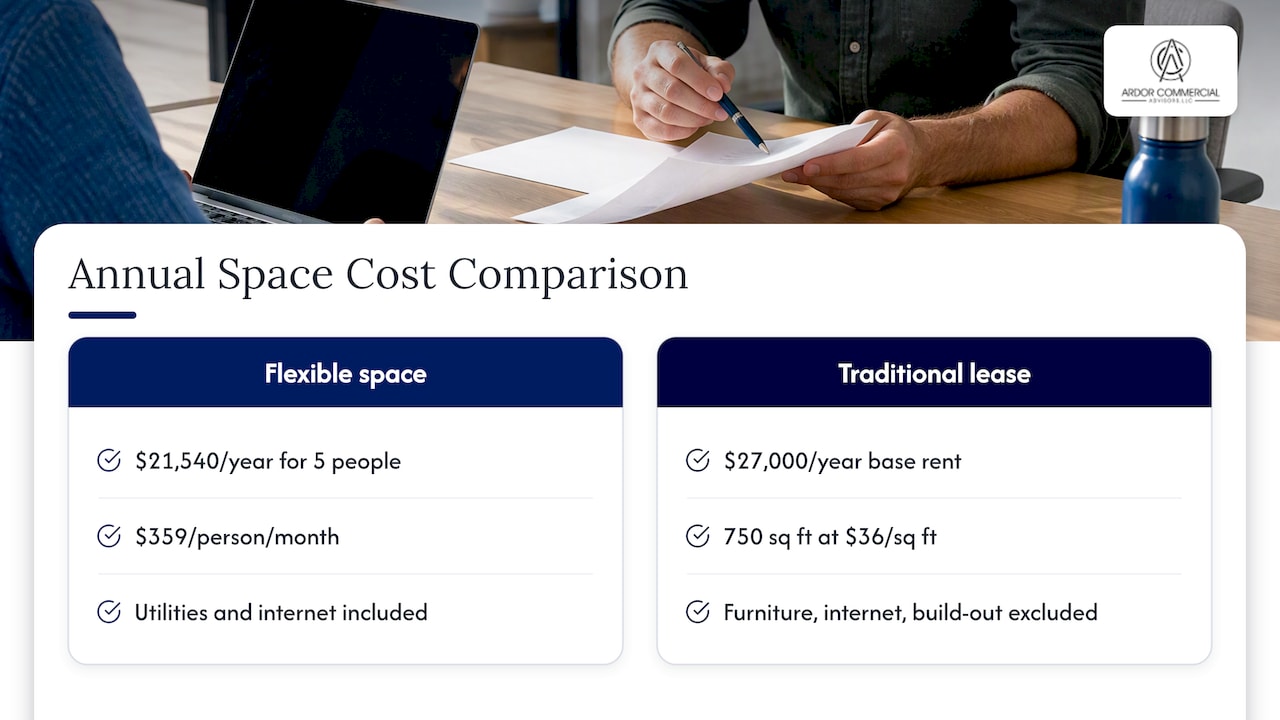
That comparison can favor flexible space for small and fast-changing teams. It tends to reverse as you grow, need privacy, require specialized build-out, or want to brand the space. National trends are moving toward more flexible, coworking-like models, with shorter lease terms and greater owner willingness to adapt floor plans, so traditional landlords are increasingly open to shorter terms and pre-built suites.
What vacancy and conversions mean for your negotiation
The Charlotte office market is getting tighter, and not only because of demand. Older office space is being permanently removed through conversions to multifamily, retail and hospitality, totaling millions of square feet. Fewer weak buildings means fewer distressed landlords willing to cut deeply.
Large corporate deals also shape the headlines. In 2026, Capital Group leased 196,940 square feet at One Independence, and Sumitomo Mitsui subleased 192,770 square feet from Wells Fargo at 301 South College. Deals of that size do not set the price for a 2,500-square-foot tenant, but they tell you which towers are filling and which landlords still have space to fill.
Practical takeaways:
- In high-end towers with a lot of vacancy, you have leverage on free rent, TI and flexibility.
- In older, well-occupied buildings, you have less leverage on rate, so focus on term, renewal rights and expense caps.
- Start early. Our 3 to 6 month leasing timeline shows why tenants who begin six to twelve months before expiration negotiate from a stronger position.
Perspective: how we would approach an office search
We work on both sides of Charlotte office deals, and the same mistake shows up again and again: tenants compare asking rents and stop there. The rent line is the easiest number to see and often the least important one. Escalations, pass-throughs, TI and the length of the commitment decide what a lease actually costs.
Our advice is to build a simple spreadsheet for each space you tour. List base rent, expense structure, escalations, free rent, TI, parking and the total cost over the full term, discounted if you want to be thorough. Two buildings that look $3 apart on the sign often end up within a dollar of each other once everything is counted, or the other way around.
For medical practitioners, dentists and professionals who put real money into build-out, we would also read the lease for who owns the improvements, restoration obligations at the end, and any assignment or sublease rights. Those clauses matter far more when you have spent six figures on plumbing and cabinetry.
— Jim
Get a real number for your space
Averages are a starting point. We represent tenants and landlords across the Charlotte metro, which means we can pull comparable deals for your size and building class, check a landlord’s proposal line by line, and negotiate the concessions above. If you are touring spaces, our tenant representation team can structure the search, and our commercial leasing and brokerage services cover everything from first tour to signed lease.
If you already have a proposal in hand, send it to us and we will compare it against current Charlotte terms before you sign.
Budgeting beyond the rent
A realistic office budget in Charlotte includes more than the monthly check:
- Parking: Uptown and South End buildings often charge separately per space.
- After-hours HVAC: Check whether it is billed by the hour.
- Moving and build-out costs not covered by TI.
- Furniture, cabling and signage.
- Security deposit or guaranty. Some landlords ask for a personal or corporate guarantee; see our guide on capping a corporate guarantee at 12 months’ rent.
- Insurance and utilities if they are not in the gross rate.
Add these up before you decide a suite is affordable.
If you own, not rent
Some tenants find that buying a small office or medical condo is cheaper than leasing over the long run, particularly when their space needs are stable. Others do better staying flexible. We cover that decision for owners and investors in our Charlotte office market analysis, including how leasing trends affect values.
FAQ
How much does office space cost per square foot in Charlotte?
Market-wide asking rent in the second quarter of 2026 was about $35 to $37 per square foot per year on a full-service basis. Class A and new-construction space asks well above that, and older buildings ask well below it. Your final cost depends on lease structure and concessions.
Are office rents in Charlotte going up or down?
The market is split. Premium buildings command high rents because demand for amenitized space outstrips supply, while older buildings face decline, and conversions to other uses are shrinking the overall inventory. Expect pressure on top-quality rates and less discounting in well-occupied older buildings.
What is the difference between full-service and triple net rent?
Full-service rent bundles most operating costs into one number. Triple net rent is lower on paper, but you also pay your share of taxes, insurance and maintenance. Compare them by asking for total occupancy cost per square foot.
Is coworking cheaper than leasing an office in Charlotte?
For small teams it often is, since the monthly price includes utilities, furniture and internet. One guide shows a median of about $359 per person per month for flexible space. As headcount grows, a traditional lease usually costs less per person.
Sources
- Charlotte Commercial Real Estate Market, CRE Terminal
- Charlotte Is Getting Tighter by Subtraction, August 2026 outlook
- Commercial Lease Mechanics: TIs, Free Rent, Recoveries
- Office National Report, April 2026