
A preventive maintenance plan is a written schedule of inspections and service tasks that keeps building systems running before they fail. Every plan needs three parts: an asset inventory, scheduled tasks with set frequencies, and documentation, ideally in a CMMS. Your fastest next step is to inventory your equipment and flag critical HVAC assets for seasonal service.
TL;DR:
- The DOE estimates preventive maintenance can save 12% to 18% over purely reactive work, but low cost, noncritical items can remain reactive.
- Many HVAC systems need service at least twice yearly before heating and cooling seasons; increase frequency for older, dusty, or repeatedly failing equipment.
- Start with five costly assets or those most important to tenants, assign task owners, and log schedules and completed work in a CMMS.
- The Better Buildings Initiative says proper HVAC operations and maintenance can reduce annual energy bills by 5% to 20% while extending equipment life.
- Charlotte area owners should confirm fire, elevator, water system, generator, and energy reporting rules with local authorities, because requirements depend on property type.
Table of Contents
- What preventive maintenance is and how it fits with predictive and reactive work
- Your system-by-system preventive maintenance checklist
- How to develop and implement a preventive maintenance program in seven steps
- Scheduling and task frequencies: turning standards into a usable cadence
- Indoor air quality and HVAC-specific preventive maintenance
- Documentation, CMMS and vendor management
- Measuring benefits and benchmarking with ENERGY STAR Portfolio Manager
- A sample preventive maintenance calendar and one-page checklist
- Budgeting and cost forecasting for preventive maintenance
- The role of preventive maintenance in commercial property valuation
- Integrating your plan with tenant satisfaction and lease considerations
- Coordinating maintenance scheduling to minimize disruption
- Technology trends: IoT sensors and smart building systems
- Regulatory compliance considerations for Charlotte-area properties
- Applying preventive maintenance to medical and office properties
- How we help you set up and run your maintenance program
- FAQ
- Sources
What preventive maintenance is and how it fits with predictive and reactive work
Preventive maintenance is scheduled, time-based or runtime-based service meant to extend equipment life and catch small problems early. You replace a filter on a calendar, not after airflow collapses. A strong preventive maintenance plan commercial owners can defend to lenders and tenants rests on this simple discipline.
It sits alongside two other approaches:
- Reactive maintenance: you fix equipment after it breaks. It makes sense for low-cost, non-critical items like a standard light fixture.
- Predictive maintenance: sensors or readings, such as vibration or temperature trends, tell you when service is due. It pays off on expensive, critical assets.
- Preventive maintenance: calendar or runtime tasks on everything that matters to tenants, safety and operating cost.
The DOE’s Operations & Maintenance Best Practices Guide estimates that preventive maintenance done correctly can save about 12% to 18% over a purely reactive program. The guide also stresses recordkeeping, checklists and following manufacturer recommendations. Most healthy portfolios blend all three methods, with preventive work as the backbone.
Your system-by-system preventive maintenance checklist
Build the checklist by system, then assign each line to a named person or vendor. These are the items we expect to see on a solid commercial plan:
- HVAC: change filters, clean coils, flush condensate drains, check belts and bearings, and run seasonal startup and shutdown procedures for cooling and heating.
- Plumbing: inspect for leaks at fixtures and mechanical rooms, check applicable requirements for testing backflow preventers, and clear floor and roof drains.
- Electrical: do visual checks of panels and disconnects, test emergency lighting, and service and load-test standby generators.
- Roof and envelope: inspect after major storms, check sealants and flashing, and clear gutters and scuppers before heavy rain.
- Exterior and grounds: maintain landscaping, pavement striping, fascia and signage, and plan snow and ice response where winters require it.
- Life-safety systems and elevators: check applicable requirements for fire alarm, sprinkler, extinguisher and elevator inspections, and file every report where an auditor or insurer can find it.
Recordkeeping matters as much as the work itself. An inspection with no record is an inspection you cannot prove.
How to develop and implement a preventive maintenance program in seven steps
You do not need a large team to launch a program. You need a repeatable workflow:
- Inventory assets and assign ownership. List every major piece of equipment with location, model, age and an accountable owner.
- Set goals and KPIs. Track downtime hours, repeat repairs and emergency call frequency so you can show progress.
- Draft task lists and frequencies. Start from manufacturer guidance, then check them against ASHRAE Standard 180 for HVAC.
- Operationalize inspections. Put every task into a work order system so nothing depends on memory.
- Train staff and document procedures. Write short, step-by-step instructions for recurring tasks.
- Set vendor scopes and parts procurement. Define who does what, and stock common parts such as filters and belts.
- Monitor and close the loop. Review results quarterly and adjust frequencies where failures keep recurring.
Pro Tip: Start with your five most expensive or most tenant-critical assets, prove the routine on those, then expand the plan building by building.
If you manage several buildings, our guide to commercial property manager duties shows which of these steps your manager should already own.
Scheduling and task frequencies: turning standards into a usable cadence
ANSI/ASHRAE/ACCA Standard 180-2018 requires owners to keep an inventory of HVAC equipment and follow a formal maintenance program with defined tasks and frequencies. For many systems, professional service at least twice a year is treated as the absolute minimum, timed to prepare for the cooling and heating seasons.
Use frequency bands as a starting point and adjust to your equipment and environment:
- Monthly: walk-throughs, filter checks on high-load units, drain and mechanical room inspections, emergency lighting tests.
- Quarterly: belt and bearing checks, damper operation, generator exercise runs, grounds and pavement review.
- Semi-annual: full HVAC service before each season, roof and gutter inspection, backflow and fire system checks per code.
- Annual: electrical panel inspections, sealant and envelope review, elevator and fire inspections as required.
- Multi-year: sensor calibration, major component replacement planning and rolling capital reviews.
Increase frequency for dusty sites, older equipment, heavy-occupancy medical suites and anything with a history of repeat failures. Calibration and validation tasks should go to qualified technicians, and a rolling multi-year plan keeps those costly items from clustering in one budget year.
Indoor air quality and HVAC-specific preventive maintenance
Indoor air quality tasks are the ones most often missing from a plan. They also drive tenant complaints faster than almost anything else. Build them in on a layered schedule:
- Monthly: walk the building looking for clogged filters, blocked drains and signs of moisture.
- Quarterly: check filtration performance, damper function and building automation sensor accuracy, aligned with ASHRAE 62.1 ventilation guidance.
- Semi-annual and annual: review your Legionella water management plan, verify cooling tower treatment, and calibrate sensors.
The Better Buildings Initiative notes that proper HVAC operations and maintenance reduces energy use and prolongs equipment life.
Following O&M best practices can save organizations roughly 5% to 20% on annual energy bills. That is the same work that keeps air clean, so one routine pays twice.
Consistent filtration and moisture control also cut stuffiness, odor and humidity complaints. For a plain-language overview of why this matters to occupants, see this indoor air quality explainer from a cleaning services provider.
Documentation, CMMS and vendor management
For every task, capture the date, technician, pass or fail result, corrective action taken, and any photos or readings. A computerized maintenance management system (CMMS) beats paper logs because you can search history in seconds when a unit fails after hours. It also builds the file a lender, insurer or buyer will ask for later.
- Standardize a work order template so every vendor reports the same fields.
- Attach manuals, warranties and prior service reports to each asset record.
- Require vendors to submit completed checklists within a set number of days.
- Audit a sample of completed tasks each quarter against site conditions.
Vendor scopes should name the equipment covered, the visit frequency, the exact tasks, response times for emergencies, parts handling and reporting format. Consolidating vendors where you can simplify accountability.
Pro Tip: Ask each vendor to photograph the equipment nameplate and filter condition at every visit; it makes your inventory self-correcting.
Measuring benefits and benchmarking with ENERGY STAR Portfolio Manager
Start by measuring where you are. ENERGY STAR Portfolio Manager is a free benchmarking tool that lets you enter energy and water data and compare performance against national baselines. Buildings that score poorly are natural candidates for the first maintenance and efficiency dollars.
Track these KPIs monthly or quarterly to prove value:
- Energy use intensity trend by building
- Emergency work orders as a share of total work orders
- Repeat repairs on the same asset
- Unplanned downtime hours
- Percent of scheduled tasks completed on time
The DOE puts the expected savings of preventive over reactive maintenance at 12% to 18%, so a falling emergency ratio should show up as lower repair spend. To weigh maintenance spending against capital projects, a cap rate calculator can help you see how operating savings affect value.
A sample preventive maintenance calendar and one-page checklist
Adapt this month-by-month outline in your CMMS:
- January and July: inspect roofs and drains after seasonal weather, test emergency lighting.
- March and September: full HVAC seasonal service, coil cleaning and belt checks.
- Every month: filter check, mechanical room walk-through, moisture and leak scan.
- Annually: fire system and elevator inspections, electrical panel review, sealant check.
For the one-page critical asset checklist, list each air handler, chiller, boiler, fire system and roof with last service date, next due date, owner and open issues. Tailor the mix by building type: medical suites weight ventilation and filtration, offices weight comfort and energy, retail weights entrances and roofs, and industrial weights dock equipment and heavy mechanical loads.
Budgeting and cost forecasting for preventive maintenance
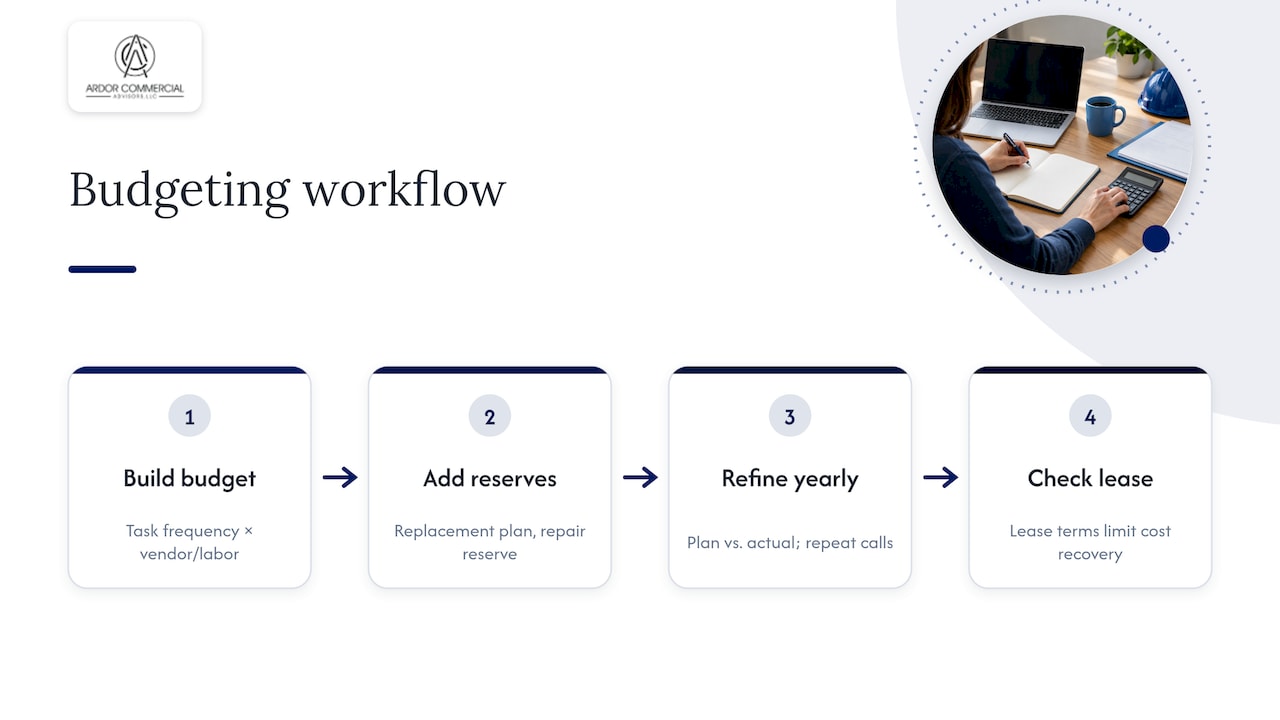
Budget preventive maintenance as a recurring operating line, not a surprise. Start from your asset inventory: each asset has tasks, each task has a frequency, and each frequency has a vendor or labor cost. Multiply them out and you have a bottom-up budget you can defend.
Then layer in reserves. Equipment nearing the end of its life belongs in a capital plan with a replacement year, so a failed rooftop unit does not blow up your annual forecast. Keep a modest contingency for corrective repairs found during inspections, because good inspections always find something.
Use your history to tighten the numbers each year. Compare planned spend against actual spend, and note which assets generate repeat calls. If a chiller costs more in emergency repairs than a replacement would cost over the same period, the data makes that case for you.
Commercial leases matter here too. In a triple net lease, many maintenance costs pass through to tenants as operating expenses, so your budget needs to match what your lease language actually allows you to recover. Our property management budget guide walks through how owners structure these lines, and our triple net lease guide explains the pass-through mechanics.
The role of preventive maintenance in commercial property valuation
Buyers, lenders and appraisers all underwrite the condition of a building, not just its rent roll. A documented maintenance history signals lower surprise capital needs, and that tends to support stronger pricing and smoother due diligence. A building with no records invites a cautious buyer to assume the worst and discount accordingly.
Maintenance also shows up in net operating income. Fewer emergencies, lower energy use and fewer tenant disputes all protect the income that valuation depends on. Deferred maintenance does the opposite: it can look like savings for a year or two, then arrive as a large capital bill right when you want to sell or refinance.
For investment decisions, keep a clean file: asset inventory, service logs, capital replacement schedule and inspection reports. When we work through commercial property valuation and discounted cash flow models, the quality of this file shapes how confidently we can forecast capital spend. If you are weighing a sale or a refinance, a tidy maintenance record helps support the conversation with lenders and buyers.
Integrating your plan with tenant satisfaction and lease considerations
Tenants judge a building by comfort, cleanliness and how quickly problems get fixed. A preventive plan addresses all three before the complaint arrives. In medical office buildings the stakes are higher, because patients and clinical staff notice temperature swings, odors and downtime immediately.
Lease language should match your plan. Review who is responsible for HVAC service inside a suite, how common area maintenance is charged, and what response times you promise for critical failures. When expectations are written down and your logs prove you meet them, disputes over charges get easier to resolve. Our team can help with lease review and CAM reconciliation analysis when charges and obligations do not line up.
Maintenance also supports retention. A tenant who rarely loses air conditioning or hot water has fewer reasons to look elsewhere at renewal. Our tenant retention strategies guide shows how to value that stability against the cost of vacancy.
Coordinating maintenance scheduling to minimize disruption
Good maintenance should be invisible to tenants. The goal is to do necessary work at times that interfere least with their business.
Start by learning each tenant’s operating hours. A medical practice may need work done on weekends or early mornings, while an office tenant may accept midday access to common areas. Put planned shutdowns, such as chiller work or electrical testing, on a shared calendar and give tenants written notice well ahead of the date.
Bundle tasks that need the same access, so a technician enters a suite once instead of three times. Sequence work by system, so you do not shut off air handling twice in one week. Avoid scheduling noisy or odor-producing work near sensitive tenants, and keep contingency plans for rescheduling around tenant events or weather.
Communicate clearly. A short notice stating what will happen, when, how long it will last and who to call is usually enough. After the work, confirm completion and note any follow-up in your CMMS, so tenants see the same quality every time.
Technology trends: IoT sensors and smart building systems
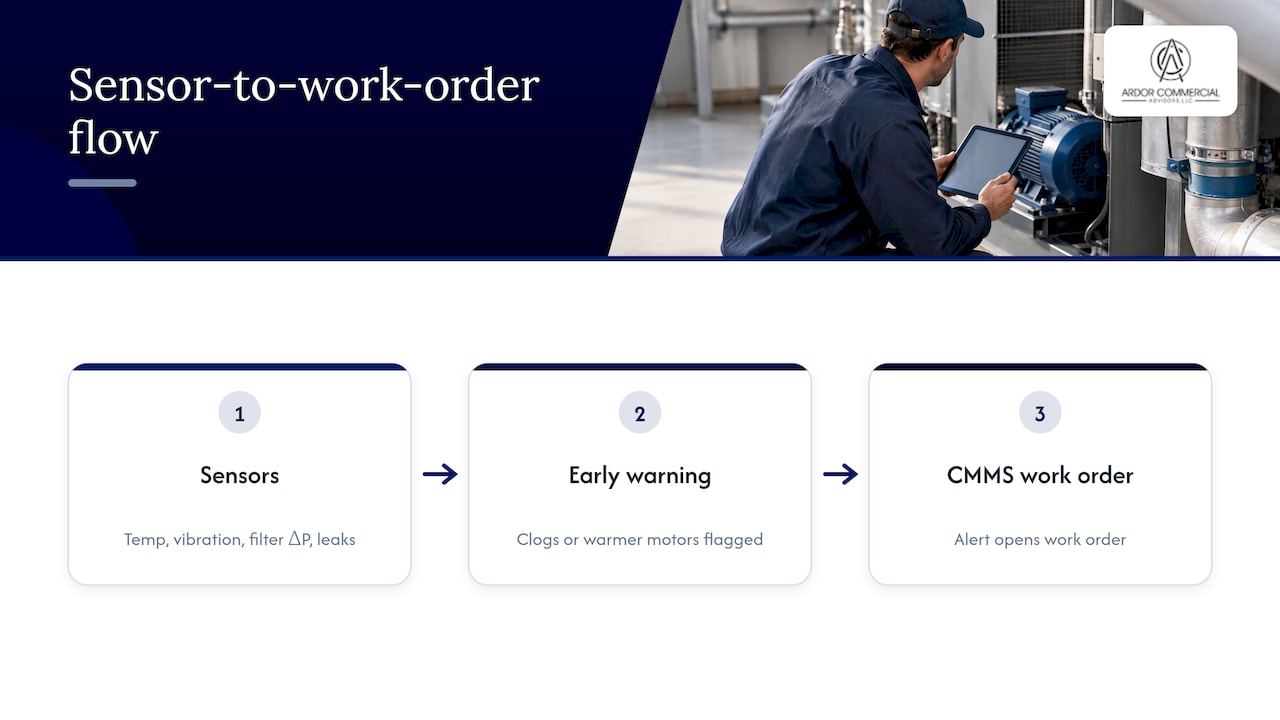
Sensors and smart building platforms let you move from calendar-based tasks toward condition-based ones on your most critical assets. Common examples include temperature and vibration sensors on motors and pumps, differential pressure sensors across filters, and leak detectors in mechanical rooms and above ceilings.
The practical value is early warning. A filter that clogs faster than expected, or a motor that runs warmer each week, is flagged before the failure. Alerts can feed straight into a CMMS and open a work order automatically.
Start small. Pick one or two assets where downtime is expensive, install sensors, and compare the alerts with your calendar tasks for a season. If the data proves useful, expand. Keep your data ownership and access terms clear in any vendor contract, and make sure the system can integrate with your work order platform rather than sit in a separate dashboard nobody checks.
Technology does not replace the basics. An asset inventory, written tasks and good records come first, because sensors only help a team that already knows how to respond.
Regulatory compliance considerations for Charlotte-area properties
Compliance depends on your building type, so treat this as a starting framework and confirm specifics with the right authorities. In the Charlotte area, owners should confirm the inspection and documentation requirements for fire and life-safety systems, elevators, and building and fire codes with the relevant state and local authorities.
Also confirm whether rules apply to water systems and backflow testing, generator and fuel storage, or energy reporting for your property. Medical buildings may have additional requirements related to the services provided inside them.
The practical step is to build a compliance calendar into your plan. Confirm applicable inspections, authorities, due dates and responsible vendors with local officials, and store relevant records in your CMMS. Check with your local fire marshal, building inspections office and insurance carrier to confirm what applies, since requirements and enforcement can change. If an inspector asks for records, you should be able to produce them in minutes.
Applying preventive maintenance to medical and office properties
In our work with medical and office owners, the pattern is consistent: the priorities differ, but the plan structure holds. Medical offices lean on ventilation, filtration and fast vendor response, because exam rooms and procedure areas cannot go without conditioned air. A strong maintenance program also supports lease obligations, since tenants in these buildings often negotiate specific uptime and response expectations.
Office buildings win on comfort, energy performance and retention. Benchmarking in ENERGY STAR Portfolio Manager gives you a defensible story for tenants and buyers, and steady comfort keeps renewal conversations short. For owners with several buildings, the question often becomes who owns the plan, which is where our property vs asset management guide helps.
My view: the most valuable maintenance document is not the checklist, it is the long-term capital view built from it. Owners who show that view to lenders and tenants negotiate from strength. If you want a second set of eyes on your plan, contact us.
— Jim
How we help you set up and run your maintenance program
We turn a plan on paper into a routine your buildings actually follow. Our team supports owners with:
- Property management, including vendor coordination and work order oversight
- Lease review and CAM reconciliation analysis, so recoveries match your costs
- Commercial property valuation that reflects your building’s condition and capital needs
Ask us for a property management proposal through our services page.
FAQ
What is a preventive maintenance plan?
A preventive maintenance plan is a written schedule of inspections and service tasks performed before equipment fails. It lists assets, tasks, frequencies and who is responsible. The DOE’s O&M guide estimates savings of about 12% to 18% over purely reactive maintenance.
What are examples of preventive maintenance in a commercial building?
Common examples include changing HVAC filters, cleaning coils, flushing condensate drains, testing emergency lighting, exercising generators, clearing roof drains and inspecting fire systems. Each is a small, scheduled task that prevents a larger failure.
What are the types of preventive maintenance?
Most programs combine time-based tasks run on a calendar, usage-based tasks tied to runtime, and condition-based tasks triggered by readings or sensors. Predictive and corrective work support these but are usually tracked as separate categories.
How often should commercial HVAC be serviced?
For many systems, ANSI/ASHRAE/ACCA Standard 180-2018 treats professional service at least twice yearly as the minimum, timed ahead of the cooling and heating seasons. High-load or older equipment often needs more.
What should a maintenance plan include to track results?
Include an asset inventory, task frequencies, a work order record for every task and a few KPIs such as emergency call frequency and repeat repairs. Benchmarking in ENERGY STAR Portfolio Manager adds an energy performance view.
Sources
- ANSI/ASHRAE/ACCA Standard 180-2018
- Benchmark Your Building With Portfolio Manager | ENERGY STAR
- Operations & Maintenance Best Practices Guide: Release 3.0
- Preventative Maintenance for Commercial HVAC Equipment | Better Buildings & Better Plants Initiative