
A commercial property manager is the owner’s operational and financial steward, the person who keeps rent flowing, vendors accountable, and the asset compliant while the owner focuses on strategy. Their duties break into six buckets: budgeting and financial reporting, lease administration, maintenance and vendor coordination, tenant relations, regulatory compliance, and capital planning. Done well, this work protects net operating income and preserves resale value.
TL;DR:
- Property managers should provide clear reporting schedules, CAM reconciliation timelines within 90 to 120 days, and documented lease renewal and expiration tracking.
- Budgeting for CAM charges and reserve schedules must be verified before year-end to prevent errors that can lead to costly disputes or mismanagement.
- Maintenance protocols require scheduled inspections for critical systems with pre-approved emergency response plans to avoid reactive costs and tenant disruption.
- A manager’s KPIs to monitor include occupancy rate, net operating income trend, rent collection rate, and average days to lease vacant spaces, ensuring asset value is maintained.
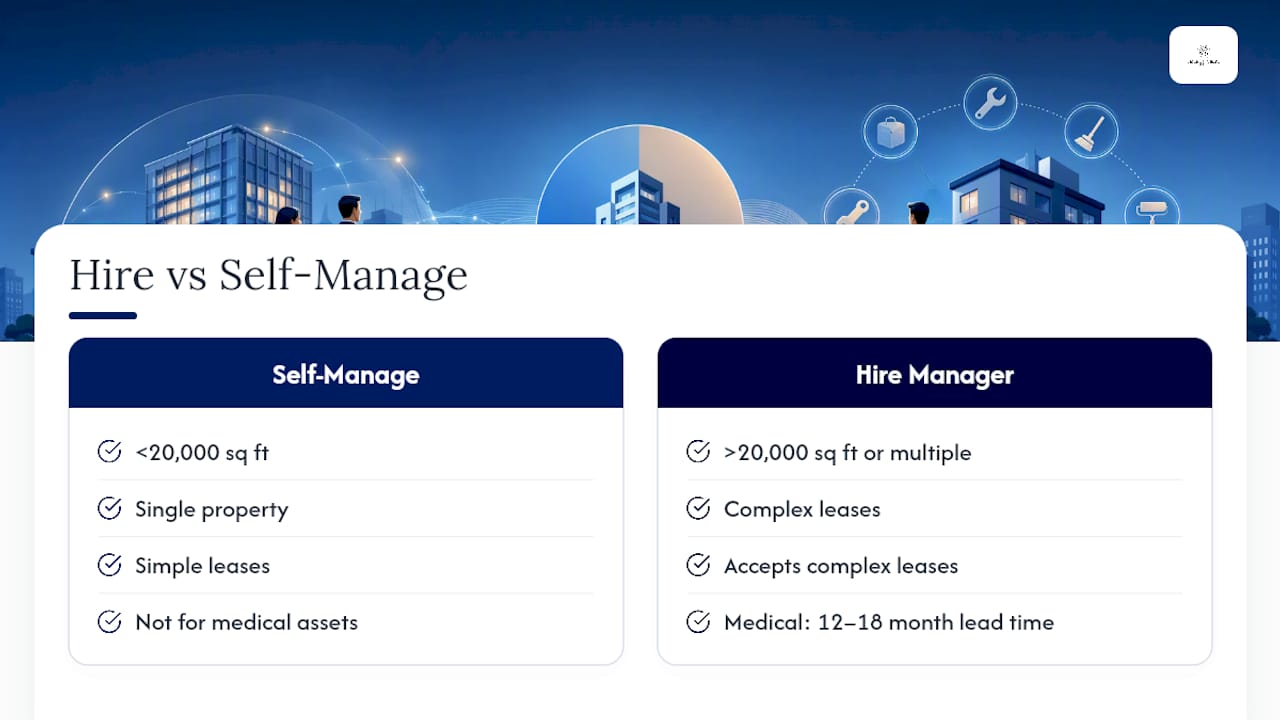
- Owners of multiple or complex assets should consider professional management over self-management, especially when medical or industrial tenants are involved, due to longer lead times and specialized needs.
Table of Contents
- Commercial Property Manager Duties: The Full Responsibility Map
- How Do Property Managers Handle Budgeting and Rent Collection?
- What Maintenance and Vendor Duties Fall on the Manager?
- How Does Lease Administration Affect Tenant Retention?
- What Compliance and Risk Duties Should Owners Expect?
- How Do Managers Plan Capital Projects and Repositioning?
- What Skills and KPIs Separate a Strong Manager From a Weak One?
- Should You Hire a Manager or Self-Manage Your Property?
- Ardorcre’s Resources for Medical Office and Office Owners
- A Practical Priority List for This Quarter
- How Ardorcre Handles the Duties Covered Here
- Sources
- FAQ
Commercial Property Manager Duties: The Full Responsibility Map
The scope of commercial property management tasks splits into three layers: operations, finance, and strategy. Operations covers the daily grind: work orders, vendor scheduling, inspections. Finance covers budgeting, collections, and reporting to the owner. Strategy covers capital planning and positioning the asset for its next chapter, whether that’s a refinance, a sale, or a long hold.
Owners typically keep major capital decisions, financing terms, and disposition strategy in-house. They delegate the rest. O*NET’s official task list for property managers confirms this split, naming budget preparation, maintenance oversight, rent collection, contract administration, and vendor coordination as core duties.
Red flags in a management proposal or contract include:
- No defined reporting cadence (monthly financials should be non-negotiable)
- Vague maintenance response times with no service-level agreement
- No mention of CAM reconciliation timing or process
- Missing vendor insurance verification procedures
- No tenant retention plan or lease expiration tracking
If a proposal skips these, keep negotiating before you sign.
How Do Property Managers Handle Budgeting and Rent Collection?
Financial management is where a manager either protects your NOI or quietly erodes it. The annual operating budget sets the baseline, monthly reports track actual versus projected spend, and variance analysis flags problems before they compound into a bad quarter.
Rent collection follows a predictable escalation path:
- Grace period tracking and automated rent reminders
- AR aging reports flagging anything past 5 to 10 days late
- Formal late notice with fee assessment
- Direct tenant contact and payment plan negotiation
- Legal notice or eviction filing as a last resort
CAM reconciliation is the part owners understand least and disputes most. Reconciliation typically happens after the lease year closes, and most leases require delivery within 90 to 120 days, with tenants given about a month to pay any balance due. Audit rights often stay open for 12 to 18 months, so sloppy reconciliation can come back to bite you long after you thought the year was closed.
Pro Tip: Ask your manager for a CAM reconciliation checklist before year-end, not after. Common errors include management fee caps applied incorrectly, gross-up formulas misused on partially occupied buildings, and capital costs improperly passed through as operating expenses.
A property management budget template with built-in reserve schedules and CAM estimate fields prevents most of these errors before they start.
What Maintenance and Vendor Duties Fall on the Manager?
Preventive maintenance runs on a schedule, not a reaction. HVAC inspections, roof checks, and life safety system tests should happen on a fixed cadence, typically quarterly for critical systems and annually for structural elements.
Vendor management means comparing bids on more than price:
- Warranty terms and how long coverage extends past project completion
- Insurance certificates and liability coverage limits
- References from other commercial clients, not just residential
- Response time commitments written into the service agreement
Emergency response protocols separate a competent manager from a reactive one. A burst pipe at 2 a.m. needs a pre-approved vendor list and a clear capex versus opex decision rule, so nobody is debating budget authority while water is spreading across a tenant suite. Partners like commercial HVAC specialists become critical here, since HVAC failures are among the most common and costly emergency calls in commercial buildings.
How Does Lease Administration Affect Tenant Retention?
Tenant relations start before a lease is signed. Owners should require documented marketing efforts and a real vetting process: credit checks, financial statements, and business references, not just a signed application.
Once a tenant is in place, lease administration protects your income stream:
- Lease abstracting that pulls every critical date into a single tracking system
- Renewal option deadlines flagged 6 to 12 months in advance
- Rent escalation clauses applied correctly and on schedule
- Default and enforcement procedures documented and ready to execute
A detailed lease abstract turns a 40-page lease into a one-page reference sheet a manager can act on instantly. Retention matters more than most owners realize: turnover costs stack up fast in downtime, tenant improvement allowances, and leasing commissions, and preventive maintenance and proactive vendor management directly reduce those costs while keeping tenants satisfied enough to renew.
What Compliance and Risk Duties Should Owners Expect?
Compliance touches building codes, life safety systems, ADA accessibility, and environmental rules, and it’s a moving target. Municipal governments update requirements regularly, and New York City’s Local Law 97 on building emissions reductions is a clear example of the kind of local regulation that reshapes capital planning overnight in the markets where it applies.
A manager coordinates insurance renewals, documents incidents the moment they happen, and keeps records organized enough to survive an audit or a lease dispute years later. Skipping this work doesn’t save money. It just delays the bill.
How Do Managers Plan Capital Projects and Repositioning?
Capital planning is where a manager shifts from maintaining value to building it. Scoping a roof replacement, parking lot resurfacing, or HVAC system overhaul starts with condition assessments and multi-year budgeting, not a reactive scramble when something fails.

Bigger projects need formal bid management: multiple contractor quotes, verified references, and phased payment schedules tied to inspection milestones. The bigger strategic question is whether capital spend should target NOI improvement for a long-term hold, or repositioning ahead of a sale or refinance. That decision changes everything downstream, including whether you’re better off holding, refinancing, or exploring a DSCR loan structure for the next phase of ownership.
What Skills and KPIs Separate a Strong Manager From a Weak One?
A competent manager needs financial literacy, working knowledge of lease law, and vendor negotiation skill. Formal training paths exist through university extension programs and community college property management coursework, so ask candidates about their background.
On the software side, expect ticketing systems for maintenance requests, accounting platforms that produce owner-ready reports, and dashboards you can actually read. The KPIs worth tracking monthly: occupancy rate, NOI trend, collection rate, and average days to lease a vacant space. If a manager can’t produce these numbers on request, that’s a problem.
Should You Hire a Manager or Self-Manage Your Property?
The threshold usually comes down to time and portfolio size: one property under 20,000 square feet might be manageable solo, but multiple assets or anything with complex leases tips the scale toward professional management. Medical office and general office assets need longer lead times. Medical tenants often require 12 to 18 months of advance planning for tenant improvements and permitting alone. Industrial assets carry different pressures: larger CAM pools and specialized racking or dock infrastructure.
Before hiring, gather your financials, current leases, and maintenance history. A manager can’t help what they can’t see.
Ardorcre’s Resources for Medical Office and Office Owners
Ardorcre focuses heavily on medical office and office assets across the Charlotte MSA, and that specialization shapes the practical guidance here. Owners can pull a sample property management budget with reserve schedules built in, or request a lease abstract walkthrough before signing a management agreement. This article was written by Jim, drawing on Ardorcre’s ongoing work with owners navigating budgeting, lease administration, and CAM disputes in medical and office buildings specifically.
A Practical Priority List for This Quarter
If you own a commercial asset, start with three things this quarter: confirm your manager’s CAM reconciliation timeline in writing, pull your last three months of AR aging, and check whether any leases expire within 12 months. Request a budget review or lease audit before those gaps become expensive.
— Jim
How Ardorcre Handles the Duties Covered Here
Ardorcre is the alternative to hiring a generalist manager for medical office and office assets in the Charlotte MSA, because the recommendations above come directly from work Ardorcre already does daily: budgeting, CAM reconciliation, and lease abstracting for exactly these asset types.
If your current CAM reconciliation feels like a black box, or your management agreement doesn’t specify a reporting cadence, that’s worth fixing before year-end closes. Ardorcre’s property management team handles budgeting, CAM reconciliation analysis and lease review, and lease abstracting for medical office and office owners across the Charlotte MSA, with landlord and tenant representation available when a lease renewal or disposition decision comes up. Request a sample property management budget or a lease review to see where your current numbers stand.
Sources
- 11-9141.00 – Property, Real Estate, and Community Association Managers
- Local Law 97 — NYC building emissions reductions (example of municipal regulation)
FAQ
What Are the Core Duties of a Commercial Property Manager?
Core duties include budgeting and financial reporting, rent collection, lease administration, maintenance and vendor coordination, tenant relations, and regulatory compliance. O*NET’s official task breakdown confirms these as the standard job functions across the industry.
How Long Does CAM Reconciliation Typically Take?
CAM reconciliation happens after the lease year closes, and most leases require delivery within 90 to 120 days. Tenants generally get about 30 days to pay any balance, while audit rights can stay open for 12 to 18 months.
When Should a Medical Office Owner Start Lease Renewal Planning?
Medical office owners should start planning 12 to 18 months before lease expiration, since tenant improvement work and permitting for medical tenants take longer than standard office buildouts. Starting late often means losing negotiating leverage on rent and terms.
Does Ardorcre Offer Property Management Services in Charlotte?
Yes, Ardorcre provides property management services across the Charlotte MSA, with a focus on medical office, office, retail, and industrial assets. Pricing details are available directly through Ardorcre’s service pages.
What KPIs Should Owners Ask Their Manager to Report?
Owners should request monthly reporting on occupancy rate, NOI trend, rent collection rate, and average days to lease vacant space. These four metrics reveal whether a manager is protecting or eroding asset value over time.