
A letter of credit makes sense when a landlord demands substantial security, such as multiple months’ rent, or when a tenant needs to protect working capital instead of tying up cash in a bank account. It rarely makes sense for smaller deposits, where the fees and paperwork outweigh the benefit. The real trade-off is liquidity for the tenant against issuer risk, renewal gaps, and legal uncertainty for the landlord. The rest of this guide covers the drafting checklist and negotiation moves that keep both sides out of trouble.
TL;DR:
- Letters of credit are most beneficial for large security needs or for tenants wanting to preserve liquidity, but are less advantageous for smaller deposits due to high fees.
- A letter of credit provides payment guarantees if the tenant defaults, but risks include issuer downgrade or failure, and it may not bypass bankruptcy protections under certain conditions.
- Negotiators should specify clear expiration, renewal, draw triggers, issuer qualifications, and transfer provisions in the lease to prevent disputes and protect their interests.
- Bank fees, underwriting time, and potential delays make issuing an LC costly and time-consuming, especially for tenants with weak credit or small security amounts.
- Proper clause drafting and proactive tracking are critical, as a poorly written LC agreement can be less effective or even worse than a simple cash deposit.
Table of Contents
- What Is a Letter of Credit in a Commercial Lease?
- Letter of Credit vs. Cash Deposit: Which Wins?
- Lease Drafting Checklist: What Belongs in the LC Clause
- Bank and Bankruptcy Risks Negotiators Miss
- What an LOC Actually Costs and How Long It Takes
- Sample Clause Elements to Hand Your Attorney
- Negotiation Tactics for Tenants and Landlords
- Ardorcre’s Perspective on Lease Security Negotiations
- Why the “LC Always Beats Cash” Advice Is Wrong
- Sources
What Is a Letter of Credit in a Commercial Lease?
A standby letter of credit is a bank-issued financial instrument that functions as an alternative to a cash security deposit. Instead of a tenant handing over a check, a bank promises to pay the landlord a set amount if the tenant defaults and fails to cure it. That single feature, a third party guaranteeing payment, is what separates a letter of credit lease from a plain cash deposit.
Three parties make the arrangement work. The tenant (the applicant) asks its bank to issue the LC. The bank (the issuer) commits to paying. The landlord (the beneficiary) draws on it by presenting documents, often just a signed certification of default and the original LC itself.
Most commercial leases use one of a few variations:
- Standby LC: pays out only if the tenant defaults; the most common lease structure.
- Irrevocable LC: can’t be changed or canceled without the beneficiary’s consent, which landlords should always require.
- Confirmed LC: a second bank guarantees payment, adding a layer of protection if the issuing bank’s credit is shaky.
- Transferable LC: moves with the beneficiary’s interest, useful when the landlord sells the building.
Picture a tenant who stops paying rent for three months. The landlord serves a default notice, the cure period lapses, and the landlord presents a sight draft and the original LC to the issuing bank. If the paperwork matches the LC’s terms exactly, the bank pays, regardless of any dispute between tenant and landlord. That’s the independence principle, and it’s both the instrument’s biggest strength and its biggest risk for tenants.
Letter of Credit vs. Cash Deposit: Which Wins?
Neither option is universally better. It depends on deal size, tenant credit, and how much administrative friction each side is willing to accept.
- Tenant liquidity: An LC frees up cash that would otherwise sit in a landlord’s account earning nothing. That capital can fund buildout, payroll, or inventory instead.
- Landlord’s payment certainty: A letter of credit gives landlords a bank standing behind the promise, not just the tenant’s balance sheet. For large security packages, some landlords also believe LCs offer better treatment in a tenant bankruptcy, though that assumption is legally shakier than most people think.
- Cost and complexity: LCs carry issuance fees, annual renewal fees, and sometimes confirmation fees. They require legal review, bank underwriting, and ongoing calendar tracking that a cash deposit simply doesn’t.
- Transfer and counterparty risk: If the issuing bank runs into trouble, or if the building sells, the LC has to be reissued, amended, or transferred, adding friction cash never has.
- When cash wins outright: For security equal to one year’s rent or less, a cash deposit is generally simpler and more cost-efficient than an LC, given the ongoing bank fees and negotiation overhead involved.
Lease Drafting Checklist: What Belongs in the LC Clause
Every letter of credit lease clause should nail down five things before signatures happen. Vague language here is where landlords lose leverage and tenants get blindsided by full draws.
- Expiry, renewal, and evergreen terms: State the initial term, automatic renewal language, and exactly how many days’ notice of non-renewal is required. Practitioners flag evergreen clauses as one of the most poorly negotiated pieces of a lease; miss the notice window and a landlord can draw the entire LC simply because it wasn’t replaced in time.
- Draw triggers: Spell out what counts as an uncured default, whether partial draws are allowed, and whether a drawing certificate is required versus a bare sight draft.
- Issuer qualifications: Require a minimum credit rating for the issuing bank, and decide upfront whether confirmation from a second bank is needed.
- Reimbursement and collateral: Clarify what collateral the tenant posts with its bank to secure the LC, since that’s a separate agreement from the lease itself.
- Transfer on sale: Require that the LC (or a replacement) transfers automatically to a new landlord if the property sells.
- Custody of the original: Name who holds the physical LC and confirms it’s genuine before closing.
Pro Tip: Ask your attorney to attach the actual form of LC as a lease exhibit, not just a description of its terms. Banks vary in their default language, and “substantially similar to Exhibit B” saves you from a fight over wording six months into the term.
Bank and Bankruptcy Risks Negotiators Miss
Two risks get overlooked constantly, and both can undo the supposed safety of a letter of credit lease.
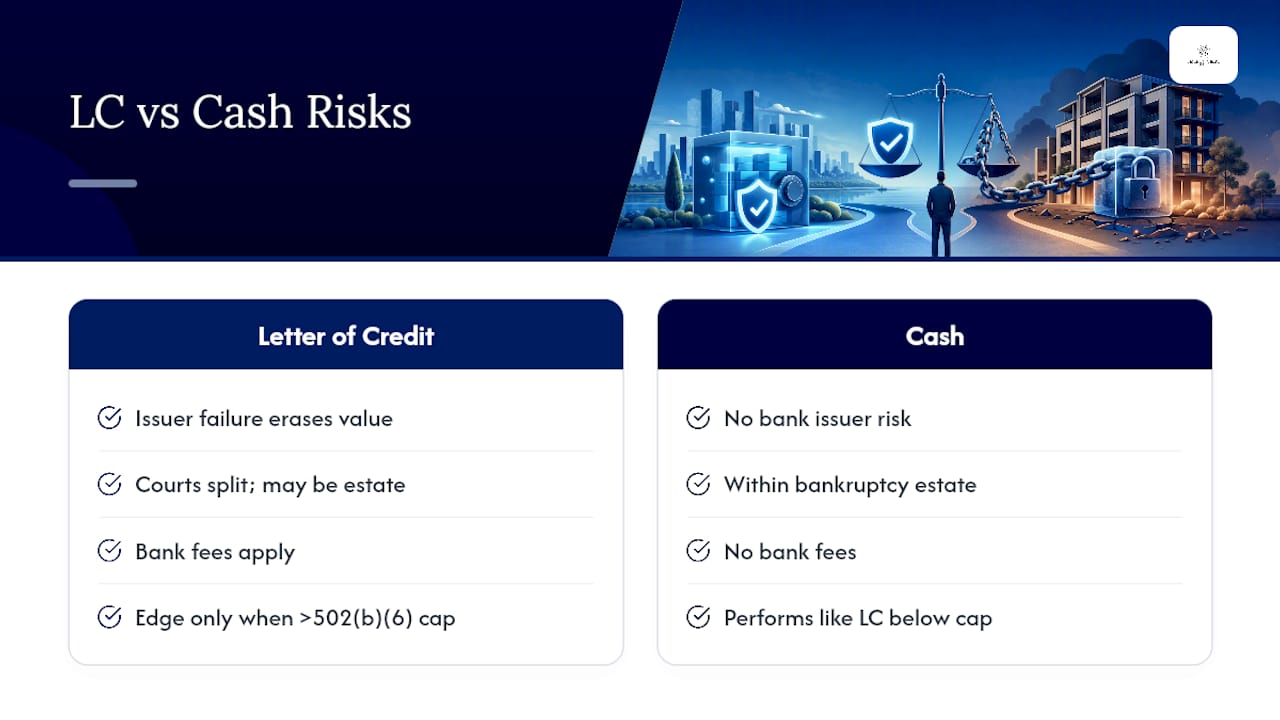
The first is counterparty risk. If the issuing bank gets downgraded or fails, the LC’s value evaporates with it. Bank failures aren’t rare abstractions. FDIC records from 2023 show how quickly a seemingly stable institution can be taken over, which is exactly why leases need a clause requiring the tenant to replace the LC within a set number of days if the issuer’s rating drops below an agreed floor.
The second is bankruptcy uncertainty, and this is where a lot of landlords oversell what an LC actually does.
Courts have split on whether a letter of credit is truly separate from the tenant’s bankruptcy estate. The common belief that an LC automatically sidesteps the Bankruptcy Code’s landlord damages cap under Section 502(b)(6) is disputed, and for security within the statutory cap, cash and LCs tend to perform about the same.
The practical takeaway: an LC’s legal edge over cash only shows up when the security package materially exceeds the 502(b)(6) cap. Below that threshold, you’re paying bank fees for a protection that may not exist.
What an LOC Actually Costs and How Long It Takes
Banks typically charge an issuance fee, an annual renewal fee, and, if a second bank confirms the LC, a confirmation fee on top of that. Underwriting looks a lot like a loan application, because functionally it is one.
- Banks often require cash collateral or a lien on other assets before issuing the LC, especially for tenants without an existing credit relationship.
- Expect the bank to review financial statements, existing debt covenants, and sometimes personal guarantees for smaller companies.
- Typical issuance takes anywhere from a few days to a few weeks, with delays usually caused by incomplete financials or back-and-forth over draw language.
- Negotiate upfront who pays renewal fees each year. Tenants often assume they will, but larger tenants sometimes push this onto deal economics elsewhere.
Statistic Callout: Trade-finance guidance consistently flags letters of credit as document-intensive instruments best suited to higher-risk counterparties or new banking relationships, precisely because of the underwriting and documentation load involved.
Sample Clause Elements to Hand Your Attorney
A workable letter of credit clause doesn’t need to be reinvented from scratch. Model forms already exist, and pulling from them saves negotiation time.
- Attach the form of LC as an exhibit, along with the drawing certificate language the landlord will use to draw funds.
- Use irrevocable, unconditional wording so the bank’s obligation to pay doesn’t hinge on any dispute between landlord and tenant.
- Require sight-draft availability, meaning payment happens on presentation of documents without further verification steps.
- Set issuer qualification and evergreen notice terms in one place, so nobody has to cross-reference three sections to understand the renewal mechanics.
- Name a custodian for the original document and designate who tracks the expiration date on the lease calendar.
Model language along these lines, including sample drawing certificates and transfer instructions, appears in Joshua Stein’s practitioner LC form and commentary, a useful starting point before your attorney customizes it.
Negotiation Tactics for Tenants and Landlords
Tenants generally get more mileage by proposing a hybrid: part cash, part LC, with narrow draw triggers and a hard cap on administrative fees the landlord can pass through. Pushing for a minimum issuer credit rating protects the tenant too, since a weak bank hurts the tenant’s negotiating position if it fails mid-lease.
Landlords should hold firm on requiring a confirmed LC or a defined issuer quality floor, a short non-renewal notice window (60 to 90 days is common), and automatic transferability if the building sells.
- Red flag for tenants: an LC clause with no cap on landlord-passed fees.
- Red flag for landlords: an LC from an issuer with no minimum rating requirement.
- Both sides benefit from centralized tracking of expiry dates and periodic checks on the issuing bank’s financial health.
Pro Tip: Calendar the LC’s expiration date at least 120 days out, not 30. Bank reissuance can take longer than expected, and missing the window handed the entire draw to the landlord in more than one deal we’ve reviewed.
Ardorcre’s Perspective on Lease Security Negotiations
We work primarily with medical and office tenants and landlords, and letters of credit often appear in larger buildouts where tenant improvement dollars run high. We’ve reviewed LC clauses that looked airtight until the evergreen notice window got missed, and others where the issuer’s rating never got checked before signing.
Our advisors help with clause drafting review, lease abstracting for expiry and renewal tracking, and bank-counterparty checks before terms get finalized. If you’re negotiating a security package right now, reach out for a lease analysis before you sign anything.
Why the “LC Always Beats Cash” Advice Is Wrong
The commercial real estate industry has a bad habit of treating letters of credit as automatically superior to cash, and that advice deserves more scrutiny than it gets. The bankruptcy advantage everyone cites gets repeated constantly in lease negotiations, but the actual case law is split, and for security packages under the statutory cap, the supposed edge may not exist at all.
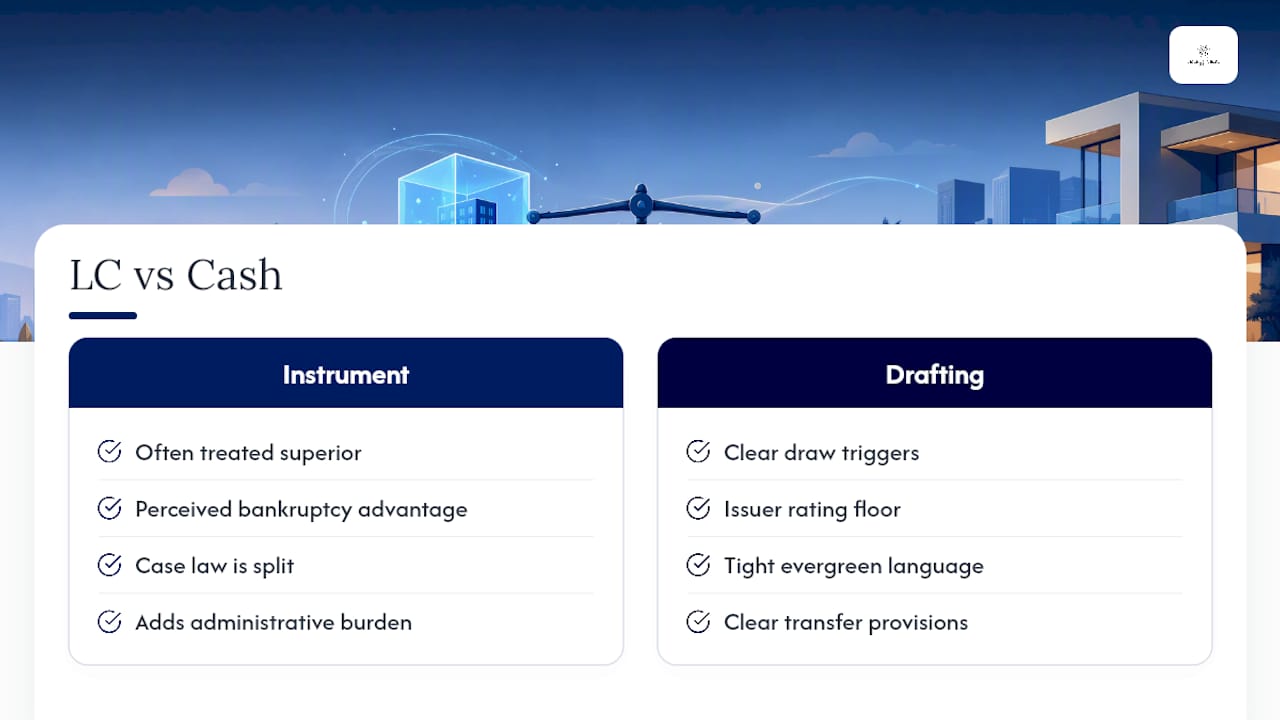
What actually matters isn’t the instrument, it’s the drafting. A sloppy LC clause with vague draw triggers and no issuer rating floor is worse than a clean cash deposit every time. A well-drafted LC with tight evergreen language, confirmed issuer quality, and clear transfer provisions can genuinely protect both sides. The instrument is only as good as the six or seven clauses that govern it, and too many leases treat those clauses as boilerplate instead of the actual battleground they are.
If there’s one thing tenants underestimate, it’s how much leverage they still have on fee allocation and draw triggers, even in a landlord’s market. Landlords who ask for an LC often haven’t priced in the administrative burden it puts on them too. That’s worth raising at the table before assuming the LC is a done deal.
— Jim
Sources
For deeper detail, Joshua Stein’s model LC form offers clause-level language. Practical Law’s clause collection covers pro-tenant and pro-landlord drafting. Nolo and Investopedia give accessible overviews of mechanics and costs.
- Nolo — Letter of credit as security deposit (commercial property)
- Stark & Stark — Letters of credit in tenant bankruptcy and §502(b)(6)
- Joshua Stein — Legal issues and sample letter of credit (PDF)