
A broker opinion of value (BOV) is a broker’s market-based estimate of what a commercial property would sell for today. Use it to price a listing, screen an acquisition, or triage a portfolio. Never use it in place of a formal appraisal when a lender, tax authority, or court needs a defensible number.
TL;DR:
- A broker opinion of value (BOV) is a quick, market-based estimate primarily prepared by brokers for early-stage decisions, not for formal lending or tax purposes.
- Drive-by BOVs rely on exterior observation and public data, while interior BOVs involve walkthroughs that better assess condition and interior details.
- BOVs are usually free or low-cost and take days to a week, whereas formal appraisals cost significantly more and may take several weeks.
- A reliable BOV depends on verified financial data, comparable sales, and transparency about assumptions, with red flags including unsubstantiated comps or owner-supplied financials.
- Use a BOV for screening, pricing, or portfolio triage, but only order a formal appraisal if the transaction involves lenders, courts, or tax authorities.
Table of Contents
- What Is a Broker Opinion of Value, and Who Prepares It?
- BOV vs Appraisal: The Core Differences and Consequences
- When Should You Actually Use a BOV?
- What Separates a Credible BOV From a Sloppy One
- How to Evaluate a Broker’s BOV: Questions and Red Flags
- What a BOV Costs and How Long It Takes
- How to Request a BOV and Put It to Work
- How Ardorcre Approaches BOV Requests
- Get a BOV You Can Actually Act On
- Sources
What Is a Broker Opinion of Value, and Who Prepares It?
A BOV is prepared by a licensed commercial broker, usually the same broker pitching for a listing, a landlord representation assignment, or an advisory engagement. Because it often arrives as part of a pitch, it’s typically free or low cost, which is exactly why it should never be mistaken for an independent valuation. The output is short and functional rather than exhaustive: a value range, a summary of comparable sales, a recommended list price, and a paragraph or two of market narrative explaining the reasoning.
Two formats show up constantly in practice:
- Drive-by BOVs rely on exterior observation, public records, and comps. They’re fast but miss interior condition, deferred maintenance, and tenant improvements.
- Interior BOVs include a walkthrough, giving the broker a real look at build-out quality, mechanical systems, and occupancy realities that photos and tax records can’t show.
The gap between the two matters more on older buildings and specialized assets like medical or industrial space, where interior condition swings value more than a drive-by can capture.
BOV vs Appraisal: The Core Differences and Consequences
The dividing line between a BOV and a formal appraisal comes down to who’s accountable and what standard they answer to. Appraisers work under USPAP in the United States (CUSPAP north of the border), a codified set of standards enforced through state licensing boards. Brokers preparing a BOV answer to no equivalent framework, which is why lenders, courts, and tax authorities treat the two documents so differently.
That difference shows up in three practical ways:
- Verification. Appraisers independently confirm data; brokers often work from owner-supplied numbers without checking them.
- Inspection depth. Appraisals typically require interior access and documented methodology; BOVs frequently don’t.
- Acceptance. Most lenders won’t close a loan on a BOV alone, even when they’ll use one earlier in underwriting to screen a deal.
A BOV can take days and cost nothing to a few hundred dollars; a commercial appraisal usually runs $2,000 to $10,000 or more and takes two to six weeks, according to industry cost benchmarks. That price and time gap explains why BOVs dominate early-stage decisions and appraisals dominate closings.
When Should You Actually Use a BOV?
A BOV earns its place in specific moments, not as a general substitute for real valuation work. Match the tool to the stakes before you order one.
- Pre-acquisition screening. Get a fast read on whether a deal is worth pursuing before you spend money on due diligence.
- Pricing before listing. Set a realistic ask based on current comps and broker read on demand.
- Refinance planning. Use it as an early, informal check before formal underwriting begins, not as the number you bring to closing.
- Portfolio triage. Rank multiple assets quickly to decide which ones warrant deeper attention or a sale.
Before requesting one, run through three questions: What’s the intended use? Who besides you will rely on this number? And how much rework or delay can you tolerate if it turns out to be wrong? If the answer to the second question includes a lender, a tax body, or a court, stop and order an appraisal instead.
What Separates a Credible BOV From a Sloppy One
The math behind a BOV isn’t mysterious, but it’s only as good as the inputs feeding it. Brokers typically build their number from comparable sales, active listings, submarket rent and vacancy data, and the property’s own rent roll and trailing financials. That last piece is the one to scrutinize hardest: is the net operating income figure owner-supplied and unverified, or has someone actually checked the leases?
Three methods show up in nearly every BOV:
- Price per square foot or per unit, benchmarked against recent comparable closings.
- Direct capitalization, dividing NOI by a market cap rate to back into value.
- A light discounted cash flow or sensitivity grid, especially for income-producing assets with variable lease structures.
Pro Tip: Pull the median cap rate from truly comparable closed sales over the trailing six months and check it against the broker’s assumed rate. Then flex NOI up and down 5% and the cap rate by 50 basis points to see how much the valuation actually moves. If a small NOI swing produces a huge value swing, the BOV is more fragile than it looks.
How to Evaluate a Broker’s BOV: Questions and Red Flags
A BOV is only as trustworthy as the assumptions behind it, and most owners never ask to see those assumptions written down. Push for specifics before you act on any number.
Ask for these in writing, every time:
- Comparable sales with exact sale dates, distances from the subject property, and adjustments made for differences.
- The NOI basis used: trailing twelve months, stabilized projection, or something else.
- The effective date of the valuation and the data sources behind it.
Watch for these red flags, which tend to travel together:
- No sourcing for comps, or comps that aren’t genuinely comparable.
- A list price that looks aspirational with no supporting sales data.
- Owner-supplied financials presented as verified fact with no disclosure.
- No sensitivity range, meaning the broker is presenting a single number as certainty rather than a range with confidence levels.
If you see two or more of these, ask for documented assumptions, get a second BOV from a different broker, or commission a formal appraisal if the transaction is large enough to justify the cost.
What a BOV Costs and How Long It Takes
Marketing BOVs tied to a listing pitch are usually free or run a few hundred dollars, since the broker is investing the time to win the assignment. Institutional-grade BOVs on complex assets, portfolios, or specialized property types run $1,000 to $5,000, still well under typical appraisal fees of $2,000 to $10,000 or more.
Turnaround is the other half of the trade-off:
- BOV turnaround: roughly 3 to 10 business days for most single-asset requests.
- Appraisal turnaround: commonly 2 to 6 weeks, longer for complex or specialized properties.
The deliverable itself is usually compact: a short narrative report, a comp table, a recommended list price, and often a brief marketing plan if the BOV is tied to a listing pitch rather than a standalone valuation request.
How to Request a BOV and Put It to Work
- Define the intended use up front. Tell the broker exactly why you need the number and the effective date you need it valued as of. This shapes which comps and assumptions apply.
- Provide real documentation. Hand over the rent roll, leases, and trailing twelve months of financials rather than letting the broker estimate them. If accuracy matters, allow an interior walkthrough.
- Decide your next move based on the result. A strong BOV might mean you test the market or submit a letter of intent. A shaky one, or a transaction with real money on the line, means ordering a formal appraisal before you commit to anything.
Pro Tip: Ask the broker to state their assumptions in the report itself, not just verbally. A BOV without written assumptions is much harder to challenge later if the number turns out to be wrong.
How Ardorcre Approaches BOV Requests
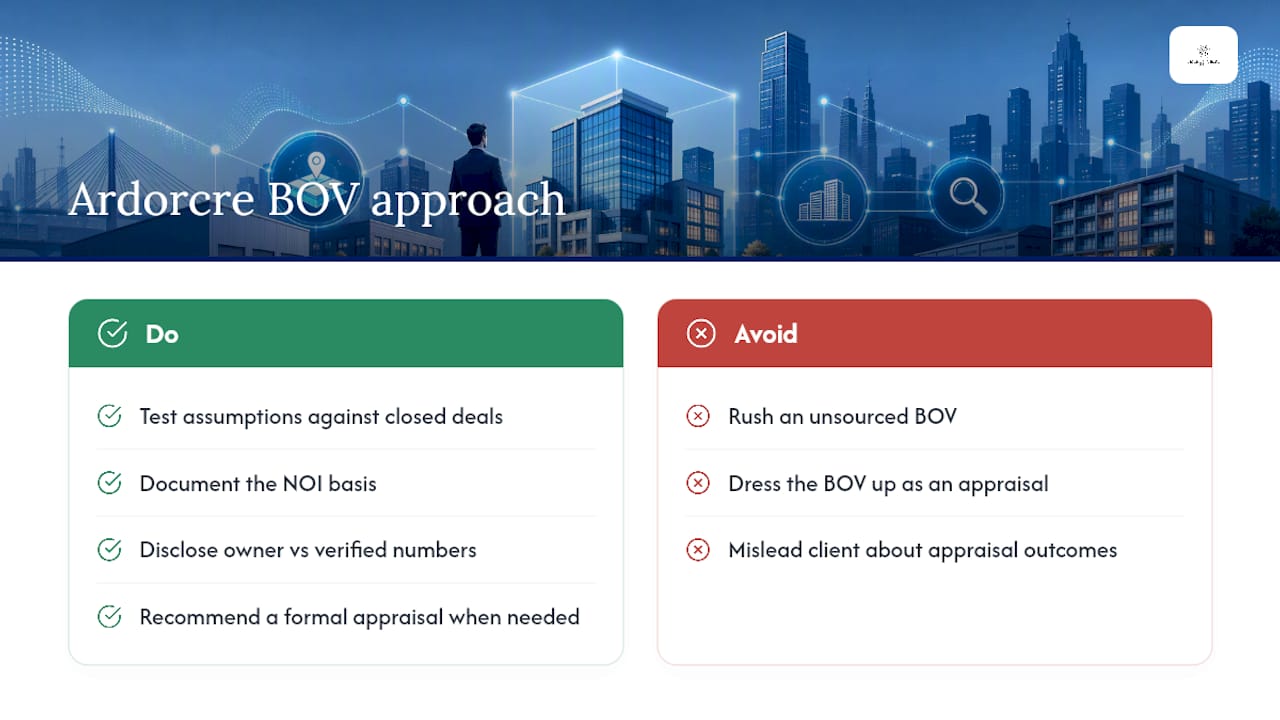
Working across Charlotte’s office, medical, retail, and industrial submarkets means our assumptions get tested against real closed deals constantly, not just comp sheets. When we prepare a BOV, we document the NOI basis, disclose which numbers came from the owner versus what we verified, and tell clients plainly when the stakes call for a formal appraisal instead of our own estimate.
That’s the balance a brokerage has to strike: give owners a fast, honest market read without dressing it up as something it isn’t. A rushed, unsourced BOV helps nobody, least of all the client who later discovers the lender’s appraisal came in far below what they were told to expect.
— Jim
Get a BOV You Can Actually Act On
Ardorcre is the practical alternative to guessing your way into a listing price or an acquisition offer. Our advisors across the Charlotte MSA prepare BOVs grounded in verified rent rolls, documented NOI assumptions, and comps we can actually defend, whether you’re pricing an office building for sale or screening a retail acquisition before you commit capital.
If refinancing is on your radar, our loan sizing guide walks through how a BOV fits into early underwriting before a lender orders their own appraisal. And if you’re gathering the lease and rent-roll documentation a credible valuation needs, our lease abstract guide shows exactly what to pull together first. Reach out to an Ardorcre advisor to scope your next BOV and get a number you can actually use.
Sources
- Broker Price Opinion vs Appraisal Explained
- BOV in real estate: how it compares to BPOs and appraisals
- How to Read a CRE Broker’s Opinion of Value (BOV)