
CAM charges are a tenant’s pro-rata share of a building’s shared operating and maintenance costs, billed on top of base rent. If you lease space anywhere in the Charlotte MSA, your first move is pulling the lease and checking three things: how “operating expenses” is defined, whether there’s a cap on annual increases, and when reconciliation happens. National benchmarks indicate typical CAM charges per square foot annually for Class A office space, and Ardorcre works with Charlotte tenants and landlords daily who get burned by vague lease language rather than bad math.
Do this before you sign or renew anything:
- Request an itemized CAM schedule from the last two years, not just a summary number.
- Confirm whether the management fee is based on CAM costs or gross rent (the difference matters enormously).
- Mark your calendar for the reconciliation window so you don’t waive audit rights by missing it.
Key Takeaways
CAM charges hinge on lease definitions more than raw dollar amounts, and tenants who negotiate caps, exclusions, and audit rights up front avoid the overcharges that surface at reconciliation.
| Point | Details |
|---|---|
| Definition drives cost | CAM is your pro-rata share of shared building upkeep, calculated as your square footage divided by total leasable square footage. |
| Watch the benchmark range | Class A office CAM typically runs $4 to $9 per square foot annually, with lower ranges for Class B, retail, and industrial space. |
| Reconciliation has a deadline | Most leases set a window after fiscal year-end for true-up billing and audit rights. |
| Fee basis matters most | Push for management fees capped as a percentage of CAM costs, not gross rent, and cap controllable expense increases annually. |
| Get language reviewed early | Ardorcre’s lease abstract service surfaces CAM definitions, caps, and audit rights before you sign or renew. |
Table of Contents
- What Charlotte Cam Charges Actually Cover in a Lease
- Which Expenses Belong in CAM and Which Don’t
- How CAM Is Calculated, Reconciled, and Verified
- Typical CAM Ranges and Where Charlotte Fits
- Lease Clauses That Determine Your CAM Exposure
- Resolving CAM Disputes Before They Escalate
- Charlotte Market Notes From an Ardorcre Perspective
- Why Lease Language Beats Lease Math Every Time
- Get a CAM Review Before Your Next Lease Decision
- Sources
What Charlotte Cam Charges Actually Cover in a Lease
Common Area Maintenance, often shortened to CAM, refers to the costs of running and maintaining the shared parts of a commercial property. Landlords sometimes label it “operating expenses” or “pass-throughs” in the lease, but it’s the same concept: tenants split the cost of upkeep for lobbies, parking lots, landscaping, and shared utilities based on how much space they occupy.
CAM sits apart from base rent, which is the rent for the tenant’s own square footage. In a triple net lease, tenants pay base rent plus three separate categories: CAM, property taxes, and insurance. A triple net lease structure shifts almost all building operating risk onto tenants, which is why the CAM definition in the lease deserves as much attention as the rent figure itself.
The pro-rata share calculation is straightforward in concept, even when the underlying expense pool gets murky:
- Take the tenant’s leased square footage.
- Divide it by the building’s total leasable square footage.
- Multiply that percentage by the total CAM expense pool for the year.
Which Expenses Belong in CAM and Which Don’t
Most CAM pools cover a predictable set of line items: janitorial service for common areas, landscaping, parking lot maintenance and lighting, common area utilities, security, and the shared HVAC systems serving lobbies and corridors. Snow and ice removal shows up in colder markets, and in Charlotte you’ll more often see line items for storm cleanup and irrigation instead.
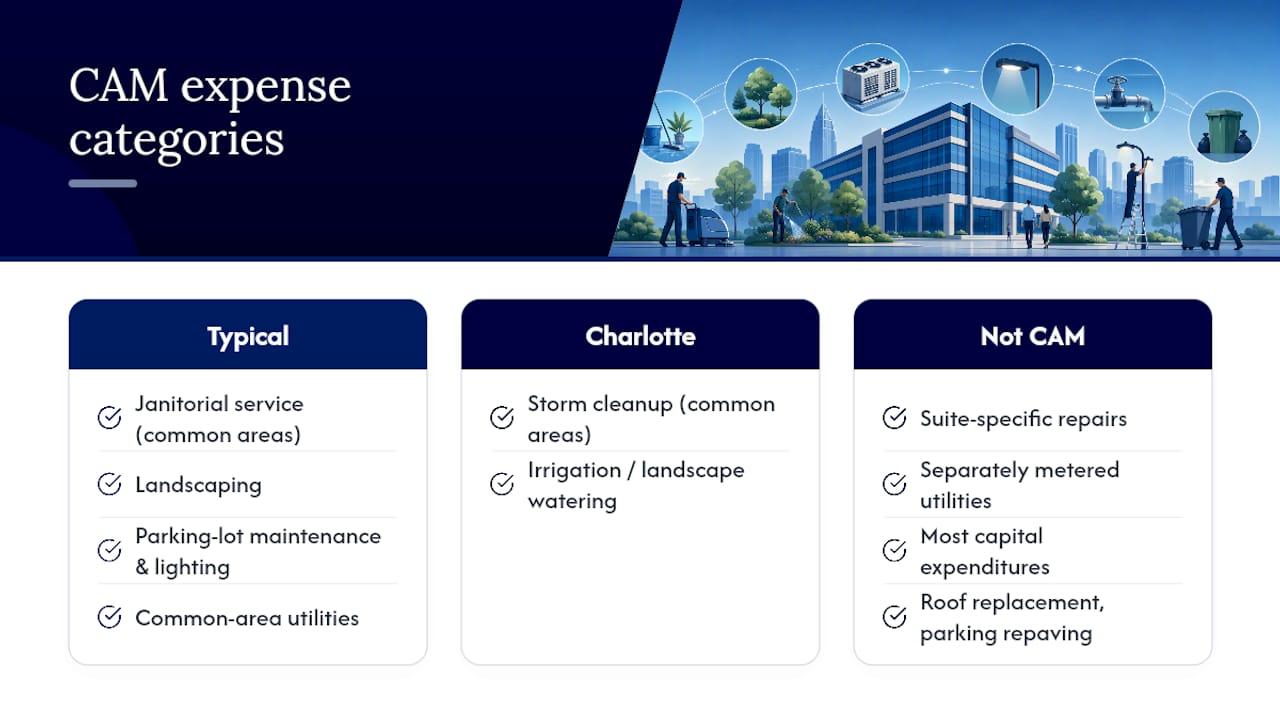
What shouldn’t land in your CAM bill: repairs specific to your own suite, utilities you’re separately metered for, and most capital expenditures. A roof replacement or parking lot repaving is a capital project with a useful life measured in years. Landlords sometimes try to fold these into CAM anyway, which is exactly the kind of dispute commercial lease attorneys in Charlotte see repeatedly.
This is where the controllable versus uncontrollable distinction matters. Controllable expenses are things the landlord can influence through vendor negotiation or efficiency, like janitorial contracts or landscaping. Uncontrollable expenses are largely fixed, like property taxes or utility rate increases. Leases that cap controllable expenses at a fixed annual percentage increase, but leave uncontrollable expenses uncapped, give tenants real protection without asking landlords to absorb costs they can’t manage.

Pro Tip: Ask for the lease to define “capital expenditure” explicitly and exclude it from CAM except for the portion representing that year’s useful-life amortization, if any is passed through at all.
How CAM Is Calculated, Reconciled, and Verified
The formula itself isn’t complicated. Tenant’s Pro-Rata Share × Total CAM Expense Pool = Tenant’s Annual CAM Obligation. The complexity lives in how the expense pool gets built and adjusted, and that’s where landlords and tenants tend to disagree.
Here’s how the annual cycle typically runs:
- The landlord estimates the coming year’s CAM costs and bills tenants monthly installments based on that estimate.
- At year end, the landlord tallies actual expenses and compares them to what was collected.
- Within a reconciliation window of a reconciliation window shortly after the landlord’s fiscal year closes after the landlord’s fiscal year closes, tenants either owe a true-up payment or receive a credit.
The landlord estimated total CAM at $250,000 for the year, so you paid $20,000 in monthly installments ($1,667 a month). Actual CAM expenses came in at $270,000, meaning your true share was $21,600. You’d owe a $1,600 true-up. If actual costs came in under budget instead, you’d get a credit applied to next year’s rent.
The most common gotcha is a “gross-up” clause, which lets landlords calculate the expense pool as if the building were fully occupied even when it isn’t. That’s a legitimate practice for allocating fixed costs fairly, but an undefined or aggressive gross-up formula can quietly inflate your share. Always ask to see the gross-up calculation in writing before you sign.
Typical CAM Ranges and Where Charlotte Fits
CAM costs vary widely by property type and building class, and knowing the range helps you judge whether a quoted number is reasonable. Industry benchmarks put Class A office CAM at $4 to $9 per square foot annually, Class B office at $3 to $5, retail strip centers at $2 to $5, and industrial or warehouse space at a much lower $0.50 to $1.50 per square foot per year, reflecting the smaller common-area footprint in industrial buildings.

Charlotte generally trades as a Tier 2 metro on these benchmarks, meaning CAM costs here tend to sit at or below the midpoint of national ranges rather than pushing toward the top like they might in New York or San Francisco. Ardorcre’s own Charlotte office market analysis shows building class still drives most of the variation within the metro. A newer Class A tower in South End with a full-service concierge and structured parking will run meaningfully higher CAM than a Class B suburban office park in Ballantyne with surface parking and a lighter service package.
Treat any published range as a directional guide, not a guarantee. Sample sizes behind these figures are limited, and a single building’s service level, landscaping schedule, or security staffing can move its CAM well outside the typical band.
Lease Clauses That Determine Your CAM Exposure
The lease language around CAM matters more than the number you’re quoted at signing, because that language determines how much the number can grow. A handful of clauses deserve line-by-line attention before you sign anything.
- CAM definition: a broad, undefined “operating expenses” clause gives landlords room to add new cost categories later without your consent.
- Gross-up provision: confirm the occupancy assumption used and how it’s calculated, not just that one exists.
- Reconciliation and audit rights: you want a specified window, itemized statements, and the right to inspect underlying invoices.
- Capital expenditure language: capital projects should be excluded from CAM or amortized over their useful life, never billed in full the year they occur.
- Management fee basis: the fee should apply to CAM costs, not gross rent, and should be capped as a stated percentage.
On negotiation, three levers do most of the work. Second, negotiate the management fee down to a set percentage, typically 10% to 15% of CAM costs, rather than accepting a fee tied to gross rent. Third, get explicit exclusions in writing for capital repairs, environmental remediation, and any costs tied to other tenants’ defaults.
Pro Tip: If the lease defines the management fee as a percentage of gross rent instead of CAM costs, that’s a red flag worth pushing back on hard. A fee on gross rent grows every time your rent grows, whether or not the landlord’s actual management workload changes at all.
Resolving CAM Disputes Before They Escalate
Three disputes come up more than any others: landlords reclassifying capital projects as CAM, management fees calculated on the wrong base, and square footage figures that don’t match what’s in the lease. Any one of these can quietly inflate your bill for years if it goes unchecked.
Tenants have more leverage than they usually realize. Here’s the practical sequence:
- Request itemized invoices for any CAM line item that looks unusually high year over year.
- Insist the landlord honor the reconciliation timeline stated in the lease, since missing that window can forfeit your audit rights.
- Use an estoppel certificate during any refinance, sale, or renewal to force written confirmation of current CAM obligations and disputes.
- Bring in counsel or a third-party auditor once discrepancies cross a material threshold, rather than after years of overpayment.
Small variances are usually resolved with a documentation request. Larger ones, especially anything tied to a capital expenditure dispute, tend to move faster once a lease attorney is copied on the correspondence.
Charlotte Market Notes From an Ardorcre Perspective
Charlotte’s CAM environment reflects the metro’s mixed building stock: a wave of newer Class A towers alongside decades-old Class B and C product, each carrying very different service expectations. Landscaping and irrigation cycles run longer here than in colder markets, parking lot maintenance shows up as a bigger line item in surface-lot suburban submarkets than in structured-parking urban cores, and security staffing varies sharply between single-tenant flex buildings and multi-tenant office towers.
A CAM number that looks high in isolation often makes sense once you see the building’s actual service package. A number that looks low can be just as much of a warning sign, since it may mean deferred maintenance is coming due.
Before signing or renewing, pull comparable CAM figures from similar buildings in the submarket and request a full lease abstract so every CAM-related clause is summarized in one place rather than buried across forty pages.
Why Lease Language Beats Lease Math Every Time
Most CAM disputes I’ve reviewed weren’t caused by bad arithmetic. They came from lease language so broad that almost anything could be justified as an “operating expense.” Ardorcre pushes clients toward tighter definitions and capped fee structures before they sign, not after a surprise reconciliation bill arrives. That’s the pattern worth remembering: the number on page one of your CAM estimate matters less than the definitions buried on page twelve.
— Jim
Get a CAM Review Before Your Next Lease Decision
A CAM estimate is only as trustworthy as the lease language behind it, and most tenants don’t find the gaps until reconciliation time, when it’s too late to negotiate. Ardorcre reviews Charlotte MSA leases for exactly this reason: unclear operating expense definitions, uncapped management fees, and missing audit rights all show up in a proper lease abstract before you’re locked into another term.
A lease abstract from Ardorcre pulls every CAM-related clause, reconciliation deadline, and fee basis into one summary you can actually use in negotiation, whether you’re renewing an existing space or evaluating a new one. Landlords get the same value from the process: a clean abstract makes it easier to defend CAM charges that are properly documented and justify pricing to prospective tenants. If you’re weighing how CAM costs affect your underwriting on an investment property, our DSCR loan sizing guide walks through how operating expenses factor into loan qualification. Reach out to Ardorcre and request a lease abstract before your next renewal deadline hits.
Sources
- CAM Charges Calculator + Reconciliation Guide (2026)
- What Are Common Area Maintenance (CAM) Fees in Commercial Real Estate?
- Commercial Leases | Charlotte Business Litigation Lawyers Arnold & Smith
- Negotiating CAM charges for a sustainable commercial lease