
Buyer-side commercial closing costs typically run 2% to 5% of the loan or purchase price, while seller-side costs are dominated by broker commissions of roughly 4% to 8%. Actual totals shift with loan type, property type, and how complicated the deal gets. The breakdown below covers every line item, how financing choice changes the math, and how to trim the final bill.
TL;DR:
- Loan financing type significantly impacts closing costs, with CMBS and bridge loans often incurring substantially higher legal and third-party fees than conventional bank loans.
- Seller expenses are mostly driven by broker commissions, which typically range from 4% to 8%, and can dominate the entire seller-side cost structure.
- Due diligence reports like environmental assessments, surveys, and appraisals are essential, with costs scaling based on property type, size, and complexity; skipping them can lead to more expensive surprises later.
- Buyers should negotiate upfront with lenders, vendors, and sellers by requesting detailed fee schedules and early payoff estimates to reduce overall transaction costs effectively.
- The most overlooked expense is the loan payoff mechanics, especially defeasance for securitized debt, which can significantly affect net proceeds and should be modeled well before listing or selling.
Table of Contents
- What Are Transaction Costs in Commercial Real Estate?
- Who Pays Closing Costs: Seller-Side Breakdown
- How Do Loan Types Change Your Closing Costs?
- Due Diligence Costs: What Reports Should You Budget For?
- Does Property Type Change What You Pay?
- How Do You Estimate and Reduce Total Transaction Costs?
- Ardorcre’s Notes From Charlotte Medical-Office and Office Deals
- The Overlooked Line Item in Commercial Transaction Costs
- Sources
- FAQ
What Are Transaction Costs in Commercial Real Estate?
Transaction costs cover every fee, tax, and third-party charge required to close a commercial property sale or business acquisition. That includes lender fees, appraisals, surveys, environmental reports, title insurance, broker commissions, and legal costs. It also covers the softer expenses buyers forget, like prorated taxes or escrow reserves. LegalClarity’s breakdown of transaction cost types frames these as the price of moving an asset from one owner to another, separate from the purchase price itself.
Here’s what buyers actually pay, line by line.
- Loan origination and points: commonly 1% to 2% of the loan amount, sometimes higher on riskier or smaller deals.
- Appraisal: generally costs several thousand dollars, more for specialized properties like hospitals or cold storage.
- ALTA/NSPS survey: $3,000 to $15,000 depending on parcel size and boundary complexity, per LegalClarity’s cost estimates.
- Phase I Environmental Site Assessment: often runs into a few thousand dollars; a Phase II assessment, if needed, can cost considerably more.
- Title insurance, recording fees, and escrow/closing agent charges: vary by state and deal size but are standard on nearly every closing.
- Prepaids and prorations: property taxes, insurance, and sometimes tenant security deposits transferred at closing.
Overall commercial loan closing costs land at 2% to 5% of the loan amount, with conventional bank financing at the low end and CMBS or bridge loans pushing the range higher. Many of these costs aren’t simply expensed. Under IRS guidance on basis and selling expenses, buyer-side acquisition costs generally get capitalized into the property’s basis rather than deducted immediately, which affects depreciation schedules and future gain calculations.
Who Pays Closing Costs: Seller-Side Breakdown
The seller’s biggest line item is almost always the broker commission, and it isn’t close. Commissions commonly run 4% to 8% of the sale price, dwarfing every other seller expense combined.
Beyond commission, sellers typically absorb:
- Loan payoff costs, including prepayment penalties, yield maintenance, or defeasance on securitized CMBS debt. Defeasance can be particularly costly on larger loans and requires early modeling with the lender to avoid surprises.
- Transfer taxes and recording fees, vary depending on local jurisdiction.
- Prorated property taxes and outstanding tenant obligations are also typical seller expenses.
- Legal fees associated with drafting agreements and clearing title issues.
- Marketing and advertising costs incurred during the sale process.
Sellers frequently underestimate defeasance and payoff costs on securitized debt, and that’s one of the more expensive surprises in commercial real estate. Building payoff modeling into the sale timeline early, rather than after a buyer is under contract, avoids a scramble at closing. Negotiation matters here too: a seller credit at closing is often easier to structure than a straight price cut, since it can be allocated to specific repair items without renegotiating the whole deal.
How Do Loan Types Change Your Closing Costs?
The type of financing you choose changes your cost structure more than almost any other variable. A conventional bank loan and a CMBS loan on the same property can differ by tens of thousands of dollars in closing costs alone.
- SBA loans (7(a) and 504): add guarantee fees and CDC fees on top of standard closing costs, offset by lower down payment requirements for owner-occupied medical or office buildings.
- Bridge and hard-money loans: generally carry higher costs with features like increased points, shorter rate locks, and possible extension fees if refinancing is delayed.
If you’re weighing a refinance against a sale on an existing CMBS loan, run the DSCR math before you decide either way. Our guide to DSCR loan sizing walks through how lenders size proceeds against net operating income.
Due Diligence Costs: What Reports Should You Budget For?
Third-party reports are non-negotiable on most commercial deals, and skipping them to save money almost always costs more later.
- Phase I Environmental Site Assessment ($2,000 to $4,000): required on nearly every commercial purchase involving financing. If it flags contamination history, a Phase II adds soil or groundwater testing at a meaningfully higher cost.
- ALTA/NSPS survey ($3,000 to $15,000): price scales with parcel size, boundary disputes, and whether easements need to be plotted.
- Appraisal ($2,000 to $5,000, sometimes more): larger or specialized properties, like a surgical center or a cold-storage warehouse, push toward the top of the range because fewer appraisers are qualified to value them.
- Zoning verification and title exception review: costs vary but are essential when a property has multiple recorded easements or unclear use rights.
- Estoppel certificates and tenant cure costs: modest individually, but they multiply fast in multi-tenant deals where every lease needs sign-off before closing.
Does Property Type Change What You Pay?
Yes, and the differences are significant enough to change your budget by tens of thousands of dollars.
Medical-office deals carry extra due diligence: tenant improvement allowances, licensing verification for physician tenants, and lease review that goes deeper than a standard office lease because of specialized clauses around equipment and compliance. Industrial properties add environmental and site work costs, especially where prior manufacturing use raises Phase II risk. Multi-tenant buildings add process, not just dollars. Every tenant needs an estoppel certificate and often a CAM reconciliation, which stretches the closing timeline and adds legal review hours.
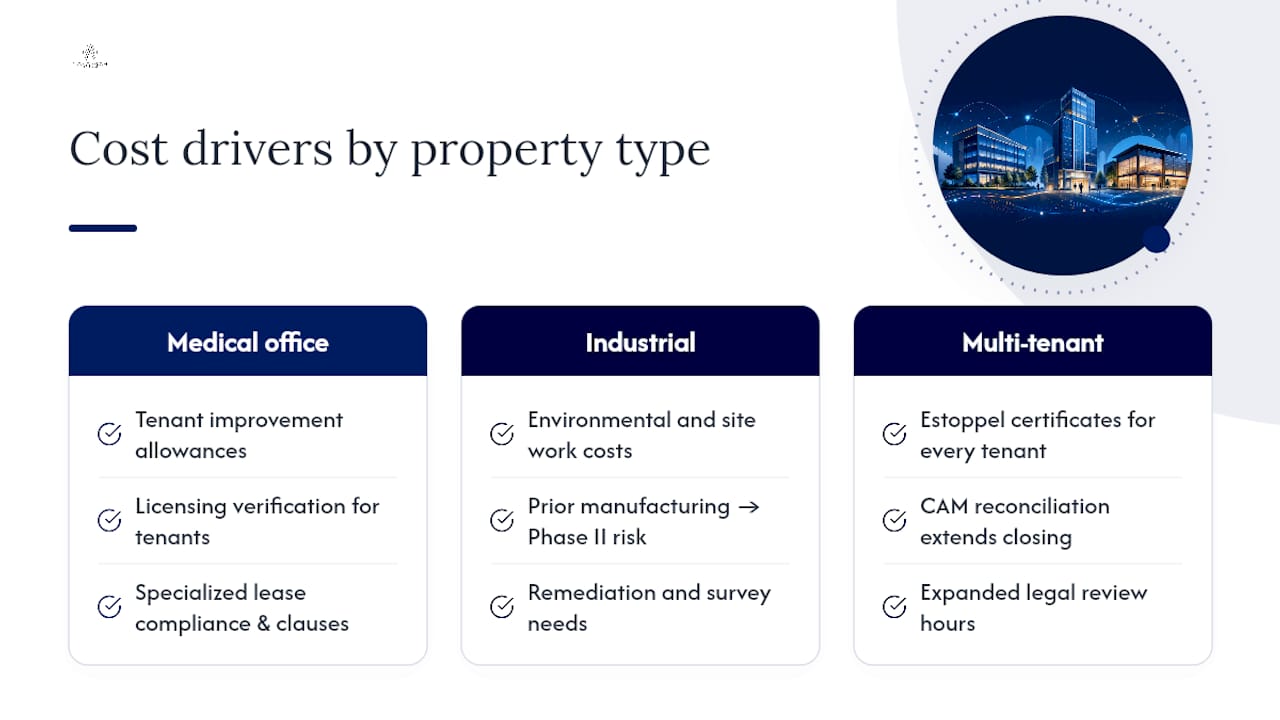
A single-tenant medical office in a stabilized building might close with modest due diligence costs. A ten-tenant multi-tenant office building with mixed lease structures can see legal and estoppel costs multiply several times over for that reason alone.
How Do You Estimate and Reduce Total Transaction Costs?
Start with a simple estimator: total buyer-side costs generally fall between 2% and 5% of the loan or purchase price, plus fixed add-ons for environmental and survey work that don’t scale down much on smaller deals.
Worked example: on a $1.5 million medical-office purchase with a $1.1 million loan, expect roughly $22,000 to $55,000 in loan-related closing costs, plus $7,000 to $20,000 for appraisal, survey, and Phase I combined. On a smaller $400,000 deal, the percentage-based costs shrink, but the fixed-cost items (survey, Phase I, legal) don’t scale down proportionally, so they eat a bigger share of the total.
To bring the number down, investors can benefit from using a real estate portfolio tracker to monitor and manage transaction-cost impact on returns.
- Request itemized fee schedules from every lender and negotiate origination points directly.
- Shop appraisers and surveyors instead of accepting the first referral from your lender.
- Ask about title reissue discounts if the seller’s existing policy is recent.
- Negotiate seller credits instead of price reductions when repairs surface in due diligence.
- Put “who pays what” in writing early in the letter of intent to avoid late-stage disputes.
Pro Tip: Contract language should spell out exactly who pays each line item before you’re under contract, not during closing week negotiations when leverage has already shifted.
Ardorcre’s Notes From Charlotte Medical-Office and Office Deals
On a Charlotte medical-office purchase, Ardorcre’s advisors budget for tenant improvement costs, licensing checks, and lease review on top of standard closing costs, since physician-tenant arrangements often carry unusual clauses. On complex medical-office or multi-tenant deals, it’s smart to add a contingency line beyond the base estimate to cover estoppel issues or last-minute environmental findings.
For owners carrying CMBS debt and weighing refinance against a sale, the decision usually comes down to DSCR headroom and how far current rates have moved since origination. If refinance proceeds don’t clear a reasonable margin over the payoff, a sale may pencil out better once defeasance costs are modeled honestly.
Local vendor relationships matter too. Negotiating commission structures and choosing surveyors who know Mecklenburg County’s title quirks can shave real time and cost off a closing. If you’re weighing this decision on your own building, Ardorcre’s services cover valuation, leasing, and disposition advisory across the Charlotte MSA.
The Overlooked Line Item in Commercial Transaction Costs
Most guides on commercial transaction costs treat every deal like a straightforward asset sale, but that framing misses where the real money leaks out. The biggest surprises rarely come from the appraisal or the survey. They come from loan payoff mechanics, especially defeasance on CMBS debt that sellers didn’t model until a buyer was already under contract.
Conventional wisdom tells sellers to focus on maximizing sale price and let the closing costs sort themselves out. That’s backwards. On a securitized loan, the payoff cost can move the net proceeds more than a modest price negotiation ever would. Anyone holding CMBS debt on a medical-office or industrial building should get a payoff estimate from their loan servicer months before listing, not weeks.
The second underrated lever is vendor selection. Buyers obsess over interest rate but skip the exercise of comparing appraiser, surveyor, and title company fees across providers, even though that comparison often saves more than a quarter-point on the rate ever would. Prioritize the payoff math and the vendor shopping first. Everything else is detail work.
— Jim
Sources
FAQ
What Are Some Examples of Transaction Costs?
Common examples include loan origination fees, appraisals, surveys, title insurance, environmental reports, broker commissions, transfer taxes, and legal fees tied to closing a commercial deal.
How Much Are Closing Costs on a $400,000 Commercial Property?
Expect roughly 2% to 5% of the loan amount in lender-related costs, but fixed expenses like a Phase I environmental report and survey don’t shrink proportionally, so they take up a larger share of the total on smaller deals.
What Is the Safe Harbor Rule for Transaction Costs?
Tax rules generally require capitalizing many acquisition-related transaction costs into the buyer’s basis rather than deducting them immediately, though specific treatment depends on the cost type and should be confirmed against current IRS guidance.
What Are Commercial Transactions?
Commercial transactions are business dealings involving the sale, lease, or transfer of property or assets between businesses or investors, ranging from a property sale to a card payment processed through a platform like Stripe or PayPal.