
South End retail asking rents currently run roughly $28 to $45 per square foot per year for street-front space, well above the Charlotte metro average of $16 to $22/SF. For a typical 1,200 to 2,000 square foot unit, that translates to a substantial monthly rent before triple net charges. Vacancy is tight enough that landlords hold most of the leverage right now.
- Asking rents: $28 to $45/SF/yr for street retail, with some corner listings quoting near $36/SF/yr
- Monthly range for 1,200 to 2,000 SF: roughly $2,800 to $7,500 base rent
- Vacancy: compressed, with limited concessions from landlords
- Action step: talk to a local broker before touring, and get your financials underwriting-ready
Key Takeaways
South End retail rents currently sit well above the Charlotte metro average, and tenants who prepare strong financial packages and negotiate TI allowances aggressively get better real outcomes than those who focus only on the quoted rate.
| Point | Details |
|---|---|
| Current asking rent range | South End street retail runs roughly $28 to $45/SF/yr versus $16 to $22/SF citywide. |
| Supply pipeline | About 212,000 SF is under construction against a 1.3 million SF existing retail base. |
| Build-out costs | First-generation shell upfits can run $70 to $90/SF, directly affecting effective occupancy cost. |
| Negotiation leverage | TI allowance and abatement period often move more than the headline rent in a tight vacancy market. |
| Local broker advantage | Ardor CRE provides off-market access, lease abstracts, and site selection analysis tailored to South End’s tenant mix and demand drivers. |
Table of Contents
- Understanding South End Retail Rents: The Current Data
- What Retail Rent Quotes Actually Mean for Your Budget
- Checklist for Evaluating and Negotiating a South End Lease
- Where to Search and How Ardor CRE Fits Into Your Process
- Historical Rent Trends and Forecasts for South End Retail Rents
- How South End Compares to Nearby Charlotte Submarkets
- Zoning Rules and Local Ordinances Shaping South End Rents
- The Retail Tenants Actually Thriving in South End
- Seasonality and Economic Cycles in South End Retail
- Accessibility and Transit Access Driving Retail Demand
- What the Data Actually Tells Tenants and Investors
- Get Local Leasing Support From Ardor CRE
- Sources
Understanding South End Retail Rents: The Current Data
South End holds about 1.3 million square feet of retail space, with 212,000 square feet under construction, according to the neighborhood’s own Fast Facts data. That pipeline sounds large until you consider the demand pushing against it: over 13,100 residents live in the submarket, median household income sits near $93,700, and roughly 3,511 apartment units are under construction, feeding a wave of daily-use retail demand for coffee shops, fitness studios, and quick-service restaurants.
Rent Snapshot: Charlotte’s citywide average asking retail rent runs $16 to $22/SF/yr, compared to a national average near $24.69/SF/yr. South End’s street-front space regularly clears $28 to $45/SF/yr, a premium that reflects foot traffic density and the neighborhood’s brand as Charlotte’s live-work-play core.
Suite sizes vary more than most tenants expect. Listing platforms like CityFeet show available South End retail space spanning 200 square feet up to several thousand, with larger blocks often quoted as “rate upon request” rather than a published $/SF figure. The most common bands fall between 1,200 and 3,500 square feet, which fits the small-format retail and food and beverage concepts that dominate the corridor.
- Common suite sizes: 1,200 to 3,500 SF for storefront retail
- Smaller formats (under 1,000 SF) exist but move fast
- Larger anchor-style spaces are rare and typically pre-leased before public marketing
What does this mean for your timing? When vacancy compresses this much, tenants lose negotiating room on free rent and tenant improvement dollars. If you’re planning a 2026 opening, start your site search at least six to nine months out, because the best corners get claimed before they hit a public listing.
What Retail Rent Quotes Actually Mean for Your Budget
Asking rent quoted at “$36/SF/yr” doesn’t mean $36 a month, and it doesn’t mean that’s your total occupancy cost either. Divide the annual rate by 12 for monthly base rent: a 1,500 square foot space at $36/SF/yr runs $4,500 a month in base rent alone, before you add operating costs.
Most South End retail leases use a triple net (NNN) structure, where the tenant pays base rent plus a pro-rata share of property taxes, insurance, and common area maintenance (CAM). A smaller share of deals, particularly in older mixed-use buildings, use modified gross terms where the landlord absorbs some operating costs into a higher base rate.
- NNN charges in Charlotte retail typically add $6 to $12/SF/yr on top of base rent
- CAM often covers landscaping, common area lighting, trash removal, and property management fees
- Property taxes and insurance get passed through separately in most NNN structures
- Percentage rent clauses appear mainly in larger anchor deals, not typical South End storefronts
Build-out costs matter just as much as the rent quote. Institutional landlords now expect stronger tenant financial packages, and first-generation shell space in Charlotte can run $70 to $90/SF to bring to a functional storefront. A tenant improvement allowance of $30/SF on a $75/SF build-out leaves you fronting $45/SF in cash or amortized rent, which changes your real occupancy cost significantly.
Pro Tip: Ask for the landlord’s TI allowance in writing before you fall in love with a space. A gorgeous corner with a $15/SF allowance on an $80/SF build-out can cost more than a plainer space with a $50/SF allowance.
Checklist for Evaluating and Negotiating a South End Lease
Touring a space is the easy part. Getting the lease terms right separates a good deal from a bad one, and in a market this tight, you need a structured approach before you sign a letter of intent.
- Confirm site fundamentals: check frontage width, pedestrian counts at different times of day, proximity to anchor tenants or transit stops, and whether parking is dedicated or shared.
- Push on financial levers: negotiate the TI allowance, ask about free rent or abatement periods, and clarify renewal terms and any percentage rent triggers before you accept the base rate.
- Verify operational clauses: nail down permitted use language, exclusive use protections against competing tenants, operating hours requirements, signage rights, and who owns HVAC maintenance and replacement.
- Review encumbrances: request an estoppel certificate to confirm the landlord’s representations about the lease match what’s actually recorded.
- Stress-test the deal financially: run the full occupancy cost, including NNN charges and amortized build-out, against your sales projections before you commit.
Landlords in a low-vacancy market tend to hold firm on rent but stay flexible on TI and timing, especially for tenants with strong balance sheets or a track record in similar formats. If a landlord won’t move on rate, ask about extending the free rent period or increasing the improvement allowance instead. That’s often where the real negotiation room lives right now.
Pro Tip: Never negotiate against yourself by revealing your maximum budget early. Let the landlord’s broker make the first counteroffer on TI and abatement, then respond.
Where to Search and How Ardor CRE Fits Into Your Process
Different listing sources serve different needs. Crexi and LoopNet cover broad market scans and larger blocks; CityFeet and TenantBase tend to surface smaller street-front availabilities faster. None of these platforms show off-market inventory, though, and in South End’s compressed environment, a meaningful share of the best deals never get publicly listed at all.
- Broad market scans: Crexi, LoopNet (compare platforms in our Crexi vs LoopNet breakdown)
- Small street-front space: CityFeet, TenantBase
- Off-market access: local brokerage relationships
A local broker earns their fee by closing that gap. Ardor CRE’s advisors track South End inventory before it becomes public, and that lead time often decides whether you land a corner spot or settle for a second choice. The brokerage’s retail site selection playbook walks through demographic fit, traffic analysis, and co-tenancy considerations that generic listing sites don’t cover, and tenant representation includes lease abstraction so you know exactly what you’re signing before you sign it.
If you’re an investor rather than a tenant, the same local knowledge applies to underwriting acquisition targets and structuring debt through a DSCR loan sizing analysis.
Historical Rent Trends and Forecasts for South End Retail Rents
South End’s retail rents have climbed steadily since the light rail extension solidified the neighborhood’s identity as a walkable, mixed-use district rather than a former industrial corridor. What started as a handful of breweries and creative-office conversions a decade ago pulled in national retail attention once the residential density hit critical mass.
The trajectory forward depends heavily on the 212,000 square feet currently under construction. New retail delivering into a market with sustained apartment growth typically gets absorbed quickly rather than sitting vacant, especially when it’s paired with ground-floor space in mixed-use residential buildings that landlords need to activate for their own leasing success.
Expect asking rents to keep climbing on premium corners through 2026 and into 2027, though not uniformly. The gap between prime street frontage and secondary side-street space will likely widen, because institutional owners increasingly reserve their best-positioned suites for national or regional credit tenants who can pay a premium and sign longer terms. Independent operators may find more negotiating room on quieter blocks a few minutes’ walk from the busiest corners, where rent growth tends to lag the headline numbers you see on flagship listings.
How South End Compares to Nearby Charlotte Submarkets
South End commands a real premium over most other Charlotte retail nodes, and that premium is the price of proven foot traffic. NoDa, a few miles northeast, offers a similar creative, walkable vibe but with less residential density and a smaller retail base, which generally keeps its asking rents below South End’s street-front pricing.
Uptown Charlotte competes on daytime office worker traffic but empties out on nights and weekends in a way South End does not, thanks to its residential base. Ballantyne and other suburban nodes offer lower rents and easier parking but lack the walkability that lets a South End retailer capture repeat customers on foot.
The practical takeaway for tenants: if your concept depends on impulse, walk-by traffic and evening or weekend activity, South End’s premium over the citywide $16 to $22/SF average is buying you something real. If your model works fine with destination customers who’ll drive to you, a lower-cost submarket might deliver better unit economics even at a lower top-line sales volume.
Zoning Rules and Local Ordinances Shaping South End Rents
Charlotte’s zoning code treats much of South End under transit-oriented development (TOD) districts tied to the Blue Line, which encourage dense, mixed-use construction with ground-floor retail as a built-in requirement rather than an option. That’s a major reason retail supply keeps pace with residential growth instead of lagging behind it.
This zoning structure indirectly supports rent levels by mandating active ground-floor uses in most new buildings, which keeps a steady stream of small-format retail suites coming online even as larger blocks stay scarce. Parking minimums in TOD zones are also relaxed compared to suburban Charlotte, which lowers a landlord’s development cost per square foot and, in some cases, gets passed through as more competitive rent on new construction.
Zoning changes can move slower than the market, though. Any tenant considering signage, drive-through service, or outdoor seating should confirm permitted use and any conditional approvals with the city before signing a letter of intent. A concept that works two blocks away might face different restrictions depending on the exact zoning overlay.
The Retail Tenants Actually Thriving in South End
Daily-use retail dominates South End’s tenant mix, and that’s not an accident. With median household income near $93,700 and a population skewed toward young professionals, the categories that perform best are the ones people visit multiple times a week rather than once a season.

Fitness studios, fast-casual restaurants, coffee shops, and boutique fitness concepts fill a disproportionate share of new leases. Craft breweries and taprooms, which helped define the neighborhood’s early identity, remain a meaningful presence, though rising rents have pushed some newer operators toward smaller footprints than the sprawling original taproom model.
Service retail, salons, med-spas, and specialty grocery or convenience formats round out the mix, benefiting directly from the apartment construction pipeline that keeps adding residents within walking distance. Traditional apparel and big-box retail remain thin on the ground, largely because the suite sizes and rent structure favor smaller, higher-frequency concepts over larger-format stores that need more square footage to pencil out.
Seasonality and Economic Cycles in South End Retail
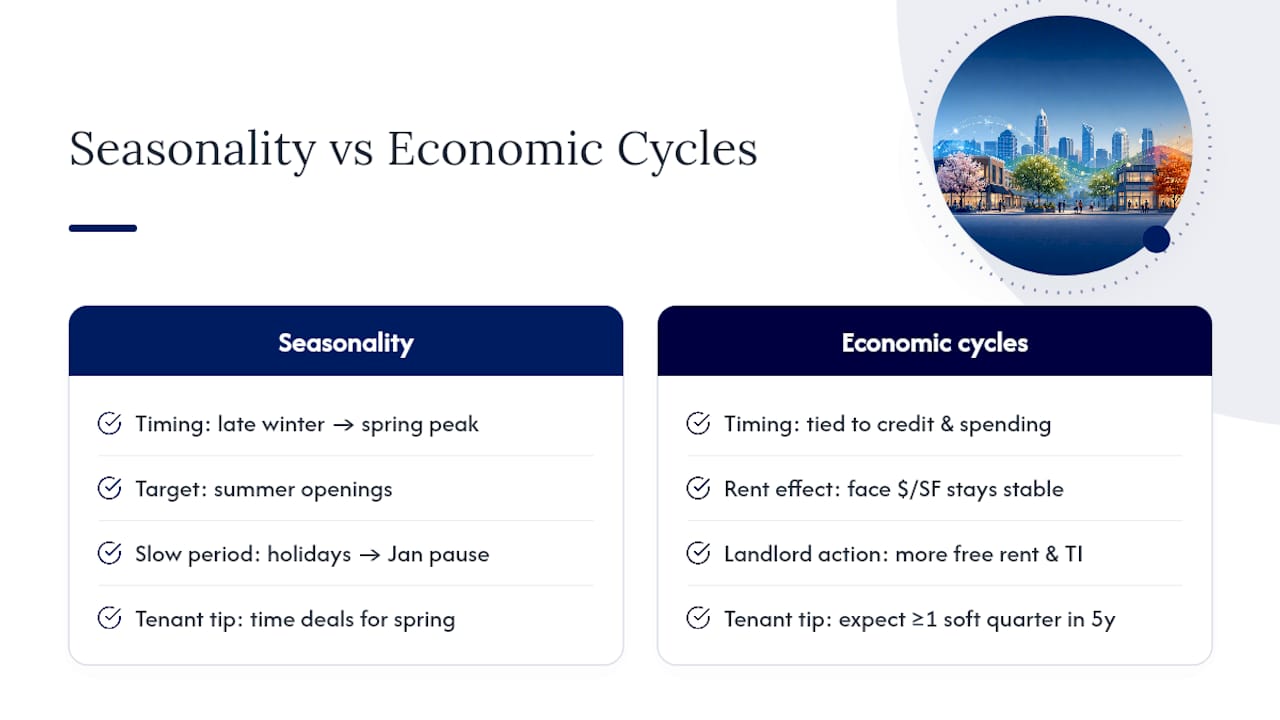
Retail leasing in South End follows a mild seasonal rhythm tied to Charlotte’s broader commercial calendar. Deal activity tends to pick up in late winter and spring as operators aim for summer openings, then slows again heading into the holidays when landlords and tenants alike prefer to wait until January to restart negotiations.
Economic cycles matter more than seasonality for rent levels. During periods of tighter credit or slower consumer spending, expect landlords to hold firmer on face rent while quietly extending more free rent and improvement allowance, rather than dropping the quoted $/SF rate. That keeps published asking rents looking stable even when the effective, negotiated rent is softer underneath.
Interest rate movements also ripple into retail leasing indirectly. When financing costs rise, some planned new construction gets delayed or repriced, which can tighten the supply picture and support existing asking rents even during a broader economic slowdown. Tenants underwriting a long-term lease commitment should build a buffer into their sales projections for at least one soft quarter within any five-year lease term, because Charlotte’s retail sector isn’t immune to national consumer spending cycles even with strong local fundamentals.
Accessibility and Transit Access Driving Retail Demand
Foot traffic doesn’t happen by accident in South End. The Lynx Blue Line light rail runs the length of the corridor, and stations at New Bern, East/West Boulevard, and Scaleybark anchor retail clusters that consistently command the highest asking rents in the submarket. Space within a five-minute walk of a station carries a measurable premium over similar space two blocks farther out.
Bike infrastructure and pedestrian-friendly streetscapes reinforce that pattern. South End’s greenway connections and dedicated bike lanes bring in a customer base that skips the car entirely, which matters for retail categories like coffee, quick-service food, and fitness that thrive on convenience and repeat visits rather than destination trips.
Parking remains the trade-off. Dedicated parking is scarce and expensive to build, so tenants relying on drive-in customers from outside the immediate neighborhood need to factor in shared garage access or street parking limitations before committing to a lease. A concept built around walkability and transit access will generally outperform a car-dependent model in this specific submarket, regardless of how well that same concept might work in a suburban Charlotte location.
What the Data Actually Tells Tenants and Investors
The conventional advice you’ll hear about South End is “get in before it’s too expensive,” which was true five years ago and is now mostly useless. Rents already reflect the neighborhood’s arrival. The more useful question isn’t whether South End is expensive, it’s whether your specific concept generates enough repeat, walk-up revenue to justify paying a premium over the Charlotte average.
What gets underestimated is how much the tenant improvement negotiation matters compared to the headline rent. Two tenants can sign leases at the same $/SF rate and end up with wildly different real costs depending on who negotiated a stronger allowance and abatement period. Tenants fixate on the rent number because it’s the easiest thing to compare, but it’s often not the number that determines whether the location is profitable.
If you’re prioritizing one thing, prioritize underwriting readiness before you tour space. In a market where institutional landlords increasingly favor tenants with strong financial packages, showing up prepared changes what landlords are willing to offer, not just whether they say yes.
— Jim
Get Local Leasing Support From Ardor CRE
Ardor CRE gives you something the listing platforms can’t: a Charlotte-based team that already knows which South End corners are about to hit the market before they’re publicly listed. That head start matters when vacancy is this tight and the best space moves fast.
Whether you’re a tenant chasing the right storefront, an investor underwriting a retail acquisition, or a landlord trying to price a vacancy correctly, Ardor CRE’s advisors handle tenant representation, lease abstracts, and site selection analysis built specifically around South End’s data and demand drivers. The team’s retail site selection playbook walks through the same demographic and traffic factors covered in this snapshot, applied to your specific concept.
If you’re ready to move on a South End location or need a second opinion on a lease you’re negotiating, reach out through Ardor CRE’s Charlotte office to get a broker looking at your specific situation this week.