
A restoration clause is the part of a commercial lease that says what a tenant must remove, repair and return when the lease ends. In practice it obligates the tenant to hand back the space in its original condition, often a “vanilla shell” or “as-delivered” state, as one lease-clause guide describes it. The cost can be large, and it is almost always set by the wording you sign on day one, not by anything you negotiate at move-out. Here is how the clause works, where the negotiating room is, and what to put in writing before the first wall goes up.
TL;DR
- Restoration duties are contractual. If the lease is silent, there is generally no restoration obligation, so the exact wording controls your cost.
- The common default at the end of a lease is broom-clean condition with ordinary wear and tear excepted, but many landlords write in removal of alterations and a return to shell condition.
- Ask the landlord to say in writing, when it approves each alteration, whether it must be removed. Silence should mean you keep it in place.
- End-of-term restoration and casualty restoration (after fire or storm) are two different duties with different rules. Check both.
- If restoration is not finished, the landlord can do the work at your expense and may charge holdover rent while the space is out of condition.
Table of Contents
- What a restoration clause actually does
- Surrender condition: broom-clean versus shell
- Which improvements the landlord can require you to remove
- Who pays, and how the lease sets scope, standard and deadline
- Casualty restoration is a different duty
- Document before you build
- Before you move out
- What happens if restoration is not completed
- Perspective
- Get the restoration terms right before you sign
- FAQ
- Sources
What a restoration clause actually does
Think of the clause as a before-and-after promise. The lease describes the space as delivered. The clause describes the condition it must be in when you leave. Everything between those two points, the walls you added, the plumbing you ran, the signage you hung, is the tenant’s responsibility to either leave behind or take out.
An American Bar Association sample alterations clause for retail leases shows the typical scope: it governs the removal of required alterations and tenant-owned property, the condition in which the premises must be surrendered, and who pays for repairs. The same sample provides that the tenant’s obligations survive expiration or earlier termination. That last point matters. Moving out, or even a negotiated early exit, does not wipe the obligation away unless the lease or a termination agreement says so. If you are considering leaving before the term ends, read our guide to exiting a commercial lease early alongside the restoration language.
The clause matters most for the tenants who build the most. A dental or orthodontic practice with plumbed operatories, lead-lined walls and compressed air lines has far more to restore than a professional office that added a few partitions. A retailer with a custom storefront faces a different list again. The same clause can cost almost nothing for one tenant and six figures for another.
Surrender condition: broom-clean versus shell
There are really two questions inside a restoration clause. First, what condition must the space be in? Second, which of your improvements must come out?
On the first question, the default most tenants should aim for is modest. A New York City Small Business Services leasing guide notes that at the end of a commercial lease a tenant is generally expected to surrender the space broom-clean, free of personal property and debris, and in good operating order, with reasonable wear and tear excepted. The same guide suggests tenants negotiate broom-clean as the standard for lease expiration to avoid the shock of unexpected restoration costs. It is a New York document, but the surrender concepts it describes appear in leases across the country, including in the Charlotte market.
A surrender clause, as a Cozen O’Connor analysis reported in 2017, generally defines the tenant’s duties when the lease expires or terminates. It commonly requires good condition, repair, broom-clean delivery and removal of personal property, while excepting ordinary wear and tear and casualty damage according to the lease wording.
Notice the phrase “according to the lease wording.” Two clauses that both say “good condition” can mean very different things. Compare these standards:
| Standard | What it usually means for the tenant | Typical exposure |
|---|---|---|
| Broom-clean | Remove personal property and debris, leave systems working, repair damage beyond ordinary wear | Low |
| Condition at delivery, wear and tear excepted | Return the space to what you received, which may include removing alterations | Moderate to high |
| Vanilla shell or base building condition | Strip tenant-installed improvements back to the structure and core systems | High |
| Landlord’s election | Landlord decides, near the end of the term, what stays and what goes | Unpredictable until the notice arrives |
If your lease uses the last row, ask for a deadline and a requirement that the election be in writing. The next sections show why.
Which improvements the landlord can require you to remove
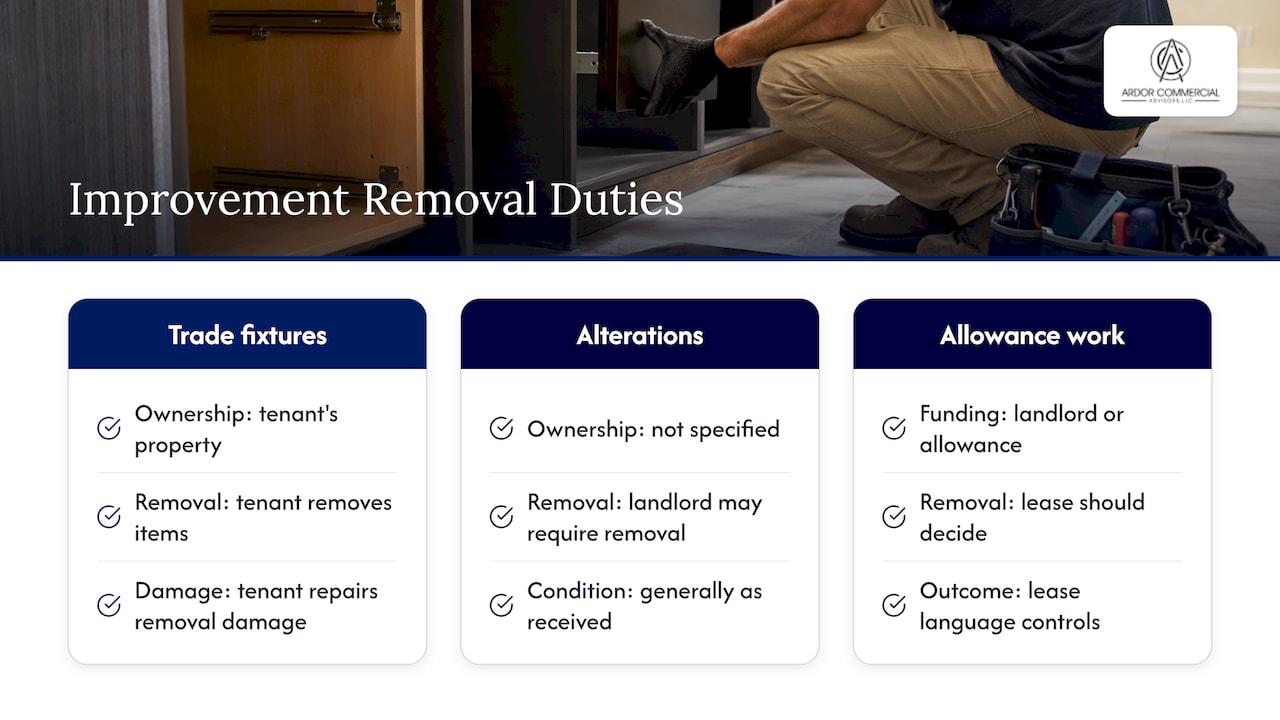
Most leases separate three categories of items, and the category decides the outcome.
Trade fixtures and equipment. These are items used for the tenant’s specific business. They generally remain the tenant’s property and must be taken out by the tenant at lease end, and the tenant must repair the damage that removal causes, according to the same NYC guide. Think imaging equipment, dental chairs, retail shelving and display cases.
Alterations and improvements. Walls, ceilings, built-in millwork, added restrooms and utility installations. Landlords often keep the right to demand removal of these non-trade alterations to restore a shell condition. A commercial lease filed with the SEC shows the common language: removal of tenant-installed improvements, alterations or utility installations at the landlord’s request. A Jenner & Block paper on office-lease restoration adds that, absent a contrary agreement, a tenant generally surrenders substantially the same condition as received, subject to ordinary wear and tear and specified casualty exceptions. Unauthorized alterations, or alterations the tenant agreed to remove, are commonly removable.
Landlord-funded or allowance-funded work. Work paid for through a tenant improvement allowance is where disputes start. The landlord paid for it, so does it stay? The lease should answer that directly. Our tenant improvement allowance playbook walks through how allowances are structured and why the restoration language should be read at the same time.
A court read the clause narrowly
In Solow Management Corp. v. Arista Records, Inc. (New York, 2006), the court held that a restoration provision did not automatically require removal of every approved change. The clause exempted changes consistent with general office use and unlikely to create additional expense for reletting. The decision is one court’s reading of one lease in one state, so do not treat it as a rule. It does show something useful: carve-outs written into the clause carry real weight. A sentence that exempts “improvements suitable for general office or medical office use” can save a tenant a great deal.
Who pays, and how the lease sets scope, standard and deadline
The tenant usually bears restoration costs. What the lease can do is shape the size of the bill. According to the restoration-clause guide, leases can designate improvements that are exempt from removal, define the required condition, and set a date by which the landlord must elect in writing which improvements have to be restored.
The ABA’s pro-landlord sample illustrates the election mechanism. The landlord may notify the tenant within 30 days before lease expiration whether alterations belong to the landlord, must be removed by the tenant, or will be removed by the landlord at the tenant’s expense. A 30-day window is tight for a tenant that needs contractors, permits and downtime. If you are negotiating, push for the election to come much earlier, ideally when the alteration is approved.
Restoration scope is also a matter of detail. Restoration of tenant installations often includes patching penetrations in floors, walls and ceilings to the landlord’s reasonable satisfaction, as seen in that SEC-filed lease. “Reasonable satisfaction” is a phrase to watch. It is subjective, so define it: patched and painted to match, or patched and left unpainted.
A practical negotiating list:
- Exempt standard improvements for your use (office, medical, retail) from removal.
- Require the landlord’s removal election in writing at the time of approval.
- Cap or define restoration to broom-clean for any improvements the landlord approved without comment.
- Let the tenant choose its own contractor, subject to reasonable insurance and licensing standards.
- Specify that the restoration period does not trigger holdover rent. This point is covered below.
Casualty restoration is a different duty
Searchers often mix up two clauses that both use the word “restore.” The end-of-term restoration clause deals with alterations at move-out. The damage and destruction clause deals with fire, storm and other covered events during the term. The Jenner paper’s practitioners treat them as separate regimes: end-of-term alteration removal is contractual surrender work, while casualty restoration is an insurance-and-repair regime.
| End-of-term restoration | Casualty restoration | |
|---|---|---|
| Trigger | Lease expiration or termination | Fire or other covered damage during the term |
| Who usually acts | Tenant | Landlord for the building, tenant for its own interior items, depending on the lease |
| Driven by | Alterations clause, surrender clause | Damage and destruction clause, insurance provisions |
| Key negotiation points | What must be removed, standard, deadline | Timelines, rent abatement, termination rights, insurance proceeds |
On casualty, the National Retail Tenants Association reported in 2019 that responsibility commonly follows the party required to insure the affected improvements. Landlords often restore building improvements, while tenants restore interior improvements, fixtures and equipment. The same piece notes that leases may allocate those duties differently, especially triple net or ground leases. If you are in a triple net structure, our triple net lease guide explains how those cost allocations flow.
Several points are worth confirming in any damage and destruction clause:
- Landlord’s repair standard. Mesch Clark & Rothschild explains that leases typically require the landlord to repair and restore improvements to the extent casualty-insurance proceeds are available, unless the lease is terminated. If proceeds fall short, the landlord may not be obligated to rebuild.
- Timelines. One U.S. lease-negotiation guide advises that the landlord should be obligated to start repairs within 30 days and complete them within 180 days of commencement, with rent abated in proportion to lost use. It also cautions against making the landlord’s duty depend on resolving insurance claims, which can take years.
- Insurance proceeds. Stoel Rives recommends that proceeds be contractually available to the party responsible for rebuilding, and that the clause define when and how either side may terminate.
- Specialty improvements. ICSC’s 2025 casualty-restoration materials illustrate that a clause may require landlord repair of the building and insured improvements while excluding tenant property and specialty alterations, and may give the tenant rent abatement while the premises are untenantable. A medical tenant with expensive buildout should know whether its specialty work falls on its side of that line, and insure it accordingly.
For abatement mechanics in medical and office leases, see our rent abatement guide.
Document before you build
The best time to deal with restoration is before construction begins. The pattern in the sources is consistent: parties should explicitly record which improvements must be removed at lease end so they do not argue about it later. The ABA’s 2022 pro-tenant sample takes the idea further. It requires the landlord to indicate, when it approves alterations, whether they must later be removed. If the landlord does not say so, the alterations are treated as landlord property and need not be removed.
You can build that discipline into the process:
- Attach plans to the lease or work letter. Identify each improvement, and mark each as remain or remove. Our 10-point landlord work letter checklist covers where this belongs.
- Get the approval in writing. An email saying “approved” is weaker than an approval that also states the restoration treatment.
- Photograph the space at delivery. A dated photo set of the shell condition gives you evidence of what “as delivered” means.
- Record mechanical and specialty work. Roof penetrations, added HVAC, dedicated electrical and plumbing are the items landlords most often want removed or certified. If your buildout touches mechanical systems, maintenance records and a commercial HVAC service contract help show the equipment is in good operating order at surrender.
- Ask for an estoppel when the time comes. At sale or refinance, an estoppel certificate can confirm in writing what obligations each side believes exist.
Before you move out
When the end of the term is in view, review the lease for the exact restoration scope, then talk to the landlord about whether it intends to enforce removal of existing improvements. That sequence, lease first and conversation second, comes straight from the research on tenant practice. Many landlords will waive removal of improvements they can reuse, particularly in medical and office space that suits the next tenant.
A workable timeline:
- 12 to 18 months out: Re-read the alterations, surrender and holdover sections. Check notice deadlines for any election the landlord must make.
- 9 to 12 months out: Request the landlord’s written position on each improvement. Get quotes from contractors for any removal the landlord insists on.
- 3 to 6 months out: Schedule work so that it finishes before the last day of the term, including permit time.
- At surrender: Walk the space with the landlord or property manager, and record the agreed condition in writing.
If you are also planning your next space, our commercial leasing timeline for medical and office tenants shows how to line up the new lease with the restoration work on the old one.
What happens if restoration is not completed
The consequences are spelled out in most leases. If a tenant fails to perform required restoration, the landlord may do the work at the tenant’s expense, charge the tenant the estimated cost, or potentially hold the tenant liable for holdover rent until the premises are fully restored, as the SEC-filed lease language illustrates.
The holdover point catches tenants by surprise. If restoration extends past the last day of the term, the space is not delivered back, and the holdover rate can apply. Some office and medical leases set that rate at a steep multiple of base rent. Read our holdover rent guide before you finalize your move-out schedule, and negotiate a short grace period for restoration work if the lease allows.
A security deposit is the other pressure point. Landlords commonly hold it against restoration shortfalls, so deposit terms and restoration terms should be read together. See our guide to commercial security deposits and burn-offs.
Perspective
Most restoration disputes we see are not about bad faith. They are about a lease that said “restore to original condition” and a buildout that nobody mapped to that sentence five or ten years earlier.
Our view is that restoration belongs in the first round of lease negotiation, not the last. When we represent a tenant, we want each planned improvement tagged as remain or remove before the lease is signed, a written landlord election tied to approval, and a surrender standard no stricter than the use requires. When we represent a landlord, we want the same clarity, because a clean, documented surrender makes the space easier to relet and keeps the relationship with the departing tenant intact.
That is why a lease review early in the process pays for itself. Reading the alterations, surrender, casualty and holdover sections together, and putting numbers on the exposure, turns a vague clause into a known cost.
Jim
Get the restoration terms right before you sign
We advise medical, office, retail and industrial tenants and landlords across the Charlotte area. Our lease review and CAM analysis service reads the restoration, casualty and holdover language so you know what the lease will cost at the end, not just at the start. If you are searching for space, our tenant representation advisors can negotiate these terms on your behalf, and our lease audit checks help owners and tenants with existing leases.
To discuss a specific lease, start at ardorcre.com or review our full list of services.
FAQ
Does a tenant always have to restore the premises at the end of a lease?
No. Restoration obligations are contractual, and where the lease is silent there is generally no restoration obligation. Even where the lease addresses it, the duty may be as light as broom-clean condition with wear and tear excepted. Read the alterations and surrender sections to see which applies.
Can a landlord make me remove improvements it approved?
Only if the lease allows it. Many leases let the landlord require removal of approved alterations, sometimes by a written election. Others, like the ABA pro-tenant sample, treat approved alterations as landlord property unless the landlord said at approval that they must be removed. A court in Solow v. Arista also read an exemption for general-use changes in the tenant’s favor.
What is the difference between a restoration clause and a damage and destruction clause?
A restoration clause normally covers alterations and condition at lease end. A damage and destruction clause covers repair after fire or another casualty during the term, usually tied to who insures what and to available insurance proceeds. They are drafted separately and can allocate duties differently.
What happens if I run out of time to finish restoration?
The landlord may complete the work and bill you, charge an estimated cost, or in some leases charge holdover rent until the space is restored. Negotiate a restoration grace period and confirm the work scope with the landlord well before the final month.
Sources
- Sample Alterations Clause for Retail Leases: Part 2, Pro-Landlord (American Bar Association)
- Sample Alterations Clause for Retail Leases: Part 1, Pro-Tenant (American Bar Association)
- Restoration Clause (Should I Sign This Lease)
- Commercial Leasing guide (NYC Small Business Services)
- Recent Federal Court Decision Adds Clarity to Ordinary Wear and Tear (Cozen O’Connor via JD Supra)
- Commercial lease exhibit (SEC EDGAR)
- Surrender Dorothy: Restoration Obligations in Office Leases (Jenner & Block)
- Solow Mgt. Corp. v Arista Records, Inc. (Justia)
- Preventing a Casualty From Becoming a Disaster (NRTA)
- Casualty Restoration Obligations (ICSC, 2025)
- Damage and Destruction Clause in Commercial Leases (Mesch Clark & Rothschild)
- How to Negotiate Adequate Casualty Provisions (SBAustin Law)
- Navigating Damage and Destruction Clauses in Commercial Leases (Stoel Rives)
- Commercial HVAC Service Contract Benefits for Properties