
A commercial real estate exit strategy is your plan for turning a building into cash, a new asset or a different income stream. It is built around four questions. What is the property worth today? Can it support new debt? What will a sale cost you in taxes? What does the next buyer or lender need to see? The best time to answer them is before you buy. The second-best time is two to three years before you want out.
This guide is written for Charlotte-area owners of office, medical, retail and industrial buildings. It covers the main exit routes, how DSCR decides whether a refinance is realistic, what changes by property type, and how to avoid the tax and timing mistakes that cost owners the most.
TL;DR
- Your realistic exits are a sale, a refinance, a 1031 exchange, a hold for income, or a restructure with your lender. Pick the one that matches your debt maturity, not your hopes.
- DSCR (net operating income divided by annual debt service) is the number that decides whether you can refinance. Lenders commonly look for 1.20 or better.
- Office has the toughest refinance path. Medical and industrial assets with long leases and credit tenants usually have more options.
- Depreciation recapture and the 1031 deadlines (45 and 180 days) should be planned before you list, not after.
- If a loan matures within 12 to 18 months, talk to your lender and your advisor now.
Table of Contents
- The five exit routes and when each one fits
- Start with the market you are exiting into
- Sell or refinance: let DSCR decide
- Office and medical office: different exits for different buildings
- The multi-tenant advantage at exit
- Industrial exits
- Taxes: plan before you list
- Financing the next move
- Our perspective
- How we can help
- FAQ
- Sources
The five exit routes and when each one fits
| Exit | Best when | Main risk |
|---|---|---|
| Straight sale | Property is stabilized and pricing is good | Tax on gain and depreciation recapture |
| Refinance and hold | Cash flow is strong and you want to keep the asset | Lender appetite and rate at maturity |
| 1031 exchange | You want to stay invested and defer federal tax | Strict deadlines and property rules |
| Hold for income | Debt is low or paid off and tenants are secure | Capital needs and vacancy |
| Loan workout or extension | NOI has slipped and maturity is near | Cash equity and concessions |
None of these is universally best. A medical building with a 10-year lease to a practice group and an older suburban office with 40 percent vacancy have very different answers, even if both were bought in the same year with the same lender.
Start with the market you are exiting into
The market has stabilized, but not evenly. The Federal Reserve’s November 2025 Financial Stability Report notes that aggregate CRE prices have stabilized since mid-2024 after falling from 2022 levels. The same report flags that a large volume of CRE debt is scheduled to mature, and that forced sales would put downward pressure on prices.
Two takeaways for owners:
- Pricing is no longer in free fall, so waiting for a perfect market is a weaker plan than preparing your asset to be financeable.
- Your lender’s situation matters. Small and mid-sized banks hold a large share of CRE debt, so a refinance exit assumes your local lender has both the appetite and the capacity to extend or restructure. That is not always a safe assumption.
Before you pick an exit, get a clean valuation. Our commercial property valuation and DCF modeling work is built for this step: what the building would trade for, what it would appraise for, and how those numbers move if rent, vacancy or exit cap rate changes.
Sell or refinance: let DSCR decide
DSCR is net operating income divided by debt service. If your NOI is $600,000 and your annual loan payments are $480,000, your DSCR is 1.25. Our DSCR loan sizing guide walks through the math in more detail.
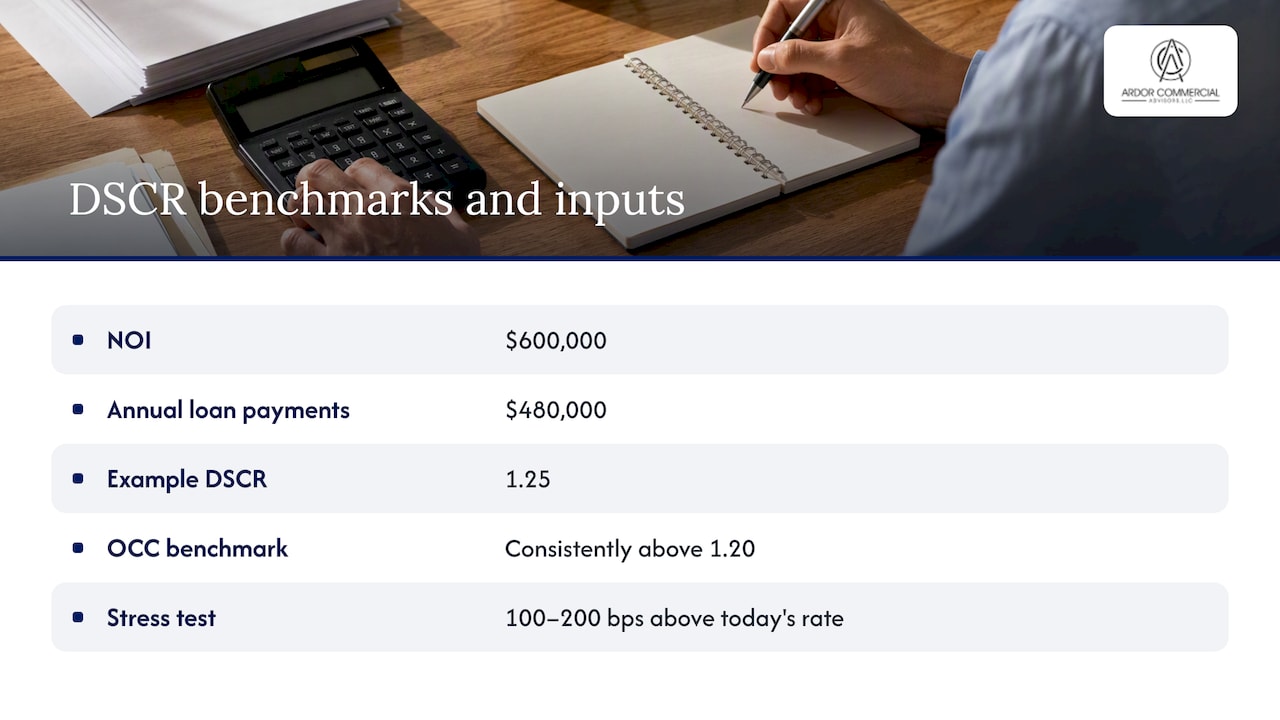
The OCC’s commercial real estate lending handbook treats a DSCR consistently above 1.20 as a standard benchmark, with exceptions possible where long-term, creditworthy tenants support the property. Lenders also assess global cash flow, net worth and secondary repayment sources, not just the building. The OCC’s older income property guidance adds that lenders should consider stressed DSCR scenarios, including higher rates. Run your own stress test at a rate 100 to 200 basis points above today’s.
A simple decision rule
- DSCR comfortably above 1.25 at the new rate: refinancing is realistic. Compare the cost of new debt with the after-tax proceeds of a sale.
- DSCR between roughly 1.10 and 1.20: you may refinance if the tenants are strong and the leases are long. Medical and credit tenants can help here, but expect the lender to ask for support.
- DSCR below 1.10 at maturity: assume you will need to inject equity, accept a shorter extension, or sell. Do not wait for the maturity letter.
What about CMBS loans?
A CMBS loan is pooled and serviced by a third party, so flexibility is lower than with a local bank. Prepayment through defeasance or yield maintenance can make an early sale expensive. At maturity, the loan has to be paid off or it can move toward special servicing. Treasury’s 2024 FSOC report says conduit refinancing success averages around 70 percent and office is substantially lower, and that office loans reaching maturity without stabilized occupancy often need workouts such as extensions, interest-only periods or cash equity to pay the loan down.
If you hold CMBS debt, do this now:
- Read the loan agreement for the maturity date, prepayment terms and any cash-management triggers.
- Calculate your trailing 12-month and projected DSCR.
- Price a sale and a refinance side by side, after defeasance or yield maintenance costs.
- If you may need relief, contact the servicer early. Federal guidance says that proactive communication before maturity preserves options, and that lenders prefer borrowers who can still service debt even at a reduced level.
Office and medical office: different exits for different buildings
Office
Financial regulators describe office weakness as structural, tied to where people choose to work. The Financial Stability Oversight Council’s June 2025 minutes note that traditional valuation models for generic office are no longer universally applicable, and that exits are often tied to repurposing or anchor tenants on long leases. In practice, that means:
- Lease up before you list. A building with a signed anchor and a clean rent roll sells on income, not on potential. Our guides on tenant retention, tenant mix and lease renewal timing cover how to protect NOI ahead of a sale.
- Test a repositioning. Conversion or adaptive reuse underwriting may beat a discounted sale if the structure allows it.
- Sell to an owner-user. Smaller office buildings often attract a business that wants to occupy part of the space.
Medical office
Medical space tends to hold tenants longer, because practices invest heavily in build-out and patient location. Lenders may accept a lower DSCR (the OCC handbook language allows exceptions for creditworthy long-term tenants), and buyers pay attention to lease term, tenant credit and specialty. Before marketing a medical building:
- Collect lease abstracts and estoppel certificates so a buyer can verify rents and terms quickly.
- Document landlord-funded improvements and any unamortized tenant allowances.
- Check for rights of first refusal or purchase options in tenant leases, since they can complicate a sale.
Leasing versus buying as a medical professional
For a practice owner, the building is its own exit strategy. If you own your space through an entity, you can eventually sell the practice and either lease the building to the buyer or sell it to an investor. If you lease, your exit is the lease itself: remaining term, renewal options and assignment rights decide what a buyer will pay for your practice. Compare owning against leasing on after-tax cost, not just monthly payment, and bring your CPA into the model. If you are weighing a lease, our tenant representation team can negotiate terms that protect you on the way out, and our guide to exiting a commercial lease early covers what termination really costs.
The multi-tenant advantage at exit
A multi-tenant building spreads risk. Losing one of six tenants hurts; losing the only tenant empties the building. At exit, that diversification shows up in three ways:
- Steadier NOI, which supports a stronger DSCR and a wider lender pool.
- Staggered lease expirations, which let a buyer see rollover as manageable instead of a cliff.
- Value-add upside: a buyer can see below-market rents to mark up and vacant suites to fill.
The trade-off is more management. Common area maintenance, reconciliations and tenant turnover cost time and money. Clean CAM reconciliation and a realistic property management budget make a multi-tenant asset far easier to sell.
Industrial exits
The Fed’s report observes that industrial and retail valuations have shown more resilience than office. For industrial owners, the details that move price at exit are lease structure and rollover. Know whether your leases are NNN, modified gross or another form, because a buyer will underwrite who pays taxes, insurance and maintenance. Also check clear heights, dock and truck-court configuration, and any deferred roof or paving work, since these are the items buyers deduct from price. If you own land with development potential in the region, our Charlotte land development guide lays out the questions to answer before you sell.

Taxes: plan before you list
Depreciation recapture
When you sell, the IRS taxes the gain attributable to depreciation you claimed. IRS Publication 544 describes this treatment, and gain on business property is reported on Form 4797 or Form 8949 depending on how the property was used. Your CPA can model the real number. Do that before you accept an offer.
The 1031 exchange
A like-kind exchange can defer federal tax on the gain. The IRS explains that both properties must be held for business or investment, property held primarily for sale does not qualify, and a qualified intermediary must hold the proceeds. Cash or non-like-kind property you receive (boot) is taxable to the extent of the gain.
The timeline is tight: you have 45 days to identify replacement property and 180 days to close, and both clocks run at the same time. Line up your replacement search before you go under contract. Our Charlotte 1031 timeline lays out the schedule step by step.
Financing the next move
Exit planning often includes financing, whether you are refinancing, buying the replacement property or helping a buyer close. Common options include bank and credit union loans, CMBS, bridge loans for properties in transition, and DSCR-based loans that size on property cash flow. A capital advisory firm can help compare lenders. For example, you can run numbers on a commercial real estate loan calculator to see how rate and term change your payment before you talk to a lender. Whatever the route, bring the same package: trailing financials, rent roll, lease abstracts and your stressed DSCR.
Our perspective
We see owners wait too long, and the pattern is consistent: they treat the exit as an event instead of a process. The strongest results come from owners who start by understanding what the building is worth and what a buyer or lender will look for. They fix the rent roll, resolve CAM disputes and organize leases before the market sees the property. In office and medical, tenant quality and lease term drive value more than almost anything else, and those are things you can improve over 12 to 24 months. If a loan maturity is forcing the timeline, the same discipline applies, just faster. Call the lender early, run both a sale and a refinance case, and decide based on after-tax numbers.
— Jim
How we can help
Ardorcre advises Charlotte-area owners, investors and tenants on sales, leasing, landlord and tenant representation, property management, valuation and lease analysis. If you are weighing an exit, start with a valuation and a review of your leases. See our full list of services or contact us to talk through your property.
FAQ
When should I start planning my exit?
Ideally at acquisition, and no later than two to three years before you want to sell. That gives you time to renew key leases, clear deferred maintenance and choose the right tax strategy. If you hold a loan that matures within 18 months, start now.
Is refinancing an exit strategy?
It is a way to extend your hold and pull equity, not a full exit. It works only if the property supports new debt, typically at a DSCR of 1.20 or better, and if your lender is willing to lend. If it cannot, sale or restructure becomes the plan.
Can I avoid taxes on a commercial sale?
You may be able to defer federal tax with a 1031 exchange if the property was held for business or investment and you follow the identification and closing deadlines. It is deferral, not elimination. Talk to a CPA and a qualified intermediary before you sign a contract.
What if my office building has high vacancy?
Try to stabilize first with leasing, a renewal program or a tenant anchor. If that is not feasible, test repositioning or sale to an owner-user, and talk to your lender early about an extension or workout.
Sources
- Federal Reserve, Financial Stability Report: Asset Valuations (November 2025)
- OCC, Commercial Real Estate Lending handbook
- OCC, Income Property Lending, Financial Analysis
- FSOC 2024 Annual Report
- FSOC meeting minutes, June 4, 2025
- Federal Reserve, Policy Statement on Prudent CRE Loan Accommodations and Workouts
- IRS Publication 544
- IRS, Sales, trades, exchanges
- IRS, Like-kind exchanges: real estate tax tips
- CBIZ, 1031 Exchange Deadlines