For buying an owner-occupied building or heavy equipment, the SBA 504 loan almost always wins on long-term cost. For working capital, business acquisitions, or anything that needs speed and flexibility, the SBA 7(a) loan is the better fit. The core trade-off comes down to rate type and timeline: 504 pairs a fixed, below-market CDC rate with slower closing, while 7(a) moves faster but usually carries a variable, Prime-based rate. Many owner-occupants end up using both.
TL;DR:
- The SBA 504 loan offers lower long-term costs for owner-occupied real estate and equipment, thanks to fixed, below-market CDC rates over longer terms.
- The SBA 7(a) loan provides quick closing times and flexible use cases like working capital, acquisitions, or equipment, with variable Prime-based rates that can rise over time.
- Borrowers should consider stacking both loans when purchasing property and funding buildouts or inventory, coordinating applications from the start to save time.
- The 504 program is often slower to close (60-120 days) but can save owners thousands over two decades due to its fixed rates, especially when property ownership is a long-term goal.
- When choosing between the two, evaluate the project’s size, occupancy requirements, and rate risk exposure, as the 504 excels for long-term real estate, while 7(a) suits urgent or working capital needs.
Table of Contents
- SBA 504 Loan: Structure, Eligible Uses, and Who It Helps
- SBA 7(a) Loan: Flexibility, Typical Uses, and Rate Mechanics
- SBA 504 vs 7(a): A Side-by-Side Comparison
- How Do You Decide Between 504 and 7(a)?
- What Should You Expect for Timeline and Costs?
- How Do You Apply for SBA 504 or 7(a) Financing?
- ArdorCRE’s Take on Financing in the Charlotte Market
- An Editorial Take on the 504 vs 7(a) Decision
SBA 504 Loan: Structure, Eligible Uses, and Who It Helps
The 504 loan isn’t a single loan at all. It’s a three-party stack: a bank funds roughly 50% of the project, a Certified Development Company (CDC) funds up to 40% through an SBA-backed debenture, and the borrower covers the rest as equity. That CDC portion is what makes 504 attractive. It’s fixed for the life of the loan, and it’s typically priced below what a conventional bank would charge for the same term, according to SBA’s 504 loan program page.
Eligibility hinges on occupancy. The SBA requires 51% owner-occupancy for an existing building and 60% for new construction, which rules out pure investment purchases. Eligible uses stay narrow but valuable:
- Purchasing owner-occupied commercial real estate
- Buying heavy machinery or long-life equipment
- Ground-up construction or major renovations
- Refinancing existing owner-occupied debt under specific conditions
Statistic callout: The CDC/504 program caps the CDC debenture at $5 million for standard projects and $5.5 million for manufacturing or energy-efficient projects, with the combined SBA exposure limit rising to $10 million effective July 4, 2026. CDCs also weigh public-policy goals like job creation, which can factor into approval even when the numbers otherwise pencil out.
SBA 7(a) Loan: Flexibility, Typical Uses, and Rate Mechanics
The 7(a) loan is the SBA’s general-purpose tool. One lender, one loan, and money that can flow toward working capital, inventory, equipment, business acquisition, or real estate, according to the SBA’s 7(a) loan program overview. That flexibility is the entire pitch. If your need doesn’t fit neatly into “buy a building,” 7(a) is usually the answer.
Typical uses include:
- Working capital to smooth cash flow or fund growth
- Buying an existing business or partner buyout
- Equipment, inventory, and leasehold improvements
- Real estate purchases, with terms up to 25 years for that use
Statistic callout: The 7(a) program tops out at a $5 million loan amount, backed by an SBA guarantee that varies with loan size. Rates run variable, tied to Prime plus a lender spread, currently landing in the 9.75% to 10.50% range. Because there’s no CDC in the mix, 7(a) loans close faster. One lender underwrites, one lender funds, and there’s no second layer of SBA authorization to wait on.
SBA 504 vs 7(a): A Side-by-Side Comparison
Here’s how the two programs stack up across the dimensions that actually drive a decision:
| Dimension | SBA 504 | SBA 7(a) |
|---|---|---|
| Primary use of funds | Owner-occupied real estate, heavy equipment | Working capital, acquisitions, equipment, real estate |
| Max loan amount / SBA cap | CDC portion up to $5M ($5.5M for special projects) | Up to $5M total loan |
| Rate type & typical spread | Fixed on CDC portion, often below market | Variable, Prime plus spread (roughly 9.75% to 10.50%) |
| Term / amortization | 10, 20, or 25 years depending on asset | Up to 25 years for real estate; shorter for working capital |
| Down payment / equity | Typically 10%, up to 20% for special-use property | Varies by lender, often around 10% |
| Timeline to close | 60 to 120 days | 45 to 90 days |
| Owner-occupancy requirement | 51% existing, 60% new construction | Not required |
| Best-for use case | Long-term property or equipment ownership | Working capital, acquisitions, speed |
Pro Tip: Run the debt-service math over the full term, not just the first year. A 504 loan’s fixed CDC rate can save tens of thousands over 20 years compared to a 7(a) loan riding Prime through several rate cycles. Ask your lender for an amortization schedule under a rising-rate scenario before you sign anything.
How Do You Decide Between 504 and 7(a)?
Run through this checklist before you talk to a lender:
- Is the primary goal owning a building or piece of equipment for the long haul, or funding operations?
- Will you occupy at least 51% of the space yourself?
- Do you need working capital alongside the real estate purchase?
- How large is the total project, and does it clear the $5 million 504 cap?
- Is timeline pressure pushing you toward the faster program?
- How exposed are you to rate risk if Prime keeps climbing?
Scenario A: You’re buying the medical office you already lease. High owner-occupancy, long asset life, no urgency. This is a textbook 504 case. The fixed CDC rate locks in your biggest fixed cost for two decades.
Scenario B: You’re acquiring a competitor’s business, including inventory and goodwill, and need capital fast. That’s a 7(a) situation. Real estate isn’t the point. Speed and flexibility are.
Scenario C: You’re buying a building and need cash left over for buildout and inventory. Many borrowers stack both: 504 for the real estate, 7(a) for the working capital piece, closed in parallel with two different lenders working from the same set of financials.
Pro Tip: If you’re stacking programs, tell both lenders on day one. Coordinated underwriting saves weeks compared to running the 504 and 7(a) processes as if they don’t know about each other.
What Should You Expect for Timeline and Costs?
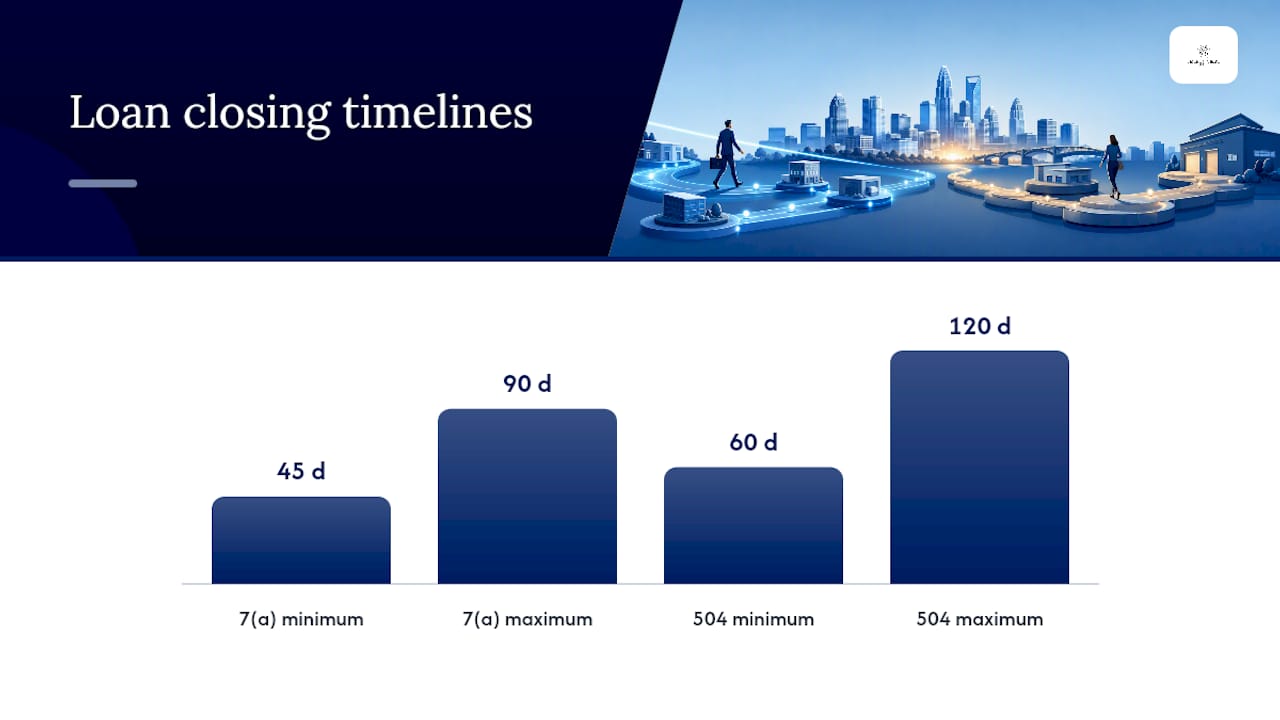
Expect 7(a) loans to close in 45 to 90 days and 504 loans to take 60 to 120 days, mostly because the CDC layer adds a second approval track on top of the bank’s underwriting.
Fees differ by program too:
- SBA guarantee fees on 7(a), which scale with loan size and can shift year to year (check the current fee notice for FY2026 figures)
- CDC processing and servicing fees on the 504 debenture
- Standard closing costs: appraisal, environmental review, title, and legal
Statistic callout: Because the 504 program’s blended rate often runs 0.5 to 1.5 percentage points lower than a comparable 7(a) loan over the full term, the fixed CDC portion tends to offset its slower closing with real savings on long-lived assets.
How Do You Apply for SBA 504 or 7(a) Financing?
- Gather three years of business and personal tax returns, financial statements, and cash flow projections.
- Document use of proceeds, including a purchase contract or equipment quote.
- For 504, confirm your occupancy percentage meets the 51% (or 60% new construction) threshold up front.
- Approach a participating bank for 7(a); for 504, find a local CDC and loop in your bank simultaneously.
- Get lender and CDC talking to each other early if you’re stacking both loans.
Clean, organized financials shave weeks off either process.
ArdorCRE’s Take on Financing in the Charlotte Market
Across the Charlotte MSA, the pattern holds: a medical practice buying its own office almost always fits 504 better than a conventional loan or 7(a). A single-tenant industrial buyer with a 20-year hold horizon gets the same benefit. Retailers doing a build-out with working capital needs often need 7(a), sometimes stacked with 504 for the real estate piece.
Before locking in either structure, run the numbers using ArdorCRE’s DSCR loan sizing guide to confirm the property can support the debt service you’re planning. Bring your broker in during financing, not after you’ve signed a letter of intent.
- Owner-occupant medical or professional office: 504 first
- Business acquisition or working capital gap: 7(a) first
- Property purchase plus buildout costs: stack both
An Editorial Take on the 504 vs 7(a) Decision
The conventional advice treats this as a binary choice, and that’s where most owners get it wrong. The real question isn’t “504 or 7(a).” It’s “what happens to my balance sheet over the next 20 years.” A 7(a) loan looks fine on paper until Prime moves against you three years in, and suddenly your debt service on a variable loan looks nothing like your underwriting model.
What gets underrated is the balloon-refinance risk conventional CRE debt carries, something the 504’s fixed debenture structure quietly removes. Owners chasing the faster 7(a) close often don’t price in that risk because it doesn’t show up until year five or six.
My honest read: if property ownership is even partly the goal, run the 504 math first, even if it costs you an extra month at the closing table. Speed is worth paying for when the need is genuinely short-term. It’s not worth paying for when the asset will sit on your books for two decades.
— Jim