
For a Charlotte commercial building, the money available for energy upgrades comes mainly from Duke Energy’s Smart $aver rebates, with federal tax deductions as a second layer whose rules changed in 2025. Who captures that money depends on your lease and on the order in which you do things. At Ardorcre we review leases, analyze CAM reconciliations and value commercial property in the Charlotte MSA, and those three things decide whether an upgrade pays off for an owner, a landlord or a tenant.
TL;DR
- Duke Energy’s prescriptive rebates cover lighting, HVAC, pumps, drives and more, are paid after installation, and are maximums that can come in lower depending on equipment cost.
- Custom and new-construction incentives need approval before you sign contracts or start work. Skipping that order is the most common way to lose an incentive.
- The federal 179D deduction ended for projects that begin construction after June 30, 2026. Projects already underway by that date can still be claimed, and documentation matters.
- In a leased building, the lease decides who pays for the upgrade and who keeps the benefit. Read it before you spend.
Table of Contents
- Duke Energy rebates: the core of Charlotte’s incentives
- Larger projects: custom incentives and Energy Design Assistance
- The federal 179D deduction after 2025
- Free help from the state and the DOE
- Who captures the savings: owner, landlord or tenant
- Documenting the work so it holds up
- Energy upgrades and what the building is worth
- Our perspective
- Put the numbers behind the decision
- FAQ
- Sources
Duke Energy rebates: the core of Charlotte’s incentives
Most of Charlotte is served by Duke Energy Carolinas, and its Smart $aver program is where most commercial owners start. The Smart $aver Prescriptive program, as described in its filing with the South Carolina Public Service Commission, pays commercial and industrial customers to buy and install high-efficiency lighting, HVAC, pumps and drives, plus qualifying process, food-service and IT equipment. It applies to new construction, retrofits and replacement of failed equipment. Incentives are capped at 75% or less of the customer’s cost.
“Prescriptive” means Duke publishes a fixed rebate per piece of equipment, so you can estimate the payment before you buy. A Duke Energy presentation to CREW Charlotte in October 2022 grouped the categories Charlotte-area buildings use most:
- Building envelope: window film, for example.
- HVAC: chillers, packaged terminal units, unitary air conditioners and heat pumps.
- Lighting: LED fixtures, occupancy sensors and DLC-listed panels, indoors and out.
- Industrial measures: air compressors and variable frequency drives on pumps and HVAC.
That presentation described more than 300 preapproved measures, no preapproval for prescriptive rebates, a 75% cap on total rebates against material cost, and payment six to eight weeks after approval. Those were 2022 program details, so confirm the current measure list before you budget.
Duke’s commercial equipment rebate page states that every prescriptive amount shown is a maximum. The actual rebate may be lower depending on what the equipment costs. Build your pro forma on the conservative end.
How to apply
The same page offers three routes: an online application, a Quick Start Form that collects basic project information, or a paper application by mail. Questions go to an inquiry form or 866.380.9580.
- Pick the equipment from the current rebate list. A model that is not on the list does not earn the listed amount.
- Get the quote and keep the invoice. Your application will need the equipment cost and details.
- Install, then submit. Prescriptive rebates are paid after installation.
- Track payment. Duke’s 2022 timeline put payment six to eight weeks after approval.
Larger projects: custom incentives and Energy Design Assistance
Projects that do not fit a published rebate, such as a process upgrade in a warehouse or a whole-building retrofit of an office, go through the custom route. Here the order of events is strict. Duke’s evaluation report on its non-residential custom program states that custom projects require pre-approval before implementation. Projects saving more than 700,000 kWh a year use Excel worksheets, smaller ones use Smart $aver Tools, and every custom measure is tested for cost-effectiveness. The practical rule: do not sign a purchase order until you have the approval.

For new construction or a major renovation, Duke’s Energy Design Assistance offers free whole-building energy consulting. It provides an on-demand modeling tool for buildings as small as 3,000 square feet and custom energy analysis for buildings of 30,000 square feet or more. Its high-performance incentive pays up to 32% more than the standard program for projects that beat state energy code by more than 30% in electric savings. Participants must be opted in, or plan to opt in, to the Energy Efficiency Rider, and custom incentives need project approval before contracts or construction.
This matters for medical and office buildouts. A dental or orthodontic suite with heavy HVAC and lighting loads, or a multi-tenant office renovation, is the kind of project where energy modeling can be done during design, not after drywall.
The federal 179D deduction after 2025
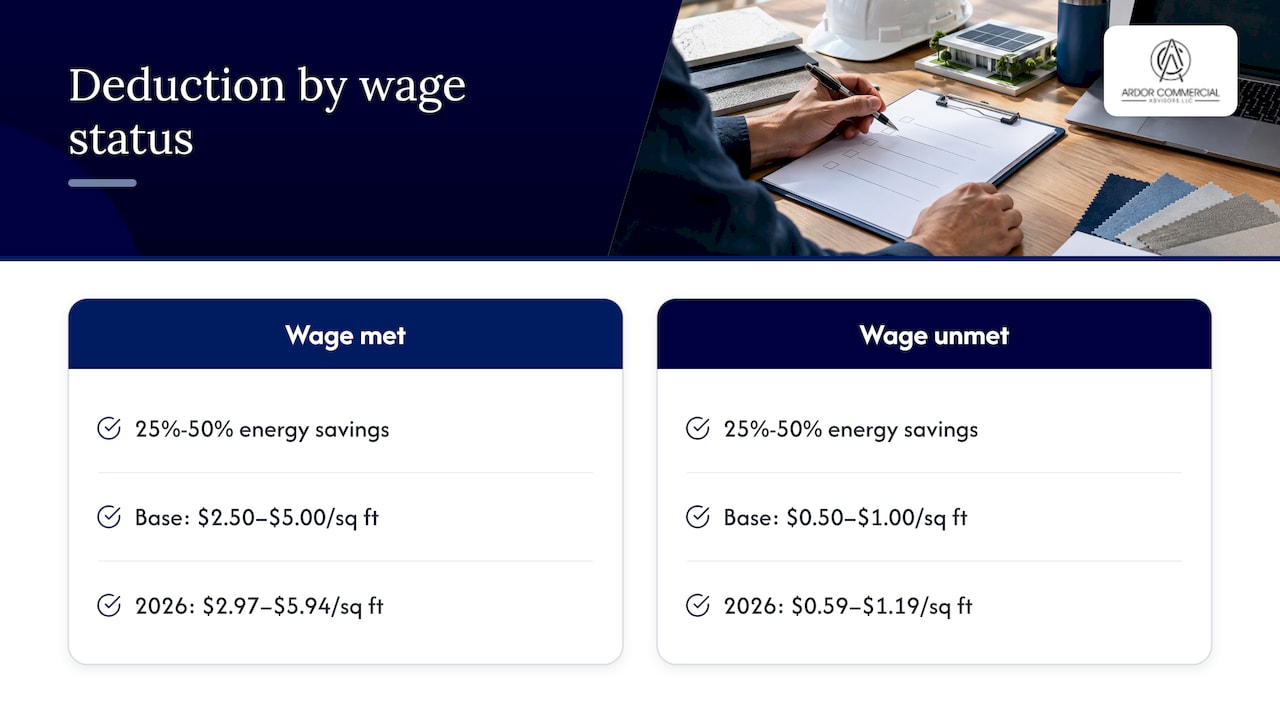
The Section 179D deduction rewards owners who improve a building’s interior lighting, HVAC and hot water, or envelope. The One Big Beautiful Bill Act, signed July 4, 2025, ended it. According to the USGBC’s analysis of the law, a project must begin construction by June 30, 2026 to qualify. The base scale runs from $2.50 to $5.00 per square foot for 25% to 50% energy savings, falling to $0.50 to $1.00 if prevailing wage and apprenticeship requirements are not met.
Because that date has passed, the question for you is whether a project you already started qualifies. If construction began on or before June 30, 2026, ask your CPA about claiming when the building is placed in service. If it did not, 179D is no longer the planning tool, and Duke’s rebates carry more weight.
The amounts are indexed to inflation. A January 2026 newsletter from a CPA firm put the 2026 deduction at $0.59 to $1.19 per square foot, or $2.97 to $5.94 with prevailing wage and apprenticeship compliance, depending on whether the building saves 25% or 50%. Improvements must be certified by an independent contractor or licensed engineer.
Two rules from a July 2026 CPA guide matter for how you scope work. The old partial-deduction route for a single system such as lighting was eliminated for property placed in service after 2022, so a project must show whole-building savings of at least 25%. And the energy model outputs, baseline assumptions and wage evidence must be kept on file even though they are not attached to the return.
Other federal credits changed too. The EIA’s summary of the 2025 legislation notes the placed-in-service deadline for wind and solar moved to 2027 and the Section 30C credit was terminated earlier. If solar is on your list, have a tax professional confirm eligibility for your specific system and date.
Free help from the state and the DOE
The NC Department of Environmental Quality offers free energy reduction assessments in which environmental professionals review your utility bills and usage to find low- and no-cost savings in the envelope, lighting, compressed air, HVAC and operating habits. It also points owners to the DSIRE database, Duke’s Smart $aver programs and the State Energy Office.
The U.S. Department of Energy’s financing guide for efficiency upgrades, updated March 5, 2026, sends owners to DSIRE for city, state, federal and utility incentives and describes debt, on-bill financing and performance contracting as complements to incentives.
Who captures the savings: owner, landlord or tenant
This is where Charlotte office, medical and industrial users most often get it wrong. An incentive goes to the party that pays for and installs the equipment. The savings land on the party that pays the utility bill. In a single-tenant lease those can be different companies.
| Situation | Who usually pays for the upgrade | Who sees the savings | What to check in the lease |
|---|---|---|---|
| Owner-occupied medical or office building | Owner | Owner | Nothing, but model payback against valuation |
| Single-tenant triple net lease | Often the tenant for in-suite work, landlord for base building | Tenant, through lower utilities | Alteration rights, who owns the equipment, restoration duties |
| Multi-tenant office | Landlord | Shared through operating expenses | Whether capital costs can be passed through |
| Industrial lease | Varies by lease type | Tenant, usually | Roof, HVAC and lighting responsibilities |
In a triple net lease, the tenant pays operating costs on top of rent. A landlord’s capital upgrade may be recoverable or not depending on the wording, and the difference shows up in the year-end true-up. Our CAM charges work, which covers lease review and CAM reconciliation analysis, exists for exactly that question. The type of industrial lease matters as much, and our guide to industrial lease types explains which party carries building systems.
A practical test before you commit capital: write down who pays, who benefits and how many years remain on the lease. A tenant with three years left will weigh a 15-year payback differently than the landlord who holds the building.
Documenting the work so it holds up
Incentives are paid on paperwork. Keep invoices, equipment spec sheets, installation dates, the model outputs for any tax claim, and a before-and-after record of utility use. Owners who also track building systems and resource use, as in these sustainable building practices for managers, tend to have the baseline data a certifier or a rebate reviewer asks for.
Energy upgrades and what the building is worth
Lower operating costs can support net operating income, and net operating income drives value and loan sizing. If you are weighing an upgrade against a sale or refinance, run it through a commercial property valuation and your DSCR, the ratio of net operating income to debt payments. Financing structure also interacts with the decision: see our look at commercial mortgage rates and SBA 504 versus 7(a) for owner-occupiers, and our piece on embodied carbon in adaptive reuse office projects if you are converting an older building.
Our perspective
Owners tend to ask which incentive is biggest. We ask a different question first: what does this building earn, and who is holding it?
A rebate that pays back an LED retrofit in a building you will sell in two years is a different decision than the same rebate on a medical office you plan to keep for twenty. The lease is the other half of the answer. A clause about capital costs or utility pass-throughs can move thousands of dollars from one party to the other, and nobody notices until the reconciliation arrives.
That is why our advisors start with the lease, the valuation and the cash flow, then bring in the engineer and the tax professional. Incentives are worth chasing when they fit the hold period and the lease structure. When they do, they are one of the cleaner ways to improve a building’s net income in Charlotte.
Jim
Put the numbers behind the decision
Before you commit to an upgrade, a purchase or a renewal, know what the building earns and what your lease obliges you to pay. Ardorcre provides lease review, CAM reconciliation analysis, commercial property valuation and DCF modeling for Charlotte-area owners and tenants, along with landlord and tenant representation.
See our commercial real estate services to start with the building or lease in front of you.
FAQ
Do I need approval before installing equipment to get a Duke Energy rebate?
For prescriptive rebates, Duke’s 2022 presentation to CREW Charlotte said no preapproval was required, and applications follow installation. For custom projects and Energy Design Assistance incentives, approval comes before you sign contracts or start work. Confirm which route your equipment falls under with Duke at 866.380.9580.
Is the federal 179D deduction still available?
It ended for projects that begin construction after June 30, 2026. A project that began on or before that date may still qualify, with the deduction claimed when the building is placed in service. Ask your CPA to confirm your start date and certification.
Can a tenant get commercial energy incentives in Charlotte?
The incentive generally goes to the party that pays for the equipment, which can be a tenant for in-suite work. Your lease determines whether you may alter systems and who owns them afterward, so read the alteration and restoration clauses first.
Does the rebate cover the full cost of the upgrade?
No. Duke caps prescriptive and custom incentives at 75% or less of the relevant cost, and the amounts on its rebate page are maximums that may be lower depending on equipment cost.
Where can I find every program that applies to my building?
The Department of Energy points commercial owners to the DSIRE database for city, state, federal and utility incentives, and NC DEQ offers free energy assessments of your utility usage.
Sources
- Smart $aver Prescriptive program filing, SC Public Service Commission
- Duke Energy presentation to CREW Charlotte, October 2022
- Duke Energy commercial equipment rebates
- Duke Energy non-residential custom program evaluation report
- Duke Energy Energy Design Assistance
- USGBC analysis of OBBBA changes to building incentives
- Gray, Callison & Jones newsletter, January 2026
- Corporate Tax Advisors guide to commercial building tax deductions
- EIA summary of legislation and regulations, 2026
- NC DEQ energy efficiency assistance
- U.S. Department of Energy financing guide for efficiency upgrades
- Sustainable building practices for managers