
Charlotte’s office pipeline is small compared with the size of the market, and the supply picture is changing through subtraction as much as construction. The count depends on who is counting: one measure covers only buildings under construction, another adds every announced project. Meanwhile, conversions are removing older space, and vacancy has been falling. If you lease, own or invest in Charlotte office space, the pipeline matters less as a headline number than as a signal of which buildings will stay competitive.
TL;DR
- Under construction is a narrow number. In March 2025 it was 527,903 square feet, 0.7% of inventory, and under construction plus planned was 4.1% of existing stock.
- Center City Partners and Axios count a wider pipeline. In the urban core, 1,246,000 square feet of office is expected to start or be underway by 2027.
- Supply is also shrinking. About 715,000 square feet has left Uptown’s inventory through conversions, with 1.9 million more proposed or under way.
- Vacancy fell 1.2 points over the year to 13.1% as of August 2026, and the gap between older and modern buildings is widening.
- Tenants should lock in decisions on older space early, and owners should price against the new product.
Table of Contents
- How the Charlotte office pipeline is measured
- What is under construction and planned
- Where the activity concentrates
- Why the pipeline is subtracting as well as adding
- What it means for tenants
- What it means for landlords and building owners
- What it means for investors
- Our perspective
- Work with an advisor on your next move
- FAQ
- Sources
How the Charlotte office pipeline is measured
Four phrases get used as if they meant the same thing, and they don’t.
- Under construction: steel is in the ground. This is the number most brokerage research reports.
- Planned or proposed: a project has been announced, often with a target start, but financing, anchor tenants or approvals may still be open.
- Announced with a forecast groundbreaking: the category Charlotte Center City Partners uses for projects expected to start by a given year.
- Completed this cycle: buildings that have already delivered and are now part of inventory.
Charlotte Center City Partners’ 2025 State of Center City report sorts projects by those statuses and reported $3.7 billion of new development in its pipeline. As Axios reported, that annual tally is meant to attract employers, investors and developers. It aggregates projects expected to start or already underway, not only buildings actively being built. When you see a large dollar figure, check whether it includes housing, hotels and storefronts. Most of it does.
For context, the Charlotte office market holds roughly 136 million square feet of total inventory as of August 2026. Against that base, even a million square feet of new office is under one percent.
What is under construction and planned
The thin construction number
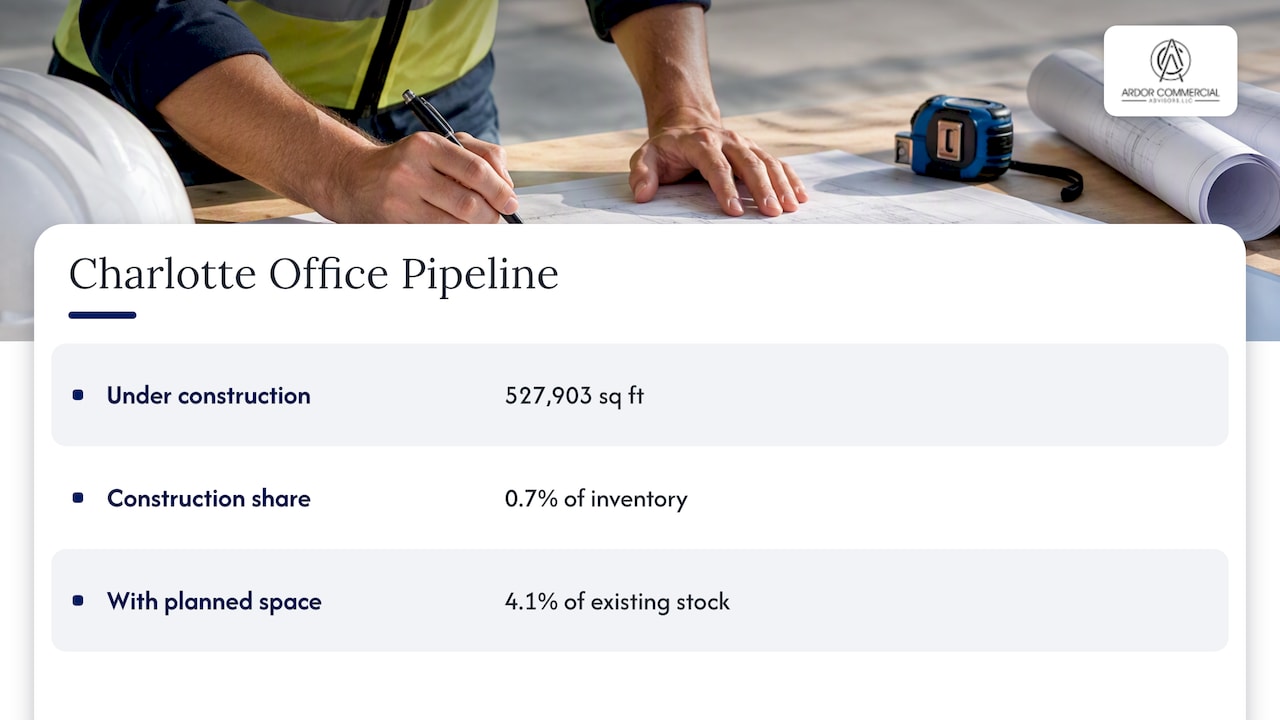
In March 2025, CommercialSearch put the Charlotte pipeline at 527,903 square feet under construction, or 0.7% of inventory. Adding planned space brought it to 4.1% of existing stock. That is a modest pipeline for a metro the size of Charlotte, and it is why tenants searching for large blocks of new Class A space often find few options.
Urban core projects
The wider view comes from Center City Partners. Axios reported in January 2026 that about $2.4 billion in new construction across office, residential and hotel uses was expected to be underway or starting by 2027 in the urban core. Within that total sits 1,246,000 square feet of office space across Uptown, South End and Midtown.
Two projects show what the pipeline looks like in practice:
| Project | Location | Office space | Notes |
|---|---|---|---|
| Carson + Tryon | Between Uptown and South End | About 560,000 sq ft Class A | Planned mixed-use with retail, a hotel and apartments |
| 1111 South Tryon, second tower | Uptown | About 356,000 sq ft | Above 346 apartments; 206,000 sq ft preleased by Moore & Van Allen and 68,000 sq ft by Pacific Life |
The second row is the pattern to watch. Projects that have large preleases and a residential component are the ones that move. Speculative office towers have been harder to launch.
Where the activity concentrates
Uptown is Charlotte’s largest office submarket by inventory, and South End is described in the Center City Partners report as a growing Class A office destination with one of the lowest availability rates among Charlotte submarkets. Nearly all of the new office pipeline sits in that Uptown, South End and Midtown triangle, not in the suburban nodes.
For a submarket-by-submarket view of where to buy, sell or refinance, see our Charlotte submarket guide. For what tenants are paying right now, see our breakdown of Charlotte office rents per square foot.
Why the pipeline is subtracting as well as adding
The most useful change in the Charlotte story is the loss of old inventory. Piedmont Crescent Capital’s August 2026 outlook reports that roughly 715,000 square feet has been removed from Uptown’s inventory through conversions, with another 1.9 million square feet proposed or under way. Those buildings are becoming residential and hotel space.
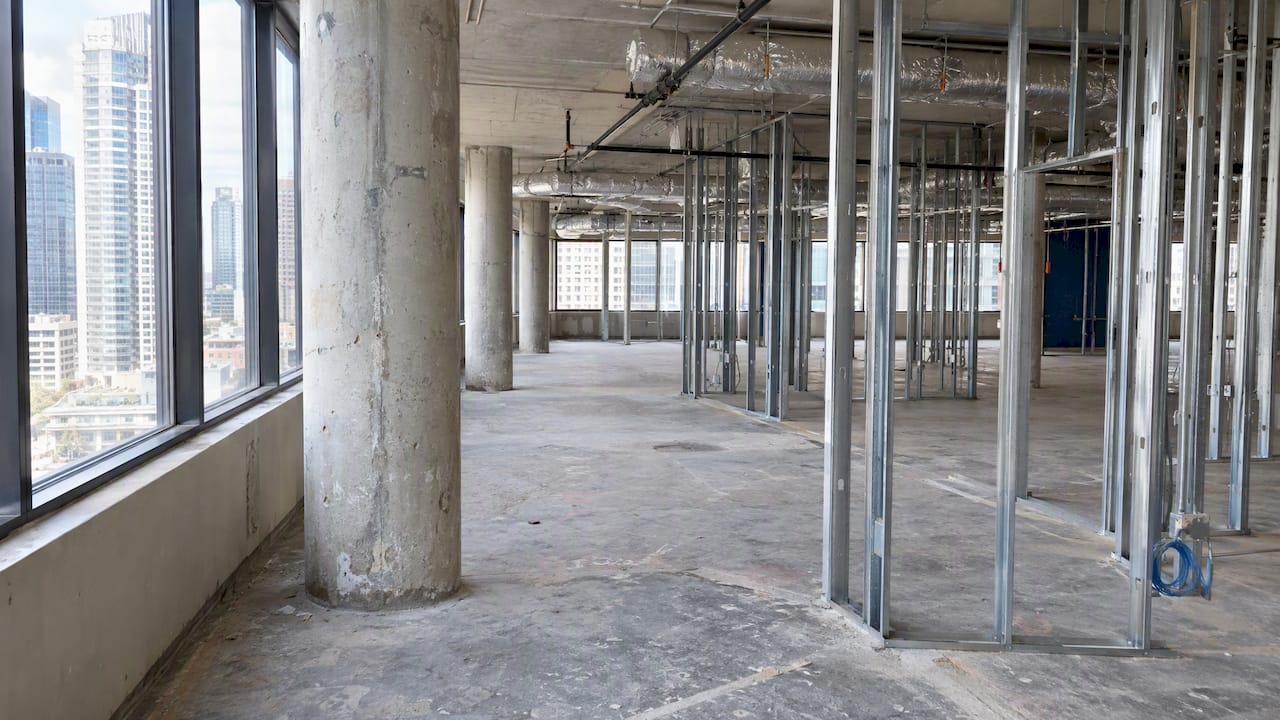
That changes how to read vacancy. The same report notes that Charlotte office vacancy fell 1.2 percentage points over the preceding year to 13.1%, and that figures vary by methodology, so a CoStar number and another analyst’s number will not match. Part of the tightening comes from space leaving the market permanently, not only from tenants absorbing it.
Demand is also part of the story. The Charlotte Observer reported in July 2026 that vacancies keep falling as leasing picks up. Cushman & Wakefield executives said that if Charlotte keeps attracting large companies such as Scout Motors, office buildings will come.
What it means for tenants
The pipeline is thin and conversions continue, so the best modern space gets absorbed before it is built. That points to a few practical moves.
- Start earlier than you think. A realistic medical or office lease process runs several months from search to signing. Our 3 to 6 month leasing timeline shows where the time goes.
- Treat the lease as the real price. Rent per square foot is one line. Operating expense pass-throughs, escalations and tenant improvement terms often move the true cost more. Our lease review and CAM reconciliation work is built around those lines.
- Know your exit before you enter. If your headcount or practice may change, read the termination terms first. We cover costs and notice in our guide to exiting a commercial lease early.
- Use representation. A tenant broker sees the available space across submarkets, including blocks that are not widely marketed. Our tenant representation structure explains how that works.
Medical tenants have extra constraints: plumbing, build-out, imaging and parking. Demand there runs on its own track, which we cover in Charlotte medical office demand.
What it means for landlords and building owners
Piedmont Crescent Capital describes a market that is splitting by vintage, not by geography. The gap is growing between older, lower-tier assets and modern, high-amenity 4 and 5-star buildings. A small pipeline helps the newer buildings. It does not automatically help an older building in the same submarket.
If you own an older office building, the decisions that matter are:
- Reposition, hold, sell or convert. Conversions are happening, but they work only for certain floor plates and locations.
- Price against the right comparable. Comparing your asking rent to a new tower’s rent can overstate what you can ask. A defensible valuation with a discounted cash flow model uses realistic lease-up, downtime and capital assumptions.
- Keep tenants you have. In a market where vacancy is falling but unevenly, renewing a good tenant early is cheaper than re-leasing a floor. Dependable operations help; our guide to property manager duties lists what to demand.
What it means for investors
Investors should look at three things: the building’s vintage, its submarket and its lease roll. A building with strong tenants and a staggered rollover can hold value even if the market is bifurcated. A building with a large share of leases expiring in the next two years is a bet on the market, not on the asset. Before buying, check the paper: estoppel certificates confirm what tenants say they owe and are owed, and right of first refusal clauses can complicate a sale.
If you are selling one office asset and buying another, the timeline for a tax-deferred exchange is tight; our 1031 exchange timeline walks through it. For the wider picture of how leasing and sales trends have moved, read our Charlotte office market analysis.
Our perspective
We read the Charlotte office pipeline as a reason to be specific, not a reason to be cautious or bullish across the board. A 0.7% under-construction figure and a $2.4 billion urban core figure are both true. They describe different things, and clients get into trouble when they treat one as the other.
What we see is that decisions depend on the building. A tenant choosing between a new tower and an older building is really choosing between rent, amenities and flexibility. A landlord of an older asset has to decide whether to reposition, hold or sell while the market tightens around newer product. An investor has to underwrite the lease roll, not the headline vacancy.
Our approach is to pair local market reporting with transaction support. That means customized market reports, lease analysis, valuation and representation on either side of the table, from the first search through closing and beyond.
Jim
Work with an advisor on your next move
Ardorcre is a commercial real estate brokerage serving the Charlotte MSA. We handle sales and leasing of office, medical, retail, industrial, land and investment properties, with landlord representation, tenant representation, property management, lease analysis and valuation. If you are weighing a lease, a sale or a purchase against the pipeline above, we can map your options to specific buildings and submarkets.
See our full list of commercial real estate services, or ask for a valuation and DCF model of a building you own or are considering.
FAQ
How much office space is under construction in Charlotte?
In March 2025, CommercialSearch reported 527,903 square feet under construction, 0.7% of inventory. Under construction and planned together made up 4.1% of existing stock. Check the latest quarterly reports for current figures, since the number moves as projects start or stall.
Why do Charlotte pipeline numbers differ between sources?
Sources define the pipeline differently. Brokerage reports usually count buildings under construction. Center City Partners counts completed, announced, under-construction and planned projects, and includes housing and hotels. Always check the status and use categories behind a figure.
Is Charlotte office vacancy going up or down?
As of August 2026, Piedmont Crescent Capital reported vacancy down 1.2 percentage points over the year to 13.1%. It noted that results vary by methodology. Part of the decline comes from office space being converted to other uses.
Which submarkets have the most new office activity?
The urban core: Uptown, South End and Midtown. Axios reported 1,246,000 square feet of office space expected to start or be underway there by 2027. South End is described as a growing Class A destination with low availability.
Should a tenant wait for new construction to finish?
Usually not without a plan. The pipeline is small and projects with preleases fill early, so waiting can leave you with fewer options. A tenant broker can compare new and existing buildings and set a timeline that protects your current lease.
Sources
- Slow Start for Charlotte’s Office Market in Q1, CommercialSearch
- State of Center City 2025, Charlotte Center City Partners
- Charlotte center city grows with $2.4B in new construction, Axios Charlotte
- Charlotte Is Getting Tighter by Subtraction, Piedmont Crescent Capital
- Riverside Lands $350M for 43-Story Charlotte Tower, The Real Deal
- Charlotte office vacancies keep falling as leasing picks up, Charlotte Observer