
A base year stop is the lease clause that sets a ceiling on how much a landlord covers for operating expenses, calculated from actual costs in a specific base year. Once expenses rise above that amount, the tenant pays its pro rata share of the increase, not the landlord. Industry guidance commonly points to a 95% gross-up occupancy standard to keep that math fair in partially occupied buildings. For tenants, that means a low base year can mean higher bills for years to come.
TL;DR:
- A low base year can lead to higher expenses for tenants if operating costs increase above the initial benchmark, especially under a 95% gross-up standard.
- Only specific operating expenses such as property taxes, building insurance, utilities, and property management are typically recoverable, while major repairs and lease dispute legal fees are usually excluded.
- Gross-up provisions set during the base year significantly impact variable costs for occupancy, and misset or low gross-up percentages can inflate tenant charges over time.
- Tenants should negotiate clear terms, itemized expense lists, and audit rights to avoid unexpected overcharges or manipulation of the base year costs.
- Careful review and verification of the base year and gross-up terms are especially critical for office and medical tenants due to rising operational costs.
Table of Contents
- How a base year stop works: calculation, billing, and reconciliation
- Which operating expenses usually count (and which don’t)
- Gross-up and occupancy adjustments: why the 95% standard matters
- Base year stop vs expense stop: which threshold fits your lease
- Negotiation checklist and tenant protections to include in the lease
- Why base year clauses matter more for office and medical tenancies
- How we help with lease review and expense reconciliation
- FAQ
- Sources
How a base year stop works: calculation, billing, and reconciliation
The base year is typically the first full calendar year of the lease term, and the landlord records actual operating expenses for that year as the benchmark using tools like ExpirationIQ to manage lease expiration and revenue timing. In every later year, the landlord compares current expenses to that base year total, and the tenant owes its pro rata share of any amount above it. Pro rata share is calculated as the tenant’s rentable square footage divided by the building’s total rentable square footage, multiplied by the dollar increase over the base year.
Billing usually happens in two stages. Landlords estimate the coming year’s expenses and bill tenants monthly based on that projection, then reconcile the estimate against actual costs after year end.
- The landlord sets a base year OPEX total from actual costs in year one.
- Each following year, the landlord compares actual expenses to the base year and calculates the increase.
- The tenant’s share equals its pro rata percentage multiplied by that increase.
- Monthly invoices carry an estimated amount throughout the year.
- After year end, the landlord reconciles the estimate against actual costs and bills or credits the difference.
Here is a worked example. The base year operating expenses for the building total $500,000. In year three, actual operating expenses rise to $550,000, an increase of $50,000 over the base year.
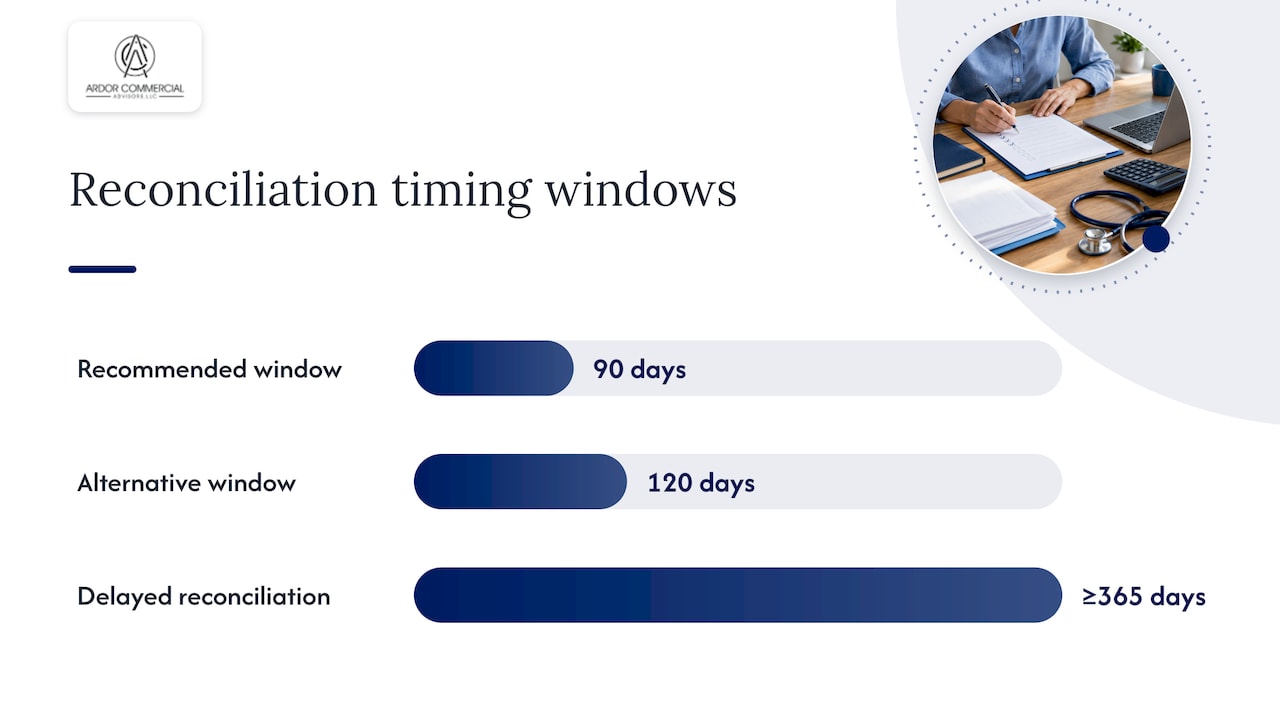
Timing issues are where most disputes start. A landlord that delays reconciliation by a year or more can present tenants with a retroactive bill covering a prior period, which is hard to budget for and harder to verify. Ask for reconciliation statements within a defined window, such as 90 or 120 days after year end, and request supporting documentation rather than a summary invoice. The CAM reconciliation process works the same way whether the lease is structured as a base year stop or a different expense pass-through model, so the document requests are similar either way.
Which operating expenses usually count (and which don’t)
Most leases define a fairly standard set of recoverable operating expenses, but the exact wording varies and that wording is where disputes happen.
Commonly included categories:
- Real estate taxes and assessments on the property.
- Building insurance premiums, including liability and property coverage.
- Utilities for common areas and base building systems.
- Janitorial and common-area maintenance services.
- Property management fees tied to day-to-day operations.
Typically excluded or negotiable:
- Capital expenditures and major structural repairs.
- Costs tied to other tenants’ build-outs or tenant improvement allowances.
- Legal fees from lease disputes or leasing commissions.
- Reserve funds set aside for future capital projects.
Vague phrasing like “all costs of operating the building” invites disagreement later. Push for an itemized list of included categories and an explicit exclusion list in the lease, not a general catch-all clause.
Gross-up and occupancy adjustments: why the 95% standard matters
Gross-up provisions adjust variable operating expenses, such as janitorial, HVAC, and utilities, as if the building were occupied at a stabilized level rather than its actual occupancy during the base year. Lowndes Law notes that standard-form leases and practitioner guidance commonly reference 95% occupancy as that stabilized target.
Without a gross-up clause, or with one set at an unusually low percentage, tenants risk years of inflated charges that have nothing to do with rising costs.
- Gross-up affects variable, per-occupant expenses, not fixed costs like property taxes.
- A base year set during low occupancy can understate true operating costs.
- That understatement compounds every year the building fills up, creating a widening gap tenants pay to close.
Base year stop vs expense stop: which threshold fits your lease
A base year stop ties the landlord’s expense coverage to actual costs in a specific year. An expense stop is a negotiated fixed dollar amount per square foot instead, set independent of any single year’s real expenses.
- Base year stops can be manipulated if a landlord inflates or deflates base year costs before signing.
- Expense stops remove that manipulation risk but can create immediate first-year exposure if the negotiated number sits below current stabilized costs.
- Landlords in markets with rising costs often prefer expense stops locked below current spending.
- Tenants with strong negotiating leverage should push for a base year stop with a verified, audited base year total.
Negotiation checklist and tenant protections to include in the lease
Before signing, request the specific terms that limit your exposure rather than relying on standard boilerplate.
- Ask for an explicit gross-up percentage, ideally 95%, written into the lease text itself.
- Request clear, itemized definitions of included and excluded operating expenses.
- Negotiate audit rights that let you review the landlord’s expense records within a reasonable window.
- Push for annual or cumulative caps on controllable expense increases.
- Lock the building’s total rentable square footage denominator so it cannot shift without notice.
- Ask for the prior year’s actual operating expense statement and a sample budget before signing.
- Confirm reconciliation timing in writing, with a defined deadline after year end.
Watch for silent gross-up language that references “adjusted occupancy” without stating a percentage, undefined “controllable expense” categories, and clauses giving the landlord unilateral rights to revise the base year after the fact.
Pro Tip: Request the base year expense statement in writing before you sign anything, not after your first reconciliation bill arrives.
Why base year clauses matter more for office and medical tenancies
Rising insurance, tax, and labor costs mean expense recovery clauses carry more weight than they did a few years ago, and a vaguely written clause can turn into a material and recurring charge for a medical practice or professional office tenant. Owners of office and medical buildings face the same pressure on the other side of the table: real operating costs are climbing, and a clause that was reasonable at signing can fall out of balance within a few years.
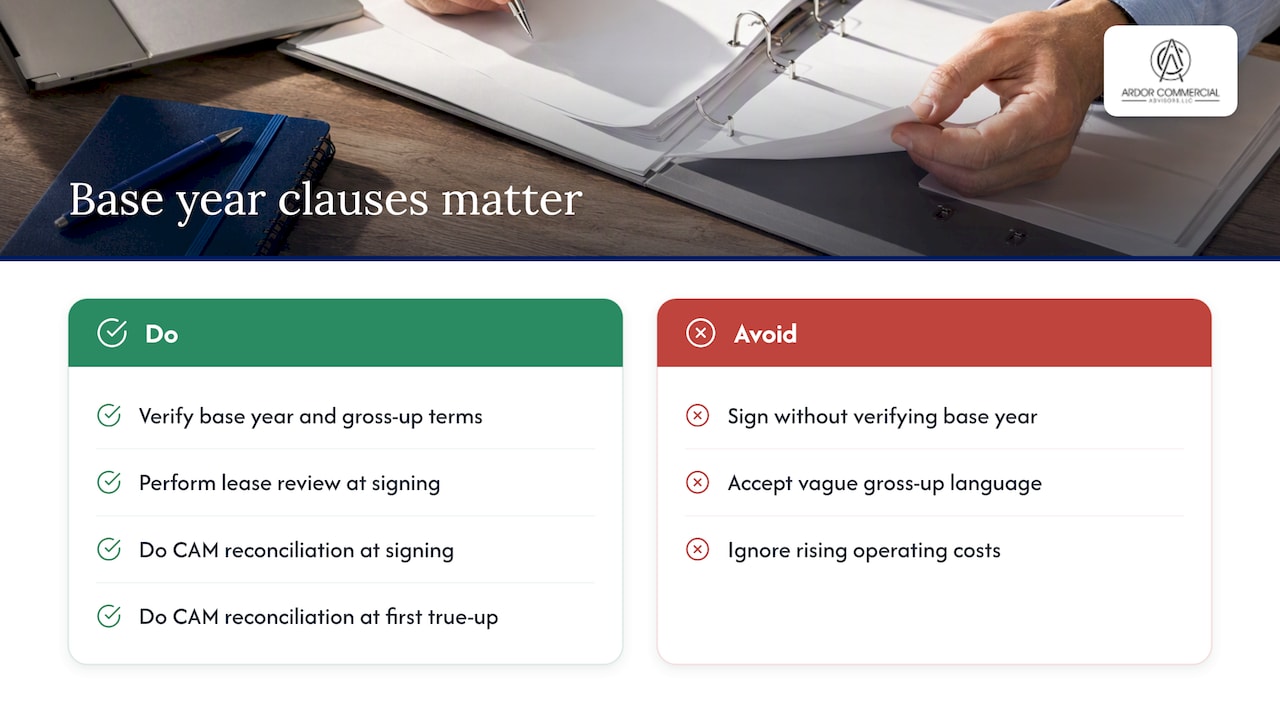
For office and medical tenants, we see the biggest risk in leases where the base year or gross-up terms were never verified before signing. A careful lease review and CAM reconciliation check at signing, and again at the first true-up, catches most of these issues before they compound.
— Jim
How we help with lease review and expense reconciliation
Reviewing a base year clause before you sign, or auditing your first reconciliation statement, is where most tenants either protect their budget or lock in years of avoidable overcharges. We handle lease review and CAM reconciliation analysis for office and medical tenants across the Charlotte MSA, checking gross-up language, expense definitions, and pro rata math before it becomes a dispute.
- We abstract lease language to flag base year and gross-up terms that need negotiation.
- We represent tenants directly in lease negotiations, including cap and audit-right requests.
- We model lease versus buy and ownership scenarios for medical and office practices weighing their next move.
If you are reviewing a lease before signing or questioning a reconciliation bill you already received, connect with our tenant representation team to get the terms checked before you commit.
FAQ
What does base year mean for taxes?
In a commercial lease, the base year sets the benchmark for operating expenses, including property taxes, that the landlord covers without charging the tenant extra. If property taxes rise above the base year amount in later years, the tenant pays its pro rata share of that increase, not the full tax bill.
What does $18.00 sf yr mean?
This notation means the rent or expense stop is quoted as a dollar amount per rentable square foot per year, a standard way commercial leases express rates. Multiply that figure by your suite’s square footage to get your annual cost for that line item.
What is a base year example?
If a building’s actual operating expenses in the base year total $500,000, the landlord covers that amount every year going forward. If expenses rise to $550,000 in a later year, tenants split the $50,000 increase based on their pro rata share of the building.
How can I terminate my commercial lease early without penalty?
Early termination without penalty generally requires a termination clause already written into your lease, a negotiated buyout, or a legal basis like landlord default. Review your lease termination options and notice requirements carefully before attempting to exit, since the costs and process vary significantly by lease.
Sources
- Base Year Stop – Glossary of CRE Terms
- Grossing up operating expenses in commercial leases (Lowndes Law)
- Base year vs expense stop (CAMAudit)