
Charlotte added 21,900 jobs in the twelve months to June 2026, a 1.6% gain, according to Southeast Economic Advisors’ August 2026 outlook. That is slower than the boom years, but it is concentrated in the sectors that fill offices and medical suites: finance, professional services, and health care. For owners, tenants and investors, the useful question is not whether Charlotte is growing. It is which property types that hiring actually reaches, and when. This article walks through the numbers, then sorts them by office, medical, industrial and retail so you can decide whether to lease, buy, sell or refinance.
TL;DR
- Charlotte added 21,900 jobs (1.6%) in the twelve months to June 2026, led by health care, finance and professional services, while manufacturing lost jobs.
- Office vacancy fell 1.2 points to 13.1%, partly because roughly 715,000 SF has left Uptown’s inventory through conversion. Tighter supply favors landlords who price correctly and tenants who start early.
- Industrial demand is strong for very large boxes, but 46.1M SF of leases expire between 2026 and 2031, peaking in 2028. Both owners and tenants should plan renewals now.
- Treat monthly job releases as provisional: the 2025 growth estimate was cut from 2.7% to 1.2% after revision.
Table of Contents
- What the Charlotte job numbers say
- Which sectors are hiring, and which are not
- Office: tighter supply, selective demand
- Medical office: health care hiring is the steadiest signal
- Industrial: big boxes tight, mid-size boxes loosening
- Retail follows households, not payrolls
- What the forecasts suggest, and what could go wrong
- What to do with this: sell, refinance, lease or buy
- How Ardorcre helps
- Our perspective
- FAQ
- Sources
What the Charlotte job numbers say
Three figures describe the labor market, and each has a period attached.
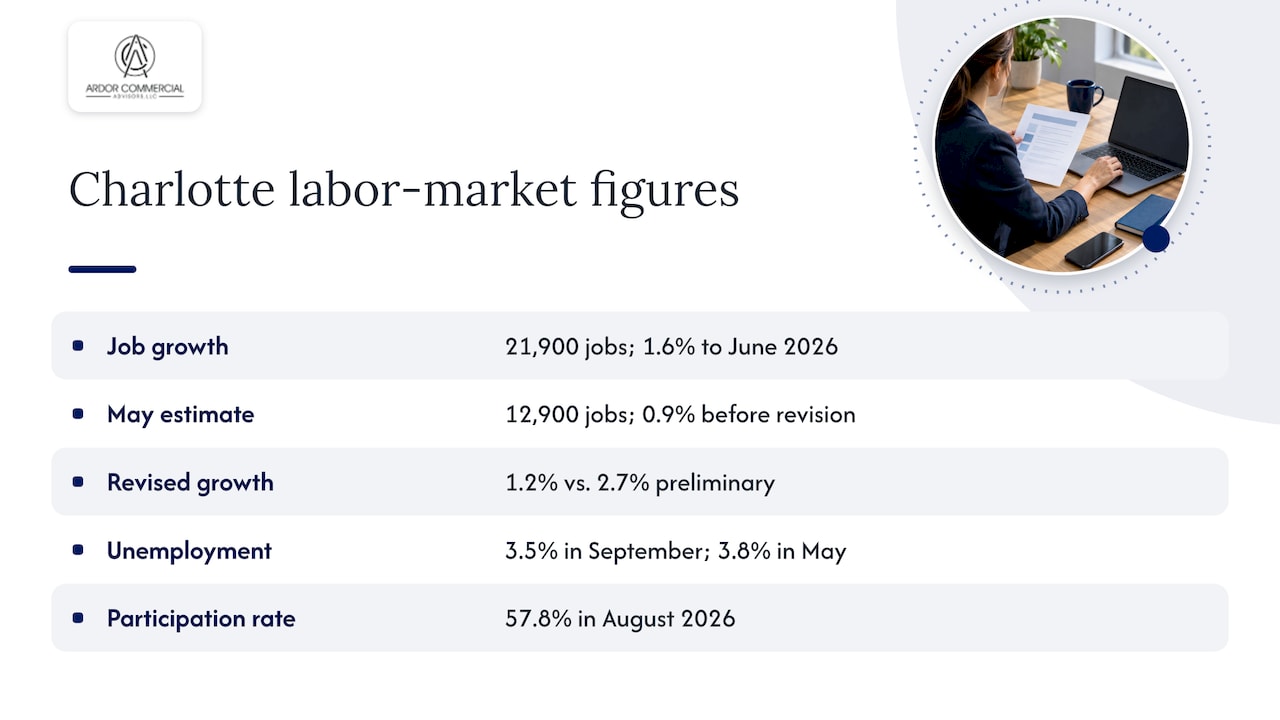
Job growth. Charlotte added 21,900 jobs over the twelve months to June 2026, a 1.6% gain, per Southeast Economic Advisors. The same firm’s May 2026 mid-year outlook had shown 12,900 net new jobs (0.9%) over the trailing twelve months before a benchmark revision, which shows how much these estimates can move.
Revisions. NC Commerce’s April 2026 Economy Watch reported that revised BLS data cut Charlotte-area annual employment growth to 1.2% as of December 2025, far below the preliminary 2.7%. If you are underwriting a purchase or a lease, build your model on revised data, not on the first headline.
Unemployment. The Charlotte-Concord-Gastonia unemployment rate, seasonally adjusted, was 3.5% in September 2026, down from 3.8% in May. The Bureau of Labor Statistics updates this series monthly, so check the live table before quoting it. One caution: WageScape’s September 2026 analysis notes that North Carolina’s participation rate fell to 57.8% in August 2026, so part of a low jobless rate reflects people leaving the labor force rather than hiring alone.
Which sectors are hiring, and which are not
The mix matters more than the total, because different industries use different buildings.
| Sector | Recent signal | Property type it feeds |
|---|---|---|
| Education and health services | Led all sectors with 6,600 jobs added, a 4.3% gain (NAIOP Charlotte, June 2026) | Medical office, outpatient, dental |
| Professional and business services, financial activities | 5,500 jobs added combined (Southeast Economic Advisors) | Office, especially Uptown and South End |
| Manufacturing | Shed 4,400 jobs, driven by transportation equipment and textiles (NAIOP Charlotte) | Smaller industrial and flex space |
| Financial job postings | Up 51.0% year over year in September 2026; professional services up 22.2% (WageScape) | Future office demand |
The finance story is the most concrete. Seven financial institutions have committed to more than 4,100 jobs in fourteen months, at salaries 20% to 114% above Mecklenburg County’s $90,706 average, including Sumitomo Mitsui Banking’s 2,000-job commitment, per the August 2026 outlook. SMBC plans to sublease 194,000 SF at 301 S. College St., and Pacific Life is adding about 300 positions in a South End hub, according to NAIOP Charlotte. Those jobs were not yet fully on payrolls at the time of the report, so the space demand they create is still arriving.
Office: tighter supply, selective demand
Office vacancy fell 1.2 percentage points over the year to 13.1%, below the national rate for the first time since late 2023, according to the August 2026 outlook. The reason is as much subtraction as addition: about 715,000 SF has already left Uptown’s office inventory through conversion, with another 1.9M SF queued. New office construction is running at just 0.6% of stock.
What that means by reader:
- Office tenants. Fewer blocks of quality space are coming, so a tenant who waits for a lease expiration to start looking can lose options. Our 3 to 6 month leasing timeline shows why starting early matters, and our page on what tenants pay per square foot gives a starting point for negotiation.
- Office owners. Falling vacancy helps, but Newmark cautions that elevated vacancy and economic uncertainty will keep asking rent growth moderate, per the same outlook. Price to the market, not to last cycle’s peak. A commercial property valuation with DCF modeling tests your assumptions before you list or refinance.
- Investors. The pipeline is shrinking through conversion, which is worth understanding building by building. Our office pipeline breakdown covers what is being built, converted and leased, and our office market analysis covers leasing and sales trends.
Medical office: health care hiring is the steadiest signal
Health care and education added more jobs than any other sector, and that growth follows population. The city of Charlotte added 20,731 residents in the July 2024 to July 2025 Census estimates, more than any other U.S. city, per the May 2026 mid-year outlook. More residents and more health care employees mean more demand for exam rooms, dental suites and outpatient space.
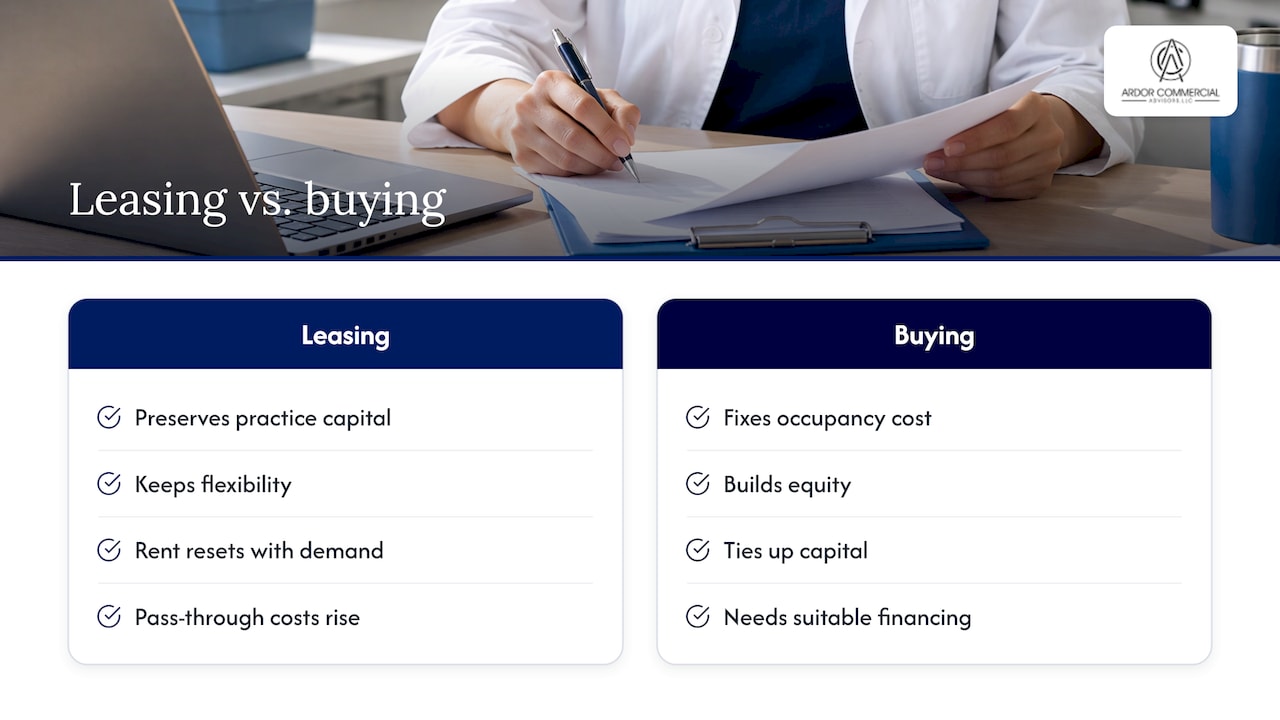
For a physician, dentist or orthodontist deciding between leasing and buying, job growth shifts the question in a specific way. Leasing keeps capital in the practice and preserves flexibility, but rent resets and operating-cost pass-throughs rise with demand. Buying a suite or a small building fixes your occupancy cost and builds equity, but ties up capital and needs financing that works at your income. Before either, review the lease itself: our lease review and CAM reconciliation analysis checks what you are charged beyond base rent, and lease abstraction pulls the key terms into one page. For what buyers and sellers are doing in the sector, see our medical office demand page.
A practice that buys a multi-tenant building can also lease its extra suites to other providers, so the rent from them offsets its own occupancy cost. That is where steady health care hiring helps most.
Industrial: big boxes tight, mid-size boxes loosening
Industrial is where the job data and the property data diverge. Manufacturing lost jobs, yet logistics and data center demand is strong. Piedmont Crescent Capital’s August 2026 outlook lists large deals: Google leased more than 729,000 SF in Rowan County, Kuehne + Nagel took 475,000 SF, Amazon took 450,000 SF in the Airport submarket, and Walmart bought the 1.2M SF Kings Mountain Corporate Center. Availability in buildings over 400,000 SF fell more than 300 basis points to 9.7%, while 100,000 to 400,000 SF buildings rose more than 300 basis points to 15.9%.
The same outlook cites Cushman & Wakefield’s count of 46.1M SF of Charlotte industrial leases expiring between 2026 and 2031, peaking in 2028 at 10.8M SF, which is 65% above the five-year average. Southwest Charlotte carries 12.8M SF of those expirations, 61.6% in leases of 99,000 SF or smaller.
Three practical points follow:
- Tenants with a 2027 to 2029 expiration should open renewal talks well ahead, since many neighbors will do the same. Our guides to industrial lease types and triple net leases explain where surprise costs hide.
- Owners of mid-size buildings face more competition for tenants than owners of the largest boxes. Check current rents and vacancy before setting an asking price.
- Land buyers should budget for site work beyond the purchase price. Clearing, stormwater and ongoing upkeep fall under land management services. Our Charlotte land prices and land development guide cover the acquisition side.
Retail follows households, not payrolls
Retail tracks population and income more than any one sector’s hiring. Retail is building at only 0.9% of stock, per the August 2026 outlook, which limits new competition for existing centers. Higher salaries from the finance expansion support spending near employment centers. Retail tenants choosing a location should read our site selection playbook and check retail vacancy in the submarket they want.
What the forecasts suggest, and what could go wrong
Southeast Economic Advisors’ revised August 2026 forecast projects Charlotte real GDP growth of 3.9% in 2026, staying near that pace through 2030 versus 2.5% for the U.S. It expects employment growth to recover to about 1.4% a year, roughly 20,000 jobs, with unemployment between 3.7% and 3.8%. Dodge Data & Analytics projects $13.2 billion in Charlotte construction starts in 2026, with office and bank building starts at $491 million, the highest projected total in five years for that sector.
The risks are specific:
- Revisions. Early monthly releases can change, as the 2025 estimate did. Underwrite with a margin.
- Industrial expirations. The 2028 peak can cut either way: more tenant choice, or more vacancy for owners who are unprepared.
- Moderate rent growth in office. Vacancy is easing, but rents are not expected to jump.
What to do with this: sell, refinance, lease or buy
Job data tells you about demand. Your own decision depends on your loan, your lease and your building. A few starting points:
- Owners with loans maturing soon should compare a sale with a refinance. The debt service coverage ratio (DSCR) is net operating income divided by annual loan payments, and lenders use it to size the loan. Our DSCR loan sizing guide walks through it, and our submarket guide shows where to buy, sell or refinance.
- Sellers who want to defer taxes should read our 1031 exchange rules before listing.
- Owners with several tenants should look at what a manager does for the property. See our property manager duties checklist and management budget guide.
- Tenants negotiating personal or corporate guarantees can see how to cap exposure at 12 months’ rent.
Tax and loan decisions should also involve your CPA, attorney and lender, who see the full picture of your finances.
How Ardorcre helps
We are a commercial real estate brokerage in the Charlotte MSA. We handle sales and leasing of office, medical, retail, industrial, land and investment properties, with landlord and tenant representation, property management, valuation, lease review and lease abstraction. If you own or occupy space and want these job-growth trends applied to your building or your lease, start with our services, or look at tenant representation if you are about to search for space.
Our team prepares customized market reporting so the numbers in articles like this one are tied to your property and submarket.
Our perspective
Job numbers are easy to quote and hard to use. A 1.6% year can hide a 4.3% gain in health care and a loss in manufacturing, and those two sectors rent very different buildings.
What we tell owners and tenants is to start from the specific asset. A dentist weighing a lease against a purchase needs the lease abstracted and the CAM charges checked. An office owner needs a valuation that survives a lender’s questions. An industrial owner with a 2028 expiration needs a plan now, not in 2028.
Charlotte’s growth is real, and it is selective. Our job is local market knowledge, close advocacy, and support from the first search through closing and after.
Jim
FAQ
Is Charlotte’s job market still growing?
Yes, at a moderate pace. Charlotte added 21,900 jobs, a 1.6% gain, in the twelve months to June 2026, and Southeast Economic Advisors forecasts about 1.4% a year going forward. Growth is led by health care, finance and professional services.
How does job growth affect commercial rents?
It affects each property type differently. Finance and professional hiring supports office demand, health care hiring supports medical office, and logistics drives large industrial leasing. Office rent growth is expected to stay moderate while vacancy is still elevated, per Newmark’s view cited in the August 2026 outlook.
Should a medical practice lease or buy in Charlotte?
It depends on capital, growth plans and your lease terms. Leasing preserves cash and flexibility, while buying fixes occupancy cost and can add rental income from extra suites. A lease review and a valuation of the specific building give you the numbers to decide.
Are the unemployment figures reliable?
Use them with care. The September 2026 seasonally adjusted rate was 3.5%, but Charlotte’s 2025 growth estimate was revised from 2.7% to 1.2%, so early releases can change.
Sources
- Unemployment Rate in Charlotte-Concord-Gastonia (FRED)
- April 2026 NC Economy Watch (NC Commerce)
- REBIC: Mark Vitner on Charlotte capital and projects (NAIOP Charlotte)
- Charlotte is Getting Tighter by Subtraction (Southeast Economic Advisors)
- Charlotte Mid-Year Economic Outlook (Southeast Economic Advisors)
- Charlotte CRE Outlook, August 2026 (Piedmont Crescent Capital)
- Metro Job Market Pulse, September 2026 (WageScape)
- Charlotte Construction Holds Steady as Market Firms (ENR)